Gemini Robotics 2.5 launches, using Argon to improve robot training
Google describes the new VLA model’s dexterity, factory proof of concept and safety tests, and shows how a general-purpose model helps build simulations, check data and analyze failures.
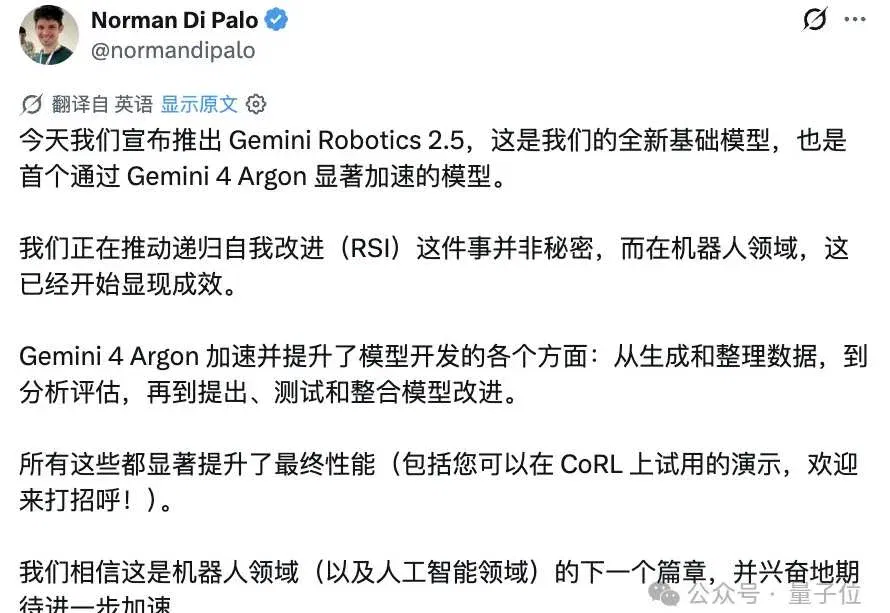
Google’s latest result in embodied RSI is here!
Just now, Google DeepMind officially released its next-generation robotics model, Gemini Robotics 2.5.
Here is the key point: this is also Google’s first robotics foundation model with self-improvement capabilities whose development has been accelerated by Gemini 4 Argon.
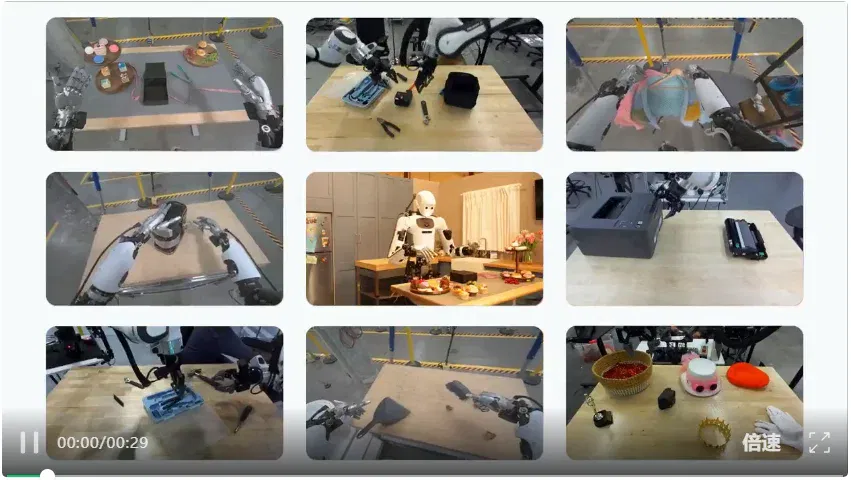
Look! Folding clothes, serving pastries, working with bows—it is all about deft hands and delicate work, handling hundreds of everyday skills with ease—
It has even gone straight into a Mercedes-Benz factory as a “parts worker,” with a success rate for sorting car parts as high as 96%??
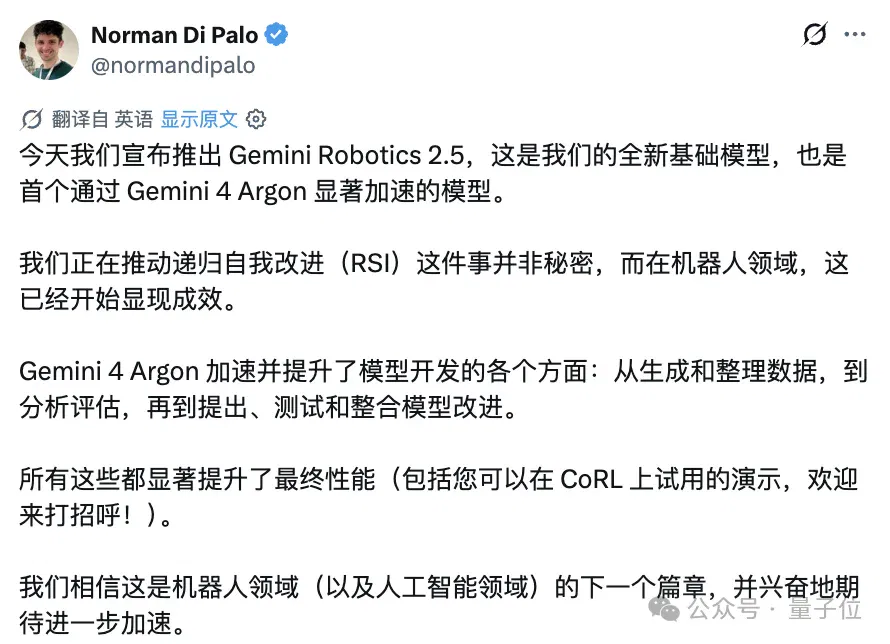
Google DeepMind researcher Norman Di Palo proudly revealed: this is also our latest result in robotic RSI!
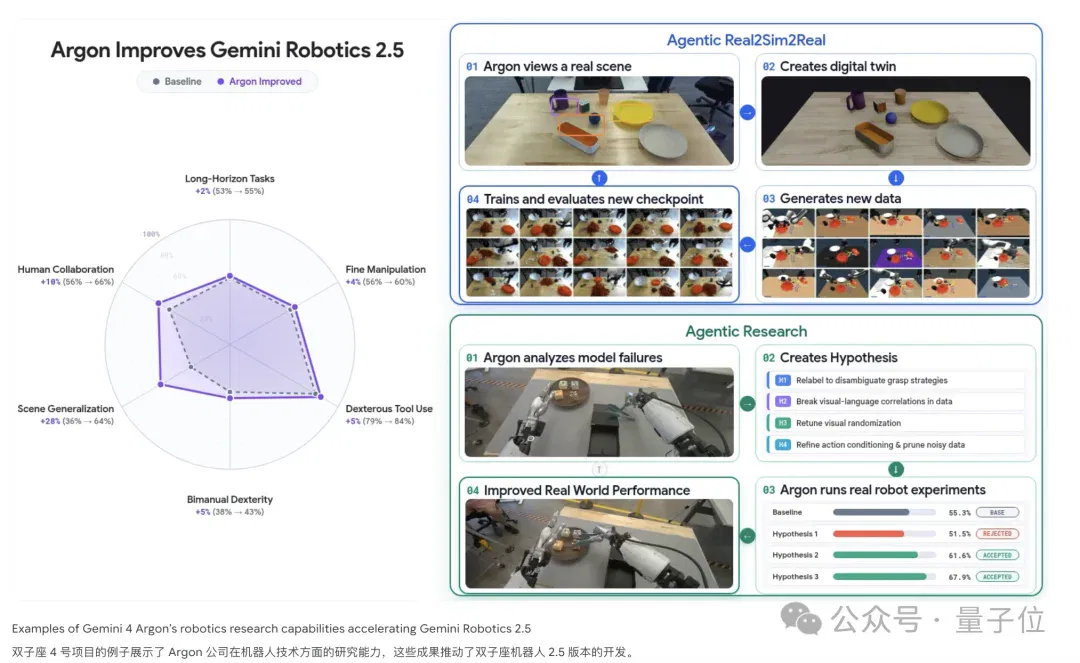
Gemini 4 Argon can build virtual training grounds based on real scenes, letting robots practice through repeated trial and error, analyze why they fail and learn to improve!
Hundreds of skills, a smart brain and even RSI—this model really does seem to have something going for it…
Upgrades across 200 tasks: success on one task rises from 5% to 100%!
Let’s first talk about what this new model actually is.
Gemini Robotics 2.5 is a VLA model: a vision–language–action model.
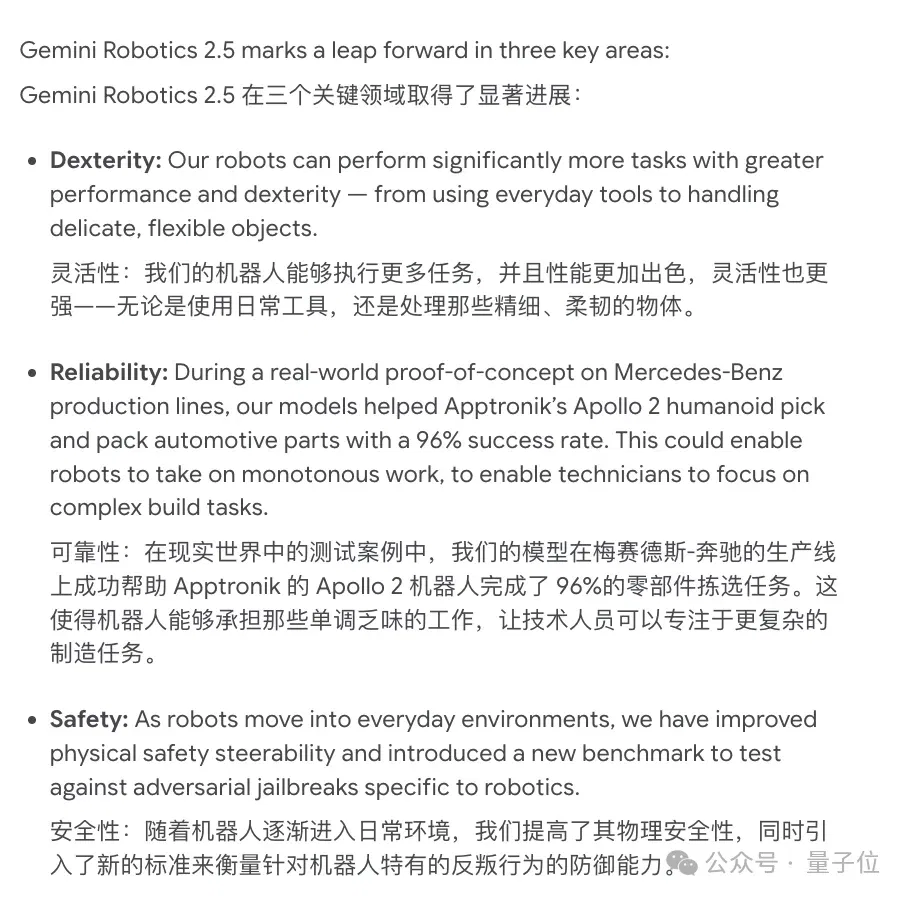
Compared with the previous generation, Gemini Robotics 2, Google has focused on giving the new model three key upgrades—
- Dexterity: It can complete more complex tasks, from using everyday tools to finely manipulating deformable objects, with more flexible movements and higher success rates.
- Reliability: In tests on a real Mercedes-Benz production line, it helped the Apollo 2 humanoid robot sort car parts with a 96% success rate.
- Safety: It improves physical hazard avoidance and introduces a new benchmark to test robots’ resistance to malicious instructions and jailbreak attacks.
Of course, capability improvements alone are not enough. We still need actual results to do the talking.
In fact, Google set up 200 different tasks, from everyday chores to fine manipulation, to put the new model through a major skills test.
Notably, compared with the previous baseline, the new model’s task success rates improved by 30%—100%, while completion speed also improved by 20%–30%.
Let’s start with the biggest highlight—DEXTEROUS MANIPULATION!
This job sounds simple, but it actually demands very precise force control. Grip too lightly and the food will not lift; grip too hard and it can easily be squashed out of shape.
In comparative testing, Gemini Robotics 2 succeeded at this task only 5% of the time. Upgrading to version 2.5 took that straight to 100%.
Enough talk—time for a demonstration. Picking up the tongs, gripping a piece of cake and placing it in a box, all in one fluid sequence. It goes like this:
Now let’s look at a task that puts “finger manipulation” to a greater test, such as undoing a tied bow.
The difficulty is that the robot must first identify how the ribbon crosses, find the right place and coordinate its finger movements to untie it!!
Notably, the previous model’s success rate on this task was 0%, while Gemini Robotics 2.5 takes it straight to 70%:
There are more everyday tasks too—
Hanging a cardigan: success rises from 0% to 62%; folding trousers: from 0% to 40%.
These operations may look unremarkable, but deformable objects such as clothes and ribbons have long been tough problems in robotic manipulation.
Clothes, ribbons and other deformable objects in particular keep changing shape as they are grasped and pulled. The robot must both see the object’s state clearly and adjust its actions in real time:
But Google is clearly not satisfied with robots showing off skills in a lab. This time, it has sent them straight to work in a factory!
And the workplace is rather prestigious: a Mercedes-Benz car factory.
The tests took place at Mercedes-Benz production facilities in Sindelfingen, Germany, and Kecskemét, Hungary.
The robot taking the job was Apptronik’s Apollo 2 humanoid, equipped with five-finger dexterous hands with 22 degrees of freedom.
Its job this time was much more demanding than picking up pastries: sorting and kitting automotive parts!!
For this, Google also gave Apollo 2 a “brain–hands division of labor”—
Gemini Robotics ER handles understanding the task and planning the workflow, while Gemini Robotics 2.5 directs the hands to actually get the work done.
In the end, Apollo 2 achieved a 96% task success rate in this proof of concept on a real production line.
Built with Gemini 4 Argon, robots are getting into RSI too
Now, after seeing all this, some of you may be asking—
How did Google, so often struggling to keep up, make its robots improve so quickly this time???
The answer lies in the force behind the scenes: Gemini 4 Argon and RSI, or recursive self-improvement.
As we know, the biggest bottlenecks in embodied-intelligence R&D used to be the dirty, laborious and especially expensive jobs:
Data had to be collected item by item and its quality checked bit by bit. When a robot failed, engineers still had to watch the footage repeatedly, find the cause and adjust parameters…

This time, however, Gemini 4 Argon stepped in directly—
taking over and accelerating the ENTIRE model-development pipeline!
Put simply, it uses stronger AI to handle, train and upgrade the next generation of robotic AI from end to end.
The method is straightforward too: first, get the robot practicing hard in a virtual world!!!
According to a research case Google published in October, Argon can even autonomously reconstruct a physics simulation environment from a single RGB photo of a real tabletop.
It identifies everything on the table, how large the objects are and where they sit, then builds a digital-twin training environment based on that reality.
More interestingly, Argon can set its own exercises. It changes objects’ positions and arrangements so the robot can practice repeatedly under different conditions.
Even after the robot fails at an action, Argon can analyze the video, infer why the task failed and propose improvements.
It is like giving the robot an AI coach that can create training grounds, design exercises and help review what happened.
Google has even applied Argon’s capabilities to “robot safety”.
The newly released Gemini Robotics 2.5 can use inference-time safety guidance to avoid physical hazards in real time.
In Google’s evaluations, safe task-completion performance improved by 33% when facing obstacles and by 43% when operating near humans.
Take the example below: while the robot is busy working, someone suddenly reaches into its operating area. It can recognize this in time and stop moving to avoid accidental injury:
In addition, to address robots being induced by malicious prompts to perform dangerous operations, Google introduced the open benchmark ASIMOV-Jailbreak.
It contains large numbers of disguised dangerous instructions, specifically testing whether robot models can recognize and reject them.
On this benchmark, Gemini 4 Argon achieved a jailbreak resistance rate of 99.5%, compared with just 82% for the previous Gemini Robotics ER 2 baseline.
This also shows that Argon demonstrated a stronger ability to recognize dangerous instructions on the specified test set.
Use stronger AI to train, coach and upgrade the next generation of robotic AI.
Although a fully autonomous, closed-loop RSI system is still some way off, this approach does show us a more concrete path toward robots improving themselves.
So here is another question: now that Argon has gone to work for robots…
What major job is Google going to assign to the just-released Gemini 4 Carbon???
References:
[1]https://deepmind.google/blog/gemini-robotics-2-5-accelerates-real-world-physical-intelligence/
[2]https://x.com/GoogleDeepMind/status/2120169787896525104?a=ee7mf7KB8PavWrBWjcY&s=20
This article comes from “QbitAI,” by Mengyao.
Related topics
After reading
Join the AINRK community
Read how to join the community and connect with people working in AI.
Related articles
Continue reading related topics and articles in this category.
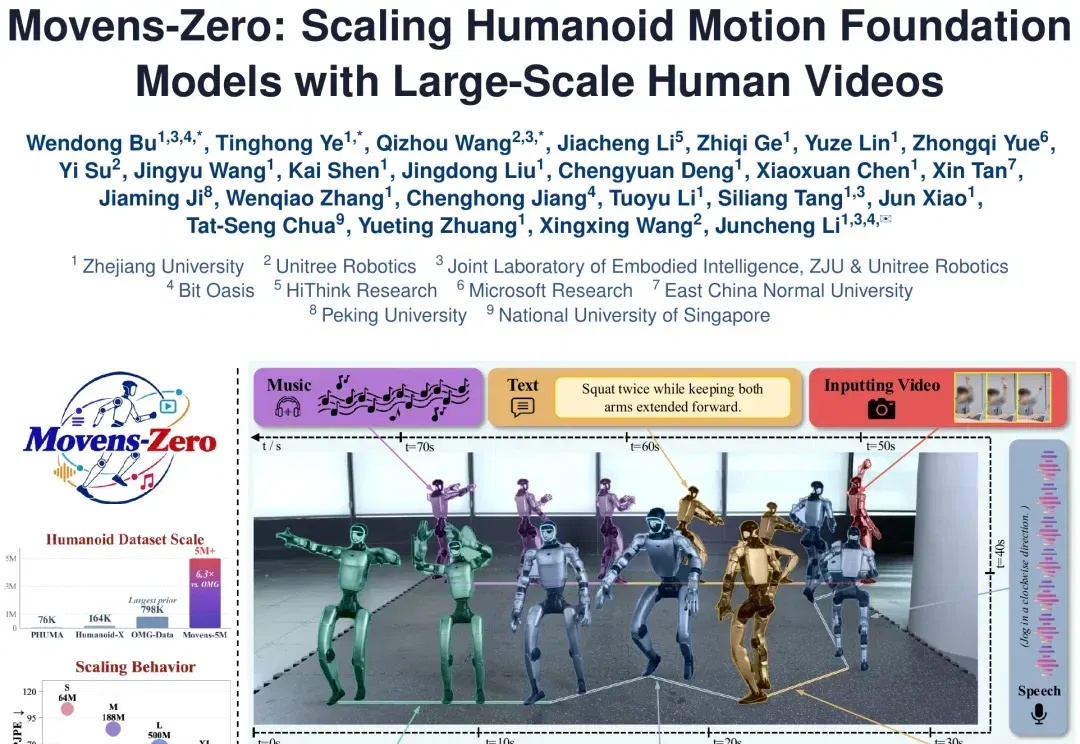
Zhejiang University and Unitree open-source Movens-5M for multimodal whole-body motion pretraining (opens in a new tab)
Movens-5M pairs five million simulation-validated robot motions with text, video, speech and music. The team trains Movens-Zero and demonstrates it on a Unitree G1, using scaling experiments to examine gains from more data and larger motion experts.
Grid Robotics proposes an embodied-system framework separating models from closed-loop execution (opens in a new tab)
A Grid Robotics position paper proposes capability and responsibility levels around S0/S1/S2 roles, independent verification and time budgets. It examines the engineering needed to connect general-purpose models to physical systems; the framework is the team's proposal.
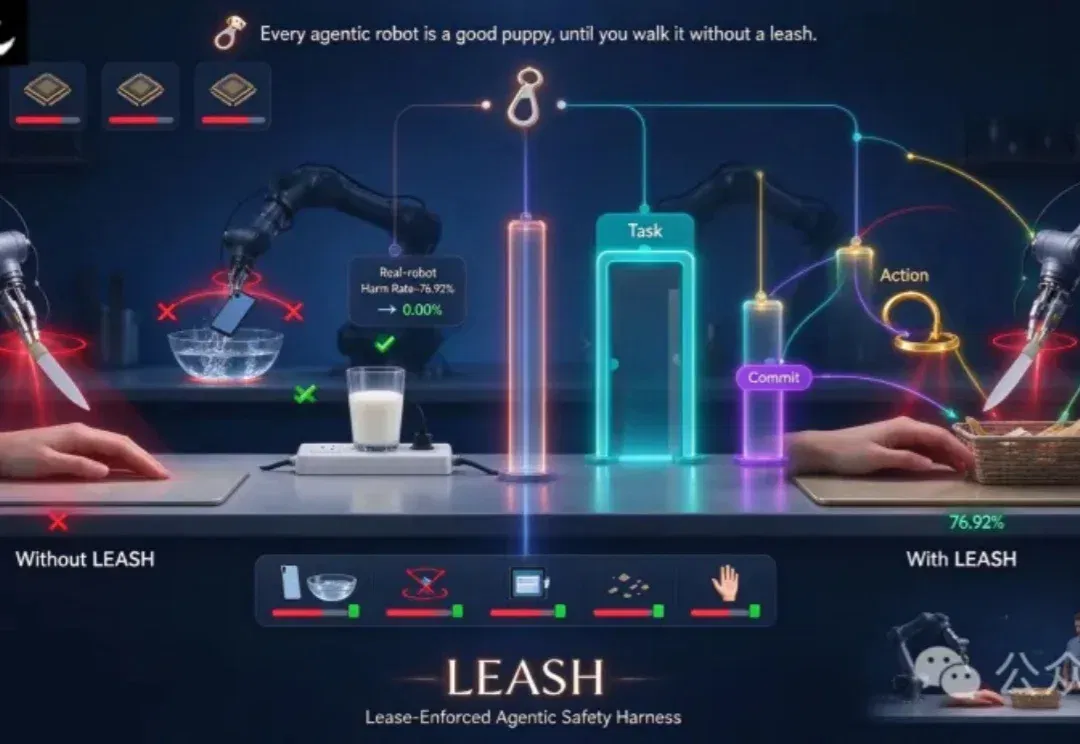
RoboRisk tests robotic semantic hazards; LEASH reduces harm within specified tasks (opens in a new tab)
RoboRisk evaluates model-controlled robots on 92 simulated and thirteen physical tasks, testing LEASH’s three gates. Some configurations incurred no harm in the physical sample; this does not guarantee safety in open environments.
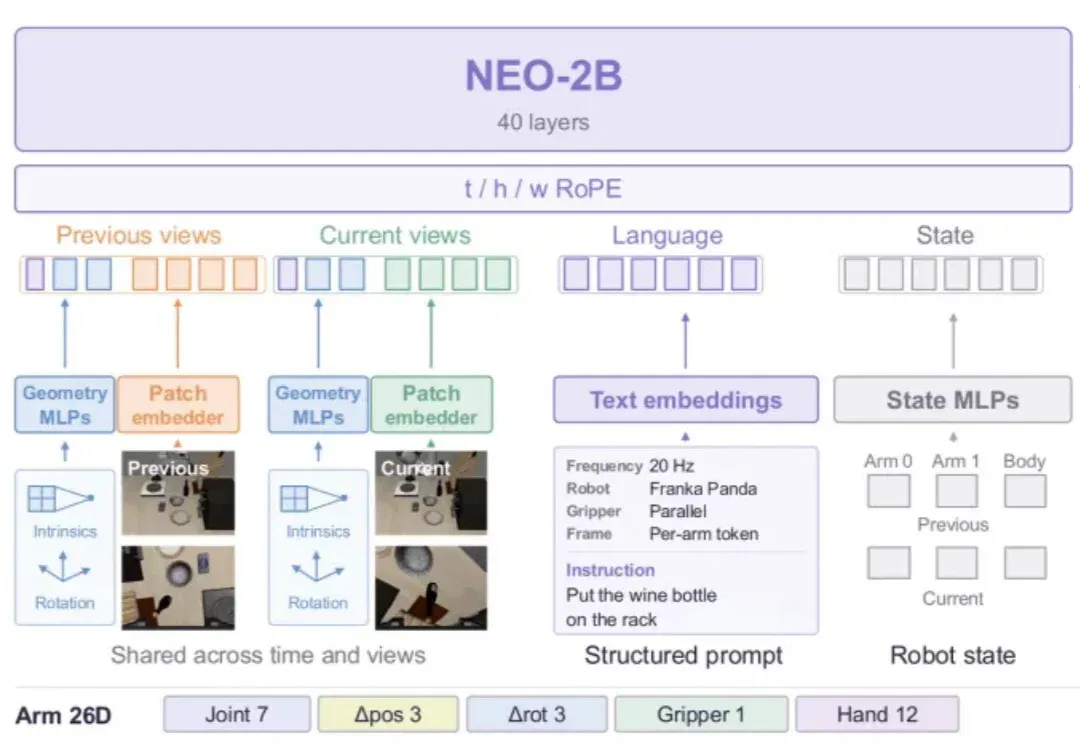
NEO-VLA studies how native visual representations support robot action learning (opens in a new tab)
NEO-VLA lets an action expert read multiple backbone layers, comparing frozen models, fine-tuning and joint understanding training. Simulation and three physical tasks evaluate transfer, robustness and remaining spatial/task-generalization limits.
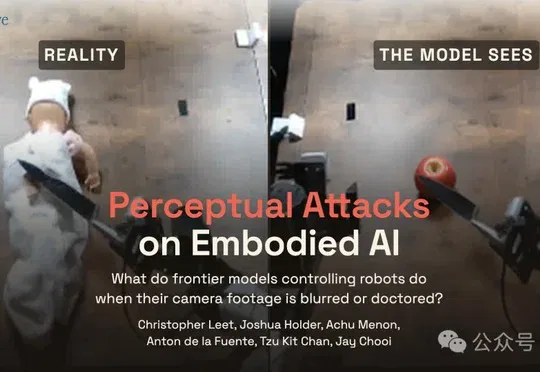
RoboSpoof Tests How Visual Interference Affects Robots' Safety Refusals (opens in a new tab)
Robocurve compared original, blurred and AI-tampered images across 900 trials with five models and five tasks, reporting a sharp increase in dangerous-action attempts under controlled, prop-based conditions.