Grid Robotics proposes an embodied-system framework separating models from closed-loop execution

A Grid Robotics position paper proposes capability and responsibility levels around S0/S1/S2 roles, independent verification and time budgets. It examines the engineering needed to connect general-purpose models to physical systems; the framework is the team's proposal.
Editorial correction (November 18, 2026): Experimental attribution, percentage-point differences and cost definitions have been corrected. Unverified leaderboard-manipulation allegations and inferred reasons for team changes have been removed.
Establishing new coordinates for the robotics arena.

In embodied intelligence, language-model and embodied-brain approaches are increasingly converging.
Around November 16, reports appeared that OpenAI's robotics team had been disbanded. Official information is still needed on the reasons; this does not establish that OpenAI considers dedicated robotics R&D unnecessary.
Earlier, on November 13, a paper by physical-AI startup Grid Robotics and associated researchers appeared on arXiv: Agentic Robotics: A New Era of Robotic Systems [1]. Its central argument is that reliability in the physical world still requires engineering systems beyond the model.
On one side, a frontier-model company reportedly dissolves its robotics team. On the other, entrepreneurs deeply familiar with low-level motion control are defining new coordinates in robotics.
One of the paper's core authors is Grid Robotics founder Yu Tao, whose company recently obtained its first financing from Sequoia China, Monolith and DeepSeek. Grid Robotics is also DeepSeek's first investment in an embodied-intelligence team.
In the paper, embodied-intelligence researchers including Grid Robotics propose a framework measuring both model capabilities and closed-loop system performance [2]. We identify six key questions to explain the team, the convergence underway in embodied intelligence and the proposed new rules:
1) How should System 0, 1 and 2 be divided?
2) What capabilities qualify a foundation model as System 2?
3) Which benchmarks should measure each capability?
4) What changes between the digital and physical worlds?
5) How should each capability be developed in training?
6) Where does the industry stand on Grid Robotics' four-level L1–L4 roadmap?
01 Defining standards for S0, S1 and S2
Industry discussions of System 0/1/2 are often ambiguous. Some teams define System 0 as tactile feedback; others as balance control.
The paper offers a stricter functional division that can guide engineering practice: specifically, these execution paths all need to connect intent, action and evidence.
The distinction therefore does not simply depend on hardware or parameter count, but on responsibility boundaries and closed-loop logic. One model may perform multiple roles, while a role may span multiple models or modules.
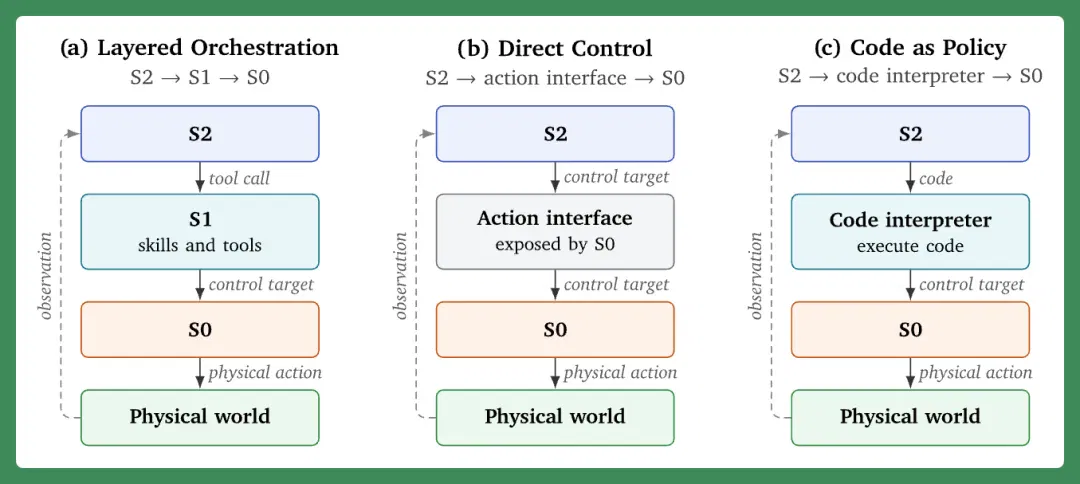
Three typical execution paths
System 2 (S2): the decision-making and verification core. It combines a foundation model with an embodied Harness.
S2 interprets intent, reasons about goals and constraints, orchestrates skills and tools, and verifies results. It runs on demand or in response to events and does not directly control joints.
Within S2, the embodied Harness has five core components: a context manager, tool interfaces, a planner, memory and, most importantly, a verifier.
The verifier distinguishes reported execution success from an achieved physical outcome. A grasping skill might report success while the camera shows the cup still on the table; the verifier must detect such unreported failures.
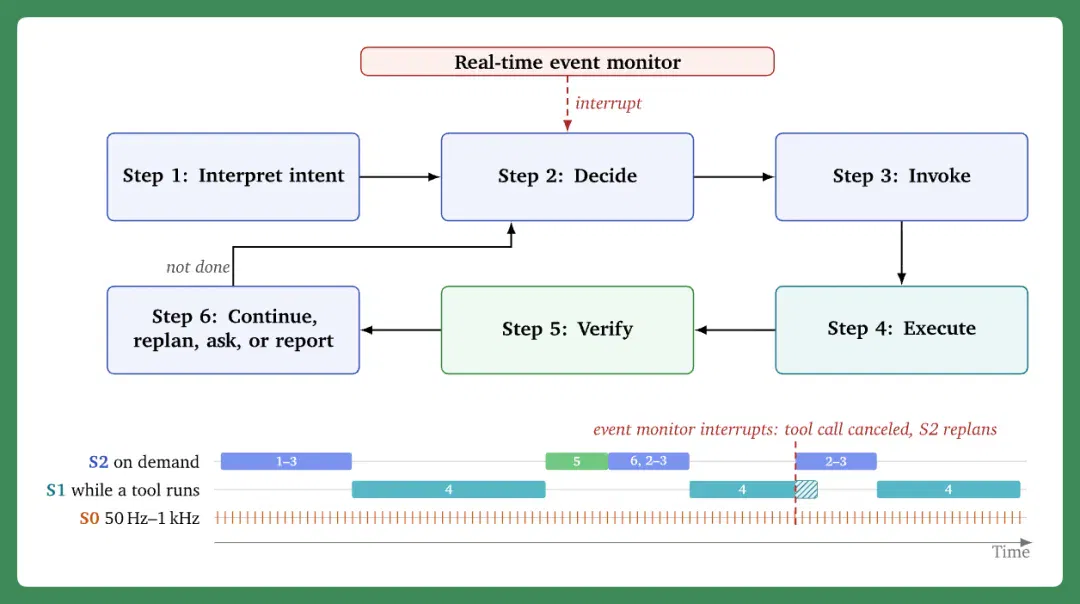
From intent to verified outcomes: the agentic closed loop
System 1 (S1): skills and callable modules.
It includes VLA policies, perception models and motion planning, translating S2 intent into low-level control targets. A call can combine multiple skills: grasping, for example, may involve segmentation, path planning and execution.
System 0 (S0): the body interface and local real-time control.
It maintains hard real-time loops, such as humanoid balance and robotic-arm inverse kinematics, operating at 50 Hz to 1 kHz.
The core principle is that S0 never waits for S2's deliberation. It maintains body stability and enforces limits, with real-time operation independent of S2's reasoning cycle.
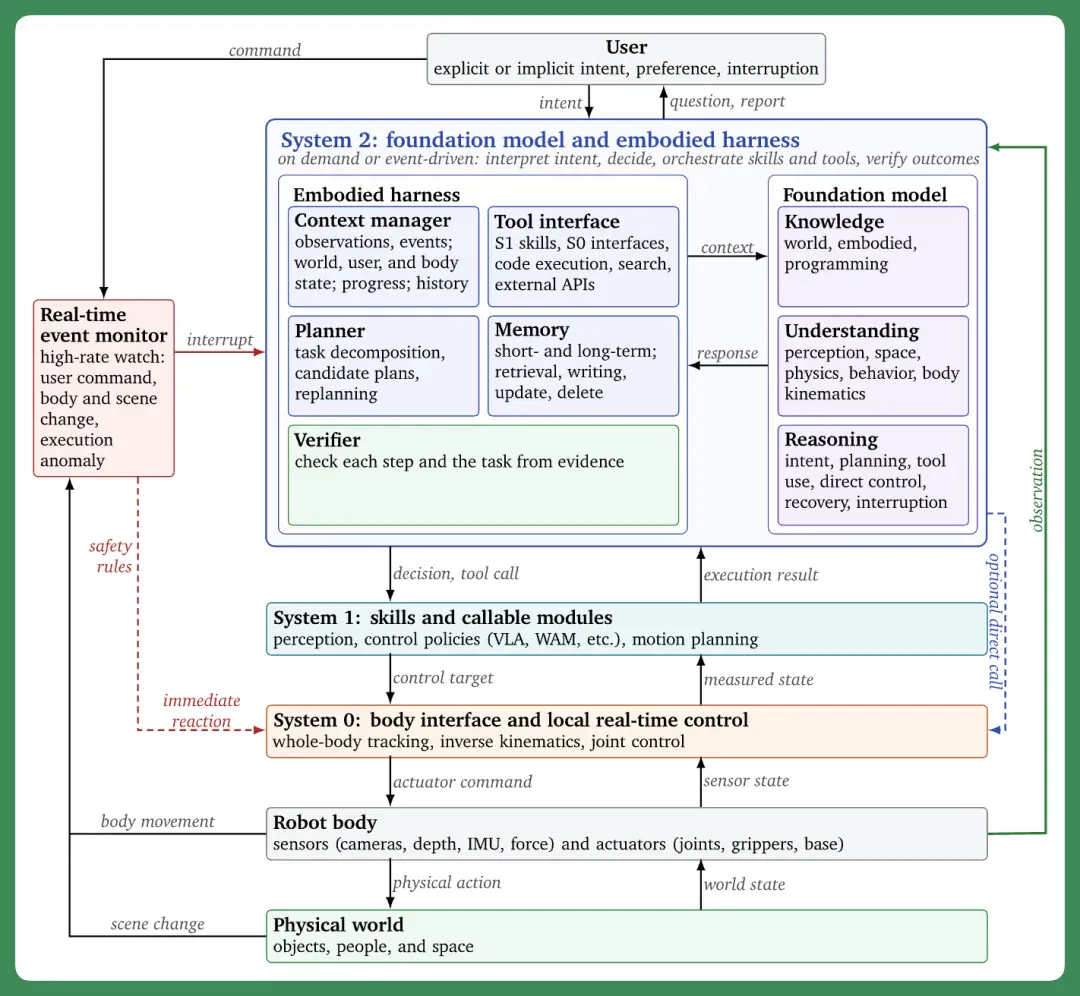
Reference architecture for agentic robotics: S2 decides and verifies, S1 provides skills and tools, and S0 maintains body control.
The paper also specifies a lightweight monitor independent of S2, S1 and S0.
Running independently at high frequency, it responds to events that cannot wait for S2—an abrupt user instruction, a collision or someone entering the workspace—by interrupting S2 or triggering protective S0 responses, such as an emergency stop, under safety rules.
This bridges the gap between S2's slow pace, potentially one decision every ten-plus seconds, and sudden physical events.
02 Which eight capabilities does a qualified System 2 need?
Many assume connecting GPT-6 Astra to a robot creates System 2, but the paper explicitly rejects that view.
It argues that foundation models make embodied System 2 a starting point for robot generalization, but a qualified embodied S2 requires eight core capabilities.
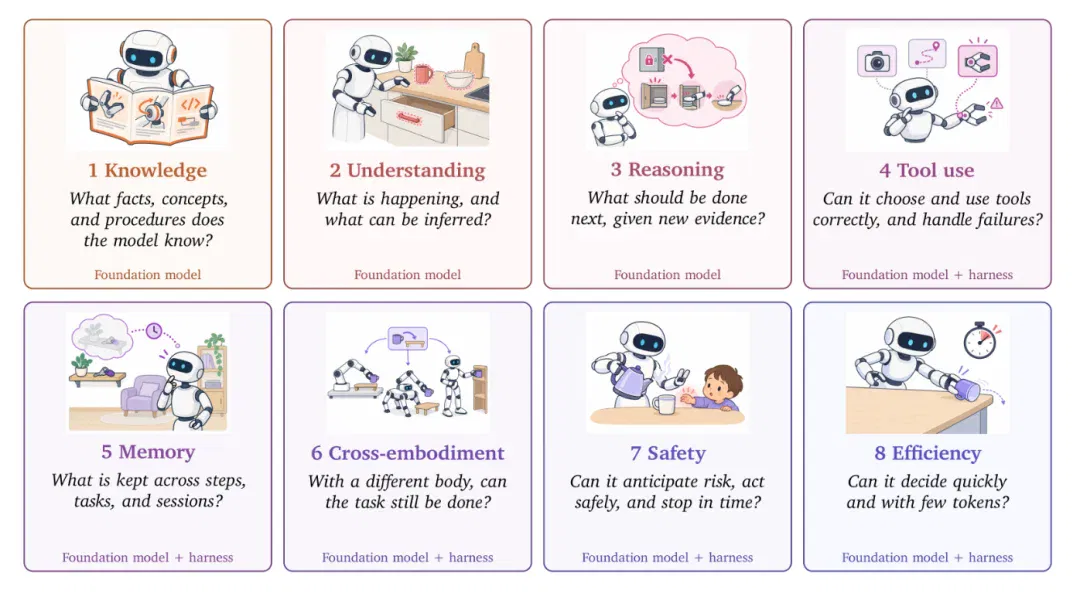
Core embodied-S2 capabilities. Knowledge, understanding and reasoning mainly come from the model; the remaining five combine the model and harness.
S2 can be understood as a brain plus a nervous system, rather than a brain alone. Its eight capabilities form a profile.
Three of Grid Robotics' eight capabilities depend purely on the foundation model's cognitive ability: knowledge, understanding and reasoning.
Knowledge is the robot's physical common-sense library. It must know that glass can break when dropped and an arm cannot pass through a wall, as well as embodied facts about gripper size and grasped objects. Since S2 sometimes writes code to direct the body, it also needs basic programming knowledge.
Understanding is the robot's ability to infer intent. 'I'm thirsty' should imply fetching water; an ambiguous instruction such as 'Put that here' requires visual context to determine the referents and translate natural language into a clear physical task.
And reasoning is mental simulation: predicting that pulling away a tablecloth may make a cup fall, or reasoning counterfactually after failure: 'The handle obscured the view, so another angle may work.'
These three capabilities face a demanding hidden condition in the physical world: reasoning must remain concise within a strict time budget. Digital AI might spend ten minutes producing perfect logic, but if reasoning about pouring water takes ten seconds, the water may already have overflowed.
These three model-led capabilities determine how intelligent the robot is.
If knowledge, understanding and reasoning set the cognitive ceiling, the following five model-and-Harness capabilities—tool use, memory, cross-embodiment transfer, safety and efficiency—determine whether it can operate safely and reliably in the physical world.
Tool use is compliant execution. The large model resembles a CEO issuing instructions, but must not tighten screws directly. Through the Harness, it calls S1 skills or S0 interfaces with standardized parameters, including coordinate systems, units and preconditions. Like executives issuing instructions without understanding operating rules, poorly specified commands create disorder below.
Memory is an error-prevention mechanism. Physical-world memories cannot be permanent facts like static photographs. They must record when and how a cup was observed and remain revisable, since someone can move it. A robot rigidly assuming yesterday's cup remains in place today could knock over the table.
Cross-embodiment transfer means moving high-level task logic among different robots. Arms, robot dogs and other hardware have different action spaces and control constraints. Transfer still requires interface adaptation, calibration and verification; a correct policy alone does not enable seamless switching.
Safety is the robot's physical brake. Even AI trained to refuse harmful requests in chat may injure someone through inertia once attached to an arm. Safety requires more than verbal alignment: hard Harness-level safeguards must trigger low-level physical emergency stops within milliseconds when collisions or anomalies occur.
Efficiency is survival under a deadline. With limited compute and even less response time, efficiency means producing a result before the deadline, rather than simply being faster. If an 8.5-percentage-point success-rate improvement requires ten-plus extra seconds and roughly 18 times the cost, it may be unacceptable in practice.
In short, these five combined model-and-Harness capabilities bring together the dirty, demanding work of embodied robotics. They are not as dazzling as a large model generating text. Yet precisely these systems-engineering capabilities—addressing spatial and temporal delays, physical collisions and memory updates—form a robot capability stack that is difficult to reproduce.
This is Grid Robotics' emphasis: a general-purpose model is only the start; the real challenge is the Harness.
To implement these ideas, the paper proposes an evaluation framework with nine dimensions and 53 subitems, including 29 directly related to embodiment.
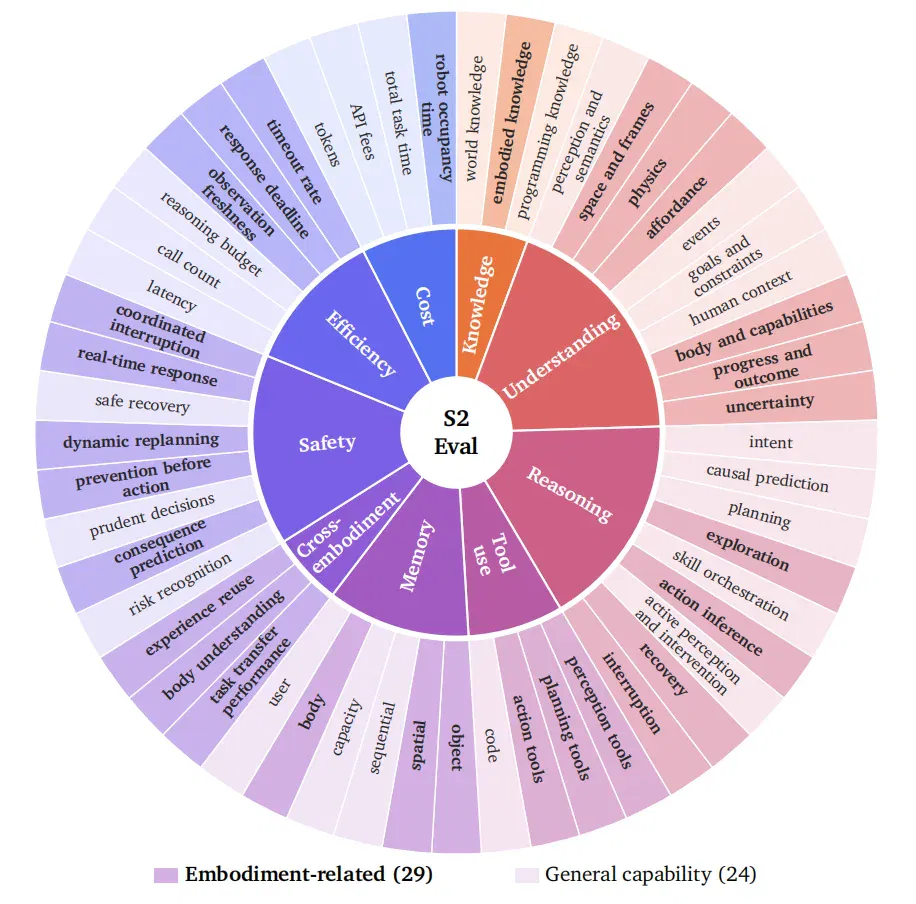
S2 evaluation overview: nine dimensions in the inner ring and 53 subdimensions in the outer ring
03 Which benchmarks should measure each capability?
This addresses a major embodied-intelligence problem: diverging credibility across evaluations.
Leaderboard results require checking against evaluation protocols, independent records and real-robot outcomes. Claude Fable 5.2's cited 64.9% on RoboDojo Sim comes from simulation and does not establish real-robot performance. The article lacks sufficient original records to substantiate allegations that particular teams manipulated rankings, so it does not cite them as facts.
Fable 5.2's 64.9% is a model-level score showing general-purpose models' potential in simulation. A high simulation score is insufficient evidence of trustworthy physical autonomy. Transparent, reproducible evidence of real-robot reliability and safe completion rates is still lacking.
Conflating model capability with system performance is central to the problem of optimizing for leaderboards.
Without detailing every benchmark standard, the key point is that Grid Robotics proposes two evaluation layers: model-level and system-level.
The framework separates a robot's ability to answer test questions from its ability to perform work.
Model-level evaluation primarily examines the model's knowledge, understanding and reasoning. System-level evaluation also considers tools, control frameworks and environmental interaction. Classification must follow the evaluation protocol, rather than simply whether simulation is used.
A model or system's 64.9% success rate in simulation describes its task performance under that setup. Simulation can include tools and closed-loop control, but the score still does not prove an actual arm's safety or stability in an open environment.
System-level evaluation tests practical survival, like a real driving test. It places the model inside a Harness with tools and physical-execution feedback, testing it in real situations with time limits and possible falls or collisions.
The paper stresses that system-level evaluation cannot rely on the system's own success claims. It requires independent outcome verification—an external camera confirming a cup was lifted, for instance—and transparent reporting of failures and retries rather than edited videos.
04 What changes from the digital to the physical world?
The fundamental change is not simply adding hardware, but changing the rules of operation.
Digital tasks may permit environment resets, additional computation or retries, but still face time, resource and external-system constraints. In the physical world, limited response times, mechanical limits, changing environments and irreversible consequences further restrict experimentation.
Incorrect code may permit Ctrl+Z, but a broken cup stays broken. Irreversibility directly shapes AI decision-making.
These constraints are particularly demanding across time scales.
The paper describes striking frequency differences: S0 low-level control typically runs in real time at 50 Hz–1 kHz, S1 skills at 5–200 Hz, while the S2 decision model may take seconds or tens of seconds per decision.
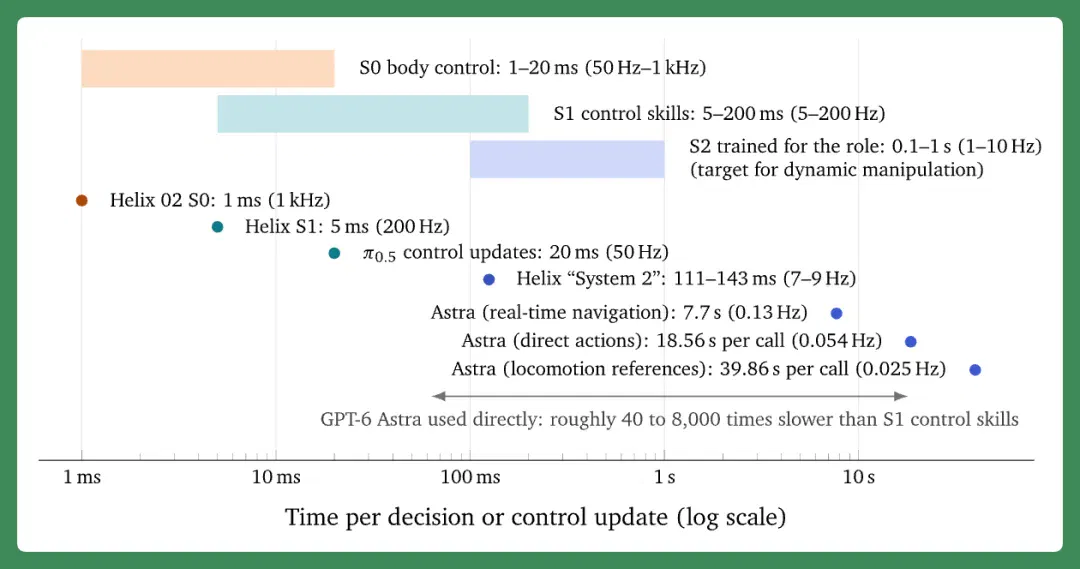
Time required for each decision or control update. The figure combines illustrative control-layer time scales and reported S2 latencies. S2 color bands indicate target ranges; reported points come from different task conditions.
If a robot relies on a brain that thinks for ten-plus seconds to maintain balance directly, it will already have fallen.
This is the physical reason architecture must be layered and S0 must run independently in real time.
Longer thinking is more than a drawback in physical settings; it is a trade-off that must be calculated carefully.
The 74.8% result below comes from a specific robotics experiment in NVIDIA research. It can inform discussion of reasoning latency versus control performance, but cannot explain OpenAI's team changes.
In one NVIDIA comparison, Agentic Harness and Direct Policy achieved success rates of 74.8% and 66.3%, a difference of 8.5 percentage points. API cost per task was $36.4 versus $1.96, approximately 18.6 times as much for the former. This is the cost/success trade-off in that experiment, not a general reliability or safety guarantee.
In embodied intelligence, the smartest model is therefore not necessarily the most valuable. Systems that deliver within physical deadlines matter.
This is the central logic behind the paper's capped scaling.
The paper argues that physical agents should not simply gain capability through more compute—monotonic scaling—but improve within a fixed time budget: capped scaling under specified limits.
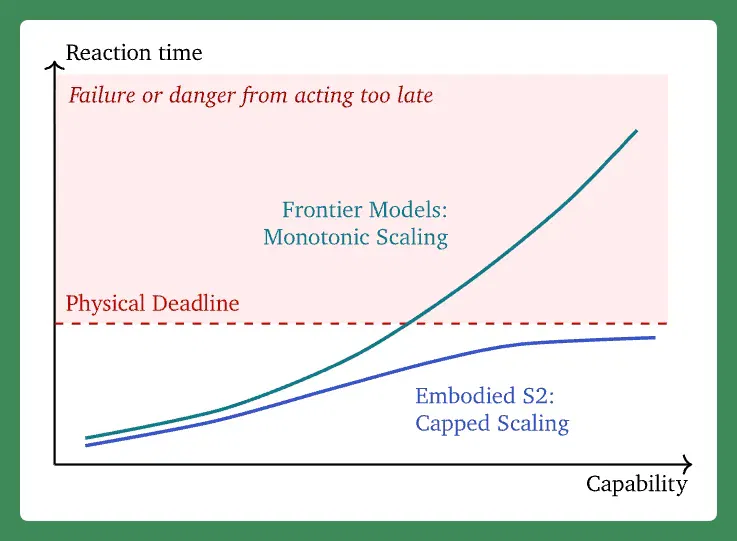
Time-constrained capability scaling: improving decision quality within deadlines. The curves are conceptual illustrations, not measured results.
05 How should these capabilities be trained?
How can S2's eight core capabilities actually be developed?
Grid Robotics provides no specific algorithmic code in the paper, but points toward a shift in training: from imitation learning based on expert demonstrations to a data flywheel of autonomous model–environment interaction.
Here, cognitive ability, or 'brainpower,' is developed through vast quantities of data, while practical collaborative capabilities, or 'survival skills,' must be honed through hard experience in the real physical world.
First come the cognitive skills: knowledge, understanding and reasoning.
These still depend on large-scale multimodal pretraining and embodied post-training. The largest challenge, however, is speed rather than understanding alone. A tendency to improve answers by thinking longer does not work in physical environments.
Training must therefore teach bounded reasoning—delivering on time. When pouring water, it must decide within half a second whether to pour directly or stabilize the vessel first. An 80-point plan delivered in time is more valuable than a 100-point plan reached after ten seconds.
Next come practical collaborative skills: tools, memory, cross-embodiment transfer and safety.
These require training and verification through real or simulated closed-loop interaction. Agentic RL is one possible method and can be combined with imitation learning. Safety also depends on the specific implementation of independent safeguards, control constraints and emergency stops. Refusal behavior or a Harness connection alone does not establish reliable millisecond emergency stopping.
Finally, efficiency requires an architectural division into fast and slow systems.
Like a human considering dinner slowly while avoiding a stone underfoot through a millisecond-scale cerebellar response, a robot needs large models for high-level semantic planning and small models for high-frequency real-time control. This division allows safe completion under extremely tight time budgets.
Grid Robotics emphasizes that for S2's long-term development, continuous learning from execution feedback in a closed loop is much more important than supervised learning on static datasets.
US company General Robotics [4] also emphasizes modularity, proposing general intelligence through combinations of robot skills. It is not the same company as Grid Robotics, which is behind this paper.
This skill-composition emphasis differs from Physical Intelligence's π-series approach, which focuses more on end-to-end foundation models.
06 Four roadmap levels, while the industry still struggles at L1 and L2
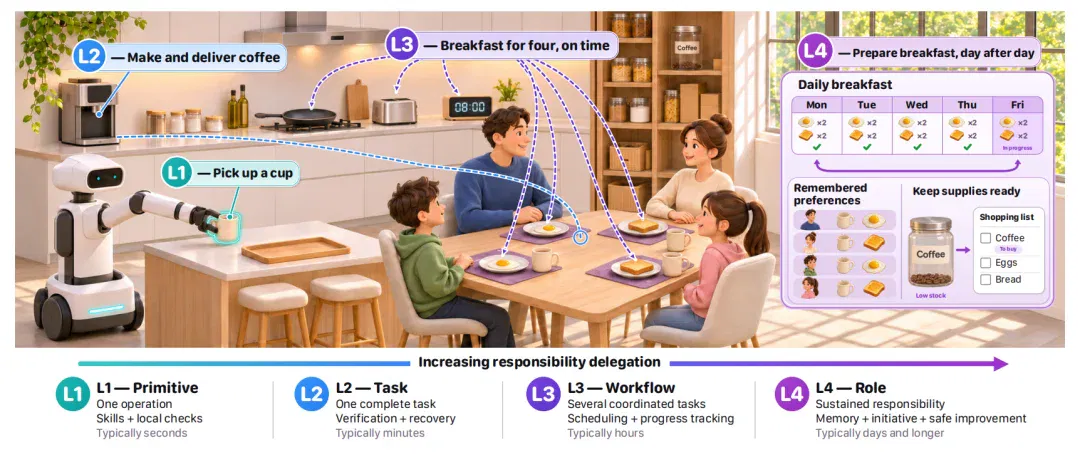
The paper's most commercially instructive element divides robotic responsibility into four progressive levels: performing an individual action (L1), completing a task (L2), coordinating a workflow (L3), and holding an ongoing role (L4).
The paper also uses an especially intuitive household-breakfast scenario to measure how much responsibility a robot can assume. At the same time, this gives us a yardstick for assessing the commercialization progress of embodied-intelligence projects.
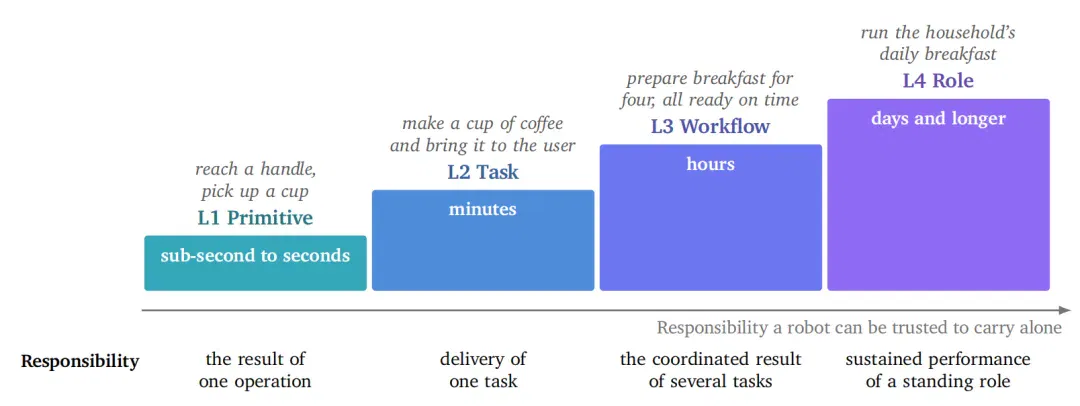
L1, Primitive, covers tasks lasting seconds. 'Pick up the cup,' for example, requires executing one skill and verifying the outcome. Responsibility is limited to whether that action succeeded.
L2, Task, covers tasks lasting minutes. For example, 'make and serve coffee.' This requires coordinating multiple skills, monitoring progress and recovering from failures. The responsibility boundary is whether an entire task has been completed in a closed loop.
L3, Workflow, covers tasks lasting hours. For example, 'prepare breakfast for four people, and do it on time.' This requires coordinating multiple interdependent tasks, scheduling and shared resources. The responsibility boundary now becomes coordination of the entire workflow.
L4, Role, covers days and longer periods. 'Be responsible for breakfast every day' goes beyond workflows to sustained agreed responsibilities, coherent memory and adaptation to change until the responsibility is withdrawn.
Most industry participants, including many impressive demonstrations, are still struggling at L1 and L2.
Actual commercial deployment, whether in factories or logistics, often lies at L3 and L4.
At those levels, customers pay not for single-grasp success rates but for memory across days, autonomous recovery from errors and safe handling of unexpected events.
Grid Robotics acknowledges that existing benchmarks barely cover L3 and L4. These levels are the larger opportunity, and where the Harness becomes decisive.
No effortless overwhelming advantage in the physical world?
After the paper's six questions, consider the company and team behind it: Grid Robotics.
Founded in September 2026, it positions itself around a general-purpose embodied brain. Public information from PEdaily [5] lists Sequoia China, Monolith and DeepSeek in its October seed round; separate angel-round information also lists LimX Dynamics.
Yu Tao previously worked on reinforcement-learning decisions for Tencent AI Lab's Juewu project. At LimX Dynamics, he led the development of LimX WBT, a whole-body motion-tracking system internally called System 0, responsible for low-level whole-body robot control.
He thus understands both decision-making and hands-on real-time body control, a relatively rare combination in embodied-brain development.
The paper's academic team is also notable. Core author Yang Zuhao is a PhD student at Nanyang Technological University, with experience in MiroMind and Kimi's native multimodal models, focusing on multimodality and video understanding. His supervisor, tenured associate professor Lu Shijian of NTU Singapore's College of Computing and Data Science, is also an author and has extensive computer-vision expertise.

Another core author, Yang Zhiqin, is active in Robot Use Agents and Physical Agents. As a co-first author of RobotWorld, he recently spoke to Crossing in the interview Astra Scores Only 19%: Possibly Today's Toughest Benchmark | The RobotWorld Team Answers Everything [6].
Amid this convergence in embodied intelligence, systems-engineering teams such as Grid Robotics argue that physical reality offers no effortless overwhelming advantage from a supposedly superior approach.
In their view, as general-purpose model capabilities rapidly become commodities, the engineering that converts them into verifiable physical behavior will remain scarce.
Latency, collisions and irreversible consequences may seem unglamorous, but addressing this demanding work may be an unavoidable step toward a viable physical-world business.
References
[1]Agentic Robotics: A New Era of Robotic Systems: https://arxiv.org/abs/2611.18359
[2]Evaluation framework: https://grid-robotics-official.github.io/agentic-robotics-roadmap/
[3]NVIDIA report released this October: https://research.nvidia.com/labs/srl/projects/astranomy/index.html?results=prompt-geometry-full-results
[4]US company General Robotics: https://beepartners.vc/general-robotics
[5]Public PEdaily information: https://vc.pedaily.cn/company/907191.html
[6]Astra Scores Only 19%: Possibly Today's Toughest Benchmark | The RobotWorld Team Answers Everything: https://mp.weixin.qq.com/s/7IKjebFqytrdQE8AGEr9BQ?scene=1
This article comes from Crossing. Author: Ms. Yi.
After reading
Join the AINRK community
Read how to join the community and connect with people working in AI.
Related articles
Continue reading related topics and articles in this category.

Zhejiang University and Unitree open-source Movens-5M for multimodal whole-body motion pretraining (opens in a new tab)
Movens-5M pairs five million simulation-validated robot motions with text, video, speech and music. The team trains Movens-Zero and demonstrates it on a Unitree G1, using scaling experiments to examine gains from more data and larger motion experts.
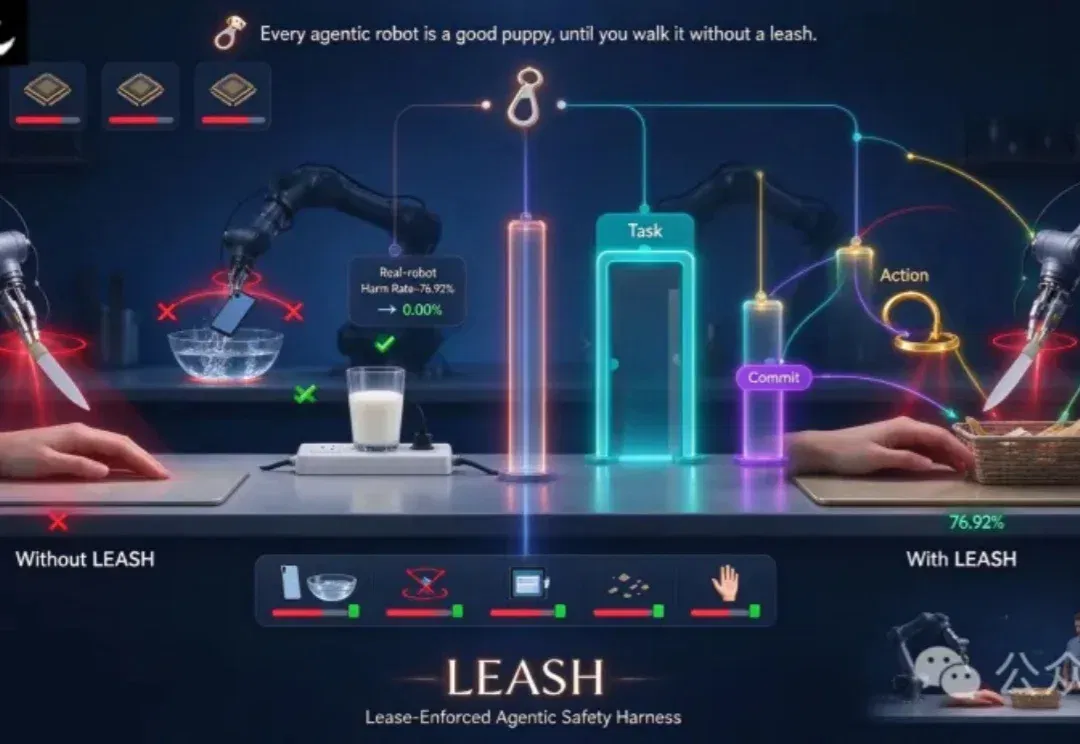
RoboRisk tests robotic semantic hazards; LEASH reduces harm within specified tasks (opens in a new tab)
RoboRisk evaluates model-controlled robots on 92 simulated and thirteen physical tasks, testing LEASH’s three gates. Some configurations incurred no harm in the physical sample; this does not guarantee safety in open environments.
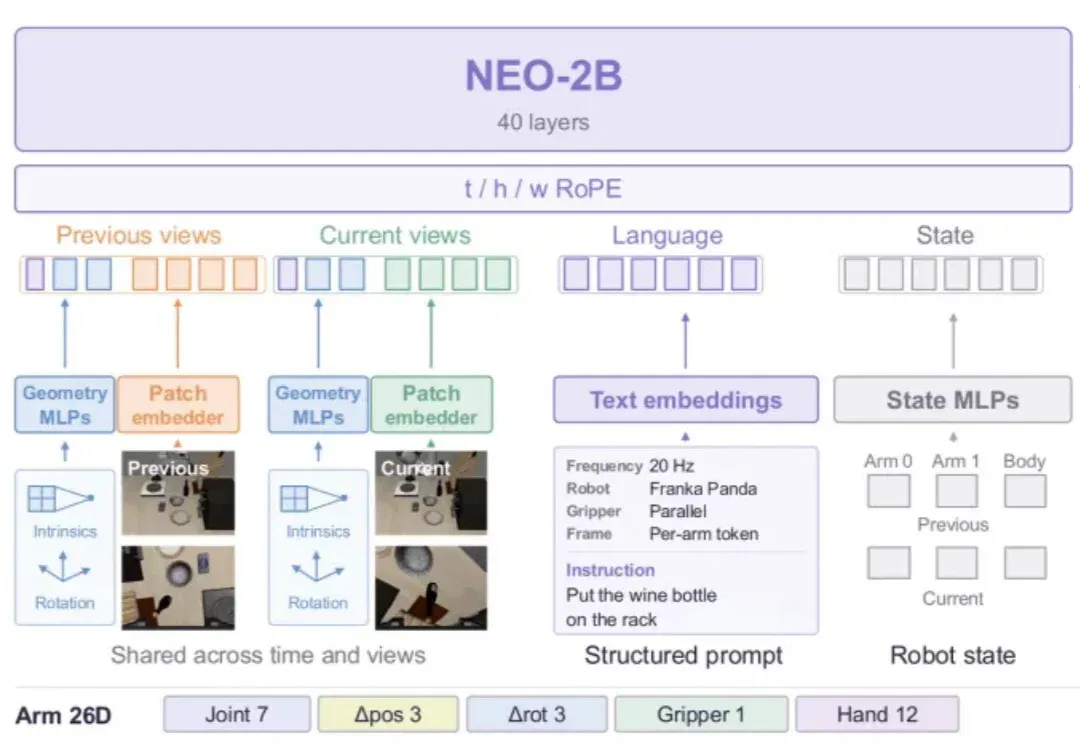
NEO-VLA studies how native visual representations support robot action learning (opens in a new tab)
NEO-VLA lets an action expert read multiple backbone layers, comparing frozen models, fine-tuning and joint understanding training. Simulation and three physical tasks evaluate transfer, robustness and remaining spatial/task-generalization limits.

RoboSpoof Tests How Visual Interference Affects Robots' Safety Refusals (opens in a new tab)
Robocurve compared original, blurred and AI-tampered images across 900 trials with five models and five tasks, reporting a sharp increase in dangerous-action attempts under controlled, prop-based conditions.
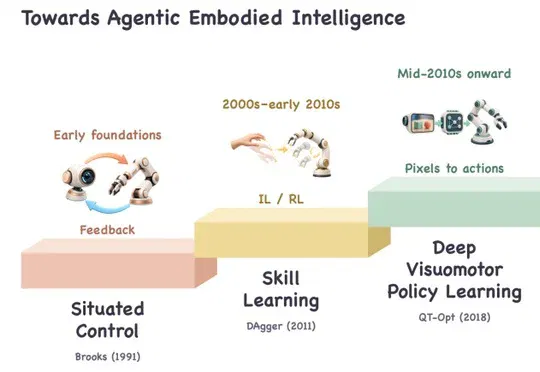
Tsinghua survey reviews embodied autonomous systems, data and evaluation through an agent lens (opens in a new tab)
The survey organizes research around perception, planning, execution and feedback, proposes levels of human-machine responsibility, and discusses cloud-edge-device coordination, safety and evidence for cross-task validation.