FaceMind explores General Looped Model across language reasoning, world simulation and diffusion
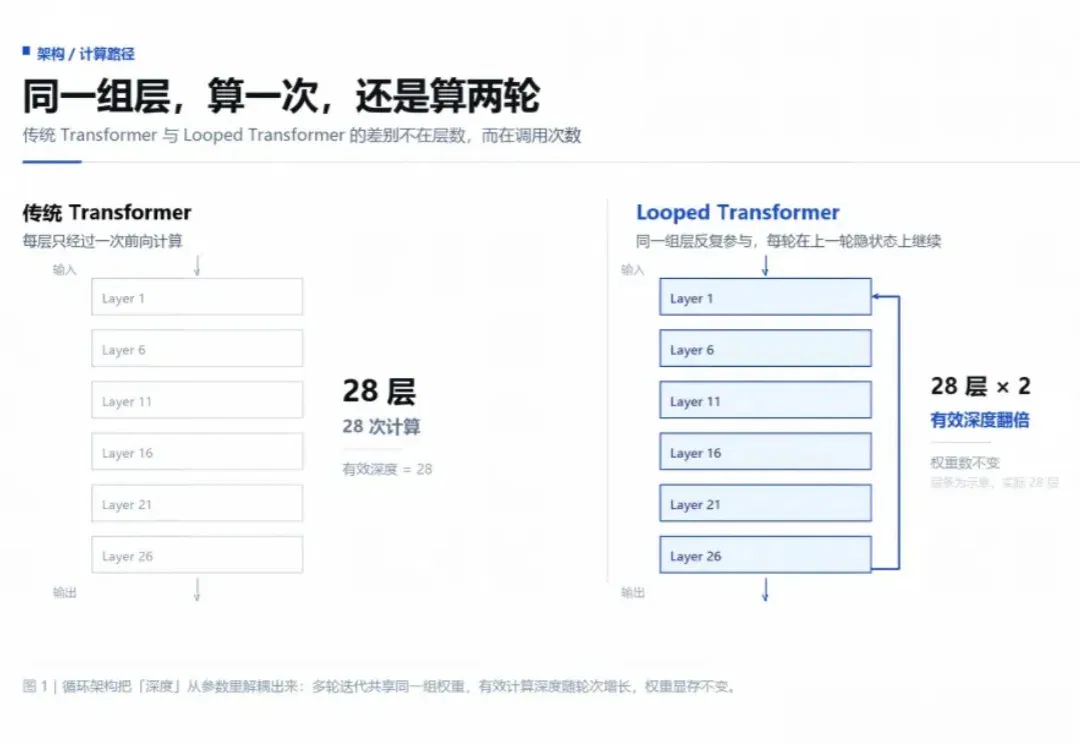
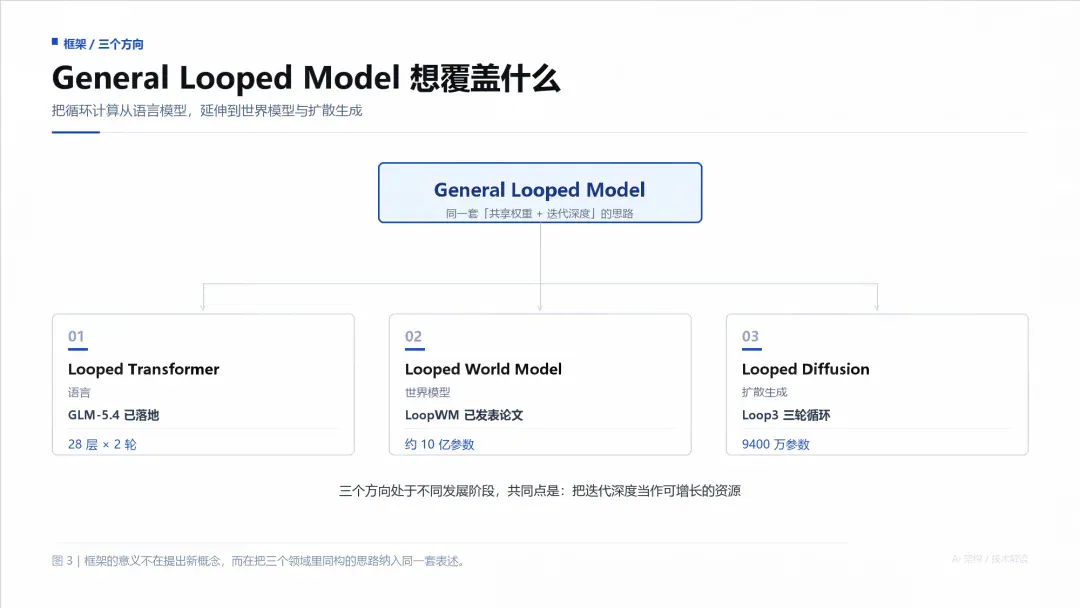
FaceMind's General Looped Model spans three research directions, with Zhipu's GLM-5.4 illustrating loop depth. LoopWM tests specific state predictions; Loop3's memory and concurrency figures come from an internal fixed-condition test. Smaller weights need not mean less compute or latency.
Editor's fact check (November 26, 2026): The comparisons in this article come from different research stages: GLM-5.4's performance results were published by Zhipu, while Astra's architecture is a media report. LoopWM's comparison at approximately one billion parameters concerns textual state prediction after five consecutive actions in ALFWorld, rather than full physical-world simulation. The Loop3 data, meanwhile, are cited from an internal FaceMind report and are limited to the article's local pipeline at 128×128 resolution, 57 frames, and FP16 precision. Savings in memory used for weights do not imply proportional reductions in total inference memory, computation, or latency. The original article's breakdown of 16 metrics totals only 15, leaving the remaining metric unexplained.Zhipu's official GLM-5.4 technical blog (opens in a new tab)Looped World Models paper (ALFWorld, Table 4) (opens in a new tab)
On November 23, Zhipu released its new flagship model, GLM-5.4. Its most noteworthy development is the company's first introduction of a Looped Transformer architecture into a flagship model.
The 28-layer network runs through two loops. Zhipu says its intelligence is already comparable to that of models with two to three trillion parameters.
Meanwhile, according to The Information, the Astra model under development at OpenAI also uses a similar looped-depth technique.
Suddenly, looped architectures have become a new focus in the large-model field.
But while the industry is still discussing how to apply looped architectures to language models, another Chinese AI company, FaceMind, has already expanded its research to world models and diffusion generation, proposing a more general framework:
General Looped Model.
After carefully examining the company's research trajectory, we found that the potential of looped architectures may extend well beyond large language models.
01 A different approach to scaling large models
Over the past few years, the most direct way to improve large models' capabilities has been to increase their parameter counts.
As models enter the trillion-parameter era, however, GPU memory capacity, memory bandwidth, and deployment costs are increasingly important constraints on their development.
Looped architectures take computational depth as their starting point.
In a conventional Transformer, each network layer is generally computed once during a forward pass. A looped Transformer allows the same group of layers to participate repeatedly, with each iteration continuing to process the hidden states from the previous round.
Because the rounds share weights, the model can increase its effective computational depth without a proportional increase in parameters.
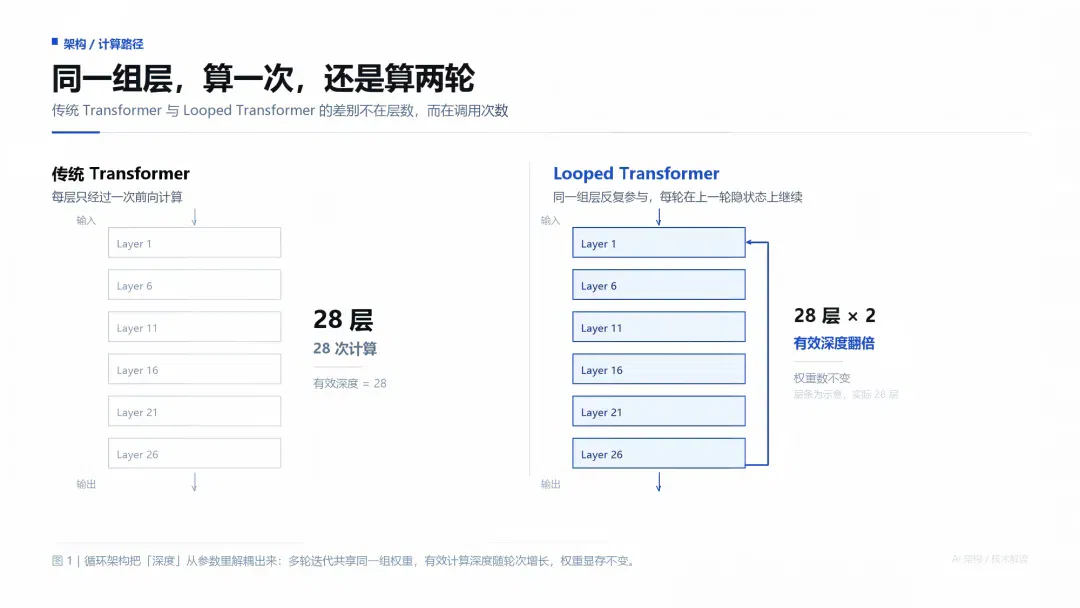
Parameter count affects how much information a model can store and represent, while computational depth affects its ability to handle complex problems.
For some tasks, increasing computational depth can therefore improve performance while easing demand for weight memory and high-bandwidth memory (HBM).
FaceMind's General Looped Model aims precisely to extend this approach from language models to more types of AI models.
The framework currently encompasses three technical directions.
02 From language reasoning to world simulation
Looped Transformer: enabling language models to think more deeply
GLM-5.4 is an important attempt to bring looped architectures into mainstream flagship language models.
In experiments published by Zhipu, a looped 30B model improved performance with the same parameter count and only approximately 10% more training compute.
Zhipu also acknowledges that looped computation is not an entirely new research idea. GLM-5.4's significance lies in bringing this architecture into use in a large-scale flagship model.
Model scaling, which previously relied mainly on increasing parameters, is moving toward the parallel development of parameter scale and computational depth.
Looped World Model: enabling AI to simulate the world repeatedly
World models need to understand environmental states and predict what happens next given particular actions. This is more complex than the tasks faced by language models. As the number of prediction steps grows, small earlier errors can accumulate and affect subsequent judgments.
In June this year, FaceMind released the paper Looped World Models, introducing LoopWM. The abstract describes it as the first looped architecture for world modeling.
Its core design uses a weight-sharing Transformer module to repeatedly update estimates of environmental states and adjust computational depth to the complexity of the prediction task.
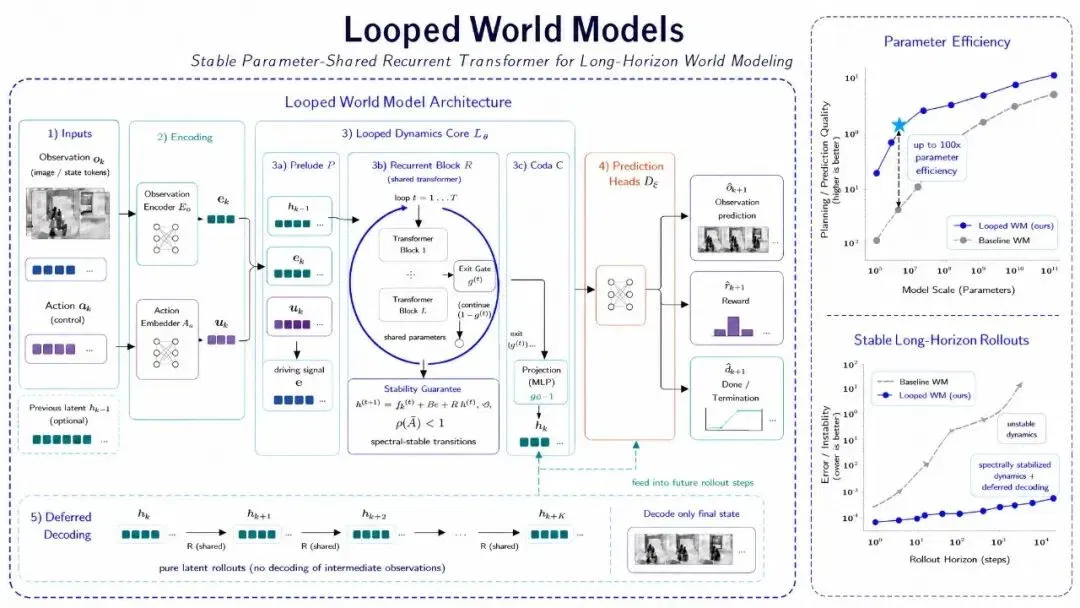
In ALFWorld multistep state-prediction experiments, LoopWM, with approximately one billion parameters, was compared with Claude Opus 4.6 Max.
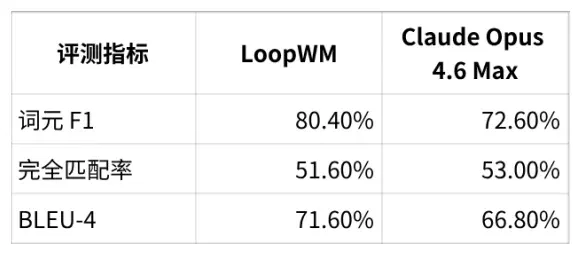
Although its exact-match rate was slightly lower, LoopWM held an advantage on some of the other metrics.
These results suggest that, through looped computation, models with fewer parameters may be able to compete with large models on specific world-modeling tasks.
Looped Diffusion: turning parameter efficiency into deployment advantages
Looped architectures have also shown potential in diffusion generation.
According to FaceMind's internal technical report dated October 8, the three-loop model Loop3, with just 94 million parameters, was compared against the five-billion-parameter BWM in a standardized local testing pipeline.
Their parameter counts differ by approximately a factor of 53.
According to that internal report, Loop3 outperforms the baseline on seven metrics, falls slightly behind on three, and remains behind on another five. These three groups total 15 metrics; the original report does not explain the remaining one of the stated 16.

The deployment differences are also substantial.
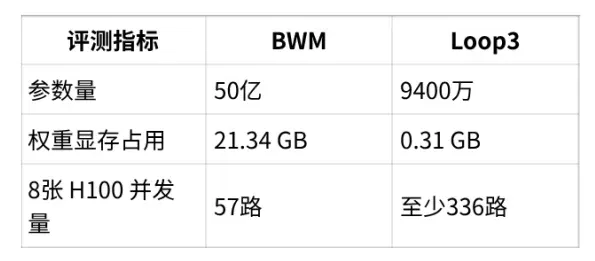
GPU memory occupied by weights falls by approximately 98.5%, and concurrency rises to nearly six times its previous level.
These figures, of course, come from a standardized test environment using 128×128 resolution, 57 frames, and FP16 precision. They cannot be compared directly with WorldArena leaderboard results.
From an engineering deployment perspective, substantially reducing weight-storage overhead while maintaining a certain level of generation quality can create the conditions for high-concurrency deployment.
03 Looped architectures have costs of their own
Fewer parameters do not mean that computational costs will decline in tandem.
Although sharing weights can reduce a model's storage demands, every additional iteration requires extra computation time.
GLM-5.4 has already revealed a similar issue. Zhipu's technical blog notes that the model sometimes becomes caught in excessively long cycles of reflection, increasing response latency.

Furthermore, if a model reaches an incorrect judgment during an early iteration, subsequent computation may continue to reason in the wrong direction.
How many loops to run, when to stop, and how to allocate compute dynamically according to task difficulty are all engineering questions these architectures must address.
These choices also affect computational efficiency. Greater parameter efficiency does not necessarily produce greater computational efficiency; this remains an issue to resolve as looped architectures move toward large-scale commercial deployment.
04 Will loop depth become a new dimension of scaling?
From Zhipu's GLM-5.4 to FaceMind's LoopWM and Looped Diffusion, looped architectures are being tested in different fields.
The significance of FaceMind's General Looped Model is its attempt to place these technical directions within a single research framework.
Language models can use looped computation to increase reasoning depth, world models can improve state prediction through iteration, and diffusion models may be able to achieve high-concurrency deployment with smaller sets of weights.
These explorations are currently at different stages of development. Bringing them into one framework also allows FaceMind to study a common question: across different tasks, how much capability improvement and deployment benefit can greater iterative computational depth deliver?
Over the past few years, the industry has become accustomed to judging a model's strength by its parameter count.
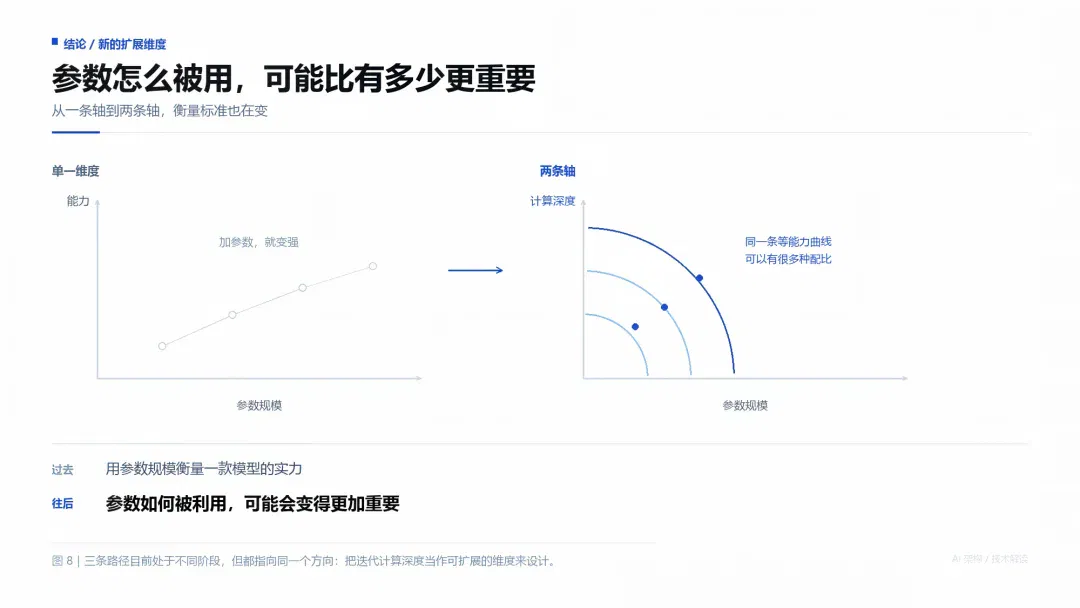
In the future, how those parameters are used may become more important.
This article is from Synced, by Synced.
Related topics
After reading
Join the AINRK community
Read how to join the community and connect with people working in AI.
Related articles
Continue reading related topics and articles in this category.

「马嘉祺」让大模型翻车,而他一年前洗澡时就发现了问题 (opens in a new tab)
一家名为脸谱心智(FaceMind)的初创公司就在顶级学术会议 EMNLP 主会上系统性地揭示了这个问题,并给出了解法。更有意思的是,就在「马嘉祺」事件前不到两周,全球最强 AI 公司之一 Anthropic 也在自家产品中悄悄落地了一次高度相关的改造 —— 方向与脸谱心智一年前的论文几乎完全一致。

OpenAI刚曝光循环架构,这家公司更早将其用于世界模型 (opens in a new tab)
9月初,OpenAI下一代模型Astra的架构细节被曝光,核心关键词只有一个:循环。

FaceMind 陆弘远:在世界模型的“原点”,做一个“非共识”的Neolab (opens in a new tab)
走在风口浪尖,拥抱最新的技术。 “世界模型”并不是新概念。但在2026 年,具身智能的“泛化瓶颈”,直接把“世界模型”推向了风口。 大洋彼岸,李飞飞的 World Labs 估值突破 50 亿美元,杨立昆的 AMI Labs 获超 10 亿美元种子轮融资,迅速推高了“世界模型”赛道的热度。资本加速涌来。世界模型及相关赛道国内已有超 33 家企业完成融资,累计吸金超 260 亿人民币。 与此同时,巨头们也在提速。阿里的 Qwen-RobotWorld、腾讯的 HY-World、字节的 Seed3D 迅速更迭;华为虽不常公开提及"世界模型",却已将盘古大模型定位为具身与自动驾驶的"训练底座"。 大

Loop世界模型论文登顶Hugging Face,来自中国一家初创,周鸿祎陆奇都投了 (opens in a new tab)
Prompt还没退场,Loop已经开始接管AI叙事。

训练世界模型,开始从人类的肌肉和脑子里偷师了 (opens in a new tab)
具身智能数据的竞争,正在从“量大管饱”进入下一关。