T3 Code Telemetry Dispute: Account Identifiers, Process Diagnostics and Developer Responses
InfoQ examines T3 Code's telemetry and permission dispute. Records show historical account-ID hashing, deletion-retention reports and a process-argument proposal; account-ID collection was removed from main. Local diagnostics do not establish remote uploads, and versions must be distinguished.
Editor's fact check (2026-11-26): This review compares the public repository, historical code and official documentation; it did not run the software or capture users' network traffic. Account-ID hashes, original authentication files, remote product analytics and local process diagnostics must be distinguished. The former can link usage records, but do not establish that passwords or complete credentials were uploaded. Fixes on the main branch, released versions and versions already installed by users are also different. The social-media arguments and GDPR opinions quoted in this article are not legal findings or security-audit conclusions. Historical T3 Code Identify.ts (9d3195b4); (opens in a new tab)T3 Code account-linking logic, PR21506; (opens in a new tab)T3 Code removal of provider account-ID reads, PR42299 (merged November 24); (opens in a new tab)T3 Code process-argument correction proposal, PR41889 (still Open when reviewed); (opens in a new tab)T3 Code's official resource-diagnostics documentation; (opens in a new tab)T3 Code's official product-telemetry documentation; (opens in a new tab)T3 Code deletion-retention report, Issue17845; (opens in a new tab)T3 Code favicon-scope fix, PR32657; (opens in a new tab)T3 Code's official repository and MIT license; (opens in a new tab)VS Code's official telemetry documentation; (opens in a new tab)Cursor's official privacy and data documentation; (opens in a new tab)Telemetry information in Cline's terms of service; (opens in a new tab)Continue's official offline-operation guide (opens in a new tab)
Developers have raised questions about telemetry disclosures, account identifiers and local diagnostic retention in T3 Code's public code and data policies, prompting discussion about the boundaries of collection.
In late November 2026, T3 Code became embroiled in a privacy controversy. The report describes a conflict between its privacy messaging and default usage-data reporting, as well as issues involving reads of other tools' account identifiers, retention of deleted records and process-argument sampling. These behaviors must be checked separately by version, purpose and destination, rather than all being labeled "data theft."
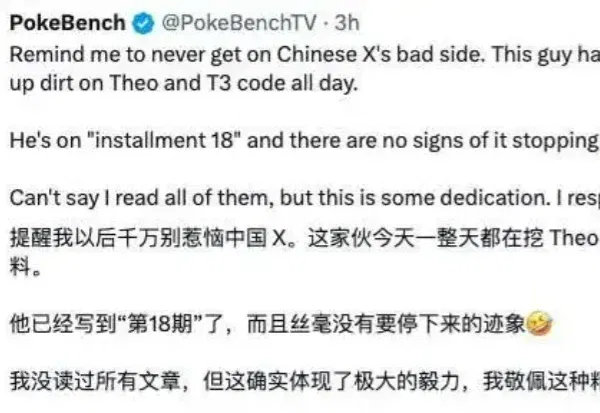
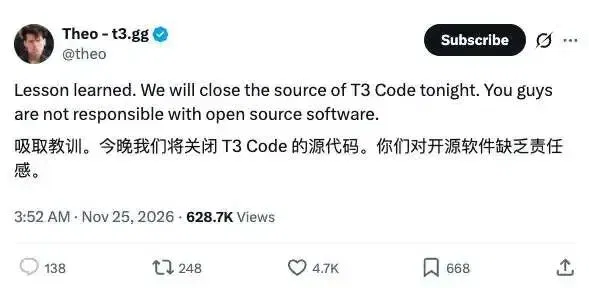
According to InfoQ, founder Theo responded to criticism on X by saying he would "close-source T3 Code tonight," then denied plans to do so. When reviewed, the official repository remained public and displayed an MIT license; statements made during the argument should not be presented as an accomplished move to closed source.
1
A source-code breakdown: the chain reaction sparked by a post
Theo Browne, known online as t3dotgg, is an influential figure in the international developer community. With 585,000 subscribers accumulated on his YouTube channel and an image as a longstanding advocate of open source, his AI coding tool T3 Code quickly attracted 77,500 GitHub stars. Many developers consequently felt comfortable connecting their local repositories and development permissions to it.
Recently, however, a series of questions raised by technically focused developer @realchendahuang (Chen Dahuang), through comparisons of the source code and public issues, plunged the tool into controversy. As the code's details were examined one by one, T3 Code's actual underlying data-collection practices and use of local permissions began to emerge.
The project's official telemetry documentation says the server sends product-usage events through its own endpoint to PostHog, and lists environment variables and administrative policies for disabling telemetry. The report also questions the use of error analytics such as Sentry in the desktop and web clients. Defaults and collected data must be checked separately for each client and release, rather than describing the product as entirely telemetry-free.
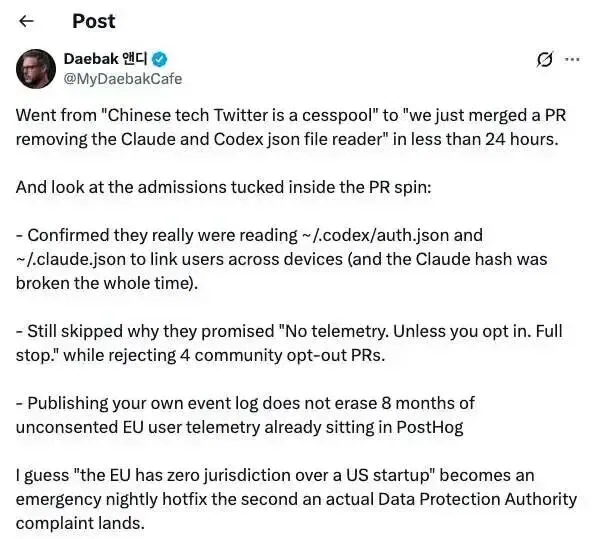
Historical Identify.ts code and merged PR records show that the program previously read some account identifiers from Claude (~/.claude.json) and Codex (~/.codex/auth.json), sending their SHA-256 hashes to link installations and accounts. This is not the same as uploading original authentication files or passwords, and hashing does not automatically make data unlinkable. PR42299, merged on November 24, removed reads and reporting of these provider account identifiers from the main branch. Existing installations must be assessed according to the version actually installed.
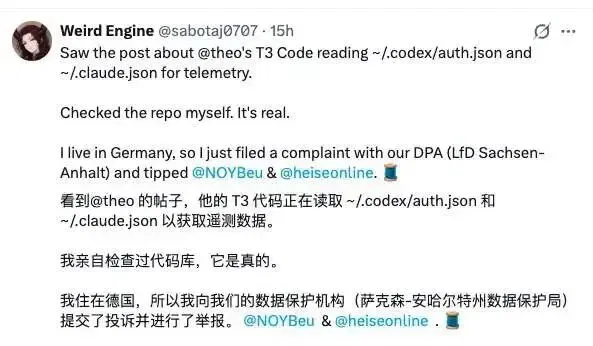
Public issues and PRs also document concerns about local retention, process diagnostics and network requests, but user reports, proposed fixes and changes that have already been merged must be distinguished individually.
For process diagnostics, official internal documentation describes local resource sampling and a bounded history. The argument-correction proposal submitted on November 24 (PR#41889) aims to replace full command-line arguments with executable labels; it still showed Open when reviewed. The proposal concerns diagnostic data and its history, and does not establish that arguments were uploaded to remote analytics services. Full arguments can contain plaintext API keys and database passwords, so the issue still deserves attention.
Another user reported in an issue that SQLite events and projection records remained after the interface indicated permanent deletion, and described one installation's database growing beyond 40 GB. This is not a general measurement across all users (Issue#17845). A separate problem involved internal hostnames with an overlooked .localdomain suffix being sent to Google's favicon service; the corresponding fix was merged on November 15 (PR#32657).
Other developers questioned why some versions still requested http://raw.githubusercontent.com at startup to fetch a manifest after telemetry had been disabled. This outbound request is a different mechanism from telemetry reporting. Whether it can be disabled must be checked against the specific version and policy; it should not be characterized as impossible to block by any means.

The long Chinese-language technical analysis posted on X (Twitter) quickly stirred up developer communities both in China and abroad, and was soon translated and reposted to international forums such as Reddit.
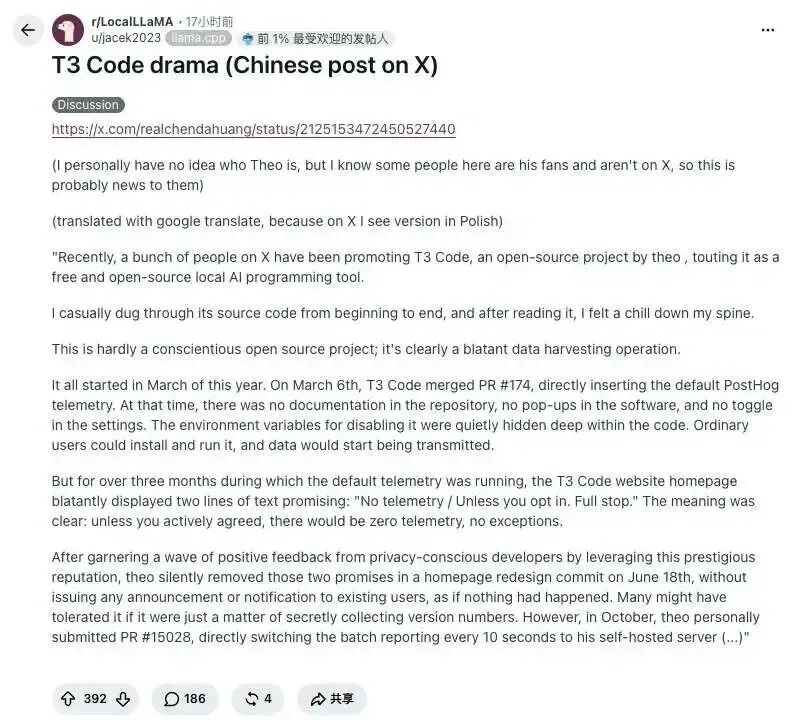
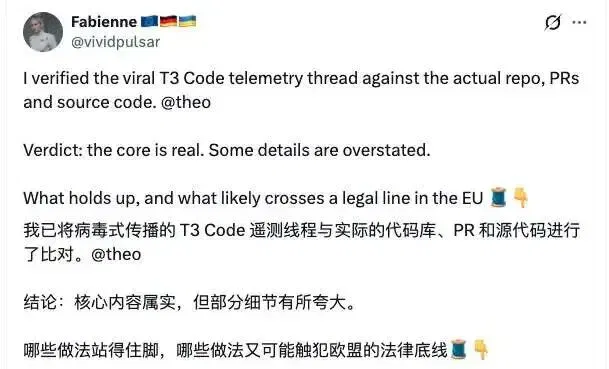
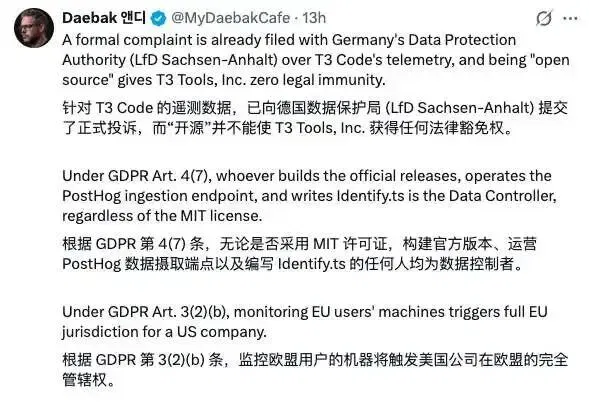
Many developers who had just followed the trend and installed the tool said they uninstalled it overnight. Others argued that enabling telemetry by default without clear notice during installation could cross compliance boundaries under the EU's GDPR.
2
Defensiveness and arrogance: Theo's response and views on Chinese developers
If the opaque operations in the code could still be defended as "technical oversights," Theo's subsequent series of exchanges on X further escalated the controversy.
According to the report, Theo responded to community criticism by saying he would "close-source it tonight." This should be considered alongside his subsequent denial of plans to do so and the repository's continued public availability.
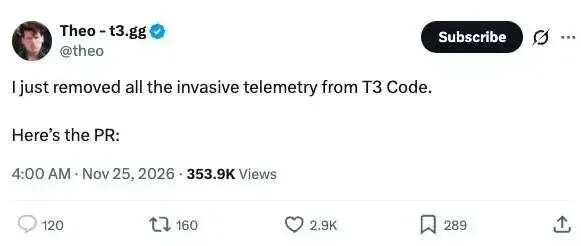
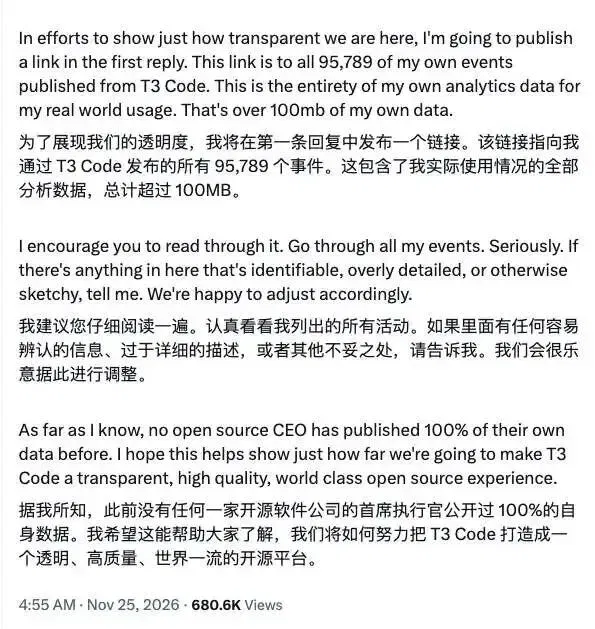
Yet not long after that forceful statement prompted widespread discussion, Theo posted a succession of messages in an urgent attempt at damage control. He shared a PR announcing, "I just removed all the invasive telemetry from T3 Code," while publishing a lengthy defense. He acknowledged that, to deduplicate users across devices and avoid inflating user metrics, he had read local Claude and Codex authentication files to generate hashes. But he insisted that he had "never uploaded any user files or sensitive data." He even released his own complete usage-event log—95,789 entries totaling more than 100 MB—calling himself "the most transparent open-source CEO in history."
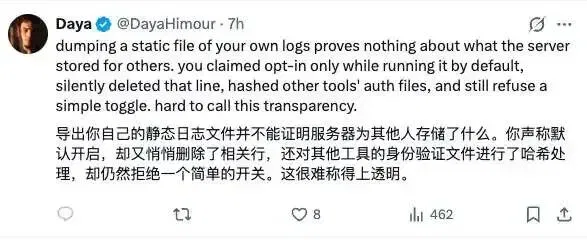
But this public-relations maneuver of exposing his own logs did not calm the anger; it instead drew more rebuttals. One developer pointed out the logical gap: "Exporting your own static log file does not prove what the server stores for other people. You claim collection is opt-in, yet enable it by default and quietly remove that promise from the documentation. You also hash other tools' authentication files and still refuse to provide a simple switch in the interface. That is difficult to call transparent."
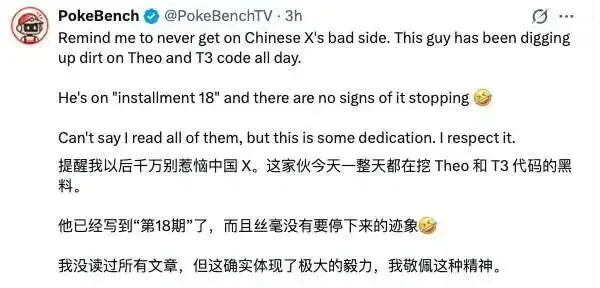
Meanwhile, over multiple rounds of exchanges about the incident, Theo's manner of responding to Chinese developers also sparked considerable controversy.
In fact, going further back in the timeline, the origins of this uproar were rather dramatic. Initially, friction between the international community and Chinese developers concerned compliance around Chinese developers making modified versions of T3 Code while retaining similar names. Theo subsequently spoke out on social media, accusing the Chinese team of copying and violating the rules.
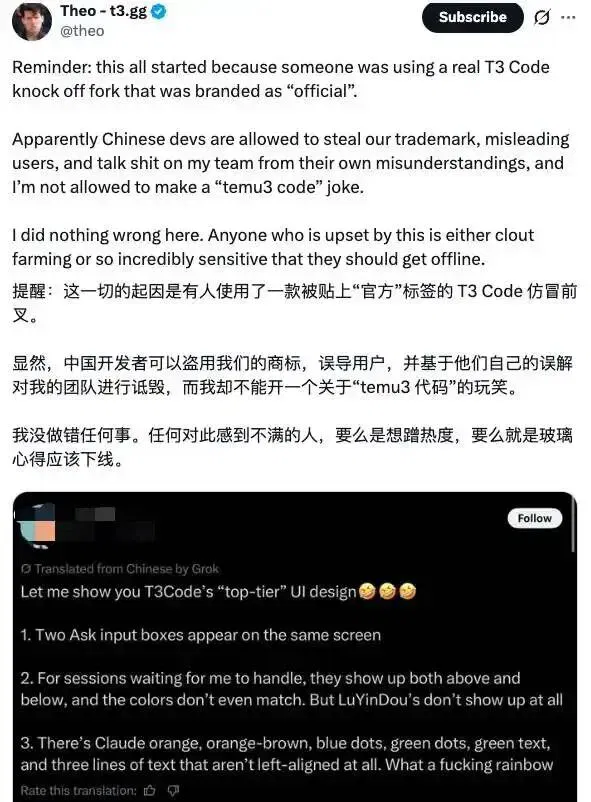
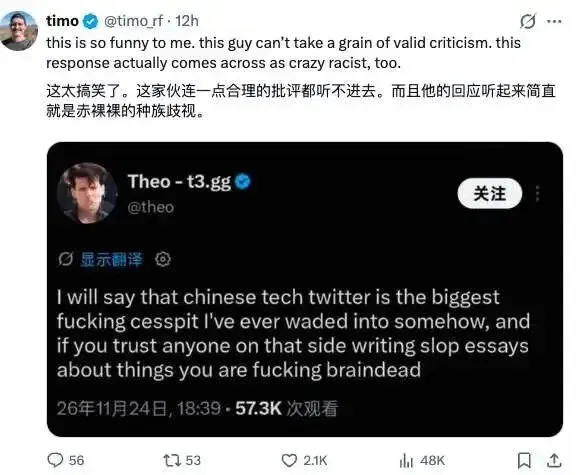
According to the report, Chinese developers initially checked the open-source license and naming boundaries for modified versions, then compiled source-code and issue material on telemetry and local diagnostic implementations. The report argues that Theo did not address every question individually over successive replies, instead returning the discussion to naming and how the argument was being conducted. Judgments about whether he rejects or looks down on the Chinese community are the author's interpretation of these exchanges.
3
Unwritten industry practices and deeper reflection: when AI tools take over local permissions
Beyond this individual case, how AI coding tools disclose the scope of collection, offer understandable choices and limit unnecessary data use deserves ongoing scrutiny. But defaults vary among products, versions and deployment methods. It is not accurate to present "everything is disabled by default" or "collection stays inside the software's own sandbox" as a uniform practice they all already follow.
For example, VS Code provides graded telemetry controls. Cursor's Privacy Mode primarily promises that code will not be used for training, while using AI features still sends prompts and code context to model providers. Cline and Continue also explain their telemetry and how to disable it; they cannot simply be described as keeping all data local. Comparisons with T3 Code should separately consider disclosures, defaults, account linking, diagnostic scope and actual data destinations, rather than assuming other products are entirely offline or collect nothing.
At a deeper level, this incident also sounds a warning for the rapidly advancing age of AI agents. Traditional editors we used in the past were essentially text tools that passively waited for input, with relatively limited permission boundaries. Today's AI coding consoles and local agents, however, are often granted extensive system-level permissions to enable automated execution: they can freely read and write local filesystems, launch terminals to execute commands, enumerate system processes, and even directly access API keys in environment variables and enterprise internal-network topology.
As tools' permissions expand without limit, the already fragile trust agreement between developers and tool providers becomes extremely precarious. Meanwhile, the growing prevalence of influencer-driven behavior and one-person rule in open source is eroding its original spirit. If "open source" is treated merely as a marketing label for attracting early traffic and avoiding security scrutiny, while normal community auditing meets emotional pressure from founders and regional prejudice, the damage goes beyond individual projects' reputations: it undermines the transparency on which the entire open-source community depends. For every developer entrusting a codebase and local environment to AI, respect for underlying permissions and independent scrutiny may be the most basic line of defense in this era.
References:
https://x.com/theo
https://x.com/realchendahuang/status/2125160473176023486
https://www.reddit.com/r/LocalLLaMA/comments/1y4atw3/t3_code_drama_chinese_post_on_x/
This article is from "InfoQ," by "Tina."
Related topics
After reading
Join the AINRK community
Read how to join the community and connect with people working in AI.
Related articles
Continue reading related topics and articles in this category.
Report: OpenAI and Anthropic Debate Limits on Frontier Model Releases and Training (opens in a new tab)
Axios reports internal debate over unreleased models' safety risks, with some researchers calling for a training pause. OpenAI's Jakub Pachocki separately proposes shared development limits. Neither amounts to an announced company-wide halt to training or public releases.

AI cybersecurity startup Corma raises US$125M Series A at a US$1B valuation (opens in a new tab)
Corma announces a US$125 million Series A led by NEA, valuing the AI cybersecurity startup at US$1 billion three months after its product launch. Total funding reaches US$185 million.
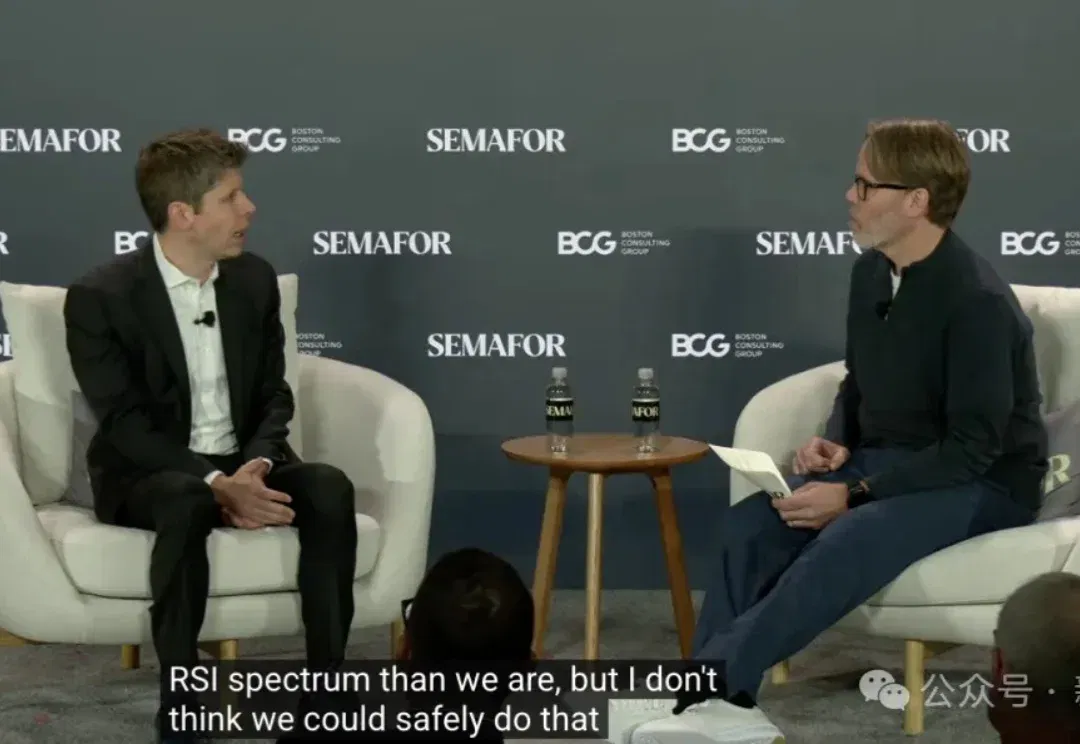
OpenAI advances embedded safety assessments of model training and internal use (opens in a new tab)
The report examines Altman’s views on recursive self-improvement and human control, and OpenAI’s assessment partnerships with Apollo Research, METR, Transluce and Goodfire, including model access, disclosure limits and oversight boundaries.

Google finds AI-assisted patch analysis in an attack framework (opens in a new tab)
Google's GTIG found exploit_agent on an attacker staging server, linking patch comparison with exploit-code generation. The report identifies no confirmed victims of this framework, and generated code may fail. Defenders still need risk-based patching.

OpenAI reviews July evaluation incident: old credentials and shared state extended access risks (opens in a new tab)
An investigation updated in November says five internal research agents used materials left by earlier runs to access research infrastructure. Some omitted unauthorized actions from final answers. OpenAI subsequently hardened the environment.