Tsinghua and Infinigence AI Open-Source Uni3Sim to Simulate LLM Inference Clusters

Uni3Sim combines compute, memory and interconnect models with native SGLang/vLLM schedulers to predict TTFT, TPOT and throughput and compare resource and cache designs. Reported errors and benefits apply to specified hardware, workloads and pricing; agent-driven design search is planned.
Editor's fact check (2026-11-24): The simulation errors, resource utilization and changes in cache revenue in this article all correspond to the hardware, models, request workloads and pricing experiments listed by the team; they are not guaranteed values for every cluster or business. The current platform predicts performance from a given configuration, while automatic design adjustment by agents remains a future plan. Official Uni3Sim open-source repository (opens in a new tab)
As model sizes and token usage continue to grow, AI inference deployments are moving from single GPUs to multiple GPUs, supernodes and cross-node clusters, with increasingly complex coupling among compute, memory and interconnects. Evaluating the performance of different hardware-system designs and model-deployment schemes before a large computing cluster is built has become an important issue in designing large-scale inference infrastructure.
Recently, Infinigence AI, together with the teams of Assistant Professor Zhenhua Zhu and Professor Yu Wang at Tsinghua University, officially announced the open-sourcing of the Uni3Sim simulation platform. It provides a simulated "laboratory" for performance prediction and infrastructure design for large-scale AI inference services, letting developers "rehearse" how a cluster design performs under different workloads before deployment and turn expensive physical trial and error into low-cost digital trial and error. Developers can feed it different models, request workloads and software/hardware configurations, simulate the execution of real inference tasks in a virtual environment, observe system bottlenecks in advance and compare the performance of different designs.

- Project website: https://thu-nics.github.io/uni3sim-website/
- GitHub: https://github.com/thu-nics/uni3sim
01 As LLM Inference Scaling Accelerates, Computing-System Design and Optimization Become Critical
As LLM inference scaling continues to develop, AI compute demand is extending further toward inference. Global demand for tokens is surging and showing a sustained long-term growth trend. AI inference deployments are expanding from one GPU to multiple GPUs, supernodes and even cross-node clusters. System performance no longer depends only on the execution efficiency of individual operators: cross-GPU communication, KV-cache occupancy and request queues are also beginning to affect the throughput and response latency of the entire service.
This means that inference infrastructure no longer faces merely a question of compute scale, but a system-design problem shaped jointly by multiple dimensions, including compute, memory and interconnects.
Meanwhile, underlying hardware architectures continue to evolve. New technologies such as wafer-scale integration, 3D-stacked DRAM, HBF, memory pooling and hybrid optical-electrical interconnects keep expanding the hardware design space, while also increasing the combinatorial complexity of system architectures and model deployments.
The problem is that more hardware resources do not necessarily translate into better service performance. Improving one part alone may also fail to deliver end-to-end benefits because of constraints elsewhere. System optimization therefore cannot focus on a single metric; it needs a comprehensive assessment of the relationships among compute, memory, interconnects, model parallelism and scheduling strategies.
Chip design typically uses EDA tools to assess performance, power and area before tape-out. Similarly, large-scale inference clusters need comprehensive evaluation of compute chips, memory capacity, link bandwidth, network topology, communication protocols, model-parallel partitioning and scheduling strategies before hardware is put in place. Even with an unchanged hardware budget, different resource configurations and deployment strategies can produce dramatically different request latencies and resource utilization.
Uni3Sim, the simulation platform jointly open-sourced by Infinigence AI and Tsinghua University, was designed for this need. Using large-scale LLM serving as its workload, the platform simulates the scheduling and execution of inference requests across a cluster based on models, request workloads, deployment strategies and hardware configurations, modeling the time spent on chip computation, data movement and communication. Developers can compare different chip, memory and interconnect designs under real workloads and assess how these choices affect time to first token (TTFT), time per output token (TPOT) and system throughput.
02 From Compute to Memory and Interconnects: Uni3Sim Builds a Unified Simulation Framework for Complex Inference Systems
Predicting the performance of a large computing cluster is not easy. Three questions are hard to avoid:
First, how much time does a local speedup save for the whole system? Compute, memory and communication performance influence one another in real systems. Sometimes they can proceed together; sometimes they must wait for one another. A simulator has to identify which parts determine a request's completion time before it can judge the actual benefit of a local speedup.
Second, hardware speed also changes the work that follows, making it difficult for static analysis to reflect a cluster's real performance in actual business scenarios. The work the system must process changes at every moment. When the previous batch finishes also affects which requests make the next batch, changing the total execution time in turn.
Finally, how detailed must a simulation be to distinguish better designs from worse ones? When faced with thousands or tens of thousands of cluster configurations, retaining the details that truly affect performance while still comparing alternatives quickly is another challenge for supernode-cluster simulation.
Uni3Sim's core idea is to bring compute, memory and communication in an inference system into one unified simulation framework, modeling the execution of different tasks on heterogeneous hardware and their resource contention and mutual effects. The "3" emphasizes unification at three levels: heterogeneous hardware, the memory hierarchy, and modeling of scale-up/scale-out interconnect protocols and topologies.
Together, these three levels of unification form Uni3Sim's ability to model complex inference systems:
- Unified heterogeneous hardware: describe the computational capabilities and execution characteristics of compute chips and hardware resources with different architectures in a consistent way, supporting operator-performance prediction across hardware platforms.
- Unified memory hierarchy: bring different tiers, including HBM, HBF, host DRAM and pooled memory, into a unified model to evaluate data-access, capacity and migration overhead under different memory architectures.
- Unified interconnect protocols and topologies: consistently describe protocol-execution mechanisms, network topologies and data-transfer processes across different scale-up and scale-out interconnect designs, analyzing how different interconnect architectures affect system performance.
Around these three dimensions, Uni3Sim builds three core models—ArchPrism, HBFrame and ProtoBridge—to estimate execution times for compute operators, memory accesses and communication tasks, respectively. The platform also integrates the native request schedulers of SGLang and vLLM, combining hardware execution models with the scheduling behavior of real inference frameworks.
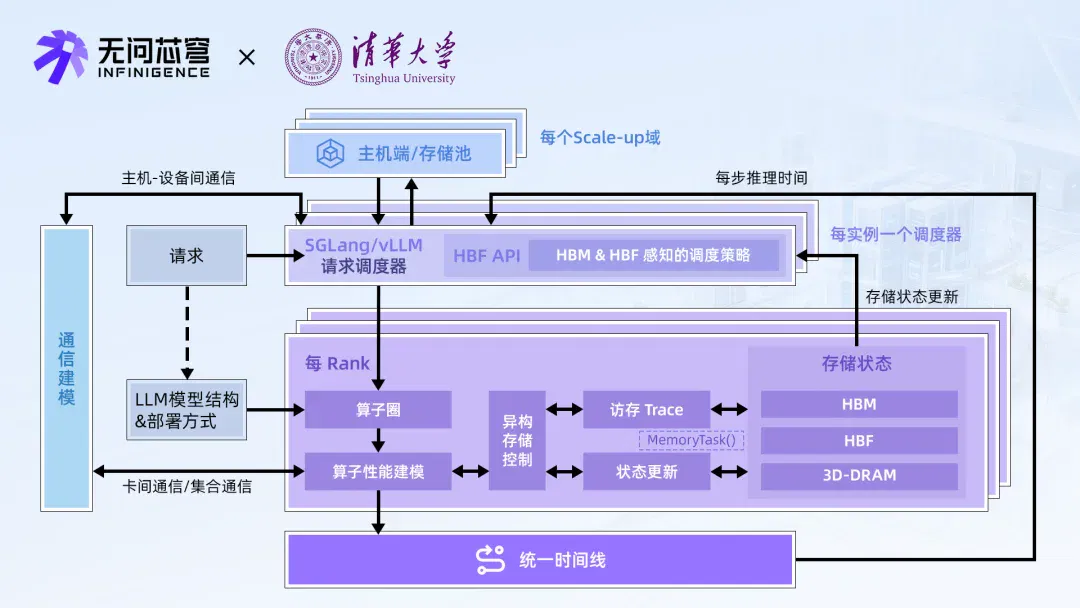
In practice, developers first supply Uni3Sim with user-request traces from real business workloads. The platform replays requests at their actual arrival times, retaining each request's input and output lengths and incorporating shared prefixes between requests to simulate how prefix-cache reuse affects the amount of prefill computation.
Developers can use the same request trace to test different model architectures and deployment strategies. They can also adjust a supernode cluster's compute resources, memory hierarchy, link bandwidth and network topology to compare designs.
The platform integrates native schedulers from inference frameworks such as SGLang and vLLM and retains their native request-scheduling and system-level optimization techniques. Combined with the model and deployment configuration, these generate compute, memory and communication tasks for each stage, which are then passed to the three core simulation models for execution-time prediction.
The results from the three models are then brought onto the same unified modeling timeline. Uni3Sim jointly considers task dependencies, hardware-resource occupancy and concurrent execution to determine when each operation starts and finishes. It feeds execution results back to the scheduler, continuously advancing subsequent requests until the inference task completes.
Rather than merely estimating how long compute, memory and communication each take and adding the results together, Uni3Sim can simulate their coordinated execution in a real system: which tasks can run in parallel, which must wait, which resources face contention, and how local bottlenecks affect subsequent requests.
Ultimately, the platform can predict end-to-end service metrics such as TTFT, TPOT and system throughput, while recording the time costs and hardware utilization of compute, communication and data movement.
03 End-to-End Service Simulation: Reproducing Real Inference-Service Execution
In real inference, runtime overhead extends beyond operator execution to graph replay, graph filling, CPU kernel launches and asynchronous request scheduling. These factors not only increase each execution round's time but also affect batching and queuing for subsequent requests, changing service metrics such as TTFT and TPOT and ultimately influencing end-to-end service performance.
Uni3Sim therefore brings framework scheduling, kernel execution and runtime mechanisms into one unified simulation process, modeling requests from system entry through completion to reproduce real-service performance as closely as possible.
The team conducted end-to-end service validation for multiple models on three hardware platforms: NVIDIA A800, MetaX C500 and Ascend 910B. Tests were run at QPS values of 4, 16 and 64, comparing predicted and measured TTFT and TPOT distributions under different request workloads to examine Uni3Sim's performance-prediction capabilities across hardware architectures and service loads.
- On Qwen3-4B, Qwen3-8B, Qwen3-32B, Qwen3-30B-A3B and Llama3.1-8B, TTFT error is < 21.2%, TPOT error is < 9.4%, and system-throughput error is < 5.2%. The platform also supports latency decomposition and simulated evaluation of tail latency.
- Compared with InferenceX's measured throughput–interactivity curve for DeepSeek-R1 inference on eight H200 GPUs, the error is only 2.8%–10.9%.
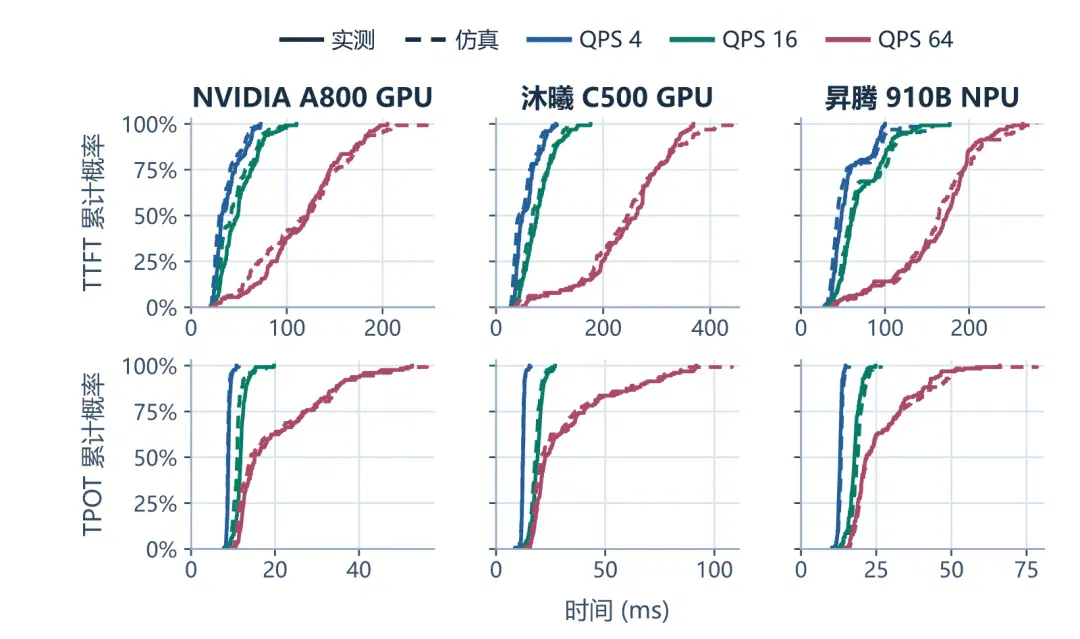
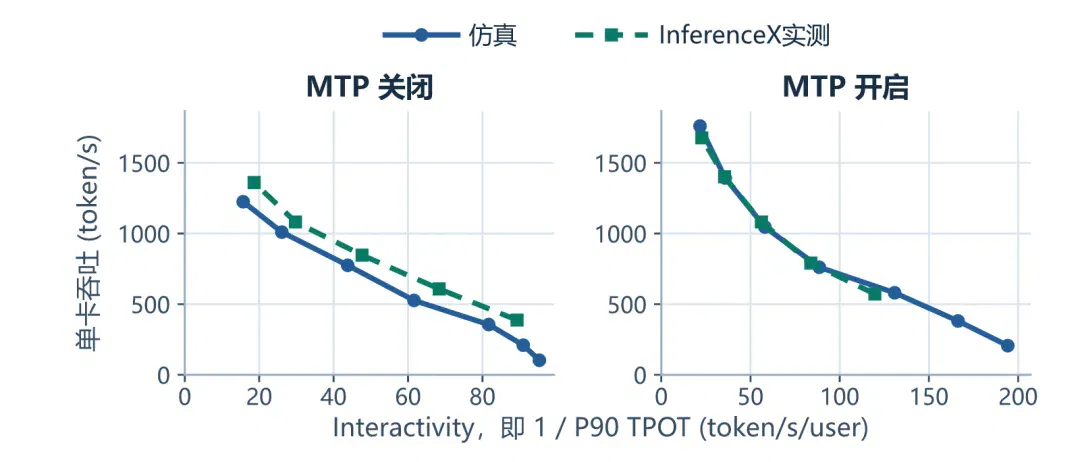
The performance-validation results across multiple platforms show that Uni3Sim can not only model compute, memory and interconnect performance on different hardware platforms, but also incorporate these parts into a complete inference-service execution process to predict real services' response speed and overall processing capacity.
04 Practical Applications: Giving System Design and Optimization an Evidence Base
The value of a system-level simulation platform lies not only in predicting what performance an inference service can achieve, but also in helping designers evaluate different resource configurations, memory architectures and deployment strategies to judge which combinations deliver better performance and resource efficiency.
Resource Configuration: The Compute-Resource Ratio Between Prefill and Decode
Replaying real-world user-request workloads for GLM-5.3/FP8 on H200 shows that actual request arrivals resemble a Poisson process, with bursts and fluctuations.
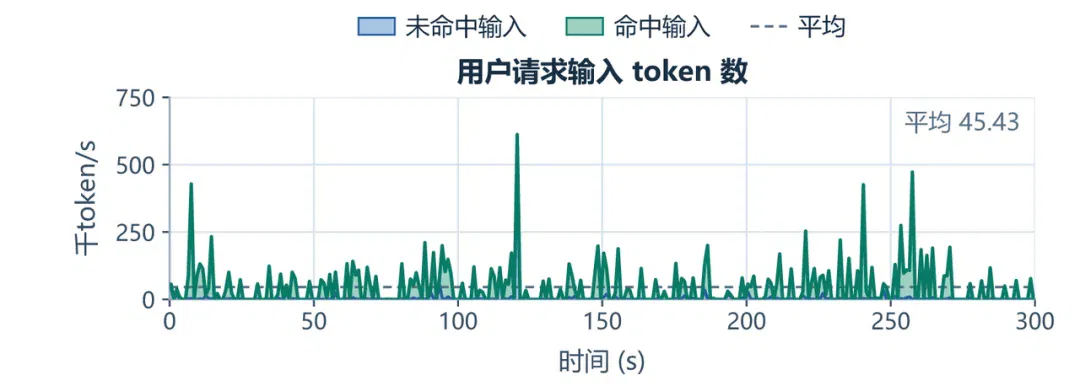
To meet TTFT tail-latency requirements, enough compute resources must therefore be reserved for bursts of peak traffic. In this example, two prefill instances and one decode instance are configured to handle the bursty workload. Average hardware busy time is only about 26% for the prefill instances, compared with 94% for the decode instance. Although prefill has a high per-pass token-processing workload, its utilization is actually lower in the real inference service.
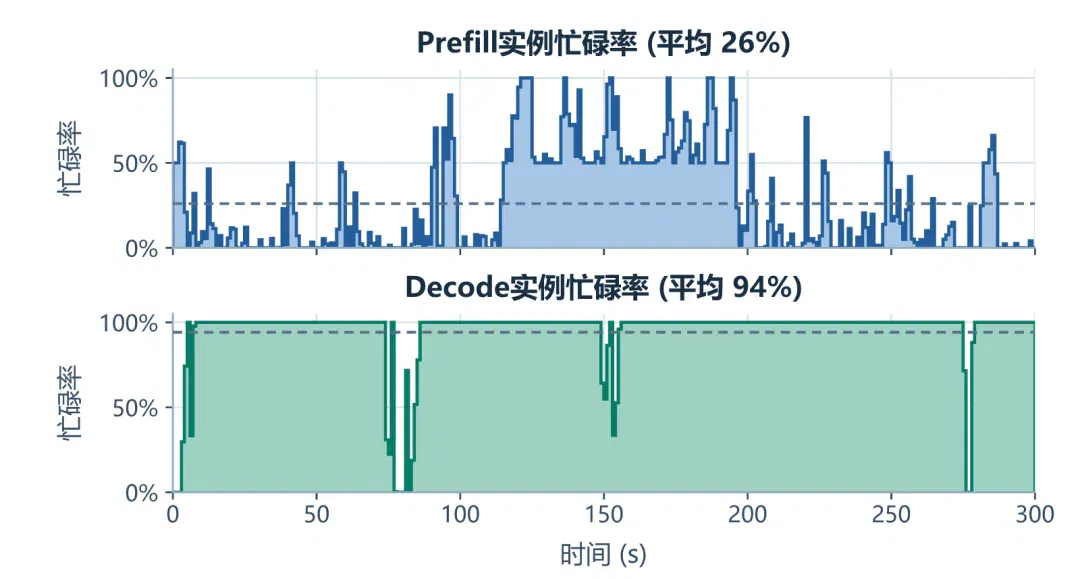
Resource ratios therefore cannot be determined solely from average utilization; request-arrival patterns, request lengths and service-level objectives (SLOs) must also be assessed together.
Memory Optimization: Assessing the Benefits of Memory-Pool Configurations and Cache Reuse
Uni3Sim also supports simulation and evaluation of different memory-system designs, covering memory hierarchies, memory-pool configurations and cache-reuse strategies, and analyzes their combined effects on end-to-end inference performance.
In the memory-pool experiment, the team used 128 H200 GPUs and a million-token context, jointly adjusting deployment strategy, memory media and interconnect topology. One selected GLM-5.2 design point achieved 1.31× per-GPU logical-token throughput and interactivity metrics (with interactivity measured as 1/TPOT), showing that the benefits of expanded capacity could outweigh the overhead of remote reads and contention on shared links.
Another cache experiment processed GLM-5.3 agentic requests on eight H200 GPUs. With four concurrent sessions, raising KV-cache reuse from 0% to 60% increased total token throughput by 50.7%, yet revenue per GPU-hour fell by 19.7% to its lowest point. At 90% reuse, throughput rose to 2.8x, but revenue was still 7.5% lower than without reuse.
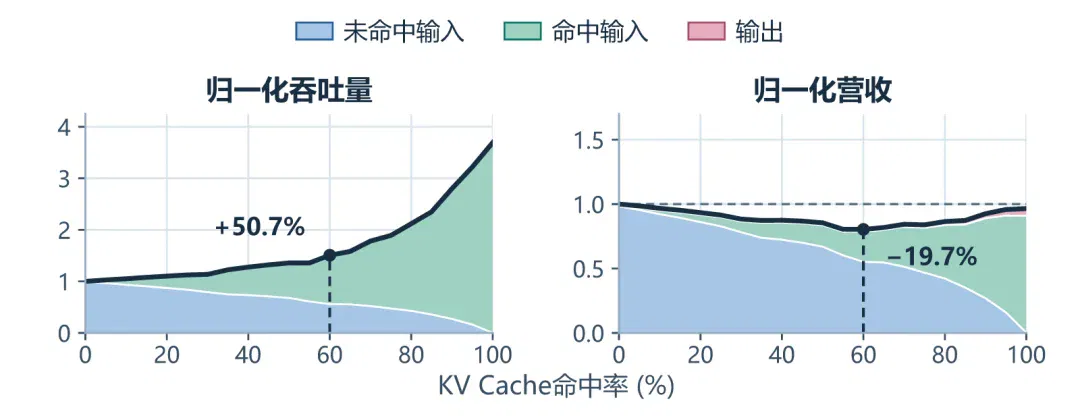
This result shows that higher throughput may not mean higher revenue. Only when reuse is high enough and cache revenue becomes the main source of income does total revenue begin rising continuously from its low point.
Reasonable cache-hit pricing must therefore account for the input/output mix and session concurrency to turn the throughput benefits of cache optimization into actual revenue.
05 Toward Next-Generation AI Supernodes: From Simulation Assessment to an Agent-Driven Loop of Design and Evolution
Uni3Sim aims to build not just a performance-prediction tool, but an open design and validation platform for next-generation AI systems.
At present, Uni3Sim can predict service performance from a given software/hardware configuration. In the future, the team plans to introduce agents or search algorithms to automatically adjust hardware specifications, link topologies and model-deployment strategies, forming an exploratory loop of "generate a design—evaluate through simulation—optimize iteratively." This would take Uni3Sim beyond performance prediction toward a system-level design-validation platform, supporting architectural design and software/hardware co-optimization for next-generation AI supernodes.
The continued evolution of infrastructure should not depend only on the technical expertise accumulated by a single team; open source and open collaboration are the necessary path. Facing increasingly diverse chip architectures and software ecosystems, Uni3Sim hopes to provide an open, reusable system-level design and evaluation platform, bringing together model, chip, system and application developers to jointly build open system-simulation benchmarks and evaluation frameworks. Through collaboration, they can accumulate reusable technical results and move AI hardware-system research from isolated paper-level validation toward open co-development.
- Project website: https://thu-nics.github.io/uni3sim-website/
- GitHub: https://github.com/thu-nics/uni3sim
Around Uni3Sim's three core simulation modules, Infinigence AI and Tsinghua University will subsequently publish a series of technical explainers, further unpacking the principles and implementation paths behind system-level simulation.
Stay tuned for more technical details!
This article comes from "Synced," written by "Synced."
Related topics
After reading
Join the AINRK community
Read how to join the community and connect with people working in AI.
Related articles
Continue reading related topics and articles in this category.
无问芯穹的算子优化 Agent:共享经验之外,资源调度也影响效率 (opens in a new tab)
这篇技术报道进一步讨论算子优化 Agent 如何利用隔离评测、Skills 和共享记忆迭代,并呈现 GPU 排队与工作流演化的观察:个体为减少等待而延长占用,可能降低整体效率。文章将资源调度与有效反馈速度联系起来,局部优化仍需端到端验证才能反哺基础设施。

清华大学联合无问芯穹开源具身智能云原生纳管平台RLark,5分钟接入、10秒启动任务 (opens in a new tab)
一架架飞机在空中有序飞行,按时起降,看似只是飞机自己的事情,实际上,它需要持续与机场、跑道、航线以及地面资源系统协同。
“接力跑”盘活全国算力,PD分离终于破局:延迟砍半、成本直降近40%! (opens in a new tab)
在刚刚落幕的2026 WAIC世界人工智能大会上,无问芯穹首次公布了其在大模型推理系统架构中的新突破——跨集群异构推理架构PDD。

超DeepEP两倍!无问芯穹FUSCO以「空中变阵」突破MoE通信瓶颈,专为Agent爆发设计 (opens in a new tab)
机器之心发布 随着 ChatGPT、Gemini、DeepSeek-V3、Kimi-K2 等主流大模型纷纷采用混合专家架构(Mixture-of-Experts, MoE)及专家并行策略(Expert
无问芯穹披露 SOL-ExecBench 成绩,介绍 GPU 算子优化 Agent (opens in a new tab)
据团队披露,截至 10 月 26 日,无问芯穹在 SOL-ExecBench 的 235 道题中取得 88 项单题第一,并在两个赛道总分领先。文章进一步介绍容器隔离评测、共享记忆与分层优化策略,展示如何把代码生成和真实硬件反馈连接起来;动态榜单成绩不等同于所有 GPU 工作负载的性能优势。