Unisound reports RMB344m Q3 revenue and 79.6% gross-profit growth as token services expand

Unisound reports Q3 2026 revenue of about RMB344m, up 53.3%, and gross profit of RMB144m, up 79.6%, at a 41.8% margin. It says U2-Flash weekly usage reaches a trillion tokens. Gross-profit gains and business prospects should be distinguished from net profitability.
Editorial fact-check (November 24, 2026): The article’s approximately US$81.3 billion for Anthropic uses the November 18 base-offering pricing basis, including selling shareholders’ proceeds, and is not the company’s net proceeds. The November 20 closing announcement includes the full overallotment: approximately US$93.5 billion for the IPO, of which about US$91.6 billion went to the company, plus a US$26 billion private placement, totaling about US$119.5 billion, all before fees. Net revenue retention of roughly 900% compares qualified customers’ revenue in the current three-month period with the corresponding three months a year earlier; it is not the percentage of customers retained. Consumption-based revenue also comes from more than APIs. Unisound’s gross-profit improvement does not establish a return to net profitability; commercial prospects and passive fund inflows remain analysis or forecasts. Unisound official third-quarter 2026 disclosure (opens in a new tab)Anthropic IPO and concurrent private-placement closing announcement (opens in a new tab)Anthropic final prospectus and metric definitions (opens in a new tab)
Capital markets’ logic for valuing AI companies has changed.
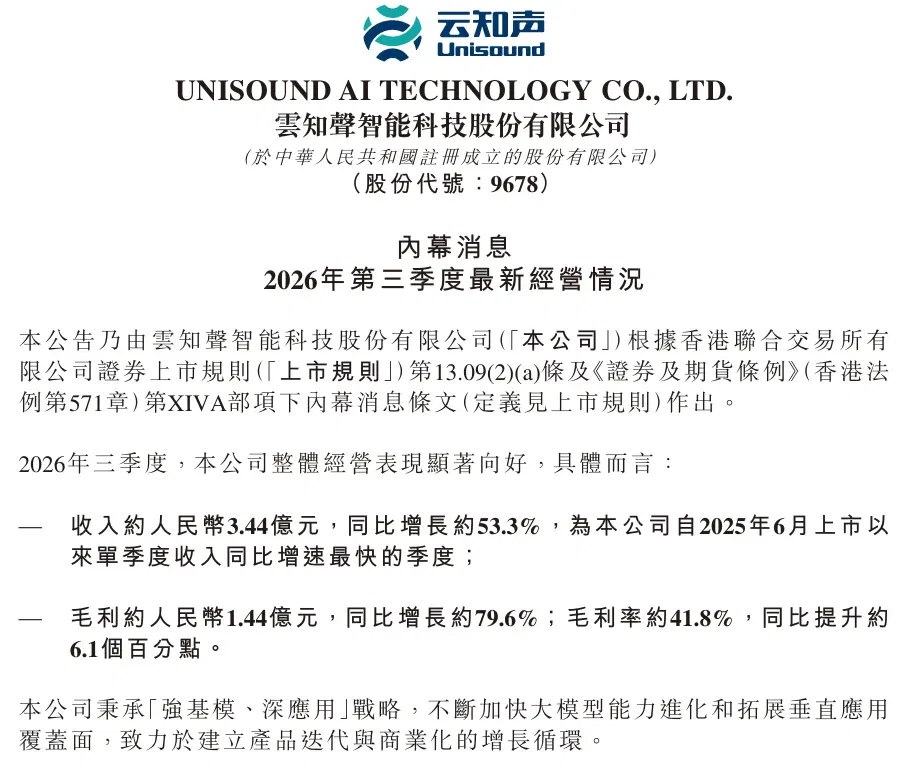
Zhidx reported on November 23 that Hong Kong-listed AI company Unisound had released its operating results for the third quarter of 2026 that day. Quarterly revenue was approximately RMB344 million, up 53.3% year over year; gross profit was approximately RMB144 million, up 79.6% year over year, and gross margin rose to 41.8%. Revenue growth was the highest for a single quarter since Unisound’s June 2025 listing.
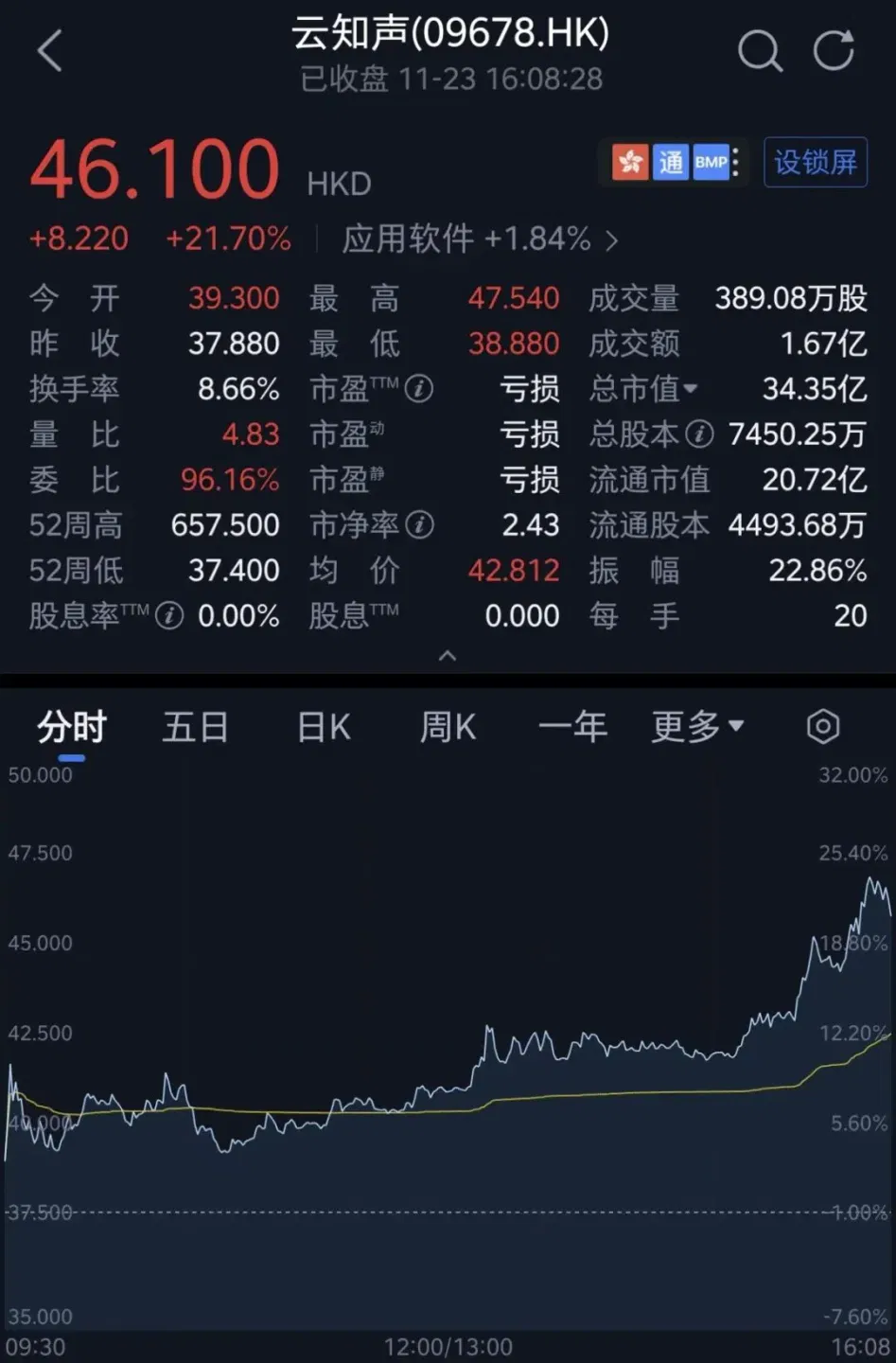
The results also drove a sharp rise in Unisound’s share price. At that day’s Hong Kong close, it was up 21.70% at HK$46.10 per share.
Just three days earlier, Unisound had been selected for inclusion in the Hang Seng TECH Index, with the changes taking effect on December 7. The index is expanding from 30 to 50 constituents and introducing a “revenue growth category” with only 10 places. Unisound joins the same batch as Zhongji Innolight and CATL. CICC estimates that index inclusion could bring Unisound more than US$100 million, approximately HK$830 million, in passive allocations.
From listing on the Hong Kong Stock Exchange’s Main Board in June 2025, to joining the Hang Seng Composite Index and Stock Connect, and now a flagship technology index, Unisound has taken less than a year and a half.
The timing of these results is also significant. On November 19, US AI company Anthropic formally listed on Nasdaq. On the November 18 base-pricing basis, its IPO totaled about US$81.3 billion, or about US$107.3 billion with the concurrent private placement. That total includes selling shareholders’ proceeds and is before fees, rather than the company’s net proceeds. The article describes it as a global IPO fundraising record. Both developments point to the same shift: capital markets’ valuation of AI companies is moving from model capabilities and technology rankings toward demonstrated commercialization.
Anthropic’s prospectus offers a reference for this shift. Approximately 79% of its revenue in the first nine months of 2026 was consumption-based, including customers’ usage through APIs and first-party applications. As of September 30, 2026, more than 11,900 customers had generated at least US$100,000 each over the preceding 12 months, while net revenue retention was approximately 900%. Enterprise customers’ continued usage and expanded purchases are becoming important supports for AI companies’ commercial value.
Unisound’s first set of results after selection for the Hang Seng TECH Index can be viewed along the same dimensions. Let us begin with the most direct financial figures and examine its third-quarter growth.
01.
Token services open up growth opportunities
Profitability improves markedly
The financial disclosure shows third-quarter 2026 revenue of about RMB344 million, up 53.3% year over year, the strongest quarterly year-over-year revenue growth since the June 2025 listing. Gross profit was about RMB144 million, up 79.6%, while gross margin was approximately 41.8%, an increase of 6.1 percentage points.
Viewed together, the figures show accelerating revenue growth. In 2025, full-year revenue was RMB1.211 billion, up 29%. First-half 2026 revenue was RMB562 million, up 38.7%. In the third quarter, quarterly revenue growth increased further to 53.3%.
The gross-profit change deserves even more attention than revenue growth. Gross-profit growth outpaced revenue growth by 26.3 percentage points this quarter, while gross margin rose 6.1 percentage points year over year. This suggests an improving profit structure alongside business expansion.
Changes in Unisound’s business mix and delivery model may underlie this development.
Unisound disclosed that large-model token usage is becoming a new source of growth. Compared with traditional industry AI projects, model API usage is more standardized and replicable. As customer numbers and usage grow, initial development and deployment costs may be spread more broadly, improving gross margin and leaving more room for scalable growth.
At the same time, Unisound’s industry models and agent platforms are gradually maturing, and enterprise AI services are no longer limited to custom development for individual projects. Existing model capabilities, industry knowledge and application modules can be reused continuously across customers and business scenarios.
Anthropic’s emphasis in its prospectus on enterprise consumption-based revenue, retention and high-value customer counts also reflects this trend. For business-to-business AI companies, value lies not simply in the number of one-off projects signed, but in whether customers continue using the service after initial deployment, expand usage and extend AI into further business processes. These metrics also indicate to some extent whether enterprise AI can generate sustained commercial returns.
Project delivery and ongoing model services are not substitutes, of course. The former helps companies enter specific industry settings, solve real business needs and establish a customer base for later services. The latter can deepen cooperation and expand revenue through model calls, agent applications and platform services. Connected together, they form the enterprise-AI commercial chain from deployment to ongoing operations.
For Unisound, these two businesses are developing synergistically. Enterprise-intelligence services continue to grow strongly, penetrating key industry scenarios more deeply and showing substantial repeat purchases. Meanwhile, token usage is gradually realizing the commercial value of model capabilities, diversifying the revenue mix.
02.
Weekly model usage reaches the trillion-token scale
A multi-tier model portfolio takes shape
Where does growth come from? Unisound’s third-quarter model strategy suggests two important paths for token-service growth: scaled usage of general-purpose models, and expansion of specialist models into healthcare, speech and other settings.
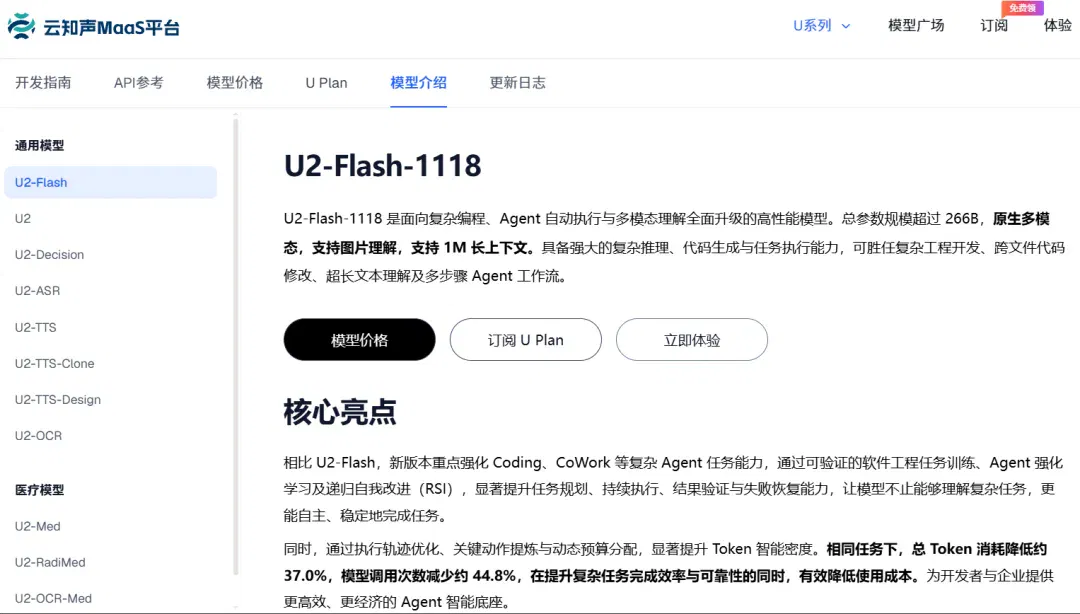
Within that strategy, general-purpose models serve broad application needs. This quarter, Unisound launched U2-Flash, its new high-performance mainstay general model, focusing on real tasks such as agents and coding.
U2-Flash has also shown some competitiveness in third-party evaluations. In the November 2026 Code Arena: WebDev update on Arena, it ranked seventh among Chinese model vendors when grouped by vendor. In an industrial coding evaluation held in September 2026, it ranked first in four tracks—chip RTL, code compilation and migration, vector rendering, and long-horizon agent decisions—and second overall.
As of November 23, the company reported weekly token usage at the one-trillion scale, with daily usage more than 30 times that on launch day.
Beyond general-purpose models, Unisound is extending token services into specialized fields. Healthcare is one of its key verticals.
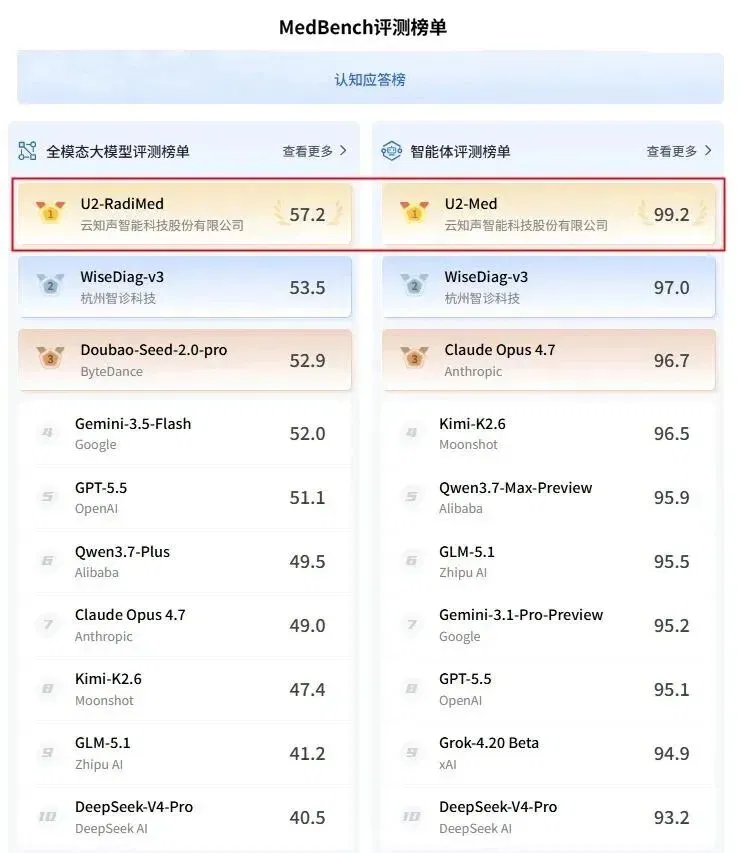
This quarter, Unisound launched U2-Med for medical care, medical insurance and pharmaceuticals, alongside its in-house multimodal medical-imaging model U2-RadiMed, further developing medical-text processing and imaging understanding.
In the latest aggregated results of OpenAI’s HealthBench medical-dialogue evaluation published in October 2026, U2-Med scored 73.67 on HealthBench Full and 61.07 on HealthBench Hard, ranking first among the evaluated models in both.
Speech is an area in which Unisound has long-standing strengths. As its large-model services mature, it is incorporating its existing speech technology into the token-service system. This quarter, it upgraded the multilingual capabilities of U2-ASR and U2-TTS to cover more than 100 Chinese dialects and over 15 international languages, with full availability on the TokenHub large-model service platform.
From general-purpose models to healthcare, speech and other verticals, Unisound is building a multi-tier product portfolio. General models address broader agent and coding tasks, while specialist models use domain capabilities to enter healthcare, speech and other focused settings. The broader the task coverage, the more customers and applications token services can reach.
03.
Industry projects move into deployment
Exploring sustainable commercialization
If token services represent scaled use of model capabilities, enterprise-intelligence services show Unisound’s ability to embed AI into specific industry operations.
In the third quarter, Unisound’s enterprise-intelligence services continued to grow, deepening cooperation in healthcare, finance, transportation and other key industries. Unlike simple product purchases, some recently deployed projects have begun expanding from individual applications into platforms and business processes.
Healthcare and finance are two typical directions. In healthcare, Unisound signed projects with several leading Grade III Class A hospitals and regional public AI platforms, accelerating scaled deployment of smart-healthcare products and agent applications. In finance, it reached several business partnerships with a leading property-insurance group, including intelligent oversight of medical-insurance funds. These partnerships show AI moving beyond an auxiliary tool into specialized business processes.
Transportation partnerships illustrate the change even more clearly. Cooperation with Shanghai Shentong Metro Group continues to deepen. The MaaS intelligent-computing platform built for its subsidiary Shanghai Shendianyun Digital Technology has completed an end-to-end chain from large-model infrastructure to an agent-development platform and agent applications.
Unisound also signed a strategic cooperation agreement with China Railway Shanghai Design Institute Group, covering an intelligent AI foundation, railway-specific datasets and vertical-model development, and intelligent applications across rail-transport scenarios.
From computing-platform construction to individual agent applications, Unisound’s transportation partnerships now go beyond supplying a single AI product to help build customers’ internal AI application systems. Such partnerships help it embed itself in business processes and create further opportunities for model usage, platform maintenance and application iteration.
Beyond domestic industry markets, Unisound is also trying to export model services. This quarter, it worked with China Mobile and other partners on what the company describes as Fujian’s first compliant “token export” business, using its own U2 model to provide livestream script generation and other services to a cross-border livestream-commerce company in Ethiopia.
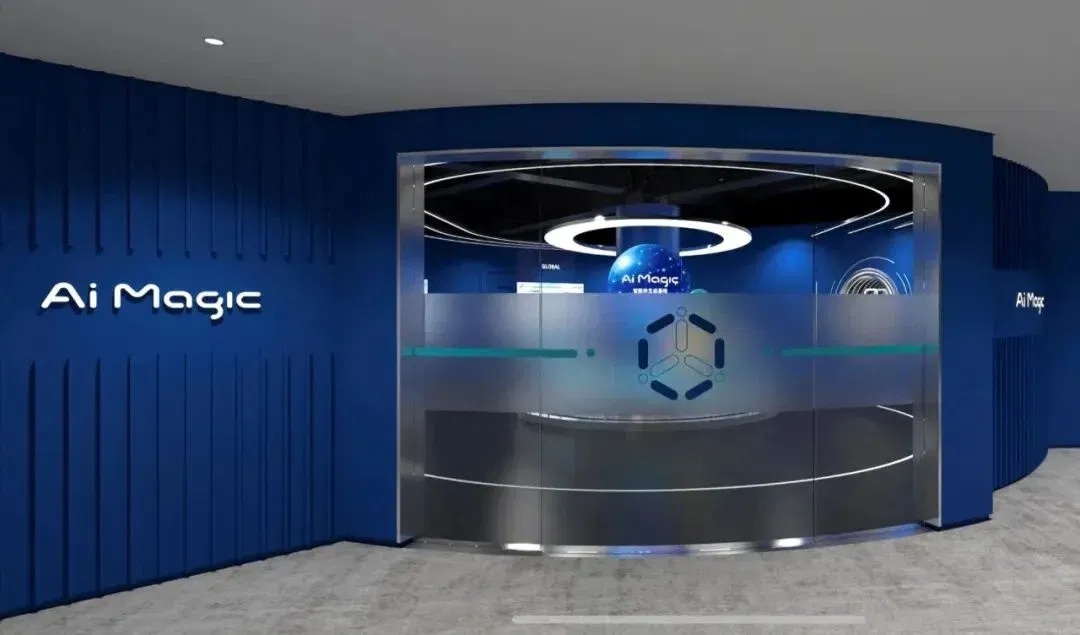
To support this direction, Unisound’s “AI Magic Token Export Ecosystem Base” in Xiamen formally began operations in September. It is jointly building a 100-billion-token resource pool with industry partners and plans overseas sites in Malaysia, Ethiopia and elsewhere.
Alongside the multilingual upgrades to U2-ASR and U2-TTS and the TokenHub service platform, Unisound is attempting to combine models, speech technology and token services to deliver AI capabilities to overseas customers.
On-device AI is another business line beyond industry deployments. Unisound continues promoting edge chips and products in emerging settings such as embodied intelligence, jointly upgrading on-device products and large-model capabilities while exploring overseas opportunities. This offers a further direction for extending model capabilities from the cloud to endpoint devices.
These projects show Unisound attempting to build a commercial path driven by industry deployments and extending into ongoing AI services. Custom solutions and infrastructure establish an initial presence in customer systems, followed by agent platforms, vertical models and model usage that broaden applications and deepen cooperation.
04.
Conclusion: enterprise AI
A new growth cycle is beginning
Anthropic’s growth trajectory suggests enterprise markets are becoming an important source of AI commercialization growth. As large models enter business processes faster, model usage, industry applications and ongoing services could generate greater demand and create opportunities for AI companies focused on business customers.
For Unisound, years of industry-customer relationships, an increasingly complete model portfolio and expansion from project delivery into token services form the basis for participating in this wave of commercialization. As models improve and industry applications deepen, it could open up further room for business growth.
This article comes from Zhidx, written by Chen Junda.
Related topics
After reading
Join the AINRK community
Read how to join the community and connect with people working in AI.
Related articles
Continue reading related topics and articles in this category.

OpenAI押注RSI,国产AI火速交卷!Flash叫板万亿大模型 (opens in a new tab)
过去两周,AI圈最让人坐不住的三个字母,就是RSI。
70亿美元!全球最大「Token中转站」OpenRouter被收购 (opens in a new tab)
今年AI圈最贵的一笔中间商买卖,落槌了!

国产大模型第一梯队迎新势力:云知声发了个原生Agent大模型U2,再次捅破行业天花板 (opens in a new tab)
今天,“港股AGI第一股”云知声发布其最新通用大语言模型U2,该模型是由云知声自研的、基于快慢思考融合的MoE(混合专家)范式构建的通用大语言模型。U2跳出了传统大模型盲目堆参数、堆Token的内卷路径,实现了“小参数强能力、少Token高产出、低算力低成本”的进化。
云知声黄伟:从 token 价值到智能密度,热身赛结束后的 AI 游戏新规则 (opens in a new tab)
新一轮 AI 比赛才刚刚开始,而 token 生成数量不能作为唯一的指标。
超前布局协和10年,云知声国产AI「三冠王」终于藏不住了,山海·知医5.0让AI从工具蜕变为真正的临床协助者 (opens in a new tab)
真正的医疗AI是什么样的?磨剑13年,中国AI拿下了三项权威评测冠军,直接刷新行业天花板。它不玩虚的,专攻临床真实场景,让AI从工具蜕变为真正的临床协助者。