Pragmatik Labs Reportedly Valued at $5 Billion in New Funding Round

Media reports put Junyang Lin's Pragmatik Labs at about $5 billion after a new funding round. The article examines its digital and physical agent directions and compares it with World Labs; financing figures, product concepts and the author's analysis are distinct.
Editor's fact check (2026-11-24): The financing, valuations and some equity information in this article follow media reports; a company's valuation cannot be directly equated with product maturity, revenue or technological capability. Some discussion of the specific paths to deploying digital and physical agents, and of investors' motivations, is the author's analysis and should be distinguished from released products and official disclosures.

A valuation has emerged for Junyang Lin's new company.
According to media reports, Pragmatik Labs, founded by Junyang Lin, has completed a new funding round at a valuation of $5 billion, equivalent to about RMB 33.5 billion. New investors include Huaye Tiancheng Capital, CDH Investments and Geely Auto.
The amount raised in this round is not large—only tens of millions of dollars—but the valuation is high. When its first funding round was officially announced this August, its reported valuation was still $2 billion. In a little over three months, it has risen to 2.5 times that level.
Pragmatik Labs has two business lines: digital office agents and physical agents.
According to its website, physical agents target scenarios such as robots, robotic arms and autonomous driving. Exactly how they will be used remains unclear to outsiders, but this already gives the company common ground with world models.
Robotics and autonomous driving are also major applications for world models. A world model simulates the physical laws of reality: given an action, it predicts what the world will look like next. Robots practice repeatedly in these simulations.
Any discussion of world models inevitably turns to Fei-Fei Li, the "godmother of AI."
Her company, World Labs, raised $1 billion this February, also at a valuation of around $5 billion. Founded in 2024, World Labs took nearly two years to reach that point. Pragmatik Labs was registered as a business on May 13, 2026, and has only just reached the six-month mark.
Of course, Fei-Fei Li has already moved one step further.
At the end of September, AMD announced the acquisition of World Labs in an all-stock deal worth approximately $8.2 billion, with Fei-Fei Li becoming AMD's executive vice president and chief scientist upon completion. So, strictly speaking, what Junyang Lin has caught up with is World Labs' final valuation as an independent company.
Pragmatik Labs has yet to release any products.
To understand what justifies that price, we first need to understand what it actually does. Fortunately, Junyang Lin left quite a few clues after the first funding round.
What Exactly Does Pragmatik Labs Do?
The first clue is its name.
Junyang Lin studied English as an undergraduate and linguistics for his master's degree at Peking University. He says he originally entered the field because a friend recommended pragmatics.
Pragmatics studies what a sentence actually means in a particular context. For example, "Have you eaten?" literally asks about a meal, but in practice serves as a greeting.
The name also carries another meaning: pragmatism. Junyang Lin says, "We believe AGI should aim for pragmatism."
The second clue is the website.

The website, launched on August 12, listed only two business lines. One is digital agents, aimed at knowledge work, enterprise operations and industrial-scale workflows. The other is physical agents that enter real environments, adapt to them, perform actions and handle long-horizon tasks.
The careers page contains just one sentence: "If you are building superintelligence with lasting value for humanity, send us a thoughtful email."
Anthropic has already provided an example of what digital agents look like.
This May, Claude entered Microsoft's Excel, PowerPoint, Word and Outlook, allowing a single conversation to carry out work across all four applications. In November, Claude Meetings launched, bringing Claude into video meetings as a participant, listening while drafting proposals.
Whatever the product form, it ultimately means having Claude live inside existing office software. Pragmatik Labs' digital agents may well take a similar path.
As for physical agents, as noted earlier, they may play a role similar to world models in robotics and autonomous driving.
The third and most important clue is the first long-form article Junyang Lin published after leaving Alibaba.
On March 26, he published From Reasoning-Based Thinking to Agentic Thinking.
The reasoning models of the past two years are like students taking a closed-book exam. Given a question, they write longer and longer answers on scratch paper, then hand in their work.
Junyang Lin believes the next step is to make a model behave like someone at work. After receiving a task, it first looks up information, then tries things out, fixes errors when they occur, and checks again afterward. His summary is: "Agentic thinking is reasoning through action."
He also says that, at this stage, the difficulty is no longer modeling but systems engineering.
Another difficulty is the environment.
Once models can call tools, cheating becomes easier too. A model that can search may simply look up the answer during training. Like a student peeking during an exam, it gets a high score while actually learning nothing.
Junyang Lin's judgment, therefore, is that competition in the agent era comes down to better environments, stronger harness engineering, and whether a model's decisions and their consequences can be connected into a closed loop.
So why develop digital and physical agents together? In Junyang Lin's framework, they are simply two different environments.
An agent operating a computer must look at the screen, invoke software and revise its plan based on feedback. An agent controlling a robot must observe space, move a robotic arm and adjust its actions based on sensors.
To some extent, a white-collar worker in an office and a worker on a factory floor face the same kind of problem.
For example, a manager says: "You handle it as you see fit."
That sentence can mean delegating authority: you make the call on this. Or it can mean demanding accountability: clean up your own mess.
Whether digital or physical, an agent hearing this sentence must first look back at what it has already done, then adjust its strategy in light of the current results to understand and carry out that instruction properly.
The physical-agent direction was not an impulsive decision either. Last October, Junyang Lin revealed that he had established a robotics and embodied-intelligence team within Qwen.
Geely Auto appears among the new shareholders in this round. Outsiders interpret this as room for connections between embodied intelligence and automotive intelligence, but neither the company nor the investors have explained publicly.
Pragmatik Labs does not intend to make a sequel to Qwen. It wants to build a more complete system.
Why It Could Catch Up with World Labs
Investors typically value a company by looking at profits, cash flow and its balance sheet. But Pragmatik Labs has no products, no revenue and no fixed assets; the entire company is still in "stealth mode."
The only thing left to put a price on is Junyang Lin himself.
First, acknowledge a fact: Junyang Lin has been very successful, leading Qwen to become the world's strongest open-source model, bar none. But his standing in AI still does not match Fei-Fei Li's.
Among the "foundation-model quartet," Jie Tang has Zhipu, Zhilin Yang has Moonshot AI, and Shunyu Yao is at Tencent. After leaving his job in March, Junyang Lin was the only one of the four still available to invest in.
Many investors therefore judged that if someone of Junyang Lin's caliber started a company, "it would be snapped up in the first circle."
The subsequent shareholder list bore this out: all four outside shareholders in Pragmatik Labs' first round had previously invested in Moonshot AI.
The same logic applies to Fei-Fei Li. AMD bought not only World Labs, but also Fei-Fei Li herself.
So for both Pragmatik Labs and World Labs, a large part of the valuation lies in the founders and teams themselves.
Pragmatik Labs raised about $220 million in its first round. Outside investors collectively received only 12% of the equity, while Junyang Lin controlled about 88% personally and through affiliated entities.

This round "sold" even less. Tens of millions of dollars against a $5 billion valuation means less than 2% of equity was given up.
Pragmatik Labs is not short of money right now. This round is more likely about Junyang Lin wanting to let certain investors "get on board." It is like CATL increasing its contribution from RMB 5 billion to RMB 10 billion during DeepSeek's second funding round.
And this price did not suddenly appear in November. Back in August, people familiar with the matter said that just after Pragmatik Labs' first round had closed, the team was already seeking another round that could push its valuation to $5 billion.
These two $5 billion figures do not carry exactly the same weight.
Next, consider the product.
A company's direction also determines its price.
Fei-Fei Li works on spatial intelligence, enabling AI to understand, generate and simulate three-dimensional worlds. This is a more research-oriented path, with the business model and means of making a profit dependent on the research results. Junyang Lin works on agents, focusing on production and results. The product form is more tangible, and revenue is easier to forecast.
Another layer is the level of the market.
Within the foundation-model quartet, Zhilin Yang's Moonshot AI has seen its valuation rise from $4.3 billion to $31.5 billion in six months. Outside the quartet, Wenfeng Liang's DeepSeek raised more than RMB 100 billion in its second round at a valuation of RMB 615.5 billion.
Compared with them, Pragmatik Labs' $5 billion is actually entirely unsurprising.
Finally, consider the shareholders.
World Labs' shareholder list includes both AMD and NVIDIA. Besides money, both provide GPUs.
NVIDIA in particular. According to media reports, it is an "ecosystem shareholder" in World Labs: early World Labs systems ran on NVIDIA's Blackwell and Isaac Sim, complementing Cosmos, the physical-AI world foundation model platform Jensen Huang announced at CES 2025.
Pragmatik Labs' shareholders do not look like purely financial investors either.
Tencent was among its first-round shareholders. In August, Tencent invested about $20 million through its subsidiary Shanghai Qishan Investment for a 1% stake. Some analysts believe WeChat, WeCom, Tencent Docs and Tencent Meeting are natural testing grounds for digital agents. Automaker Geely corresponds to the physical-agent half.
Is $5 Billion Inflated?
Looking at products alone, digital-agent company Manus had ARR of around $100 million when Meta acquired it last December for about $2 billion. The deal was unwound this year; reportedly, the buyback price paid by Chinese investors was still around $2 billion, even though its ARR had by then exceeded $300 million.
Manus's experience is indeed unusual. But setting those circumstances aside and looking only at the business, Manus—a company with a product and revenue—was still valued far below $5 billion.
Then consider World Labs. By the time it reached a $5 billion valuation, its product Marble had already launched.
Viewed this way, Pragmatik Labs' $5 billion may contain an element of overvaluation.
Another variable is the founder. Companies that secure high valuations in stealth mode on the strength of their founders' aura are not uncommon in AI. The most representative example is Thinking Machines, founded by former OpenAI Chief Technology Officer Mira Murati.
Founded in San Francisco in February 2025, the company completed a $2 billion seed round in July at a $12 billion post-money valuation, led by a16z, with NVIDIA, AMD, Accel, Cisco, ServiceNow and Jane Street all participating.
Crunchbase called it the largest seed round in the history of its database. At the time, like Pragmatik Labs today, the company had no products and had not even disclosed its direction.
Its business model did not take shape until October 2025, with a core product called Tinker.
Tinker is a cloud-based fine-tuning API, essentially a "model foundry." Enterprises bring their own data and scoring rules; Thinking Machines provides computing power and engineering to fine-tune open-source models into specialized ones, and customers pay by usage.
What happened next?
In November 2025, Thinking Machines sought funding at a $50 billion valuation, but negotiations had completely stalled by January 2026. Around the same time, four of its six co-founders left: three returned to OpenAI, and one went to Meta. The company finally regained its footing when PyTorch co-founder Soumith Chintala took over as chief technology officer.
In March 2026, Jensen Huang stepped in: NVIDIA made a strategic investment of an undisclosed amount, then brought Thinking Machines onto its ship through a long-term compute partnership.
Another similar example is SSI, founded by former OpenAI Chief Scientist Ilya Sutskever. It secured a $5 billion valuation as early as September 2024 and, as of publication, had still not released any models, products or papers.
A founder's aura can sustain a valuation, but a company's subsequent development still depends on its business and products.
This article comes from "Zimu AI," written by "Miao Zheng."
Related topics
After reading
Join the AINRK community
Read how to join the community and connect with people working in AI.
Related articles
Continue reading related topics and articles in this category.
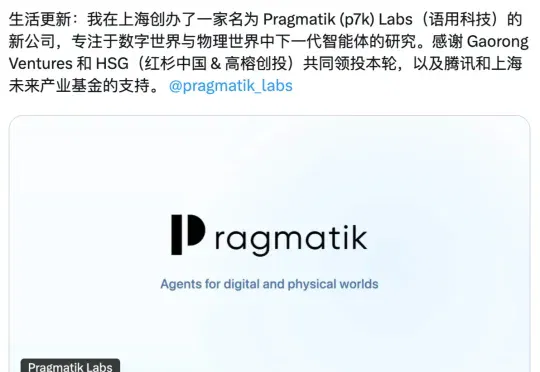
刚刚,林俊旸官宣创业公司Pragmatik Labs! (opens in a new tab)
就在刚刚,原阿里千问技术负责人林俊旸官宣创业新动向:在上海创办了一家新的 AI 公司 Pragmatik Labs(语用科技),简称 p7k。方向也第一次正式公开:研究横跨数字世界和物理世界的下一代 Agent。
腾讯1.3亿入局!林俊旸新AI Lab首轮投后估值135亿,已寻求下一轮 (opens in a new tab)
前阿里 Qwen 技术负责人林俊旸的创业公司,有了新消息。据外媒 The Information 援引知情人士的消息,在林俊旸完成的首轮融资中,腾讯投资了 2000 万美元。本轮融资总额达数亿美元,投后估值约 20 亿美元。

林俊旸推荐,Anthropic研究者自白:如何成为一位优秀研究者? (opens in a new tab)
咱们 AI 领域,研究者既是一个身份,也是一种幻觉。

腾讯投了林俊旸1.4亿!前千问负责人创业,估值135亿 (opens in a new tab)
就在昨天,外媒The Information爆料——前阿里巴巴千问大模型负责人林俊旸创办的AI实验室已经完成首轮融资,融资总额达数亿美元,投后估值达20亿美元!其中,红杉中国、高榕资本各投1亿美元领投,互联网巨头腾讯狂掷2000万美元跟投。

林俊旸创业,新公司估值约20亿美金丨智能涌现独家 (opens in a new tab)
独家获悉,前阿里千问大模型技术负责人林俊旸近期已经开启创业,考虑方向包括世界模型和具身大脑。目前,林俊旸已经招募数名字节、腾讯和海外背景的成员,并以约20亿美金的估值开启融资,接触基金包括红杉中国、高榕创投等。