Open-source STRAND predicts multigene CRISPRi responses from DNA sequence and position
Harvard Medical School and collaborators present STRAND, predicting CRISPRi gene-expression responses from DNA sequence, target location, and control cells. Tests use specified cell lines and a 2,000-gene panel, rather than validate whole cells or every editing method.
If the activity of a small stretch of DNA is suppressed, which genes in the cell will change in response? Would the result be the same if a different location were targeted?
On November 11, Google DeepMind released AlphaGenome 2, incorporating cell type and state as prediction conditions to further characterize how DNA variants affect different cells.
For a given cell state, it can predict how a DNA variant will affect gene expression within the same stretch of sequence, examining up to approximately one million base pairs at a time.
Researchers at Harvard Medical School and Johns Hopkins University and Merck developed STRAND, which focuses on a different question: if one location is perturbed, can the responses of genes outside that stretch of sequence also be predicted?
The team focuses on the cascading response to an intervention: specify a location on the DNA and, together with the state of an unperturbed cell, generate the post-perturbation expression profile of multiple genes.
Local DNA provides the intervention cues, while the predicted gene responses can extend beyond the input window.
The work has been accepted to the NeurIPS 2026 main conference, and the code is publicly available.
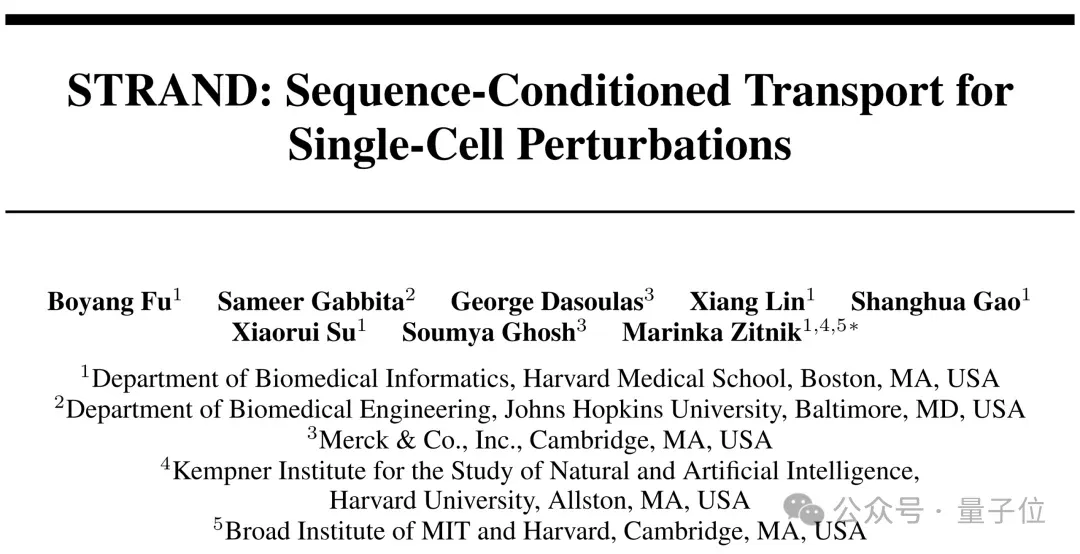
Only about 1.5% is protein-coding sequence: How can perturbation prediction move beyond coding regions?
Only approximately 1.5% of the human genome directly encodes proteins. The much larger noncoding regions contain regulatory elements controlling when, where, and how strongly genes are expressed. Promoters are like "starting gates," while enhancers can adjust gene activity. The locations that can be targeted to change cellular behavior extend far beyond the entities represented by gene labels.
Many single-cell perturbation models describe interventions using a gene ID. If two different starting gates for the same gene are perturbed separately, the input is still the same ID, so the model receives no information distinguishing the locations.
STRAND changes the intervention input to "DNA sequence + target position". The architecture described in the paper supports inputs covering approximately 95% of the genome, using 128 bp as its representation unit and allowing intervention sites to be specified in noncoding regions.
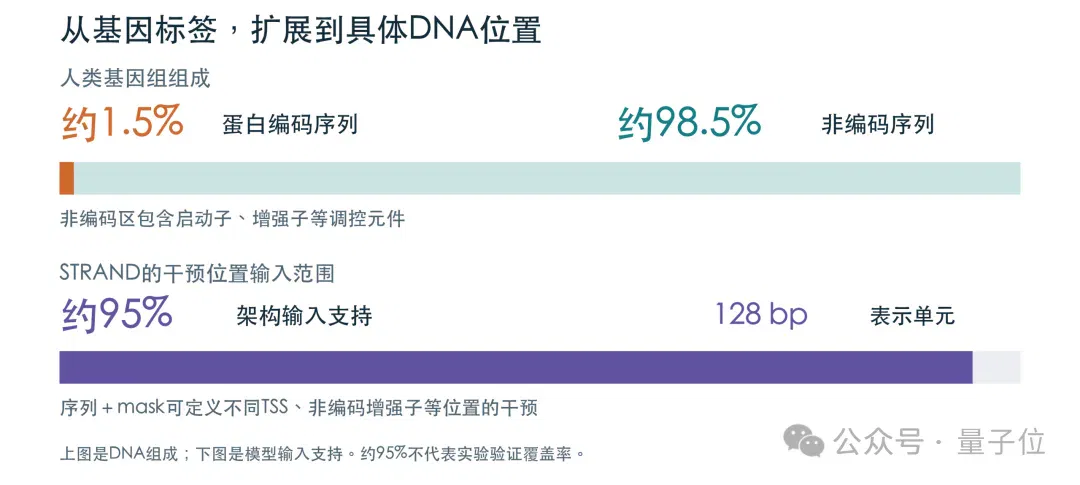
△Approximately 1.5% refers to protein-coding sequence, while approximately 95% refers to the input coverage supported by STRAND's architecture.
How a DNA foundation model connects to single-cell perturbations
The challenge is that the two types of data have different granularities: DNA models can provide representations at sequence positions, whereas many single-cell perturbation datasets label only "which gene was perturbed." STRAND uses a learnable DNA interface to connect sequence representations to a model that generates cellular responses.
You can imagine a cell's state as a ball on a hillside: from the same starting point, perturbations at different locations may send the ball into different valleys.
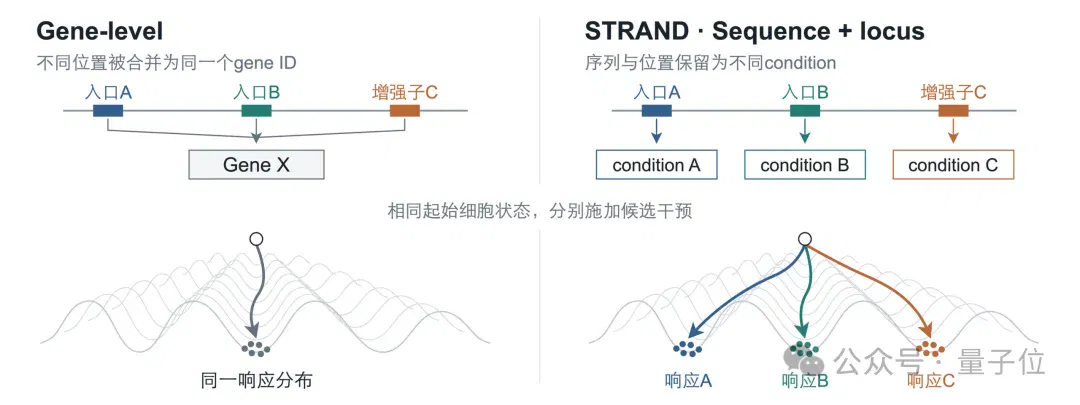
△The difference between gene-label inputs and sequence-and-position inputs in the same cellular context. The point clouds in the valleys represent predicted response distributions; the terrain and paths are conceptual illustrations.
Giving different locations their own conditioning
STRAND uses a frozen Flashzoi/Borzoi model to encode DNA, with each token corresponding to 128 bp. A mask marks the region whose perturbation is to be simulated, while the surrounding sequence is retained as context.
The DNA perturbation module first aggregates the tokens covered by the mask to form a query. It then reads sequence information within the window through cross-attention, adding a relative-distance bias. The resulting conditioning describes both "where the intervention acts" and "what regulatory cues surround it." Moving the mask changes the intervention representation received by the model even if the gene ID remains unchanged.
For data annotated only with gene names, the team used transcription start sites (TSS) with 200 bp on either side to approximate the target location; when precise gRNA coordinates were available, inputs were constructed according to the actual location. The DNA foundation model provides pretrained representations, while single-cell experiments teach the new modules what cellular changes correspond to such sequence conditions. Coarse-grained experimental labels are thus connected to inputs containing both position and sequence content, making it possible to ask about the effects of different DNA locations during inference.
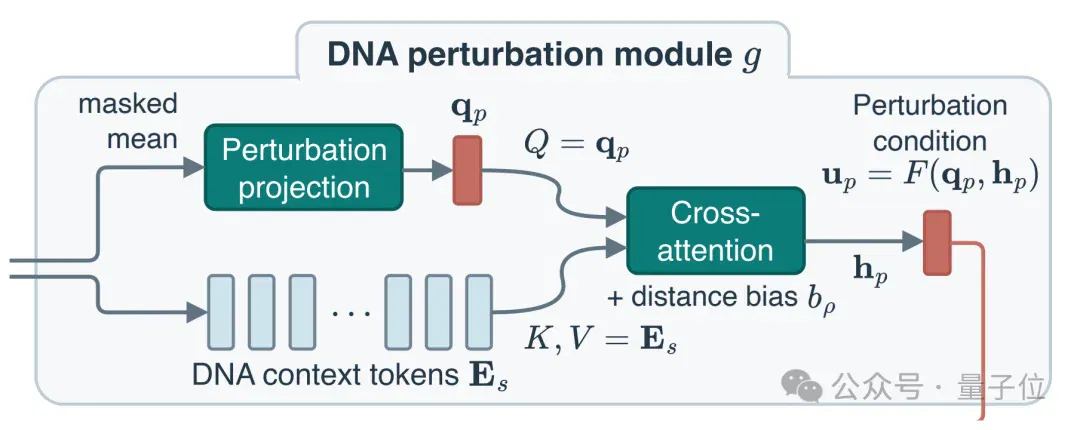
△Detail of the DNA module. The target region forms a query, and cross-attention reads the sequence context within the window.
Starting diffusion from an actual cell state
The frozen RNA encoder SCimilarity compresses the expression profile of an unperturbed control cell into a latent representation. Because single-cell sequencing generally cannot track the same cell before and after a perturbation, STRAND first uses Optimal Transport to establish statistical pairings between control and perturbed cell populations.
I²SB then constructs noisy intermediate states between the latent representations at the two endpoints, learning to recover the perturbed state conditioned on the DNA representation and control latent. Inference starts from the control cell's latent representation and generates the response through multiple reverse-bridge steps. This allows the cell's original state to participate directly in generation.
For example, an intervention might cause half the cells to respond strongly and the other half to barely change. Their mean could be the same as if "every cell changed a little," despite the actual cell populations being very different. It is precisely this response distribution that diffusion is intended to learn.
Finally, a residual decoder uses control expression as a reference to reconstruct changes in the expression of multiple genes from the generated latent, handling zero and nonzero expression separately. Training also uses contrastive learning to align DNA conditioning with average RNA changes. The joint evaluation uses a panel of 2,000 highly variable genes as its output; these output genes do not have to be located within the input DNA fragment.
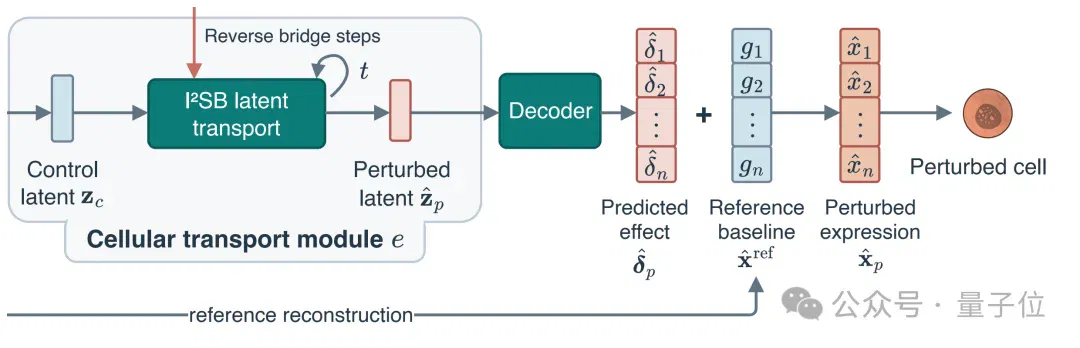
△Detail of the generation and decoding modules. DNA conditioning enters I²SB, the control latent supplies the starting point, and the decoder outputs multigene expression predictions.
Two starting gates for the same gene are indistinguishable to a gene-level model
Take FLVCR1 as an example: this gene has several different transcription start sites (equivalent to different transcriptional "starting gates") and can produce protein isoforms with different functions. Existing experiments show that, in K562 cells, FLVCR1b produced from a different start site (an alternative starting gate) is particularly important for erythroid differentiation.
STRAND applies virtual interventions to these starting gates separately, ranking the FLVCR1b gate first among five candidates. Its predicted impact score is 0.683, higher than the 0.564 for the commonly used FLVCR1a gate, consistent with existing functional studies.
For models conditioned on a gene ID alone, these two questions correspond to the same input, so they cannot produce different responses based on location. STRAND, however, can test the two sites separately and compare their effects. Similarly, when the target is an enhancer without its own gene ID, sequence and coordinates can still define the intervention.
Near the e-HDAC6 enhancer, STRAND's scanning curve shows a local peak less than 400 bp from the center of the experimentally validated enhancer. A model receiving only gene labels cannot produce a location-dependent response curve along this DNA stretch; in STRAND, by contrast, this becomes a directly computable input.
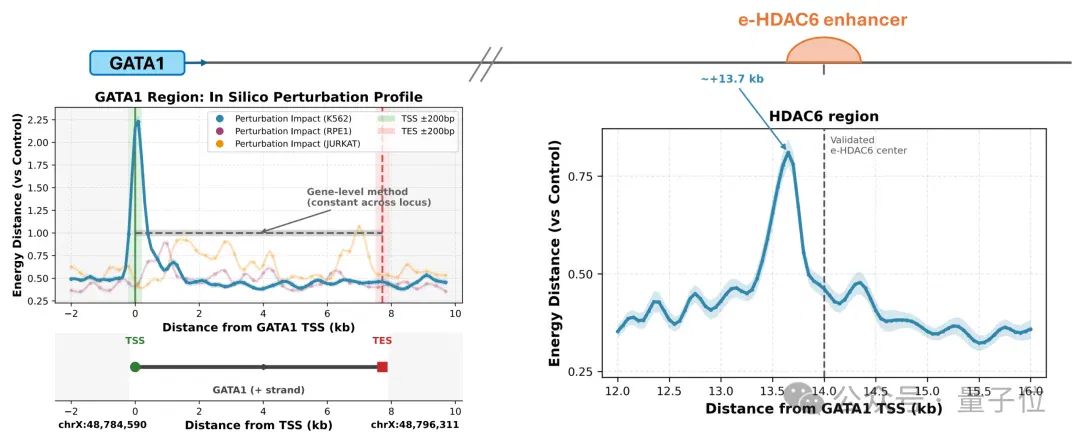
△The gray curve on the left illustrates how a gene-level model cannot distinguish positions within a gene; the right shows STRAND's predicted peak near a noncoding enhancer. FLVCR1 and e-HDAC6 are locus-level case studies compared against existing biological evidence.
Can it still predict a different perturbation or a different cell type?
In few-shot experiments on the three cell lines K562, Jurkat, and RPE1, only five perturbed cells per test gene were provided for training. STRAND's overall average rank across seven metrics was 1.86, compared with 3.14 for the next-best method. On K562, the perturbation discrimination score rose from STATE's 0.538 to 0.710, a relative improvement of approximately 32%; for genes not seen during training, STRAND also achieved the best overall rank among the evaluated methods.
Ablation experiments further tested the contributions of the two modules: compared with fixed mean pooling, the DNA module increased Pearson correlation for the top 100 changed genes by an average relative improvement of 16.6%; compared with a deterministic MLP, the generation module reduced Energy Distance on the combined dataset by 38.9%, bringing predictions closer to the measured cell distribution.
Cross-cell-line testing used a setup in which the model was trained on other cell lines while one cell line was completely excluded (held-out) from training. For the 100 most changed genes, STRAND's average agreement with the direction of up- or downregulation was 58.7%, compared with 50.0% for STACK and 48.1% for STATE. In the HCT116 test from an independent source, the model needed only control cells from the target cell line (without its perturbation data or retraining) to reach agreement of 56.8%.
Compare "where to intervene" in the model first
Experimental researchers can hold the cellular context fixed, scan a gene's different starting gates and surrounding regulatory locations, compare predicted responses, and then choose more promising candidates for experiments. Current validation centers on CRISPRi, which suppresses transcriptional activity in a specified region; other editing methods still require corresponding experimental validation.
For AI researchers, STRAND demonstrates how two types of foundation models can be connected to a new task: the DNA model supplies an intervention representation containing sequence content and a specific location, the RNA model provides the system's current state, and conditional generation learns the changes following intervention. A virtual cell can thus continue asking: what happens if the same gene is targeted at a different starting gate, or if the target moves to a noncoding regulatory site?
The authors, in paper order, are Boyang Fu, Sameer Gabbita, George Dasoulas, Xiang Lin, Shanghua Gao, Xiaorui Su, Soumya Ghosh, and Marinka Zitnik. Paper: https://arxiv.org/abs/2602.10156 Code: https://github.com/mims-harvard/STRAND Project website: https://zitniklab.hms.harvard.edu/STRAND/
This article is from "QbitAI," by the "STRAND team."
Related topics
After reading
Join the AINRK community
Read how to join the community and connect with people working in AI.
Related articles
Continue reading related topics and articles in this category.
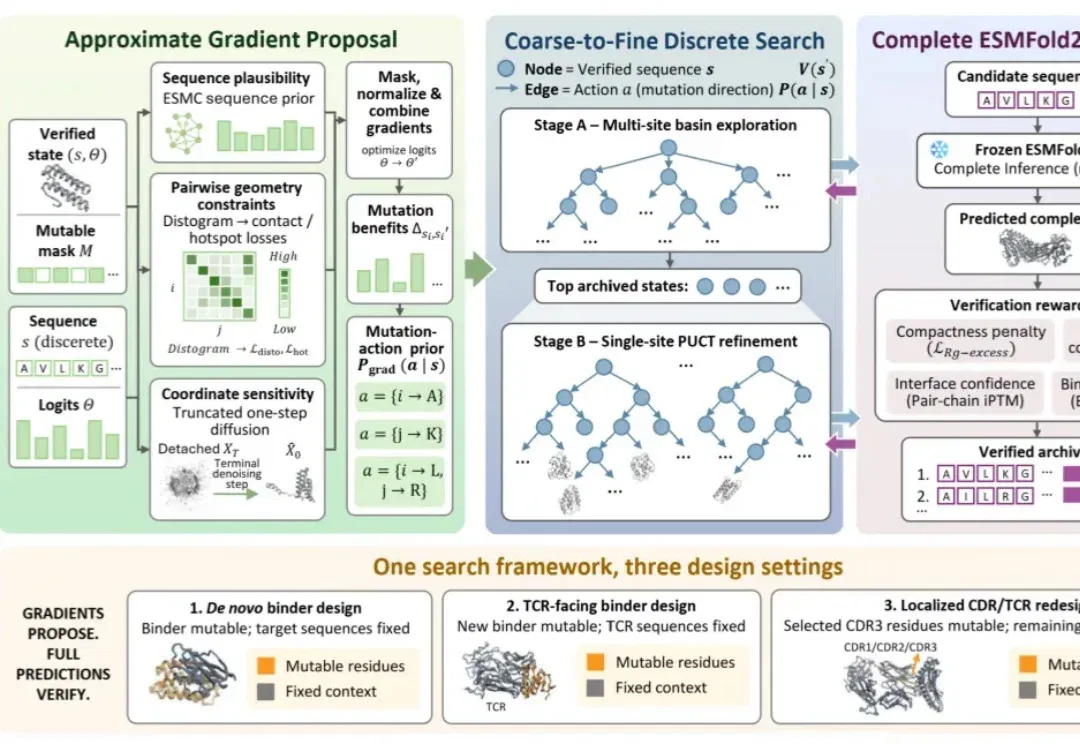
从头设计到局部精修:ProteoCraft探索可控蛋白质设计 (opens in a new tab)
ProteoCraft 结合近似梯度提案、完整结构预测和两阶段树搜索,支持结合蛋白从头设计与局部精修。团队报告计算基准改善,并在PD-L1等候选上开展结合实验;命中率按成功表达样本计算,尚需后续功能与开发性质验证。

刚刚,Claude 64小时设计31万种蛋白,17种通过实验验证 (opens in a new tab)
AI 制药的故事,终于从计算机里的分子结构,走到了实验室的试管里……
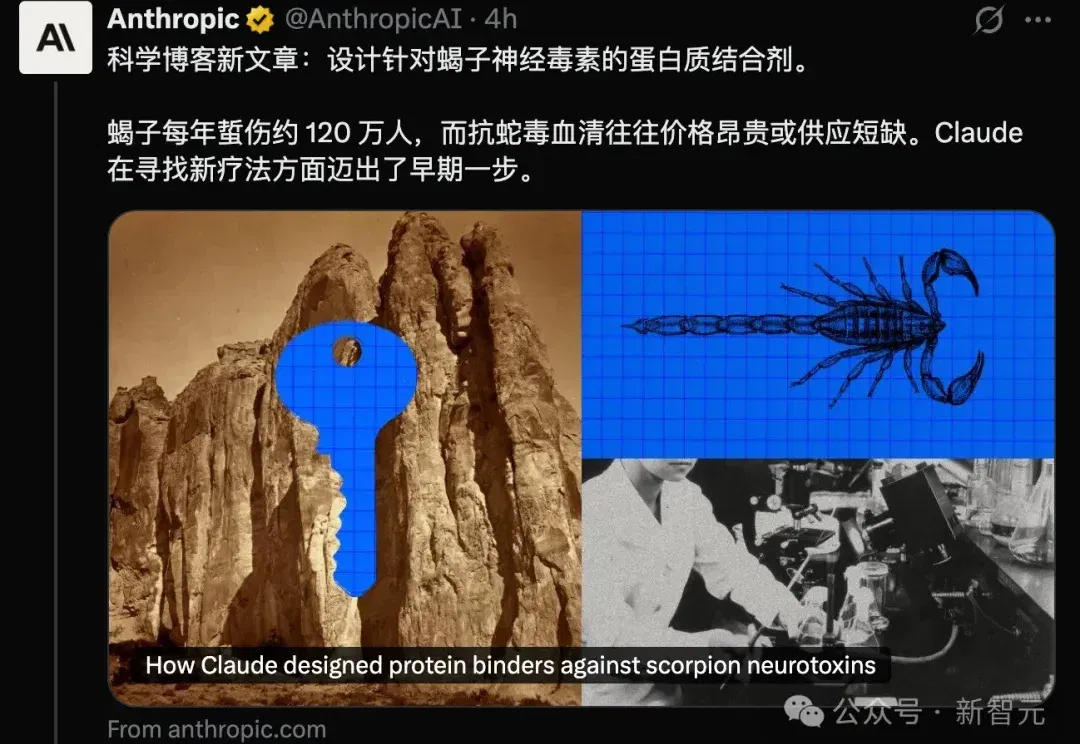
刚刚,Claude首次设计出抗蝎毒蛋白!狂算64小时,已过实测 (opens in a new tab)
Claude最新成果,在生物和AI圈彻底刷屏了。

诺奖得主用AI凭空造出基因剪刀,比进化几十亿年的那把还准 (opens in a new tab)
7月16日,Nature刊出消息:科学家用AI造出了自然界里从来没有过的CRISPR酶,切基因比「天然版本」更利索。论文同日发表在Science。带队的人,是2020年因为CRISPR拿下诺贝尔化学奖的Jennifer Doudna。
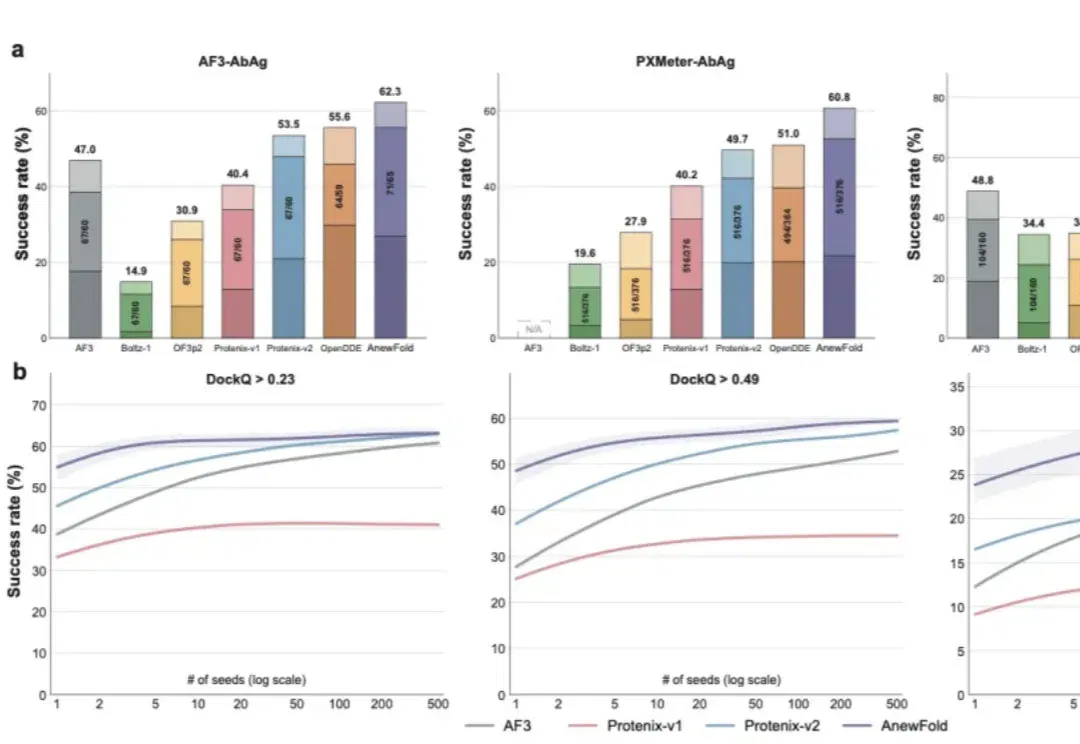
Anthropic做药,Isomorphic补大模型,Anew带着什么走到台前? (opens in a new tab)
一笔融资、一份技术报告,让一个过去五年鲜少公开发声的团队,逐渐显露出更完整的面貌。