CSS scene-caption evaluation: Tested VLMs favor object size and are less sensitive to people
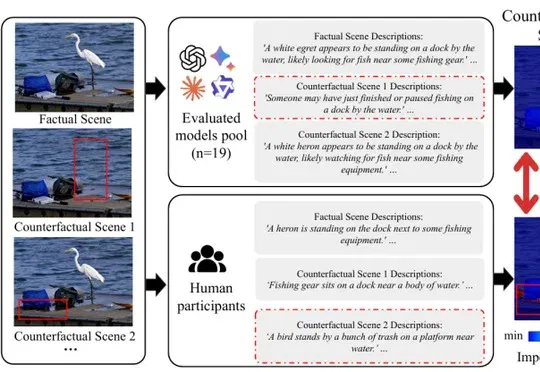
UCSB researchers compare 19 VLMs with human descriptions across 307 original scenes and 1,306 object-removal variants. The tested models rely more on visual attributes such as size; size bias correlates with the accuracy gap.
Editor's verification (2026-11-22): The paper (opens in a new tab) evaluates changes in the meaning of descriptions for specified scenes and their object-removal variants; its conclusions are limited to the models, prompts, and tasks tested. Lower sensitivity to people than the human participants does not mean that a model cannot see people at all, pays no attention to anyone, or has a particular set of values. The cross-model correlation between deviations in size sensitivity and the accuracy gap provides a clue to the mechanism, but cannot by itself establish that this is the sole cause of all human–model differences. Nor can the white-box comparison on a single model be generalized to all interpretability tools.
Large vision-language models (VLMs) can already handle many complex scene-understanding and visual question-answering tasks with ease, but do models really understand scenes in the same way as humans?
Many previous computer vision studies have pointed out that, although models and humans appear able to reach the same level on the same tasks, and models can even surpass human performance, models and humans rely on different features, leading models to behave inconsistently with humans in many circumstances.
Researchers at the University of California, Santa Barbara, point out that both open- and closed-source large vision-language models differ significantly from humans in their understanding of the importance of objects in a scene. These models rely particularly heavily on objects' size, centrality, and low-level saliency, while showing little sensitivity to whether an object in a scene is a person.
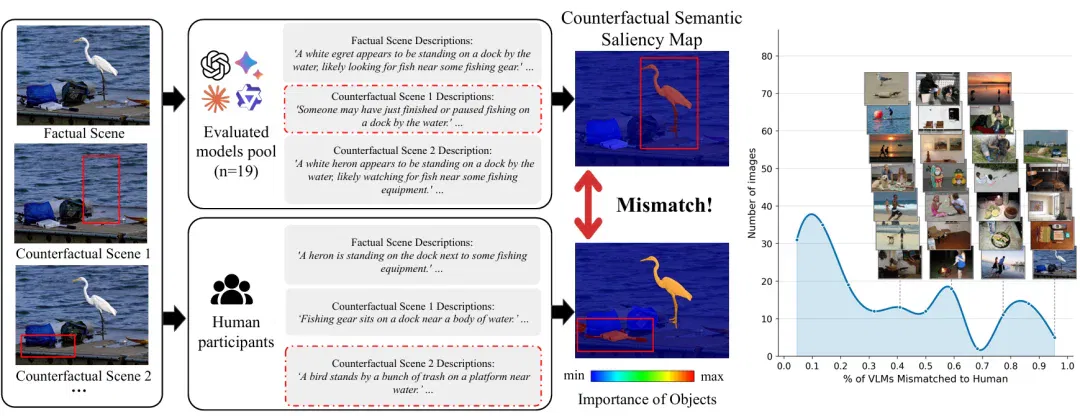
- Paper title: Revealing the Gap in Human and VLM Scene Description through Counterfactual Semantic Saliency
- Paper: https://arxiv.org/abs/2605.13047
- Project code: https://github.com/starsky77/Counterfactual-Semantic-Saliency-Data
- Project website: https://starsky77.github.io/Counterfactual-Semantic-Saliency
- Project data: https://huggingface.co/datasets/starsky77/counterfactual-semantic-saliency
Contribution 1: A model evaluation method for quantifying semantic saliency in scenes
Why a black-box method is needed
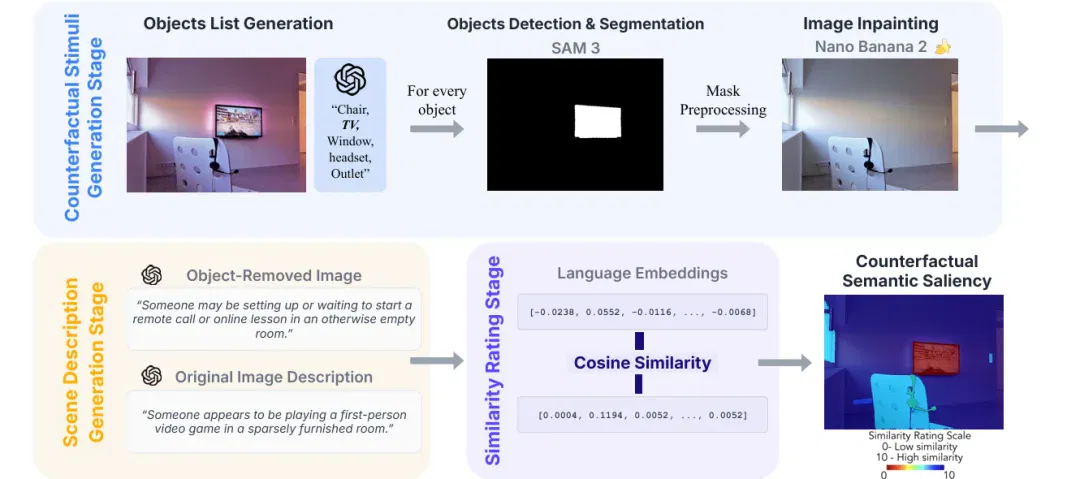
Modern large vision-language models have enormous numbers of parameters, and many are closed-source. Traditional "white-box" interpretability methods, such as visualizing attention maps or gradient heatmaps, are either unavailable or struggle to reveal the features that actually play a causal role. To address this, the paper proposes a black-box evaluation method applicable to all open- and closed-source models to quantify how objects in a scene affect the scene description a VLM produces.
Counterfactual Semantic Saliency: Remove an object and see how much the description changes
The basic idea behind Counterfactual Semantic Saliency (CSS) is to use causal intervention to test the effect of each input element on the output separately, thereby determining how each visual element in a scene affects its meaning. If removing a monitor from a scene produces the most drastic change in the scene's meaning, the monitor is the most critical element for understanding that scene. Conversely, if removing an electrical outlet does not change the scene's meaning, this indicates that such an element has low semantic saliency.
Contribution 2: A human dataset for counterfactual scenes
307 original scenes + 1,306 counterfactual scenes
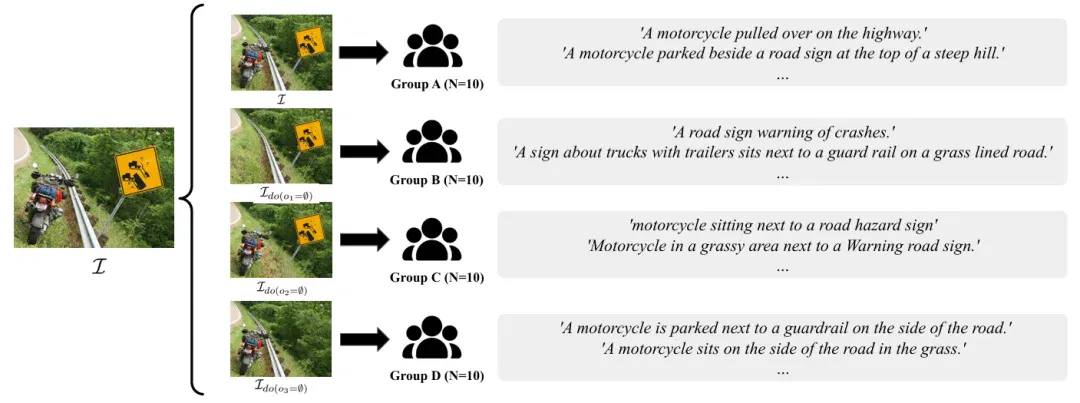
To compare differences in scene understanding between humans and models, the researchers used the OSIE dataset, which is widely used in visual saliency research, to construct a dataset consisting of 307 original scenes and 1,306 counterfactual scenes. Each original scene has 3–6 corresponding counterfactual scenes, with one corresponding object removed in each counterfactual scene.
A human baseline consisting of 227 participants and 16,603 descriptions
The paper collected scene descriptions from 227 human participants through the Prolific platform. To avoid memory effects and interference between earlier and later exposures, the experiment used a between-subjects design: for a scene containing N target objects, the original image and N counterfactual images were assigned to N+1 non-overlapping stimulus sets. Each set was completed by approximately 10 independent participants, ensuring that each participant saw only one image from any given original scene and its counterfactual variants. The researchers collected a total of 16,665 trials. After excluding low-quality responses that were clearly inconsistent with the descriptions of other participants, approximately 0.3% of the total, they retained 16,603 scene descriptions. Each image had approximately 10 independent descriptions, ranging from 9 to 11, forming the human baseline.
Contribution 3: Models differ significantly from humans in scene understanding and rely on different features
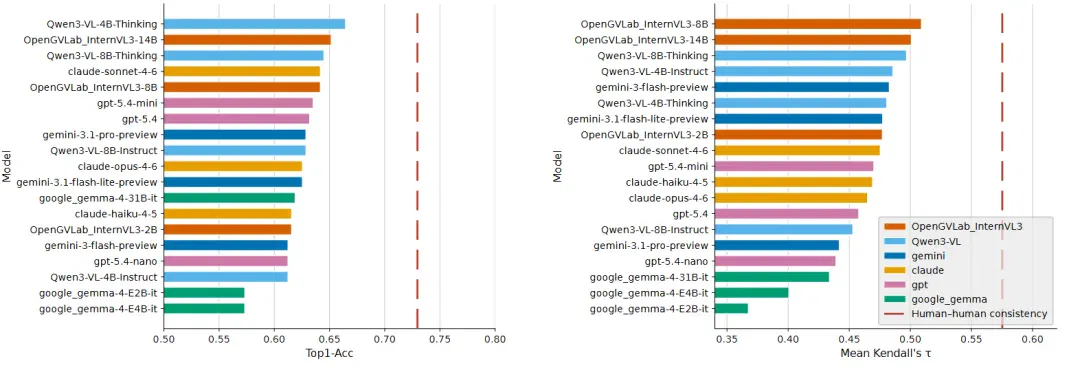
19 models, none reaching the human level
The researchers evaluated 19 mainstream open- and closed-source large vision-language models, covering families including Qwen3-VL, InternVL3, Gemma 4, GPT-5.4, Claude 4.x, and Gemini 3.x. The results show significant differences in scene understanding between all the models and humans: whether identifying the most semantically salient object in a scene or ranking the importance of objects within the same scene, the models fell significantly below the level of agreement among humans.
Four hypotheses: Size, centrality, low-level saliency, or "people"?
To further understand what causes differences between models and humans in scene understanding, the researchers drew on human vision research and previous studies of biases in deep learning models to propose four hypotheses about factors that might affect scene understanding:
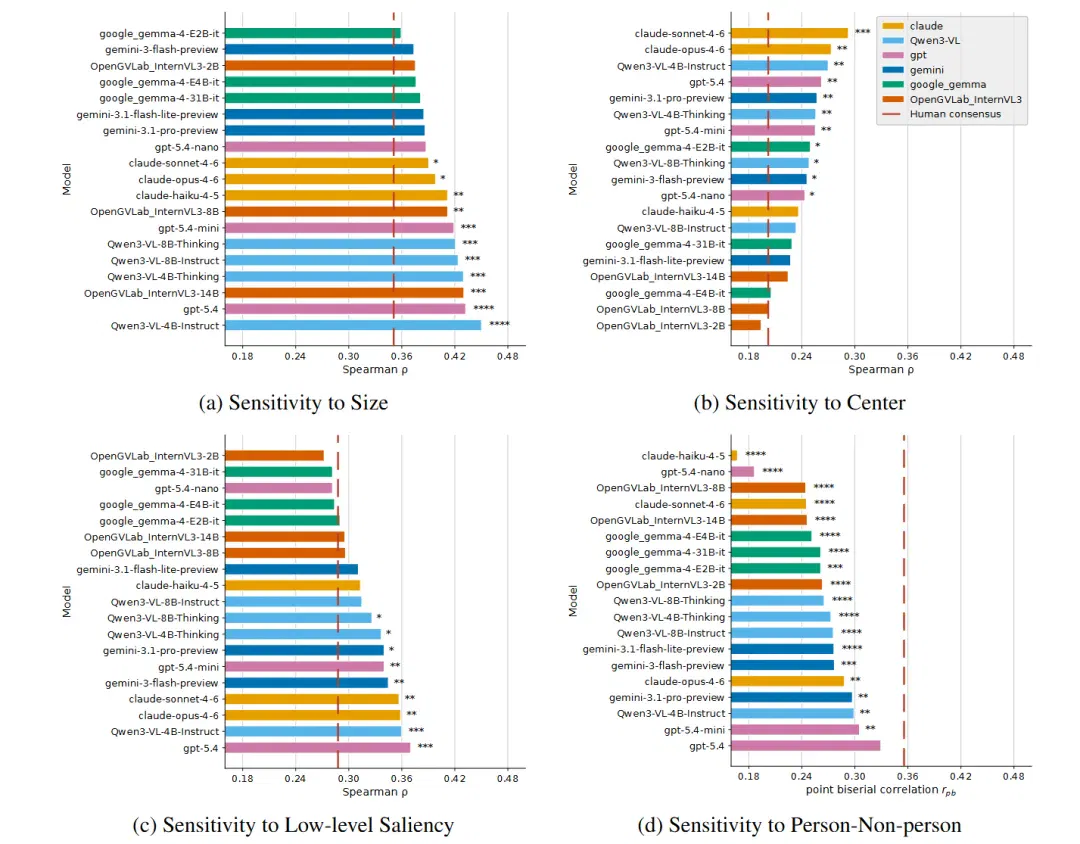
1. Sensitivity to Size: The size of an object stimulus is an important cue for human visual attention. Previous studies also show that deep learning models for object recognition rely excessively on object size. The researchers measured object size using the area of its segmentation mask.
2. Sensitivity to Center: Human vision naturally attends to objects at the center of an image, and many visual models are trained on object-centered data, such as ImageNet and MS-COCO. The researchers measured centrality as the negative distance from the object's center to the image center.
3. Sensitivity to Low-level Saliency: Research on visual attention shows that contrasts in low-level visual features such as color and brightness affect human visual perception. Other studies suggest that visual models may favor low-level visual features over high-level semantic information. The researchers used the traditional low-level saliency model Graph-Based Visual Saliency (GBVS) to quantify low-level saliency in an image, taking the peak low-level saliency within an object's region as that object's low-level saliency.
4. Sensitivity to Person-Non-person: Human eye-tracking research shows that people prioritize looking at people in a scene even when they have not been given a specific task. No work has yet systematically examined whether large vision-language models also have this sensitivity to people. The researchers used GPT-5.4 to label whether objects in the scenes were people.
Based on these four hypotheses, the researchers analyzed the correlations between objects' semantic saliency and their size, centrality, low-level saliency, and status as a person or non-person. They found that, compared with human observers, large vision-language models rely significantly more on objects' low-level attributes; conversely, the models are significantly less sensitive to "people" than human observers. In other words, models are more easily "led astray" by objects that are large, centrally positioned, and visually striking, regardless of whether those objects really matter semantically. Human scene descriptions, by contrast, are strongly affected by whether people are present in the image, while models are relatively insensitive to this.
Size preference is the primary factor behind the human–model gap
Since models differ from humans in their sensitivity to all four attributes, which one is chiefly responsible for models "picking the wrong key object"?
The researchers calculated two "gaps" for each model: first, the difference between the model's sensitivity to a given attribute and human sensitivity (Δr); and second, the difference between the model's Top-1 accuracy and human accuracy (ΔAcc). They then examined whether these two gaps were correlated across the 19 models. If models that deviate further from humans on a particular attribute also perform worse at identifying the key object, that attribute is likely to be a factor driving the gap. Of the four attributes, the results show that only the deviation in size sensitivity was significantly correlated with the Top-1 accuracy gap; the other three attributes did not reach statistical significance. This also explains the example at the beginning of the article: the white bird occupies far more pixels in the image than the fishing rod. The model's excessive reliance on size obscures the fishing rod's importance, ultimately leading it to a judgment contrary to that of humans.
White-box attention maps cannot tell us what models "really care about"
Researchers have long used attention maps or activation maps to "see" which areas of an image attract a model's attention. Can these white-box methods produce assessments of object importance consistent with CSS?
On the open-source Qwen3-VL-4B-Instruct model, the researchers compared three commonly used white-box methods: raw attention maps, Grad-CAM, and AGCAM, or Attention-Guided Class Activation Mapping. Because the model generates a description one token at a time, each token corresponds to a heatmap. The researchers aggregated all token heatmaps by taking their maximum values, then took the maximum value within each object's region as that object's importance.
The resulting white-box heatmaps were either disorganized or overly sparse, and often focused on semantically irrelevant regions. Their rankings of object importance even correlated negatively with CSS. This suggests that, for structurally complex modern VLMs, interpretability methods based on passive observation struggle to reveal the causal factors that actually drive model output.

Conclusion
This study proposes Counterfactual Semantic Saliency (CSS), a black-box, model-agnostic evaluation framework. Combined with large-scale human psychophysical experiments, it systematically reveals widespread gaps between large vision-language models and humans in scene understanding: humans naturally attend to people in a scene, while models by default rely excessively on low-level visual features such as object size, centrality, and low-level saliency, with excessive reliance on object size being the principal factor behind this gap. At a time when generated data is being used extensively to train models, "whether models see the world as humans do" may be another question deserving attention.
About the author:
The paper's first author, Ziqi Wen, is currently a PhD student in computer science at the University of California, Santa Barbara. His research lies at the intersection of computer vision and cognitive science: modeling human vision, examining behavioral differences between models and humans, and investigating their causes. He completed his graduate studies at Carnegie Mellon University's School of Computer Science and his undergraduate studies at Zhejiang University's College of Computer Science and Technology.
This article is from the WeChat public account "Machine Heart," by "Machine Heart".
Related topics
After reading
Join the AINRK community
Read how to join the community and connect with people working in AI.
Related articles
Continue reading related topics and articles in this category.
JANUS explores fine-tune-then-rectify: Jacobian projection to mitigate catastrophic forgetting (opens in a new tab)
Tsinghua and DiDi Autonomous Driving researchers propose JANUS, using Jacobian null-space projection and multi-step adaptive rectification after fine-tuning. Retention metrics improve on tested 7B/8B models; the necessary and sufficient condition concerns local first-order loss changes.
NUS Introduces SO-Arena: Measuring the Breadth and Reliability of System One Decisions (opens in a new tab)
NUS xML Lab's SO-Arena uses 2,919 tasks to evaluate capability, option-order stability, and recognition of absent correct answers. Capability and reliability rankings differ, while local H100 and remote API latency measurements use different conditions.
NPU proposes ROSE: Orthogonal editing and knowledge integration reduce interference in multimodal updates (opens in a new tab)
Northwestern Polytechnical University proposes ROSE for lifelong multimodal knowledge editing. Risk-aware orthogonal editing and multi-granularity integration reduce interference; reliability, generalization, and locality are evaluated on specified VLKEB and MMEdit setups.

miHoYo unveils Gamer VLA research for long-horizon memory and real-time game control (opens in a new tab)
miHoYo’s Honkai AI R&D team presents Gamer, generating keyboard and mouse actions from screens, instructions and memory. The team reports over 95% autonomous runtime across five Star Rail story chapters and about 50 hours; this is not a task success rate.
Why do large models develop massive activations? Tsinghua and Peking study finds a backpropagation clue (opens in a new tab)
Researchers connect attention sinks and massive activations through backpropagation, proposing that RMSNorm lets large activations regulate local gradients. V-scale and backward-only experiments support this explanation, primarily in Llama-style dense models.