Forward-only search and SVD rank reduction explore efficient LLM task adaptation
Researchers from Lund University and Google DeepMind use activation angular concentration to select SVD components for task adaptation without backpropagation. Reported compute and memory gains concern adaptation search, not continuous autonomous improvement in every conversation.
Editor’s verification (November 22, 2026): The paper (opens in a new tab)uses forward-only search to select SVD rank-reduction schemes for task adaptation on specified datasets. No backpropagation does not mean no additional search, data or validation. “Speedup” includes comparisons of adaptation-search FLOPs and computational complexity, not measured acceleration of every online generation. Continuous real-time adaptation from users’ preferences and its commercial value are future possibilities discussed in the original article, not proof that a model automatically, continuously and autonomously improves with every conversation.
As AI systems are deployed at scale, AI services are becoming a key driver of rising energy consumption, especially large-language-model inference services. The large volume of inference generated by real user interactions prompts us to reconsider how to use inference itself to improve the serving system, particularly through efficient task-specific LLM adaptation.
Mainstream LLM adaptation uses tuning techniques, such as parameter-efficient fine-tuning (PEFT) and prompt tuning, and knowledge-augmentation techniques, such as retrieval-augmented generation (RAG) and prompt engineering. Knowledge augmentation primarily injects knowledge and does not modify internal weights during inference. Tuning typically relies on backpropagation, adding resource costs beyond inference itself. By contrast, emerging forward-only learning methods [1], relying solely on forward passes, are becoming a promising approach to adaptation during LLM inference.
In one sentence: an LLM evolves during inference, adapting to downstream tasks through forward-only passes without backpropagation.
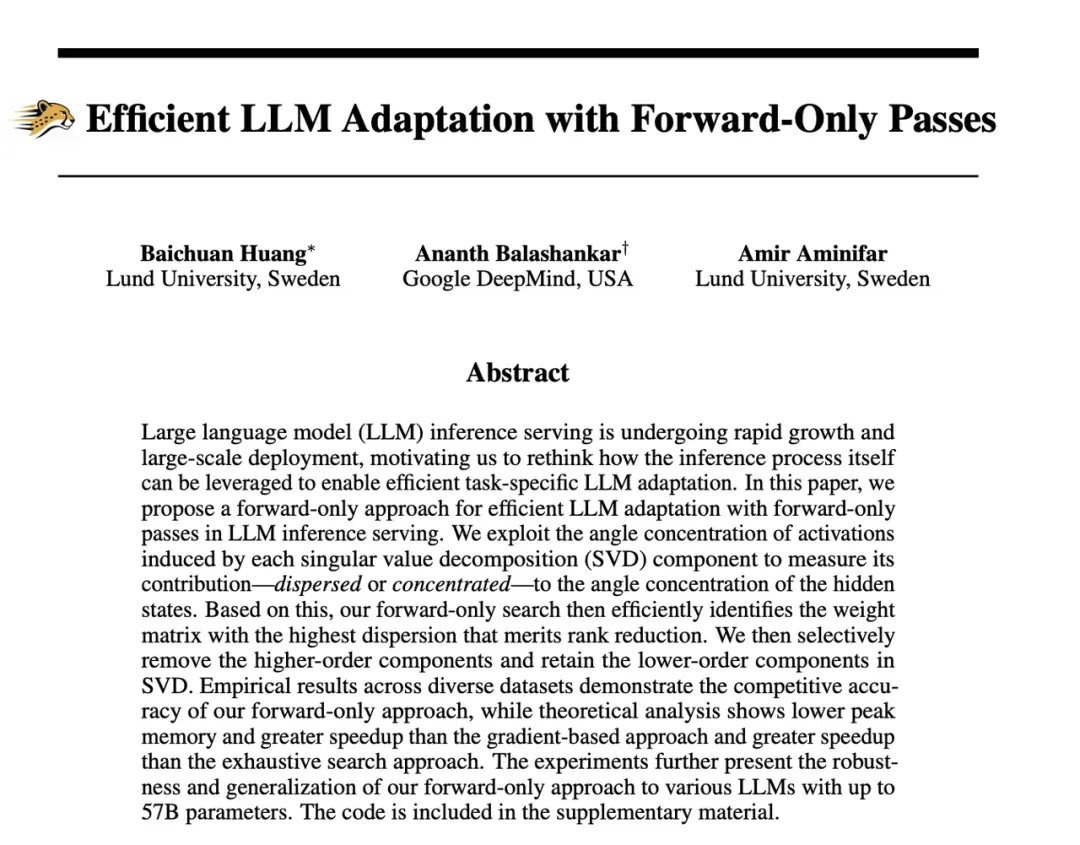
- Paper title: Efficient LLM Adaptation with Forward-Only Passes
- Research team: Lund University, Sweden, and Google DeepMind, New York
- Paper: https://arxiv.org/abs/2611.10610
- Official NeurIPS page: https://neurips.cc/virtual/2026/loc/atlanta/poster/148809
Core contribution:
Using the angular concentration of activations in LLM forward passes to measure how different SVD ranks of parameters contribute to activations, then pruning the corresponding ranks.
This work aims to achieve efficient LLM adaptation using only forward passes during inference serving. We propose forward-only search to accelerate identifying selected weight matrices by exploiting differences in angular concentration between the activations induced by SVD components and hidden states. Each component’s activation angular concentration measures whether it disperses or concentrates the hidden states’ angular concentration. Our forward search proceeds as follows:
First, SVD decomposition into multiple components
Second, summing the activations of all SVD components recovers the standard forward pass
Third, calculating angular concentration
Forward passes measure angular concentration to identify the weight matrix with the greatest dispersion, which is then selected for rank reduction.
Results
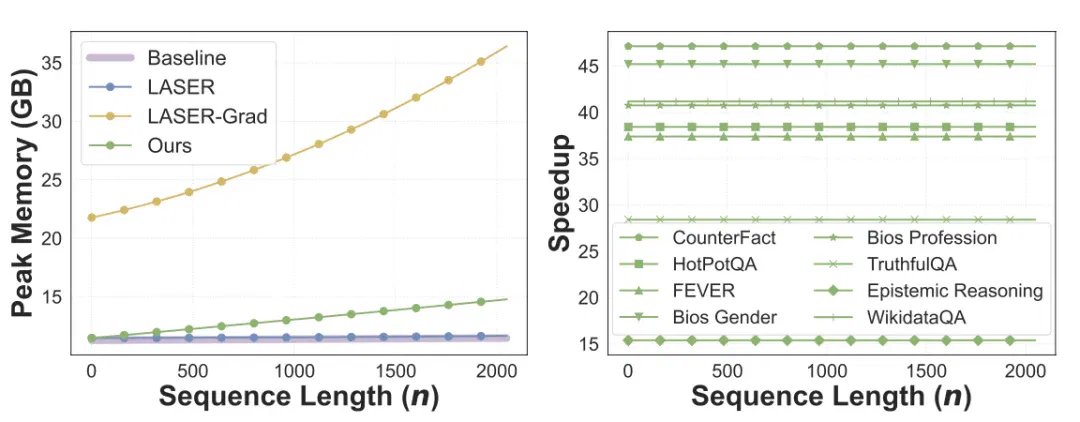
Compared with the gradient-based method LASER-Grad, our forward method uses less peak memory and achieves greater speedup. Compared with exhaustive search, LASER, it also delivers greater speedup with comparable accuracy.
Across datasets covering knowledge reasoning, knowledge intervention, multi-hop reasoning, fact verification, fairness and bias evaluation, hallucination detection and information retrieval, our forward-search method achieves lower peak memory and greater speedup than gradient-based methods. It also achieves greater speedup and comparable accuracy relative to exhaustive search.
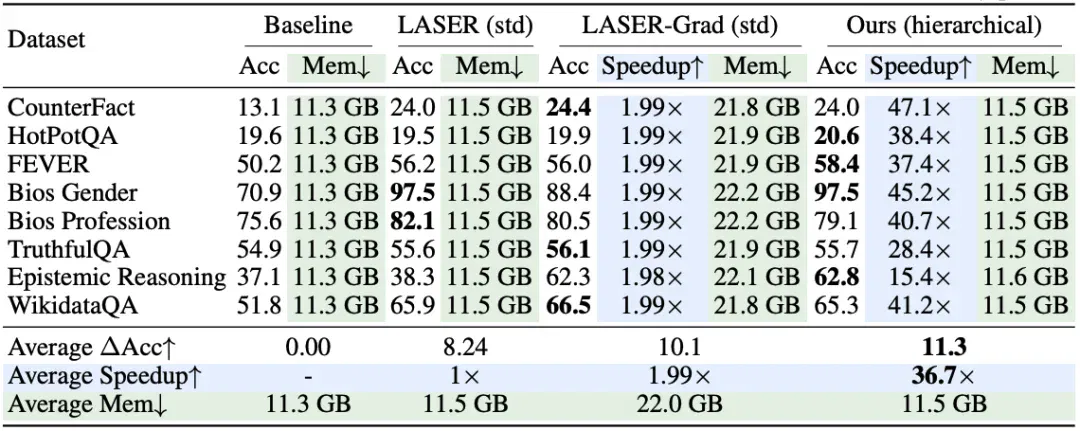
GPT-J evaluation: accuracy (Acc, %), speedup and peak memory (Mem)
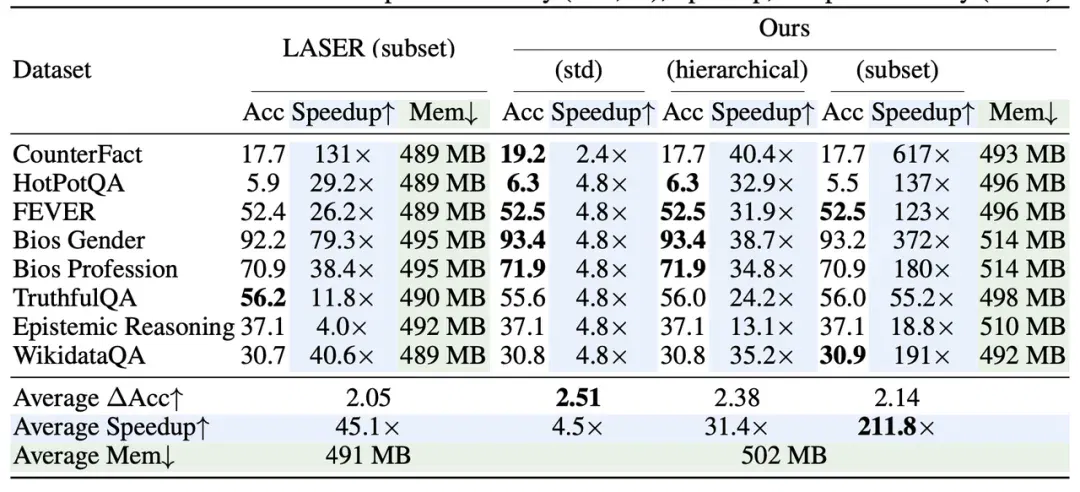
RoBERTa evaluation: accuracy (Acc, %), speedup and peak memory (Mem)
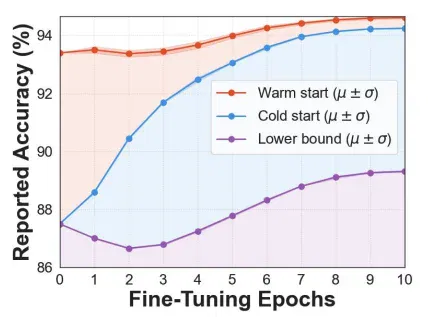
Extended experiments further demonstrate the effectiveness and robustness of our forward-search method and its ability to enhance fine-tuning.
GPT-J
Roberta on Bios Gender
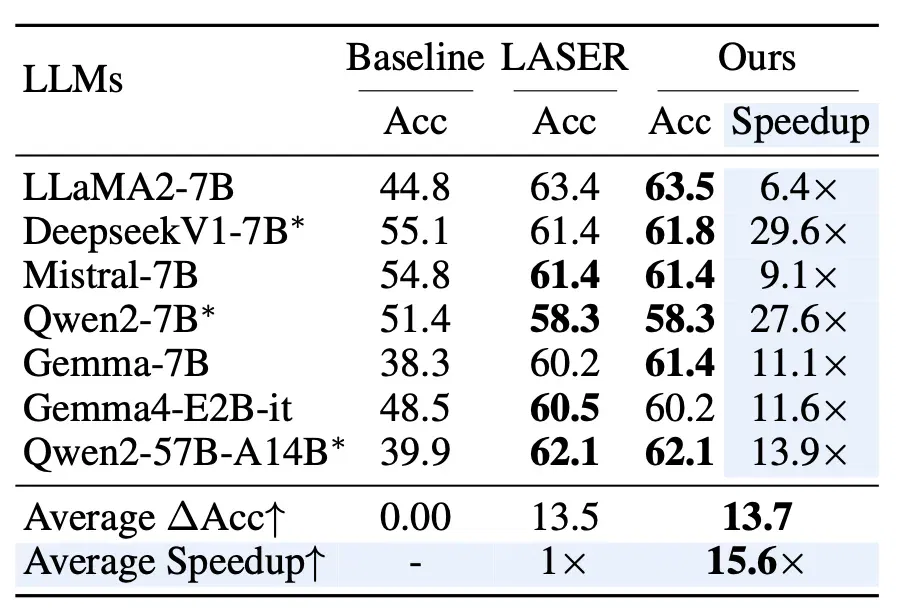
We also conducted extensive experiments on LLMs with up to 57 billion parameters, including LLaMA2, DeepSeekV1, Mistral, Qwen2 and their mixture-of-experts (MoE) variants, as well as multimodal Gemma 4. The results show strong generalization of our forward-search method.
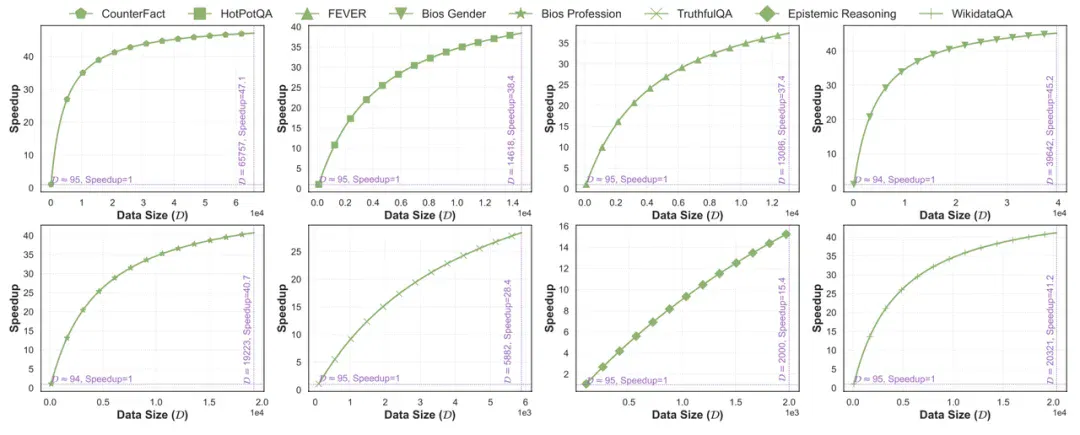
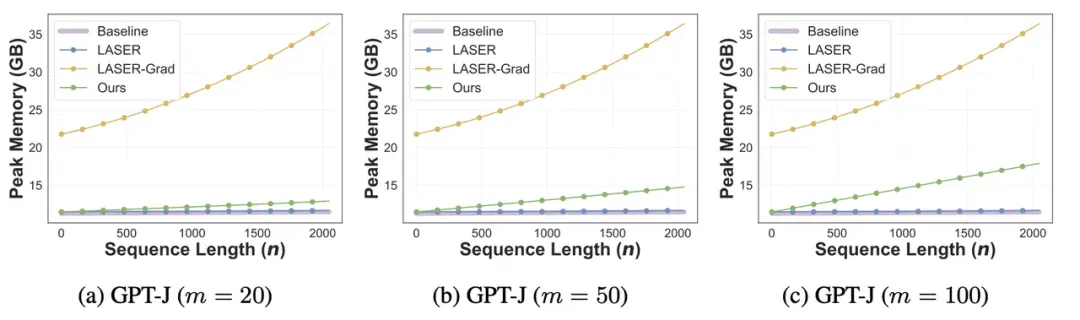
Ablation experiments show that our efficient hierarchical-search algorithm accelerates computation effectively and robustly while retaining downstream accuracy. Across different sequence lengths, our forward-only method also uses substantially less peak memory and achieves greater speedup than LASER-Grad.
We added Key, Query and Value weight matrices to the default FFN input/output candidates. The results show that forward-only search selects the same top-j weight matrices as when considering only the default FFN input/output. In other words, attention-module weight matrices can be omitted from this search to speed computation.
Related work:
LLM compression, LLM adaptation and forward-only learning
LLM compression: Model compression generally aims to reduce storage without compromising downstream accuracy. Methods including quantization, distillation, tensor decomposition, pruning and key-value-cache compression also aim to retain downstream accuracy, but to varying degrees require additional steps such as fine-tuning and alignment, or inference after compression to improve downstream performance. Notably, selectively removing higher-order SVD components of weight matrices can improve downstream accuracy.
LLM adaptation: Adapting LLMs to downstream tasks typically involves tuning and knowledge augmentation. Tuning includes supervised fine-tuning (SFT), PEFT such as low-rank adaptation (LoRA) and adapter tuning, prompt tuning, prefix tuning, bias-efficient fine-tuning (BEFT), instruction tuning, the alignment techniques discussed below, and test-time training. These techniques typically rely on backpropagation. Even training-free alignment adds resource overhead beyond inference itself. Knowledge-augmentation methods—including in-context learning (ICL), prompt instructions, RAG, prompt engineering, activation steering and tool-based approaches—primarily augment prompts or inject information, and are orthogonal to modifying internal weights during inference.
Forward-only learning: Emerging forward-only learning algorithms suggest a promising adaptation trend: moving from dependence on backpropagation toward more direct use of forward passes, particularly important at today’s unprecedented LLM scales. Scaling forward-only learning to deeper models such as LLMs remains challenging. Among forward-only techniques, forward-gradient methods can scale to deeper models by averaging multiple perturbations or improving gradient estimates with local losses, while zeroth-order optimization can scale to deeper models and LLMs. Evolution strategies applied to LLMs require either adjusting input prompts/embeddings or multiple iterations of forward passes and adjustment.
Conclusion
Emerging forward-only learning methods, using forward passes without any backpropagation, are gradually finding more practical applications in large models.
Overall, because the proposed method completely avoids backpropagation-based gradient computation and combines low memory use with substantial speedup, the article envisages real-time online adaptation during actual LLM serving. A system could use preference data from user interactions or self-labeled validation data to adjust a model dynamically and cheaply during service, better fitting particular tasks or user groups and offering substantial commercial value.
References:
[1] Baichuan Huang, Alexander Ororbia, Amir Aminifar. Backpropagation-Free Learning: On the Emergence of Forward-Only Algorithms. TechRxiv. 2026.
DOI: https://doi.org/10.36227/techrxiv.176739859.93468234/v1
This article originally appeared on the WeChat account “Synced,” written by Synced.
Related topics
After reading
Join the AINRK community
Read how to join the community and connect with people working in AI.
Related articles
Continue reading related topics and articles in this category.
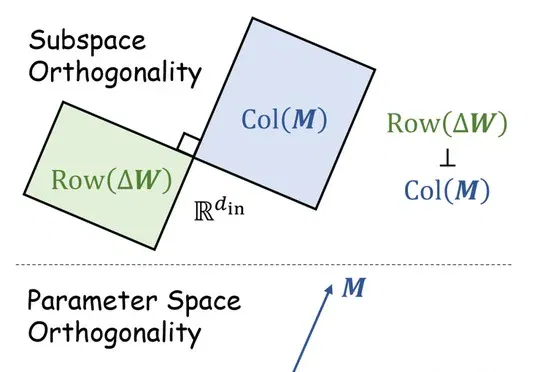
JANUS explores fine-tune-then-rectify: Jacobian projection to mitigate catastrophic forgetting (opens in a new tab)
Tsinghua and DiDi Autonomous Driving researchers propose JANUS, using Jacobian null-space projection and multi-step adaptive rectification after fine-tuning. Retention metrics improve on tested 7B/8B models; the necessary and sufficient condition concerns local first-order loss changes.
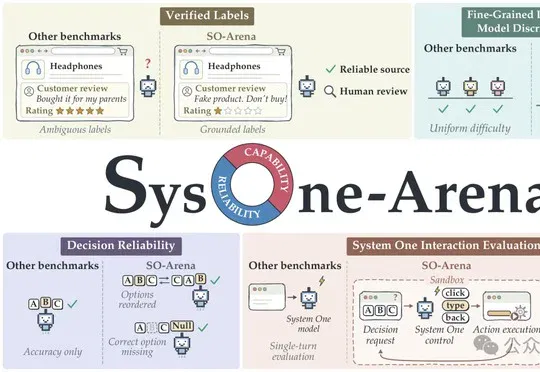
NUS Introduces SO-Arena: Measuring the Breadth and Reliability of System One Decisions (opens in a new tab)
NUS xML Lab's SO-Arena uses 2,919 tasks to evaluate capability, option-order stability, and recognition of absent correct answers. Capability and reliability rankings differ, while local H100 and remote API latency measurements use different conditions.
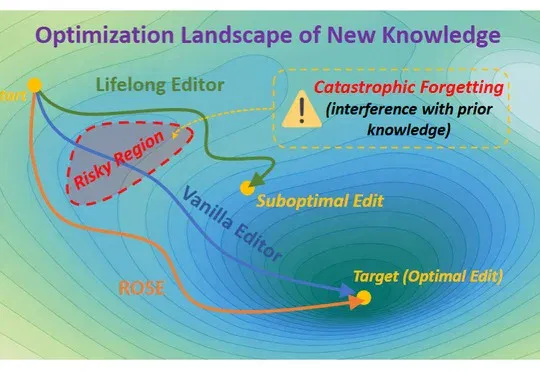
NPU proposes ROSE: Orthogonal editing and knowledge integration reduce interference in multimodal updates (opens in a new tab)
Northwestern Polytechnical University proposes ROSE for lifelong multimodal knowledge editing. Risk-aware orthogonal editing and multi-granularity integration reduce interference; reliability, generalization, and locality are evaluated on specified VLKEB and MMEdit setups.

miHoYo unveils Gamer VLA research for long-horizon memory and real-time game control (opens in a new tab)
miHoYo’s Honkai AI R&D team presents Gamer, generating keyboard and mouse actions from screens, instructions and memory. The team reports over 95% autonomous runtime across five Star Rail story chapters and about 50 hours; this is not a task success rate.
Why do large models develop massive activations? Tsinghua and Peking study finds a backpropagation clue (opens in a new tab)
Researchers connect attention sinks and massive activations through backpropagation, proposing that RMSNorm lets large activations regulate local gradients. V-scale and backward-only experiments support this explanation, primarily in Llama-style dense models.