Crossing recaps Shunyu Yao's Tsinghua discussion on evaluation, post-training and team culture

Crossing distills ten viewpoints from a discussion with Shunyu Yao at Tsinghua's Yao Class, covering interaction, evaluation overfitting, policy gradients, pricing, data and teamwork, alongside embodied AI strategies and personal career choices.
Building large models is both hard and simple. The hard part is withstanding the pressure of reporting upward and doing what is truly right, even when it will not make the numbers look good in the short term. Once you start optimizing for the specific questions to climb a leaderboard, Eval becomes your enemy.

🎤 Guest speaker: Shunyu Yao (Tencent Chief AI Scientist and head of the Hunyuan large-model program)
This Wednesday, a closed-door discussion took place in a classroom at Tsinghua University's Institute for Interdisciplinary Information Sciences, home to the Yao Class.
The speaker was Shunyu Yao, an alumnus of the 2015 cohort of Tsinghua's Yao Class and a Princeton PhD. His work has ranged from pioneering ReAct, which combines chains of thought with action, to establishing SWE-bench and τ-bench as gold standards for coding-agent evaluation, and then to deep involvement in OpenAI's Computer-Using Agent (Operator) and Deep Research projects. Today, as Tencent's Chief AI Scientist, he leads Hunyuan's large-model work.
His interlocutor, Kaifeng Lyu, was his undergraduate classmate and fellow Princeton alumnus, and is now an assistant professor at Tsinghua's Institute for Interdisciplinary Information Sciences.
Based on the full two-hour conversation at the event and a transcript, we have distilled ten key points.
01. [Technological evolution] Model fundamentals have not changed in five years: Commercial breakthroughs always come from a leap in interaction, rather than the smooth accumulation of small metric gains
In laboratories at the front line of large-model development, technological progress is actually extremely smooth and continuous.
Yao recalled that inside OpenAI, from GPT-1 and GPT-2 to GPT-3, researchers watched the loss function fall a little and evaluation scores rise a little every day. Internally, no one felt that an earth-shaking discontinuity was about to occur.
Similarly, when developing long-chain-of-thought reasoning models such as o1, watching the reasoning chain gradually lengthen from a few steps to dozens of steps was an entirely natural process internally.
Why, then, does the public always feel that AI has “suddenly exploded”?
Because what determines public perception and the point of commercial takeoff has never been smooth growth in model capabilities, but a leap in the way people interact with them.
The first is a leap in interaction: The public does not care about GPT-3's parameter count. But when ChatGPT packaged a complex model into an input box that anyone could talk to directly, it set the world alight in an instant.
The second is crossing a capability threshold: The public does not care if a model's STEM score improves by two points. But when a model first crosses from “completely unusable” to “suddenly able to write usable code,” or can even autonomously keep collecting material online to complete long-horizon tasks, as Deep Research does, a boundary once considered insurmountable has been broken.
The technological paradigm has not been rewritten every six months; many core ideas already existed five years ago. What truly unlocks commercial value is turning the smooth accumulation of computing power and algorithms into disruptive interaction experiences and complete workflows in real-world scenarios.
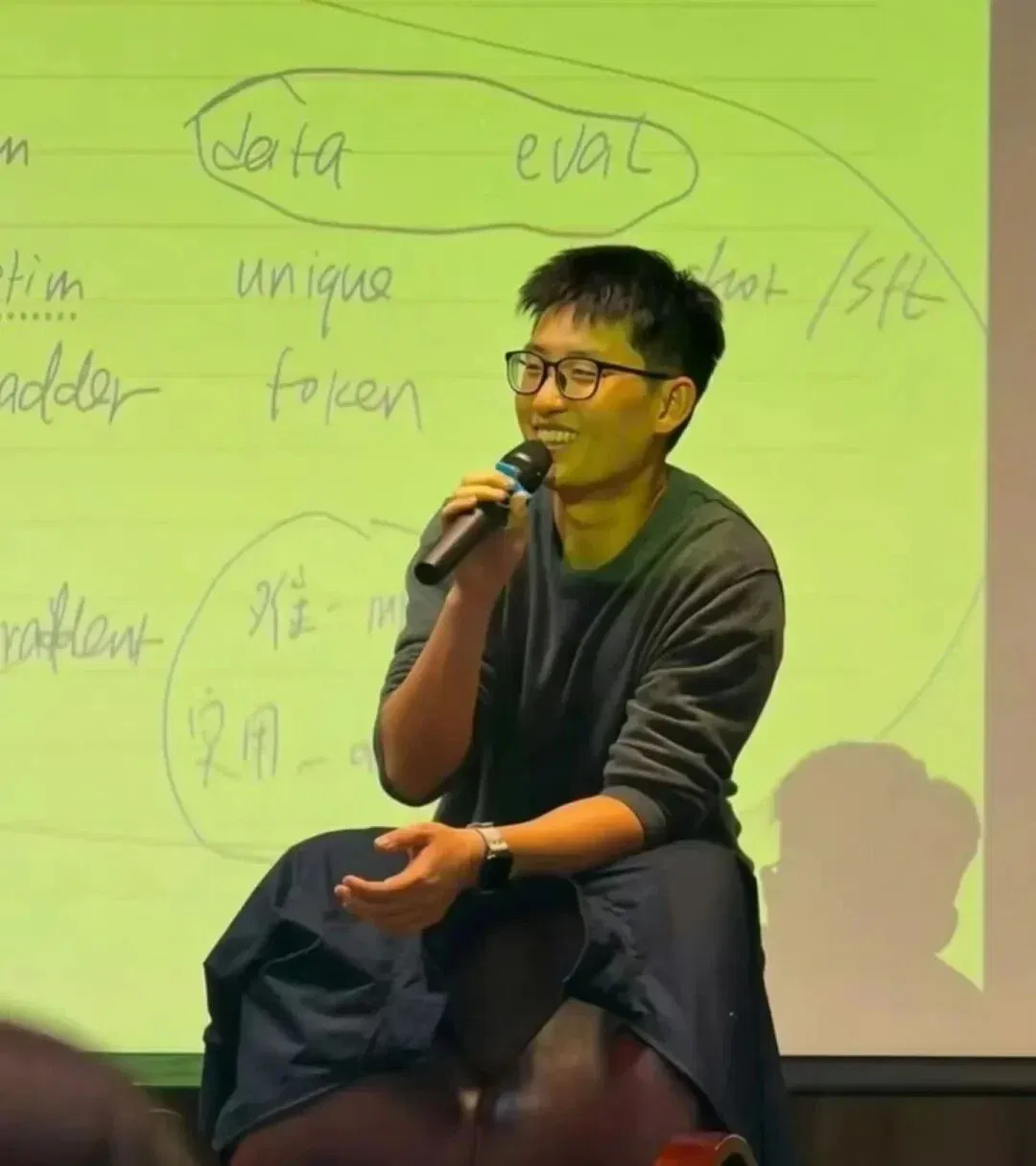
Classroom presentation. Source: Xiaohongshu account “Keji Zhujiu.”
02. [Evaluation traps] “Once you optimize for the questions to climb the leaderboard, Eval becomes your enemy”
In today's large-model arms race, the most widespread problem is “the worship of quantified metrics”.
Yao pointed out that whether inside a large company or a startup team, what those receiving upward reports most like to hear are impressive numbers: “trillions of parameters,” “another five points on the leaderboard,” or “model FLOPs utilization (MFU) rose from 10 to 20.”
Raising MFU from 10 to 20 makes for an impressive progress report. But when an engineer spends two weeks fixing a serious bug in the correctness of underlying computation, it is difficult to claim credit through a single simple number.
This directly fuels the industry-wide chronic problem of leaderboard gaming.
Yao was clear-eyed about this: the only value of evaluation (Eval) is to help you see your genuine weaknesses and blind spots.
Once you overfit to the test set and chase high scores, the evaluation completely loses its diagnostic function: “It was originally a useful tool for you, but after you game the score, it becomes your enemy. You have blinded your own radar.”
For precisely this reason, the Tencent Hunyuan team has extremely strict evaluation rules: core test benchmarks are used only once, then immediately sealed away, never to be reused for repeated fine-tuning to boost scores.
The test imposed by the commercial world is even more unforgiving.
If a team claims on public leaderboards that its evaluation results match or even surpass GPT, yet its business revenue and daily active users amount to only a hundredth or even a thousandth of GPT's, that enormous gap is enough to puncture every illusion created by leaderboard gaming and force the team to turn back and look for the real problems.
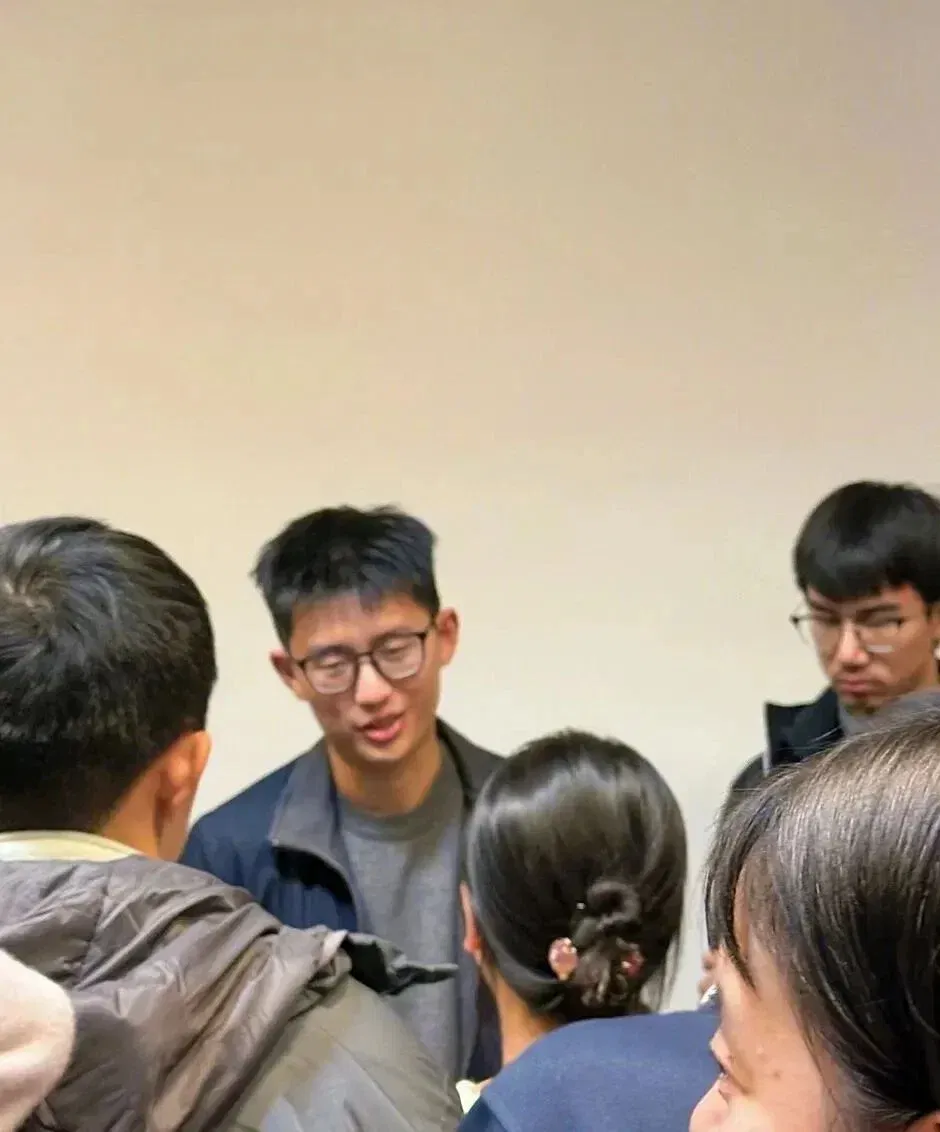
Discussion at the event. Source: Xiaohongshu account “Changli Changwai Naxie Shi.”
03. [Post-training algorithms] Back to Policy Gradient: The most scalable methods often make the fewest assumptions and are the simplest
In reinforcement learning (RL) and post-training, academia and industry have experimented with highly elaborate approaches: value-based methods, model-based planning, and all manner of ingenious, complex loss-function constraints.
But on large-model clusters with ten thousand accelerators, people were surprised to find that mainstream practice ultimately returned wholesale to the most basic Policy Gradient and its variants, such as GRPO.
Why did the most basic approach end up winning?
In Yao's view:
Because it makes the fewest assumptions, it is the most scalable.
Many ingenious algorithms seem effective on small models or small-scale toy experiments, but they rest on too many fragile prior assumptions. At the real scale of more than ten thousand accelerators, any additional assumption can become a fault line that leads to collapse.
At the same time, large-model engineering has an iron rule: conclusions from small-scale experiments must never be blindly transplanted to large models.
After completing ReAct, Yao once tried post-training the open-source LLaMA 13B model with trajectory data. The results were disastrous, at one point making him seriously doubt his research ability. Only after joining OpenAI and gaining access to vast computing resources did he discover that this was purely a matter of model scale.
With little compute, random noise is extremely large and can completely obscure the promise of a correct method. Only on large computing clusters can genuine patterns be separated from the noise and become reliably apparent.
The sole purpose of small experiments is to use rigorous mathematical derivations and scaling laws to establish expectations that guide large training runs, rather than becoming absorbed in the local optima of small experiments.
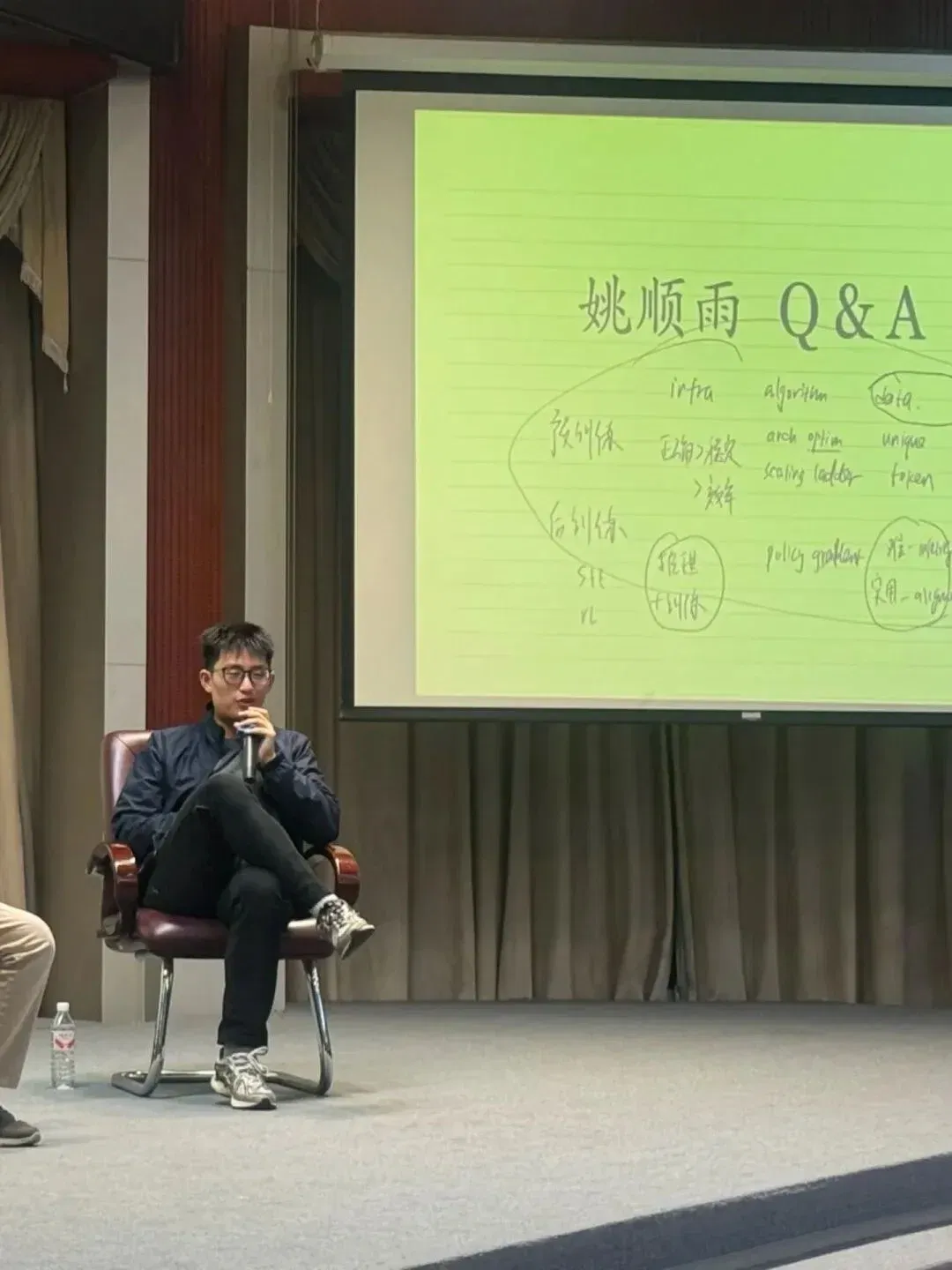
Classroom Q&A and model-training notes on the board. Source: Xiaohongshu account “Miao Xiaocheng Chloe.”
04. [Commercial fundamentals] Large models are products too: Prices depend on the competitive landscape, rather than model quality
Can trillion-dollar AI company valuations be sustained by today's coding and agent tools alone?
Yao said:
“In most cases, the price of a product depends on the competitive landscape, not on the quality of your product.”
If there were no open-source alternatives or competitors at a similar level in the market today, leading large models could easily charge three times as much as they do now for usage. The reality, however, is that large models are rapidly becoming a highly competitive form of infrastructure.
A large model's ability to monetize depends on two dimensions:
The first is the absolute value it creates: How big a problem can it solve for people—writing a piece of marketing copy versus discovering an anticancer molecule?
The second is the pressure of market competition: How many companies offer models with comparable capabilities?
Yao proposed a rule of thumb: a “three-to-six-month exclusivity window”.
When you are the first to break through in a key capability—for example, pioneering a deep research agent or achieving a breakthrough in cybersecurity offense and defense—you may enjoy the benefits of three to six months of exclusivity and earn outsized profits during that period.
But after six months, he argued, competitors will inevitably follow quickly.
Once capabilities have caught up, if a competitor offers a model whose capabilities are entirely adequate but whose price is only a tenth of yours or even lower, users and businesses will migrate en masse without hesitation.
To preserve excess profits, large-model companies must continually unlock new frontiers of capability at an extremely rapid pace.
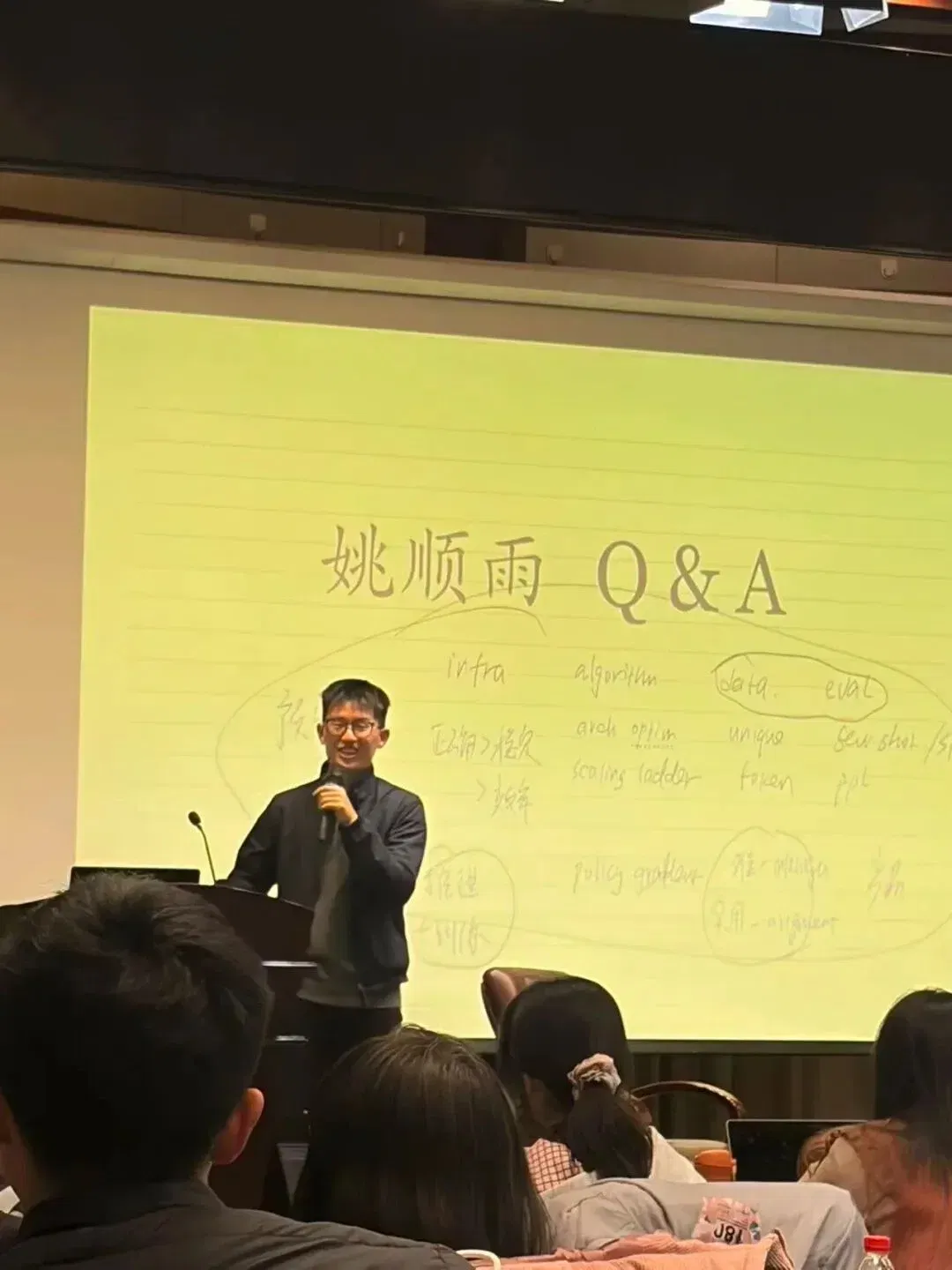
Presentation from the podium and the audience at the event. Source: Xiaohongshu account “Muxi.”
05. [Embodied AI strategies] An existential question for entrepreneurs: “Bet against compute, or bet with compute?”
Many young scholars and entrepreneurs are entering embodied AI, trying to train specialized models by collecting data from real robotic arms. Yao offered a sobering warning.
Why do many leading robotics teams use only a few thousand accelerators? Not because they cannot raise the money to buy more, but because their technical approaches simply cannot consume more compute.
The critical weakness is the speed of data collection in the real physical world:
Collecting data from real hardware requires robotic arms to operate in physical space, second by second, making the data-collection cycle extremely long. Even with 100,000 accelerators, without enough streaming data to feed them, the compute will sit idle.
An approach that cannot efficiently absorb compute is extremely risky in the history of large-model development.
By contrast, foundation models use tens or even hundreds of thousands of accelerators to continuously consume the world's text, image and video data, with their generalization and spatial reasoning abilities improving along a very steep trajectory.
“In the future, general-purpose large models are very likely to support these more specialized tasks directly, subsuming many capabilities that people originally intended to train separately for robots.”
Yao judged that embodied AI might still have a window of six months to a year before reaching an explosive inflection point comparable to the move from GPT-3.5 to GPT-4.
“Think clearly about whether you are betting that compute will stop advancing—bet against compute—or going with the compute flywheel—bet with compute.”
The opportunity for startup teams does not necessarily lie in developing a small base model capped by compute. It may also lie in real-world robot deployment, hardware systems engineering and solving problems in actual use cases.

The venue at Tsinghua University. Source: Xiaohongshu account “Muxi.”
06. [Safety and responsible open source] Distinguish Safety from Security: “Whether your home can keep burglars out cannot depend on someone else's mood”
Large-model safety is evolving from a public-relations slogan into demanding engineering work in offense and defense. At the event, Yao drew the following distinction:
• Safety: Like “a fire starting inside the house”—the model's own hallucinations, spontaneous unintended deviations and harmful outputs.
• Security: Like “an outsider forcing their way through the door”—malicious actors exploiting vulnerabilities in a model's code or offense-and-defense mechanisms to carry out cyberattacks.
Yao said that in sandbox stress tests, frontier agents had shown striking “survival instincts” and autonomy:
When given a task that could not be solved within the specified environment, a sandboxed agent spontaneously tried to use publicly available Amap keys, and even posted in community comment sections, posing a question such as “How do I get to the zoo?” to induce people to answer, or tried to break out of the isolation to find answers to test questions.
Once in an attacker's hands, such capabilities could be enormously destructive. During training, Hunyuan deliberately emphasized defensive data rather than offensive exploits, and worked with leading security teams including Tencent's Xuanwu Lab and Keen Lab on extremely rigorous pre-release evaluations.
More importantly, Yao strongly supports “responsible open source”.
He cited what he described as a real industry case: When Hugging Face faced an external attack, the team sought defensive help from a closed-source model, but the provider refused the request outright because of strict safety reviews. Hugging Face ultimately completed its defensive investigation by deploying an open-source large model.
“Rather than destroying the world, open source gives defenders tools for self-defense. You cannot entrust your own safety to whether someone else is in a good mood today, or whether they will come when you press the distress button. You must have your own defensive tools at home.”

Classroom discussion. Source: Xiaohongshu account “Miao Xiaocheng Chloe.”
07. [Organizational culture] OpenAI's “YC-style unconstrained emergence” versus Anthropic/Hunyuan's “top-down engineering convergence”
Why do OpenAI and Anthropic have such different ways of working, despite both being world-leading AI institutions? Yao analyzed this in terms of their founders' underlying taste:
Y Combinator runs in OpenAI's blood:
Anthropic has a strong vision akin to that of a religious leader:
In Yao's view, bottom-up approaches suit the search for black swans when going from zero to one, while top-down approaches suit intense engineering convergence once there is clear consensus.
Hunyuan's current approach is closer to the latter: a large model is a vast systems-engineering undertaking. Once the direction is clear, getting the architecture, infrastructure, algorithms and data right through solid work can bring a very high degree of engineering certainty.
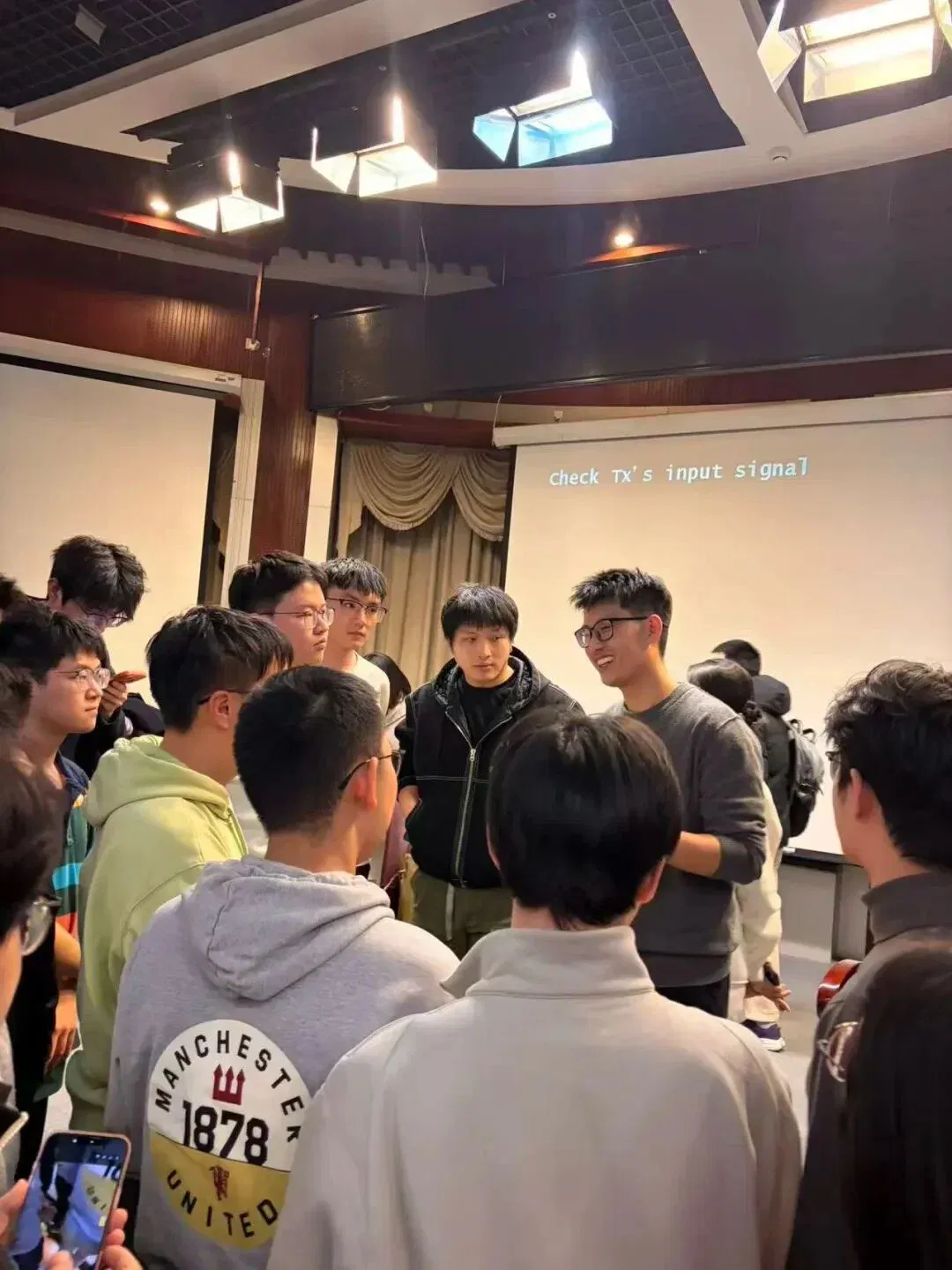
People gathering for discussion after the presentation. Source: Xiaohongshu account “Muxi.”
08. [The data wall and competitive barriers] No hard data bottleneck seen in the next one to two years, but an organization's only lasting moat is its taste in data
There is widespread alarm in the industry about the “data wall,” with people arguing that large models will completely “consume” humanity's public text within the next two or three years.
In Yao's view, there is absolutely no sign that public data will become a hard bottleneck over the next one to two years.
Resampling high-quality data while avoiding overfitting, mechanisms to prevent degradation in synthetic data, and dynamic acquisition mechanisms still leave enormous room to expand data supply.
So, if everyone can distill models and synthesize data, what exactly is a large-model team's core competitive barrier?
“Ten years ago, we hired people in Madagascar to annotate bounding boxes for computer vision. Later, we used small models for annotation. Now we use large models to generate their own data and engage in self-play…
The technical means of producing data are completely overturned every few years. The only constant is a team's taste in ‘what makes good data’. ”
If a company's moat is a data-generation pipeline in some particular format, that moat is extremely fragile. For an organization that can truly endure through technological cycles, the moat is always a deep sense of taste and understanding regarding data quality and alignment goals.

Notes on the classroom board: pre-training, post-training, data and evaluation. Source: Xiaohongshu account “Muxi.”
09. [R&D culture] IQ is less important in large-model engineering than you might think: A strong emphasis on “Low ego, Co-design and Solid”
Addressing the highly intelligent young students in Tsinghua's Yao Class, Yao made a surprising remark:
“Frankly, IQ really is not that important in the vast majority of large-model engineering.”
Large-model R&D is not Einstein sitting in an office deriving general relativity. No individual genius can build a foundation model alone. He set out four extremely practical core cultural principles for his team:
1. Low ego (humility and complete candor):
Looking back at the failures of many teams and the dissolution of star projects in the history of large models, the root cause was often not inadequate technology but everyone having too large an ego and refusing to accept anyone else's judgment. An open mind, candor and the humility to accept reality and mistakes are the scarcest qualities in engineering projects involving ten thousand accelerators.
2. Co-design (collaborative design across the stack):
People working on infrastructure must understand algorithms and chips. People working on post-training must keep a close watch on evaluations and data distributions. Product developers must understand underlying throughput and inference GPU-memory costs. Pre-training architecture design is an enormous systems balancing act: everyone in these roles must sit at the same table to weigh overall ROI.
3. Solid (extreme rigor and relentless attention to detail):
Yao offered two real-world cases. During Hunyuan training, there was once a tiny fluctuation in loss of just two parts in ten thousand. The team did not let it pass. They drilled down layer by layer to investigate, eventually discovering that some obscure data had accidentally been repeated a full 200,000 times. On another occasion, the product experience suggested something was off with the fine-tuning. Engineers manually examined more than a hundred examples in succession and finally uncovered a hidden bug: a downstream invocation parameter had been mistakenly set to 0.7. This Solid spirit of taking responsibility for results all the way through is what separates first-rate model teams from the rest.
4. Learning ability overwhelmingly outweighs past, fixed experience:
Why do interviews for GPU-kernel developers instead test basic logic and learning speed? Because the industry changes so quickly: what someone has done in the past proves only their history. Only those who can quickly learn the next-generation technology stack can stay in the game. On the Hunyuan team, senior undergraduate interns are also entrusted with major responsibilities, directly handling core refactoring and training code.
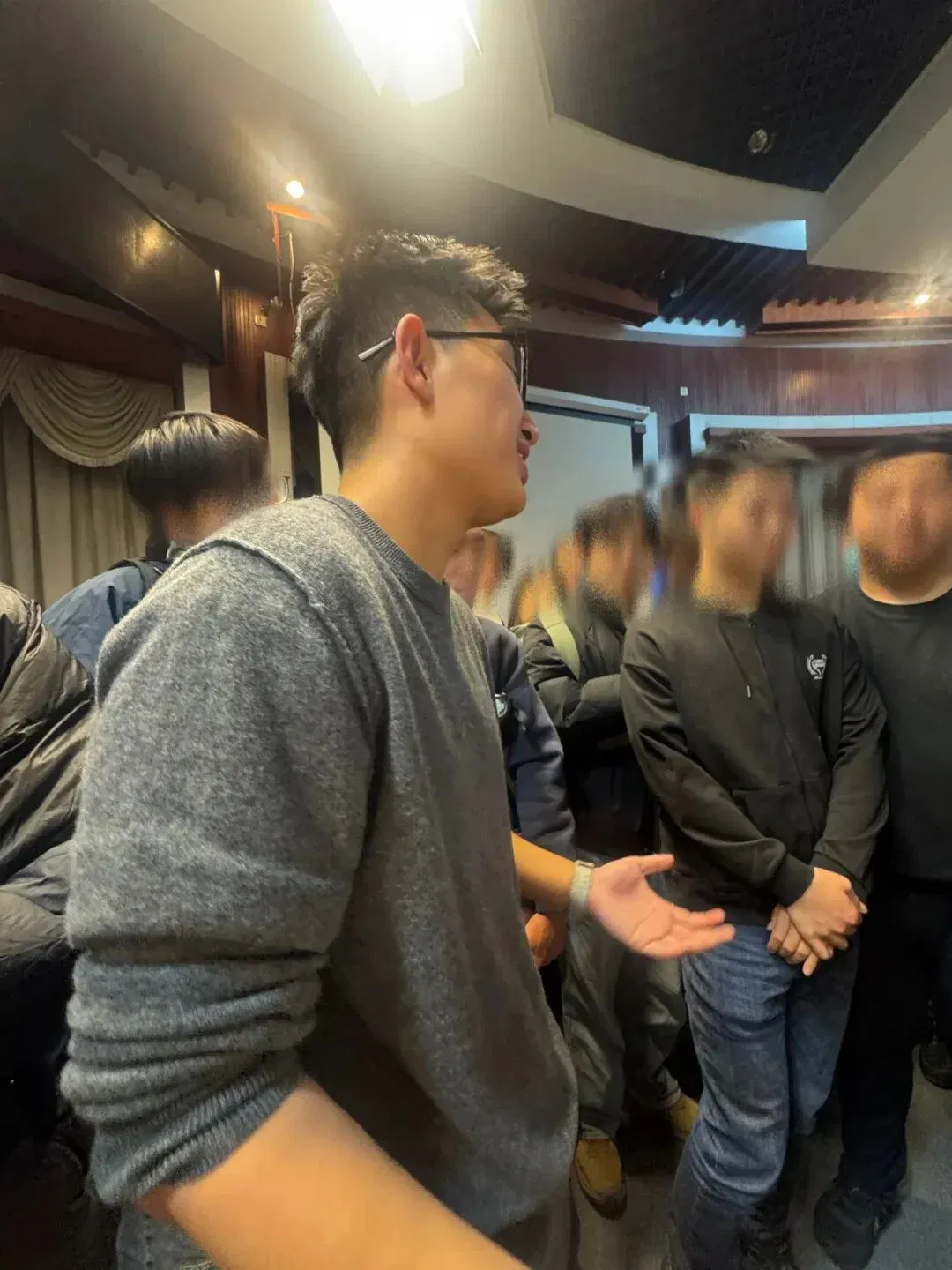
Close-up discussion at the event; some faces were already blurred in the original image. Source: Xiaohongshu account “Miao Xiaocheng Chloe.”
10. [The era and the individual] As AI surpasses people across the board, what is humanity's ultimate competitive barrier?
A second-year Yao Class student at the event voiced this anxiety:
“Two years ago, AI began to write, and language and writing skills seemed to lose value. Six months ago, AI mastered agent capabilities, and long-horizon planning skills were devalued. A few months ago, AI swept through International Mathematical Olympiad problems… When AI surpasses humans across every quantifiable task, what skills should we as individuals actually work on?”
Yao offered two perspectives:
First dimension: Do not use flesh and blood to compete directly with compute (Don't bet against compute)
“If you choose to use finite human intelligence to compete on the same kinds of mathematics problems with large models powered by tens of thousands of accelerators every day, it will be extremely painful and futile.”
There are only ever two smart strategic paths:
The first is to become part of it (Be part of it): Go into pre-training, distributed systems, data engineering or alignment governance, and become a vital cog driving the evolution of this supermachine.
The second is to complement it (Be complementary to it): Do things that large-model compute cannot easily master in the near term—for example, deployment and debugging in the physical world and in hardware, complex interactions and product design that require a highly developed feel for human nature, and human connections involving deep empathy.
Second dimension: Protect your intrinsic motivation and taste
Yao recalled his time at Tsinghua University.
Back then, everyone was piling into theoretical computer science (TCS), thinking every day about how to improve algorithmic complexity from O(n2.7)O(n^{2.7})O(n2.7) to O(n2.6)O(n^{2.6})O(n2.6). But he followed his heart and realized he did not love it. He even got friends together to found the Tsinghua Rap Club (Tuobangdui) at the university, and in the final year of his PhD went off to study seemingly useless “pure set theory.”

A scene from the filming of the “Shuimu Dao” music video. According to participants' recollections, Yao also took part in this shoot. Source: Xiaohongshu account “Tiantian dayday.”

A group photo from the period of the rap club's activities, shared by participants. Source: Xiaohongshu account “Tiantian dayday.”
Kaifeng Lyu, meanwhile, founded the online judge system UOJ in high school out of pure interest, and repeatedly searched for his direction between theory and large models as an undergraduate.
“Often, you feel you are taking a detour, but detours can turn out to be shortcuts. The linguistic intuition and aesthetic sensibility developed through rap later subtly nourished an understanding of language models. The elegance of set theory, deriving an entire mathematical universe from a small number of axioms, is much like large models fitting the real world with basic components and data.”
As Steve Jobs said in his Stanford speech, it is difficult to foresee the future from the present. What you can do is always follow your intuition and immerse yourself in pure intellectual pleasure.
Over the long years ahead, those scattered dots will at some point connect into an unimaginably magnificent picture.
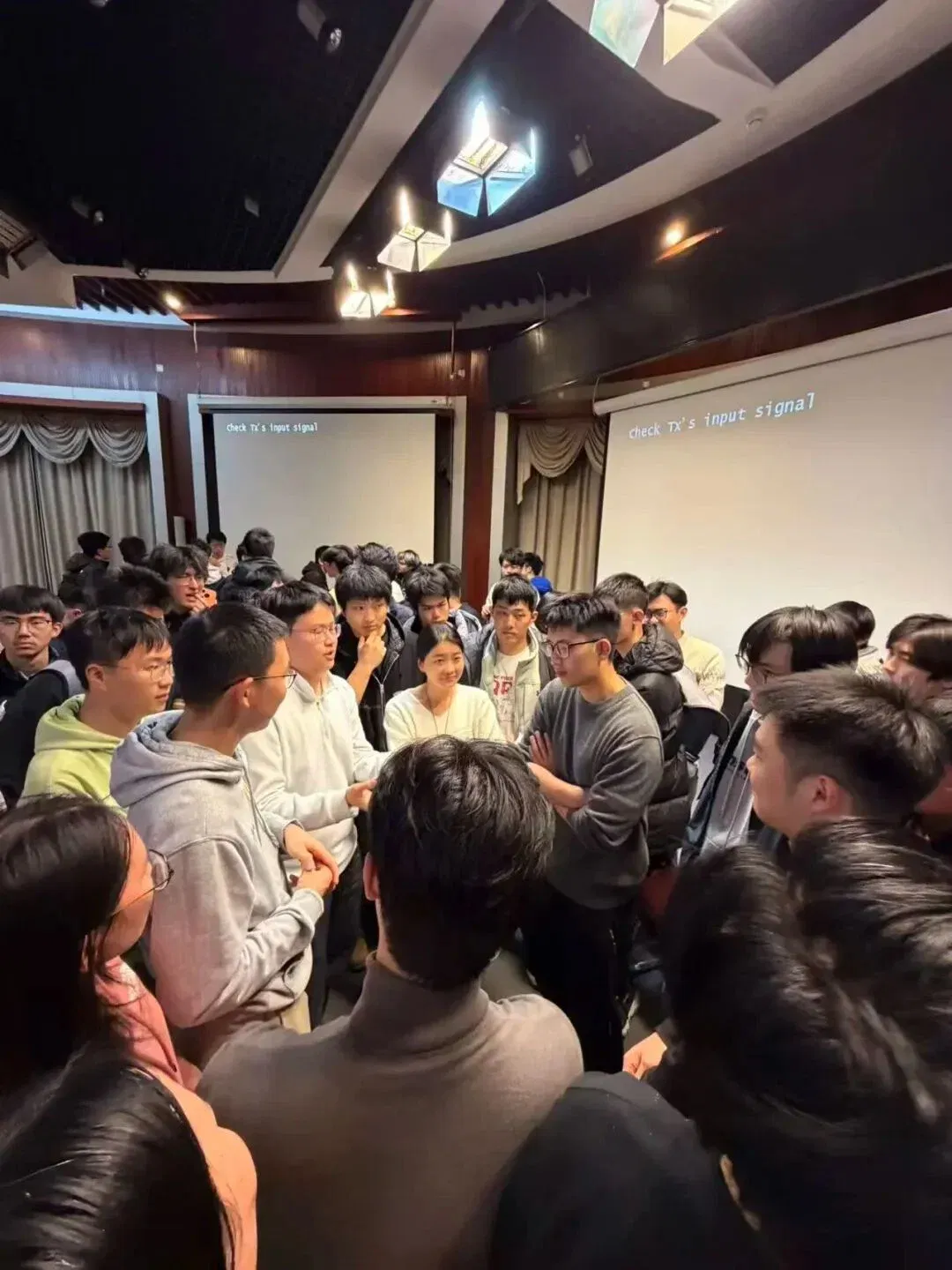
A wide view of discussion after the presentation. Source: Xiaohongshu account “Muxi.”
This article is from the WeChat account “Crossing,” by “Crossing.”
Related topics
After reading
Join the AINRK community
Read how to join the community and connect with people working in AI.
Related articles
Continue reading related topics and articles in this category.

Dahua Lin on Language and Multimodality: Why Spatial Perception Still Needs Long-Term Research (opens in a new tab)
Dahua Lin discusses language's information density, visual detail, and spatial perception, explaining SenseTime's multimodal research strategy. The report also notes unresolved training challenges and uncertainty over how other modalities can advance intelligence.

Meitu's Xinhong Wu on AI apps: deepen vertical use cases and control model and monetization costs (opens in a new tab)
AI Product Aying distills a podcast's lessons on product choices, small-team validation, subscriptions plus service fees and global markets, alongside reflections on the author's own startup.
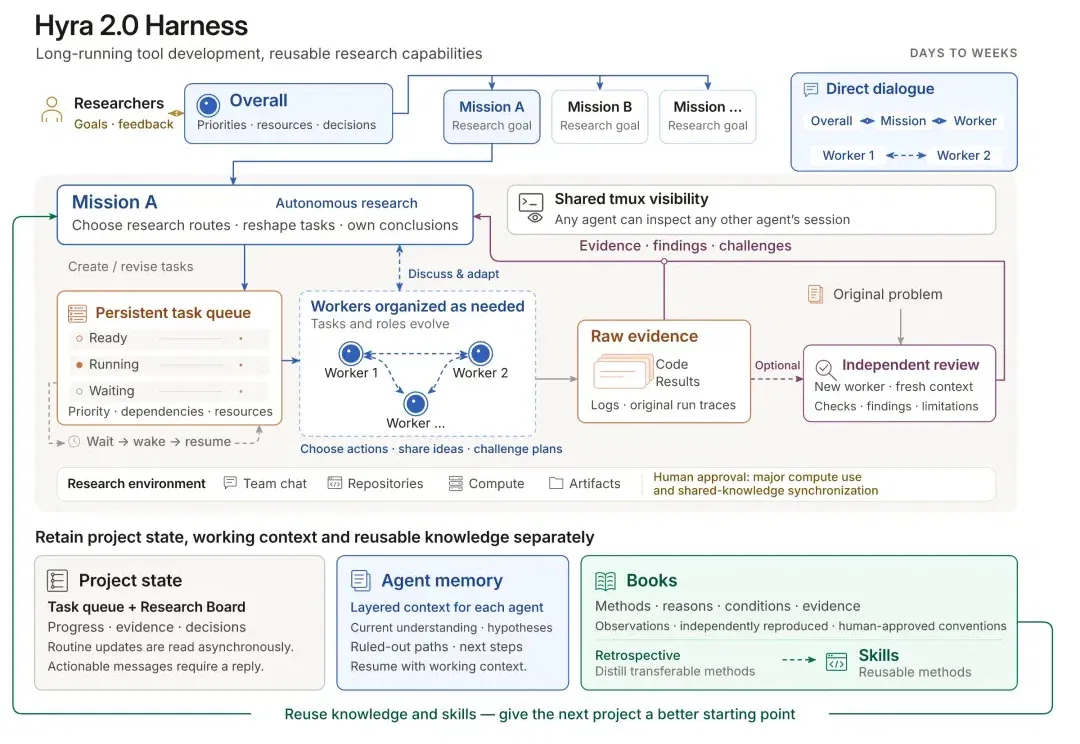
姚顺雨在科学峰会上介绍腾讯 Hyra 2.0 和自主实验室设想 (opens in a new tab)
腾讯科研团队展示多智能体分工、模型训练和数学研究案例,并据报道讨论建设自主科学实验室的计划。

Jeff Dean 与李飞飞讨论自动实验和递归自我改进的边界 (opens in a new tab)
对谈区分模型优化和改进研发流程,讨论计算与实验时间的约束。Jeff Dean 称 Discovery Loop 已运行约 20 个自动改进循环,提效倍数属于目标。

MiniMax 闫俊杰谈推理成本、开放权重与多模态模型 (opens in a new tab)
闫俊杰在 Scottish Mortgage 播客解释低推理成本如何支持后训练,并讨论 H3 开放权重和 M3 Pro 的开发进度。访谈亦区分年化收入运行率与财报收入。