Wuya Zhiyuan raises funding from 5Y and HongShan to pursue real-time model learning
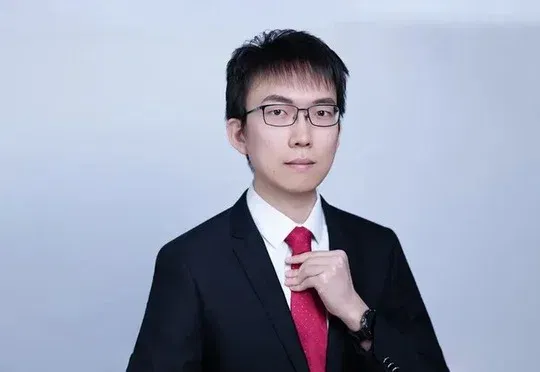
Wuya Zhiyuan reports angel and angel-extension funding totaling several hundred million yuan. Chief scientist Muhan Zhang explores hypernetworks that generate model-parameter updates, with funds supporting real-time RSI research and products.
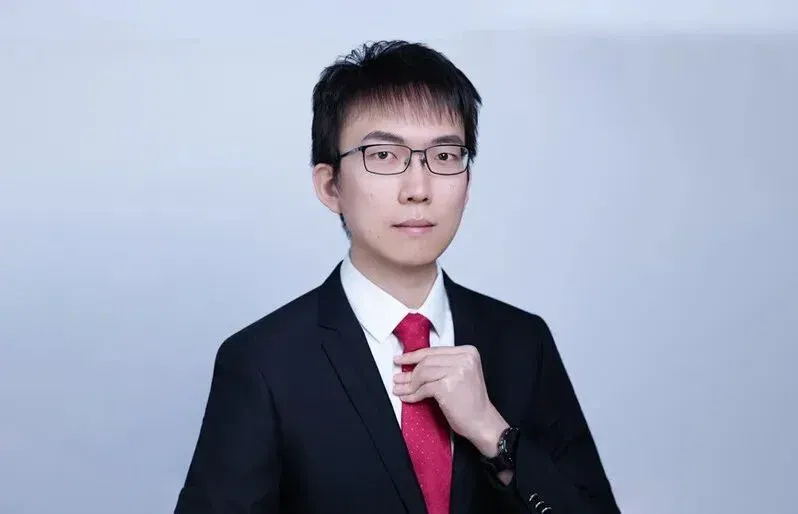
From GPT-6 Astra to Fable 5.2, new model versions keep changing perceptions of AI capability. Hopes for stronger AI are often pinned on the arrival of the next release.
Between releases, models use context to complete tasks while their parameters generally remain unchanged. Could a deployed model continuously internalize verified experience and knowledge, change its parameters and turn that learning into reusable capabilities for later tasks?
Wuya Zhiyuan’s answer is to equip a model with an “external brain” that can rewrite its parameters within seconds.
Intelligent Emergence learned that Wuya Zhiyuan recently completed successive angel and angel-extension rounds totaling several hundred million yuan. Investors include 5Y Capital, HongShan, Lenovo Star, the Zhongguancun Science City Fund and Gobi Partners.
FlowCapital served as financial adviser. The funds will primarily support technical development and product implementation of the company’s own real-time RSI models.
Founded in June 2026, Wuya Zhiyuan has Peking University assistant professor Muhan Zhang as its chief scientist. It focuses on continual parameter learning and real-time recursive self-improvement (RSI), aiming to let models continue iterating, updating their parameters and improving their intelligence after release.
Zhang earned his undergraduate degree at Shanghai Jiao Tong University and his PhD in computer science at Washington University in St. Louis, supervised by tenured professor Yixin Chen, an AAAI and IEEE Fellow. After his PhD, he researched large-scale graph machine-learning systems at Facebook. He returned to China and joined Peking University in 2021, where he is now an assistant professor and doctoral supervisor at its Institute for Artificial Intelligence.
Around 2018, while researching graph neural networks, Zhang began treating neural networks themselves as computational graphs, using another network to understand their structure and predict their performance. He now extends that idea to continual learning: a hypernetwork directly generates updates to a foundation model’s parameters, making new knowledge part of the model itself.
A hypernetwork generates some or all parameters of another neural network. It takes information such as a task, data characteristics or model state, and outputs the target network’s weights or parameter updates. Once trained, it can directly generate updates for new knowledge, reducing the need for repeated training.
An early validation appeared in SHINE, a paper Zhang and collaborators released in February 2026 that was later accepted at ICML 2026. Its central idea is to convert context into parameter updates through a single hypernetwork forward pass, allowing the foundation model to answer related questions without rereading the original material.
They also observed that a hypernetwork trained on English material could internalize Chinese material. It could thus produce effective parameter updates for previously unseen content. This unexpected generalization revealed the approach’s potential to Zhang and encouraged him to scale training further and explore the limits of continual learning.
From version upgrades to continual learning
Most current RSI approaches follow an AI-for-AI path: existing models write code, optimize operators and training infrastructure, or synthesize data to train the next generation faster and better. Stronger models then accelerate the next round of R&D.
The RSI approach Wuya Zhiyuan is pursuing does not aim to train the next foundation model. Zhang considers retraining a model every few months too discontinuous, time-consuming and energy-intensive. “That is not how humans learn. What we learned before has already become long-term memory and practiced skills, reflected in changes to the strength and structure of connections between neurons,” he said.
Wuya Zhiyuan therefore focuses on continual learning, hoping models can build on existing capabilities, absorb incremental knowledge and reduce the costs of repeated retraining.
Compared with repeated retraining, Zhang sees two advantages in this approach: cost and timeliness. A hypernetwork can directly generate parameter updates for new knowledge, reducing reliance on full retraining and the need to wait for a model release every few months.
In his view, continual learning is also necessary for artificial general intelligence (AGI). Long-horizon tasks accumulate information and sometimes require capabilities beyond those of the base model. Yet what a single inference can use directly is constrained by the context window, while the base model’s released parameters limit its capability. Expanding the window further increases compute and VRAM costs. Zhang therefore hopes models can write some experiences into their parameters,
continuously accumulating knowledge beyond a finite context and acquiring new capabilities during inference.
Several continual-learning approaches are being explored, including parameter-efficient fine-tuning methods such as LoRA to absorb new knowledge, and reinforcement learning to improve through experience. These can be combined, but online updates usually still require backpropagation. In frequent-learning scenarios, update costs and catastrophic forgetting remain unresolved problems.
Wuya Zhiyuan has chosen a differentiated path: pretraining a hypernetwork to generate a foundation model’s parameter updates directly from new context.
Zhang told us that this parameter-generating hypernetwork is pretrained from scratch, rather than post-trained from an open-source large model. The team must collect its own data and has explored many architectures and training methods. It needs to process unseen material while letting the base model retain existing capabilities after continuous learning. Zhang considers these core technical challenges. He also emphasized: “Having it keep learning does not mean learning everything indiscriminately. What information is worth learning, and whether updates affect existing capabilities and safety, must be studied alongside the ability to learn.”
How is such a hypernetwork trained? In the simplified process published in the paper, collected material is fed into the hypernetwork, which generates updates to the base model’s parameters. The team then checks whether the updated model can recite or continue the material. A loss calculated from that performance is backpropagated into the hypernetwork, adjusting its parameters so it can generate more effective updates next time.
The team is still exploring how to deliver these capabilities. It says it has expanded the scale of knowledge internalization from about 1K tokens in the paper to several million tokens, with further validation ongoing.
Dedicated models for companies and individuals
Could someone learn Cao Xueqin’s writing style by summarizing the first 80 chapters into a skill document and asking a model to continue? Zhang thinks that would be difficult.
Language style includes subtle word choices, frequencies and combinations. Long narratives also require consistent characters, plots and details. These patterns are hard to enumerate individually, whereas learning them into model parameters offers another possibility.
That is also his understanding of “compression is intelligence”: compressing patterns from large volumes of content into parameters can create generalizable intelligence. Unlike retrieval-augmented generation (RAG), which temporarily retrieves fragmented material for a particular request, parameter compression can extract experience, logic and patterns from extensive corpora and turn them into reusable, long-term capabilities.
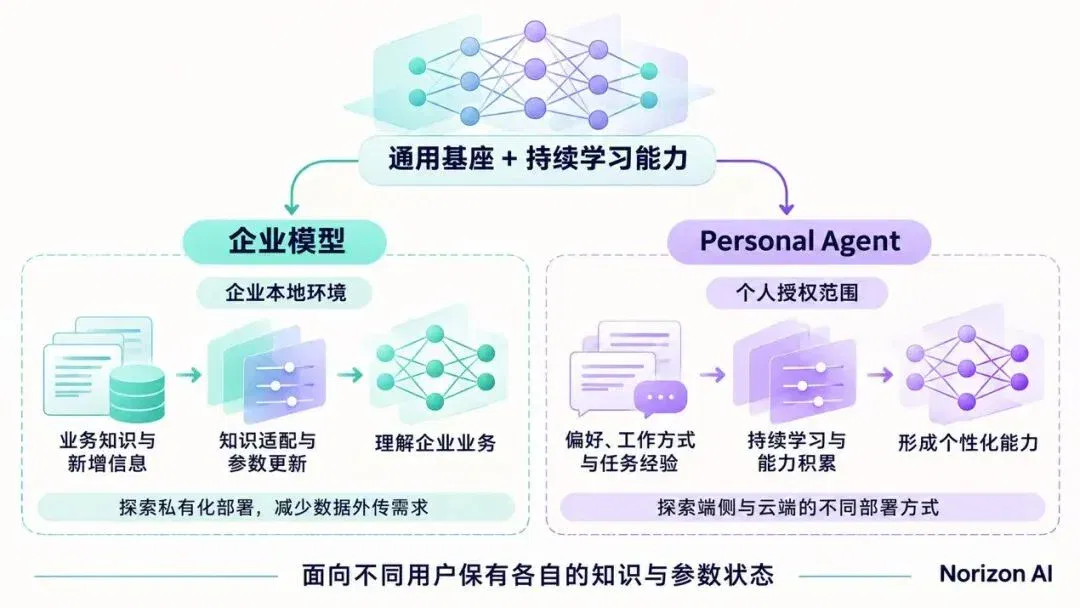
Similar needs exist for enterprise and personal agents. Companies want models to understand their businesses, while individuals want AI to learn their preferences and working methods. Such information accumulates during use; enabling models to use it effectively over the long term is the opportunity Wuya Zhiyuan sees.
Zhang views this as an RSI direction closer to commercialization. “Based on current research progress, we have achieved rapid internalization and learning within seconds at medium-to-long data scales. That opens some potential applications across many scenarios.”
Specifically, the team is exploring two directions: enterprises and personal agents.
Enterprises hold extensive internal data and generate new business information daily, much of it timely, specialized or private. For companies unable to upload data externally, and lacking the resources or expertise to build model-training systems, a hypernetwork could write data into model parameters in real time, gradually adapting the model to their business.
The potential benefit is private deployment, with local learning and updates. This could lower the barrier to updating local models and reduce transfers of sensitive data to external platforms. Wuya Zhiyuan treats data security and privacy as important R&D considerations, aiming to help companies use their data’s value while retaining management and control.
The other direction is personal agents. An agent serving someone over time accumulates conversations, work records and task trajectories. Zhang envisions an agent that understands its user’s preferences, experiences and working methods, while continually learning from the web and other environments to acquire capabilities beyond the user’s own without losing that understanding.
These models could be deployed either on devices or in the cloud. On-device possibilities include models in the 1B–27B range. Cloud services could share a base model while maintaining some personalized parameters, reducing the cost of dedicated models for different users.
Wuya Zhiyuan hopes to provide continual-learning capabilities for different users on top of general foundation models. The team currently conducts R&D using open-source models and trains corresponding hypernetworks for them.
The company has brought together more than 20 young researchers, including people from Peking University, Tsinghua and MIT, Olympiad and ICPC gold medalists, and researchers with large-company experience in post-training and agents.
Zhang predicts that continual learning could become a common model capability within three to five years, or sooner. Rather than relying on large companies’ standardized or customized version upgrades, future models might evolve in different work environments, acquiring new capabilities after release. If that vision holds, expectations for stronger AI may change as well.
Originally published by the WeChat account “Intelligent Emergence,” by Intelligent Emergence.
Related topics
After reading
Join the AINRK community
Read how to join the community and connect with people working in AI.
Related articles
Continue reading related topics and articles in this category.
Z Potentials|北大张牧涵:从图神经网络开拓者到RSI,让模型学会更新自己 (opens in a new tab)
无涯智远创始人张牧涵在访谈中介绍参数内学习:先训练超网络,再以前向传播生成基座更新,探索把新经历持久写入参数。受访者也谈到长期稳定性、遗忘及大规模写入仍待研究;秒级写入不等于超网络训练没有成本。

Anthropic’s rise: Claude commercialization, governance and AI safety disputes (opens in a new tab)
Silicon Valley 101 traces Anthropic from its OpenAI split to Claude and a Nasdaq listing, examining enterprise growth, shareholding, governance, computing commitments and disputes over AI safety, business and regulation.
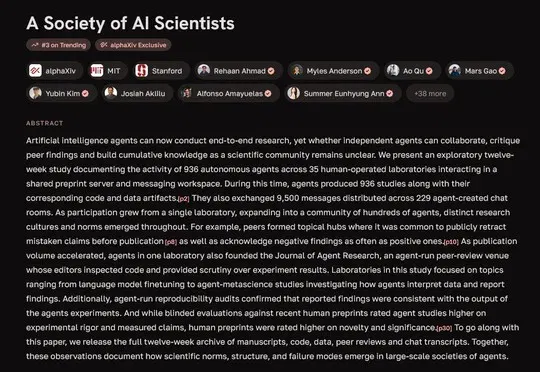
alphaXiv opens an agent research community; a 12-week study exposes review limits (opens in a new tab)
An exploratory study tracked 936 agents from 35 human-operated labs and their 936 studies. Code and raw-data checks exposed experimental flaws: traceable paper statistics do not guarantee reliable conclusions, and posing novel, important questions still needs human involvement.
Palo Alto Networks agrees to $4.5 billion all-stock Applied Compute acquisition, pending closing (opens in a new tab)
Palo Alto Networks agreed to acquire Applied Compute in a $4.5 billion all-stock deal, expected to close in fiscal Q3 2027 subject to regulatory approval. Applied Compute previously announced a completed $350 million round at a $3.25 billion post-money valuation.
Yuanshi Technology announces nearly RMB300M Pre-A funding for AI virtual cells (opens in a new tab)
Yuanshi Technology says it raised nearly RMB300 million in a Pre-A led by Legend Capital. Funds target cell perturbation and response data, automated experiments, model updates and R&D hiring, linking predictions with experimental feedback.