Microsoft Ignite updates MAI and Copilot for enterprise agent collaboration
Microsoft announces coding, security, voice and decision models alongside Copilot, Agent365 and MicrosoftIQ updates. Cost claims refer to specified tests; 50 million is a cumulative registered-agent count. Some features remain in preview or phased rollout.
Taking on GPT and Claude.
Zhidx reported on November 18 that, early this morning, Microsoft announced five new models and updates on two existing models at Ignite 2026. Across four coding benchmarks, its MAI Code 2 coding model achieved an aggregate score of about 98% of GPT-6.1 Sol's; its test cost, as a share of GPT-6.1 Sol's, was about 40%.
The five new models and upgraded versions announced this time were the coding models MAI Code 2 and MAI Code 2 Flash, the cybersecurity model MAI Cyber 2 Flash, the real-time voice-conversation model MAI Realtime 1, and the decision model Microsoft-Decision-1.1.
There were also updates on two previously released models. MAI Image 2.7, an image model released on October 27 this year, rose from second to first on Artificial Analysis's image-editing leaderboard, and Microsoft also introduced MAI Image 2.7 Flash. The medical speech-transcription feature Dragon Copilot Transcribe, built on MAI Transcribe 2 released this September, is already used in Microsoft's healthcare AI product Dragon Copilot, covering about ten million patient encounters a month and reducing multilingual transcription errors by roughly 50%.
Other models, as well as MAI Code 2, perform close to or even above leading competitors. Microsoft says its cybersecurity model MAI Cyber 2 Flash performs comparably to GPT-6 Astra in vulnerability-detection tests, at less than 2% of the latter's compute cost per task. Its image model MAI Image 2.7 tops Artificial Analysis's image-editing leaderboard, four points ahead of GPT Image 2.6 Sunburst Max, at roughly one-fifth the price.
Microsoft Chairman and CEO Satya Nadella wrote on X that the company hopes the technologies and product updates announced at Ignite will turn technical progress into real outcomes that benefit individuals, businesses and society as a whole.
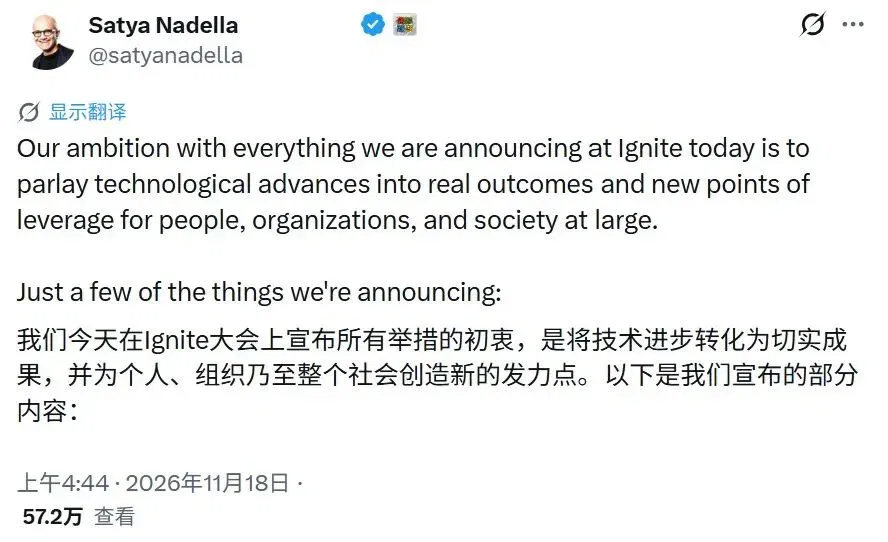
▲Satya Nadella's post (Image: X)
Beyond the models, the updates remained strongly focused on enterprise AI agents. Microsoft announced multiple Copilot updates, including orchestrating several AI agents to work together and proactively identifying to-do items in email.
Users can have Autopilot keep track of projects, arrange meetings and follow up on tasks, or work with AI in Workspaces to revise documents and complete projects. Enterprises can also use Agent 365 to centrally manage agents from platforms including OpenAI and Anthropic, inspect completed tasks and estimate business benefits. Microsoft disclosed that, since its launch this May, more than 50 million agents have been registered cumulatively in Agent 365.
Microsoft also made substantial upgrades to its enterprise knowledge-management platform Microsoft IQ. The platform combines Work IQ, Fabric IQ, Foundry IQ and Web IQ, providing more than 350 third-party connectors to help different agents access enterprise knowledge, business data and operational tools. Microsoft also introduced Business Plugins, enabling enterprises to package their business rules, expertise and operational capabilities for reuse by different agents.
01.
Seven model announcements from Microsoft
Coding results approach GPT and Claude
Test costs as low as 5% of a competitor's
Microsoft presented five new models and updates on two existing models. The two coding models and the decision model are now generally available. The coding models have been integrated into GitHub Copilot, while the decision model powers Auto in Cowork.
MAI Code 2 and MAI Code 2 Flash are primarily aimed at software development. The former can handle complex debugging and changes spanning multiple files. According to Microsoft, across four coding benchmarks, MAI Code 2 achieved an aggregate score of about 98% of GPT-6.1 Sol's, at roughly 40% of its test cost. Compared with Claude Opus 5.5, it achieved about 96% of the score at around 5% of the test cost.
MAI Code 2 Flash focuses on code explanation, localized changes and everyday bug fixes. Microsoft says that, across three everyday coding benchmarks, its performance is comparable to GPT-6 Luna and Claude Haiku 5.5, at test costs calculated using promotional pricing of about 65% and 20% of those models' costs respectively. Both models are integrated into GitHub Copilot, and MAI Code 2 Flash is also available in limited preview on Microsoft Foundry.
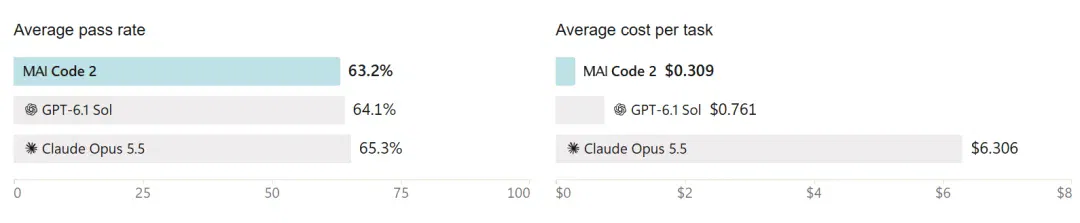
▲MAI Code 2 aggregate scores and test costs (Image: Microsoft)
In cybersecurity, MAI Cyber 2 Flash can help find software vulnerabilities, analyze threats and suggest fixes. On CyberGym-E2E, it achieved a task success rate of 92.3%, slightly above GPT-6 Astra's 91.5%, at less than 2% of the latter's compute cost per task. Microsoft plans to begin rolling it out to eligible customers through the MDASH security-scanning tool in mid-December this year.
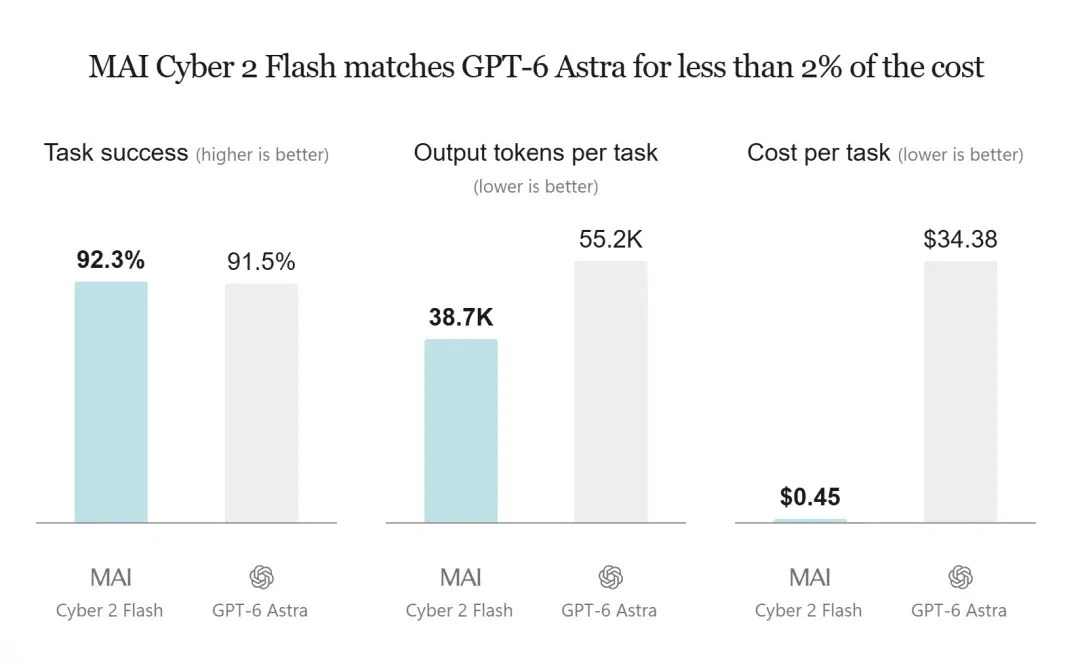
▲MAI Cyber 2 Flash evaluation in the official technical blog (Image: Microsoft)
The image model MAI Image 2.7 was released on October 27, primarily for image generation and localized editing. Since release, it has risen from second to first on the image-editing leaderboard of third-party evaluator Artificial Analysis. Its score of 1,215 puts it four points ahead of GPT Image 2.6 Sunburst Max, at around one-fifth the price. Microsoft also introduced MAI Image 2.7 Flash for batch image generation and the Canvas workspace for interactive image editing. Both image models are in public preview on Microsoft Foundry, and users can also try image generation and editing through MAI Labs.
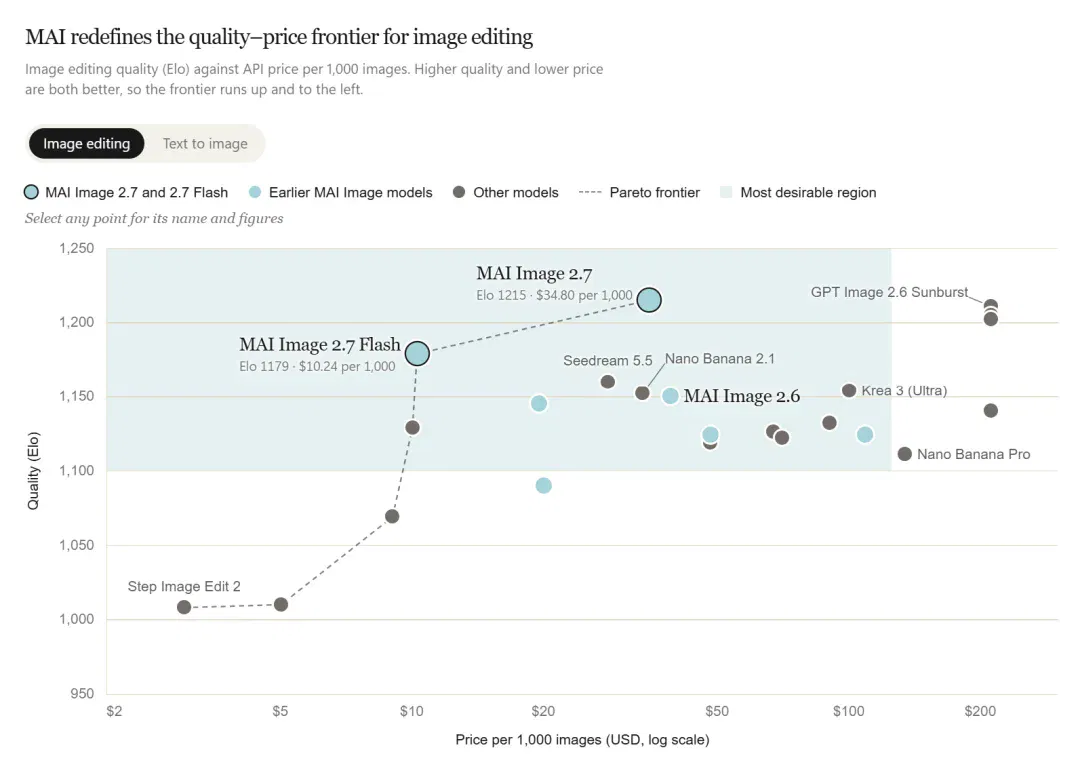
▲MAI Image 2.7 rises to first on Artificial Analysis's image-editing leaderboard (Image: Microsoft)
For voice, MAI Realtime 1 supports real-time spoken conversations for applications such as AI customer service and voice assistants. Microsoft says the model outperforms GPT-Realtime 2.1 in speech-understanding and task-execution tests. Basic voice service starts at $0.01 per minute, with inference charged separately. Users can currently try the model in MAI Labs, and developers can apply for limited preview access in Microsoft Foundry.
Another speech-transcription model, MAI Transcribe 2, was released this September. Microsoft disclosed that Dragon Copilot Transcribe, a medical speech-transcription feature based on the model, is now used in its healthcare AI product Dragon Copilot for all clinician-patient conversation transcription. It covers about ten million patient encounters a month, with multilingual transcription errors reduced by roughly 50%.
The decision model Microsoft-Decision-1.1 became generally available at this event. It mainly handles information classification, model selection and task routing, and adds support for image inputs. On Artificial Analysis's Decision Index leaderboard, it scored 68 points, six points above its predecessor, ahead of Jev 1.14, Google's Gemini Decision 1 and OpenAI's GPT-6 Luna decision variant. Microsoft says it processes decision tasks 50 times as fast as GPT-6.1 Sol, at approximately 1/79 of the cost. More than 4,000 customers currently use it.
Microsoft also announced the enterprise model-weight licensing service MAI Licensed Weights. It plans to provide eligible enterprises with weights for its in-house models, allowing customers to customize models using internal data and deploy them in their own Azure environments. Enterprises can control model access themselves and retain control of their data and model customizations. The service will roll out gradually through Microsoft's Frontier Company partnership program.
02.
Copilot upgrades multi-agent collaboration
AI can proactively find work and follow tasks over time
Microsoft's main Cowork updates improve multi-agent collaboration and add proactive task recommendations, while expanding access to the autonomous agent Autopilot to Frontier customers. Copilot's unified Home work interface and built-in file-editing feature, Office in Copilot, are also generally available.
The newly available Copilot Home is Copilot's unified work interface, bringing Chat for questions and answers together with Cowork for complex tasks through a single entry point. Users can initiate tasks in one input box, while Copilot uses Auto to select a model and reasoning effort automatically. For more complex tasks, the system suggests handing them to Cowork, retaining the previous conversation's context so users need not re-enter instructions.
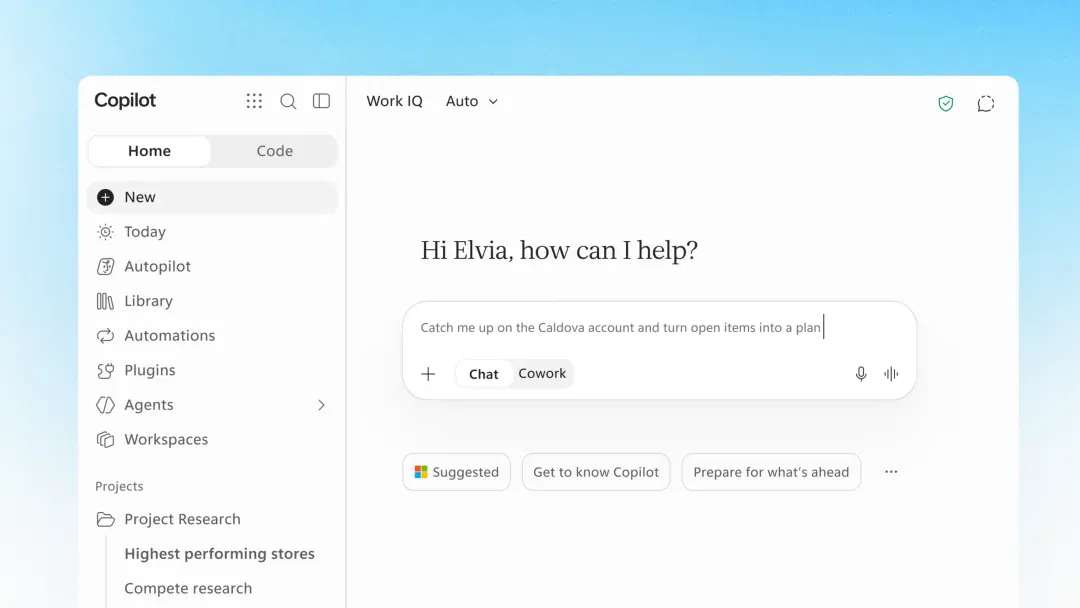
▲Copilot Home's unified work entry point (Image: Microsoft)
Copilot Cowork has upgraded Auto to use Microsoft's Microsoft-Decision-1.1 model to select suitable models and reasoning effort for different task steps. It also adds parallel execution by multiple subagents, dividing complex tasks among subagents that work simultaneously.
For example, when a user requests a competitive-analysis report, Cowork can have one subagent use a Claude model to research competitors and another use a GPT model for financial comparisons, then combine the results into a report. Over the past week, Microsoft has added models including GPT-6.2 Sol and Claude Fable 5.2 to Cowork. Auto enhancements such as multi-subagent orchestration have begun rolling out to Frontier users.
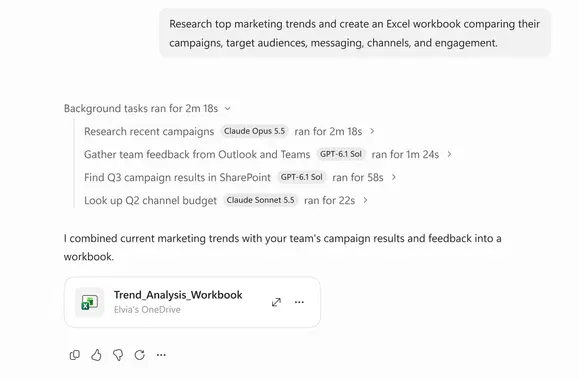
▲Multiple Cowork subagents collaborating (Image: Microsoft)
Cowork also adds proactive task recommendations. Through Work IQ, it can identify work suitable for AI from users' email, meetings and Teams chat history, such as preparing materials for the next day's customer meeting or following up on important unanswered emails. Cowork can begin after the user confirms. This feature is also available to Frontier users.
Copilot Autopilot, previously in private preview, is expanding to Frontier customers. Unlike Cowork, which mainly handles tasks assigned by users, Autopilot can run autonomously over extended periods, continuously monitoring Teams channels, following up on email and handling recurring tasks.
For example, users can assign a supplier-review project to Autopilot, which makes a plan, schedules meetings, prepares materials and contacts the relevant people for progress updates. Administrators can restrict Autopilot's access, review activity records and require human approval before important actions.
The previously announced human-AI collaboration space Workspaces is also opening to Frontier customers. Employees and agents can share files and project materials in the same space—for example, an agent drafts a document, employees suggest changes, and the agent continues refining it.
Office in Copilot was announced as generally available, bringing Word, Excel and PowerPoint editing directly into the Copilot app. Users can create and revise documents, spreadsheets and presentations through conversation, and invite colleagues to edit together, without switching to separate Office apps.
The previously introduced Copilot Code is also scheduled to become generally available in the coming weeks, allowing users to develop apps, interactive dashboards and other tools using natural language. Copilot Managed Runtime, which hosts these apps, is already generally available. Edge for Business also made Cowork's ability to execute multistep tasks across websites generally available. It can fill in forms and handle workflows on sites users are authorized to access, while sensitive actions still require user confirmation.
In enterprise adoption, Microsoft disclosed that Eli Lilly has more than 5,000 people using Copilot Cowork each month, including research scientists. Some researchers delegate multistep research and analysis to Cowork, using AI to help screen promising directions for further study before conducting experiments.
03.
Agent 365's cumulative registrations:
Over 50 million agents
Microsoft helps enterprises manage AI investment
Microsoft expanded third-party management and security controls in its enterprise agent-management platform Agent 365, adding business-value analysis tools.
According to Microsoft, enterprises have cumulatively registered more than 50 million agents in Agent 365 since its general launch this May. As registrations grow, enterprises are looking beyond agent identity, operating status and access rights to usage costs and actual results.
For cross-platform management, Agent 365 further expanded support for platforms including OpenAI, Anthropic, Google, Salesforce and Databricks. Connected, supported agents can automatically receive a distinct Microsoft Entra Agent ID, allowing enterprises to see their origin, owner and tools, and apply identity and access management. On some supported platforms, administrators can also inspect agent activity and task-execution records. These capabilities are in preview and will become available in phases.
For local agents, Microsoft expanded discovery and control on devices and networks. Tools including Microsoft Defender and Microsoft Entra Global Secure Access can now identify more than 60 local AI agents, including Claude Code and GitHub Copilot CLI. Defender's device-side discovery is generally available, while Global Secure Access's network-side discovery remains in preview. Administrators can discover agents employees use on their own initiative and, in supported scenarios, use the relevant management and security tools to restrict access to enterprise data.
The newly introduced Agent 365 Business Analytics helps enterprises analyze AI usage costs and estimate business value. It brings agent usage, costs and completed tasks into one interface, with metrics including task success rate, user satisfaction, assisted work hours and estimated business value.
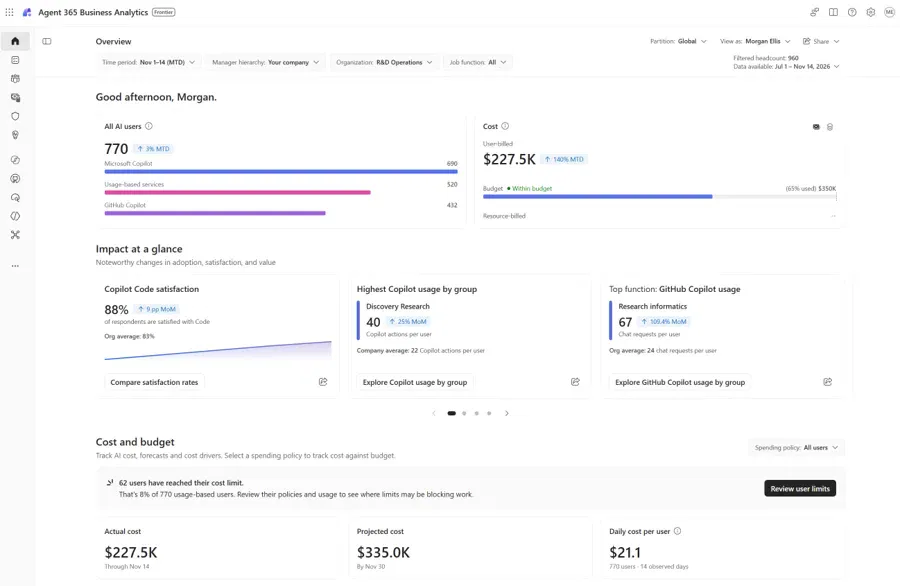
▲Agent 365 Business Analytics dashboard (Image: Microsoft)
For Copilot Cowork, for example, the system can estimate AI-assisted work hours and their corresponding value by combining the human time a task typically takes with the proportion of work performed by AI. These are not measured reductions in human work time, however, and cannot be equated directly with financial benefits the enterprise has already realized. Business Analytics is beginning to roll out to Frontier users.
Agent 365 Cost Management already provided AI cost management. At this conference, Microsoft further upgraded spending reporting and budget controls. Enterprises can view spending by employee, user group, agent and model, set spending caps and cost alerts, and restrict teams' use of expensive models. Administrators can, for example, define which models each team may use, reserving high-cost models for tasks requiring complex reasoning to keep spending under control as AI usage scales.
04.
Microsoft upgrades Microsoft IQ:
More than 350 connectors
Agents can act directly in business systems
According to Microsoft, nearly 60,000 customers now use its enterprise knowledge platform Microsoft IQ. Launched at Build this June, it brings together Work IQ, Fabric IQ, Foundry IQ and Web IQ, with more than 350 third-party connectors. The upgrade focuses on letting enterprises centrally manage dispersed knowledge, business rules and operational tools for reuse by different AI agents.
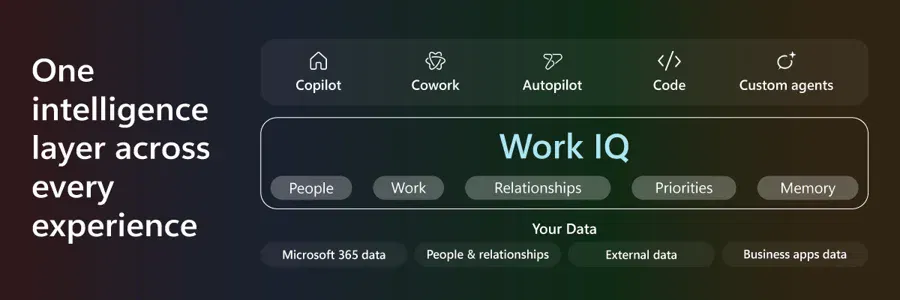
▲Work IQ knowledge and context architecture (Image: Microsoft)
The newly added Business Plugins let enterprises package business knowledge, operational rules and tools into plugins for reuse across departments and agents. In Microsoft's example of a supply-chain disruption, an agent can look up affected orders, check supplier contracts and identify the employee responsible for handling the issue. Enterprises configure the relevant knowledge and operational rules once, and multiple agents can call on them. This feature is available to users in the Frontier program.
Work IQ highlighted its ability to move from retrieving work information to taking action. On November 3, Microsoft opened public preview access to more than 60 native SharePoint actions. Agents can do more than look up project materials: they can directly create project-tracking lists, handle approvals and perform other tasks. Microsoft internal tests showed that, with these tools connected, Work IQ's task pass rate increased from 70.1% to 84.6%, while token usage decreased by 16%.
Among these capabilities, Listen can start tasks automatically when a message arrives or a business event occurs, without waiting for a user instruction. Listen is currently in public preview.
Microsoft is also extending Work IQ to third-party AI assistants. It says ChatGPT Business and Enterprise users can now use a plugin, with authorization, to access work information from Outlook email, Teams chats and SharePoint files. A plugin for Claude will also roll out progressively.
For enterprise business-system partnerships, Microsoft and Salesforce announced the Copilotforce initiative, bringing Salesforce customer data and business capabilities into Copilot. The newly introduced Salesforce in Copilot plugin includes more than 38 prebuilt sales skills. Salespeople can, for instance, combine Salesforce customer records with communications in Outlook and Teams to look up opportunities and prepare for customer meetings. The plugin is currently in public preview.
05.
Conclusion: Microsoft connects the full enterprise-agent toolkit
In-house models compete for business
At this Ignite, Microsoft further expanded its enterprise AI presence. It upgraded Copilot into a unified work entry point, integrating agent execution, enterprise knowledge and management tools. At the same time, it showcased the performance and cost advantages of its own AI models, beginning to compete directly for model business with partners such as OpenAI and Anthropic. Microsoft hopes to control more enterprise AI workflows while continuing to offer third-party models.
Microsoft's existing Office user base, Azure cloud services and ability to connect enterprise data give Copilot a foundation for entering real business processes. Whether enterprises can continue expanding agent usage, however, depends on reliable task execution, effective cross-platform collaboration and actual returns on investment. The cost and business-value analysis tools introduced at this event also reflect a shift in enterprise AI competition, from adding features toward controlling costs and validating real results.
Source: Microsoft
This article comes from Zhidx. Author: Sun Xiaowen.
After reading
Join the AINRK community
Read how to join the community and connect with people working in AI.
Related articles
Continue reading related topics and articles in this category.
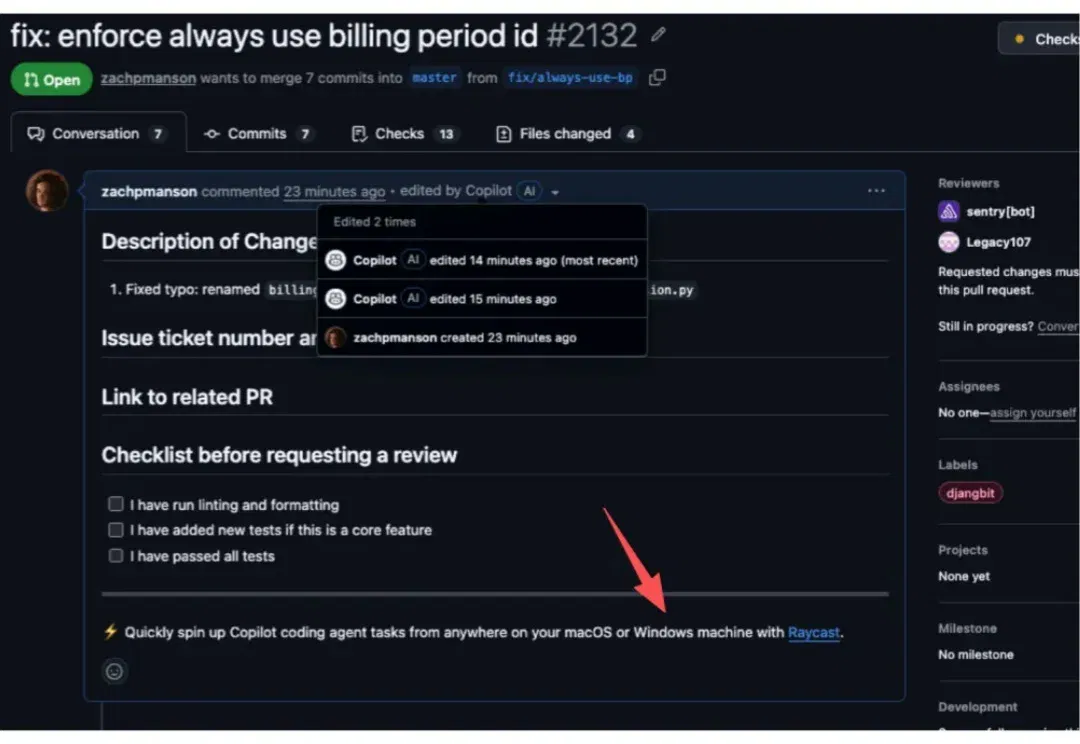
微软把Copilot 变成牛皮癣,偷偷爬进上万个开源代码库贴小广告 (opens in a new tab)
绝了,真的绝了。 Copilot 开始自作主张,在 GitHub 代码仓库里加广告了……

烧掉724亿,纳德拉挥刀重组Copilot (opens in a new tab)
砸了724亿美金「学费」后,微软用一场大重组承认 Copilot「走弯路」了。
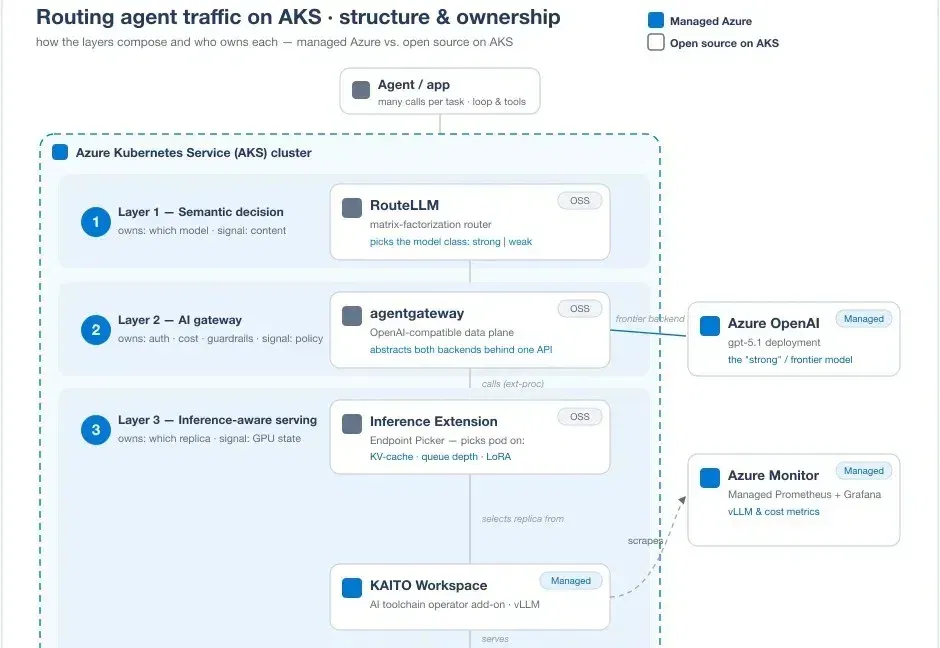
最高节省 85% 成本:微软公布 AI 智能体 LLM 路由方案 (opens in a new tab)
Microsoft 发布了 一个用于在 Azure Kubernetes 服务 上路由智能体流量的参考架构。它将这个问题分解为三个关键选择:由哪个模型响应调用、如何管理调用,以及由哪个 GPU 副本处理调用。
微软,刚刚靠Anthropic赚了216亿 (opens in a new tab)
盘后上涨8.83%。 智东西7月30日报道,今天凌晨,微软公布2026财年第四季度(对应自然年2026年第二季度)及全年财报,其AI业务商业化规模继续扩大,算力投入和成本压力也在同步上升。其中Azure年度营收首次突破1000亿美元(约合人民币6770亿元),Microsoft 365 Copilot付费席位超过3000万个,Azure AI Foundry客户达到10万家;与此同时,本季资本开支同比增长70%,至410亿美元(约合人民币2775.7亿元)。 本财季,微软营收达到900.07亿美元(约合人民币6093.5亿元),同比增长18%;净利润为357.66亿美元(约合人民币2421.4
速递|微软推出自研网络安全AI模型MAI-Cyber-1-Flash,对标Anthropic Mythos (opens in a new tab)
微软周一发布了一款名为Project Perception的新AI安全产品,该产品由微软自主研发、专门针对网络安全任务打造的新一代AI模型驱动。微软将这款产品定位为Anthropic旗下Mythos模型的低成本替代方案,后者同样利用AI模型自动发现软件漏洞。