Photon cofounder on agent messaging infrastructure and personal-assistant retention

Founder Park interviews Photon cofounder Ryan Zhu about messaging access, its $4.5M seed round and expansion plans. Revenue growth, customer mix and retention observations largely reflect the team’s own platform sample.
The company that gives personal agents a “phone SIM” has raised funding.
Photon recently announced a $4.5 million seed round co-led by Gradient and A*, with participation from Vercel, Sequoia China, Z Fellows, Llama Ventures, Karman and several angel investors.
Photon builds messaging infrastructure for agents. With its API, an agent gets a phone number and email address and can communicate with people directly through iMessage, WhatsApp, email and phone calls. Ordinary users need not know what an agent is: if they can send messages, they can use it.
Companies attracting recent attention, including corgi and Manus, are Photon customers. From May to August this year, Photon’s revenue grew tenfold and monthly message volume fivefold. Customer churn was below 3%, and more than 50,000 developers had registered on the platform.
In September, Photon held a developer event in a San Francisco church called “App Funeral,” attracting coverage from TechCrunch and trending on X. Its message was that users do not want another app. Agents should appear in the conversation windows people already open hundreds of times a day.
Photon occupies an unusual position: every message between an agent and its users passes through it. We spoke with cofounder Ryan Zhu about what the company sees from this messaging layer during the personal-agent boom—things an individual agent company cannot see and may be reluctant to discuss.
01
Messaging infrastructure takes at least half a year to build;
even OpenAI uses third-party providers
Photon began as a weekend hackathon project.
Cofounder Daniel Tian exported his entire iMessage history and gave it to a language model. Through browser and phone automation, he fed the model’s responses back into iMessage, creating a bot that could imitate him and reply on his behalf. His friends continued chatting with the bot for several days without realizing it was no longer Daniel.
After the project was open-sourced, thousands of developers started using it overnight. The bot itself was not especially advanced. The real attraction was that it entered somewhere agents had previously struggled to reach: text-message conversations.
At the time, Ryan was researching human–computer interaction at MIT Media Lab. He kept wondering whether, five years later, people would still deliberately open ChatGPT and ask AI questions inside an app.
His view was that if agents become people’s coworkers, friends or even companions, they must enter existing human social systems rather than remain inside an app’s input box. People spent twenty or thirty years learning to text and make calls; redesigning interaction around agents would be difficult. Connecting agents to calls and texts lets ordinary users get started without learning much new.
Photon began building agent messaging infrastructure in September last year. It did not immediately build a consumer personal agent, partly because model capabilities were not mature enough: a consumer product required extensive tuning and still offered a limited experience. For first-time founders, enterprise customers also offered a faster way to validate the idea. “Whether businesses are willing to pay tells you whether the hypothesis holds.”
Connecting agents to iMessage, WhatsApp and phone calls involves far more than writing a few APIs. Communications is a decades-old industry. Different protocols need compatibility, but public documentation is scarce. Large-scale use also requires building data centers, working with carriers and lawfully managing large numbers of phone numbers.
Ryan estimates that an agent company building this infrastructure from scratch would need at least six to eight months. Even large companies cannot easily eliminate that time by hiring more people; complex organizational processes may slow them down further. “Even companies like OpenAI use third-party solutions.”
In today’s AI industry, six months can encompass an entire boom-and-bust cycle for a popular direction. The time saved becomes a competitive moat.
Photon officially began commercialization in April this year. It provides standardized, general-purpose APIs without custom services and charges by connection and end-user scale. A Business connection costs $250 a month and covers roughly 200–400 users. Enterprise customers currently provide most revenue; developers contribute under 10%, although many are gradually becoming enterprise customers.
02
Personal agents seen from the infrastructure layer:
more like notification bots
In Photon’s platform data, personal agents are the fastest-growing category, with user counts at some products nearly doubling every day.
Their appeal is easy to understand, especially in the United States. Booking a dentist may require more than a dozen calls. Returning an item or changing a flight can also consume substantial time. If an agent takes over those chores, ordinary users can immediately see the value without understanding models or technology.
Hermes and similar products brought Photon its first wave of demand in April and May. In September, a wave of personal agents including Instinct appeared, accelerating business again. Personal agents now account for 40–50% of Photon’s customers, and that share is rising.
The enthusiasm at the application layer is real, as are the problems Photon observes underneath.
First, many personal agents have poor retention. Users rarely reply to their messages, and many stop using them after a week or two. Ryan believes ordinary people simply do not have that many everyday tasks to hand over. Slightly more complex tasks still require step-by-step human instructions; after a few attempts, users conclude it is easier to do the work themselves.
Second, usage frequency differs greatly between weekdays and weekends. Personal agents are used more on weekdays, then less over the weekend, especially Sundays. People mainly see them as tools for getting things done, such as processing email and arranging schedules during the workweek. In purely personal life, they are less likely to involve an agent.
Third, much of the supposed “proactivity” does not create real engagement. Proactivity is the story this generation of personal-agent companies tells most often. Scheduled daily messages may superficially seem to keep users engaged. But Photon finds most agents’ initiative amounts to sending a notification when an email arrives. In Ryan’s words, they resemble “notification bots.”
Ryan believes genuine proactivity should work the other way around: the agent filters and processes most redundant information in the background, presenting only the most important parts to the user.
Fourth, users are clearly diverging. Although most people leave, every product retains a small group of power users. Interestingly, someone who churns from one agent may become a power user of another.
Agents are gradually developing distinct strengths. Some provide emotional support; some call developer tools such as Cursor; some specialize in browser use; others make phone calls and handle errands. Each agent has limited context capacity, and teams can focus on only a few areas. Users move between agents with different characteristics according to their needs.
Verticals also vary markedly in popularity. Health agents and products helping people develop businesses and build connections are popular. Agents that socialize on people’s behalf or try to replace time-passing entertainment products generally perform less well. Ryan thinks socializing still requires real people’s deep involvement.
On engagement and retention alone, the platform’s standout categories are actually “AI boyfriends” and “AI girlfriends,” substantially outperforming conventional personal agents. One Photon customer switched businesses and stopped maintaining its companion agent. A month after shutdown, users were still sending it daily messages: “Are you back? Where did you go?”
These companion products also have the most rich-media interaction, including images and voice. Ordinary personal agents send plenty of notifications but retain far fewer people.
Ryan compares today’s personal agents to the early mobile internet. Companies are competing aggressively for users, and eventually everyone will have their own agent. Before then, though, growth, retention and what proactivity really means need further thought.
For Photon, these underlying behavioral data also offer a new business. In the app era, product teams instrumented detailed analytics. In the agent era, developers struggle to know whether users opened a message, which device they replied on or what happened as they switched from computer to phone. Those data sit in Photon’s messaging pipeline.
Starting with messaging, how deeply does Photon intend to build this infrastructure? Where does it see personal agents heading next? The following conversation between Founder Park and Ryan has been edited.
03
Infrastructure startups
must target foundational capabilities agents cannot do without
Founder Park: Do you still believe instant messaging will be the main entry point for personal agents, rather than standalone apps?
Ryan: Yes. Instant messaging will be one of the main entry points.
Instant messaging naturally suits collaboration between people and agents, without extra education. Building a standalone app and inviting every teammate and friend again makes little sense. I already have a thousand friends in my contacts and messaging apps; I cannot import everyone into a new product. Messaging contains people’s accumulated social relationships and context, and everyone already knows how to use it.
Interaction habits rarely change dramatically in a short period; they evolve slowly. Compared with ten years ago, smartphones’ basic interaction has changed little except replacing the Home button with an upward swipe. Computers still retain “folders” because people carry old habits forward. Learning an entirely new system is difficult; transferring familiar habits to something new comes more naturally.
Founder Park: But Instinct has said it plans a standalone app, perhaps because apps offer more complete service and experiences. What do you think?
Ryan: Many customers are also building apps. But those mainly serve power users—for instance, when someone needs a more complex interface such as a canvas.
Most such products synchronize their app and iMessage in both directions. Most users’ everyday interactions remain in messaging; the app is an advanced supplement for heavy users.
Apps also have another advantage: access to local phone data, such as health data, which lies beyond messaging’s capabilities. Many messaging-agent companies therefore also build companion apps.
But “local data can only be accessed through an app” may change. System interfaces currently open only to apps may eventually open to iMessage or WhatsApp too.

Founder Park: Can agent companies not obtain the underlying user data you see themselves?
Ryan: In the mobile-internet era, apps had detailed analytics instrumentation. That layer is generally missing in the agent era.
We can obtain data from deeper in the communication chain. A user might message an agent on a Mac one moment and switch to a phone the next. Messaging from a computer probably means sitting at a desk working; switching to a phone may mean being on the move. That reflects the current context. An agent’s capabilities, response length and interaction style should differ between those situations.
That is one of our next steps: helping customers instrument and analyze messaging agents to optimize user experience and agent capabilities.
Founder Park: Will you keep expanding horizontally into more instant-messaging channels?
Ryan: People use only so many channels frequently: iMessage, WhatsApp, Slack and calls already cover most situations.
So our next steps are four vertical capabilities.
First, Identity: identity and security authentication. Traditional SIM cards and phone numbers may be spoofed or hijacked. How do we confirm the person communicating with an agent is the same person? We want to use end-to-end encryption at the communications layer to identify which device sent each message. When users message from a new phone or Mac, an old device could verify it first.
Second, Analytics. Combine the agent’s internal tool-calling logs with actual behavior in messaging, such as when a message was opened and which device was used to reply, helping developers find product problems and improve retention.
Third, Payment: embedding a smooth, secure payment experience natively in agent conversations.
Fourth, Memory. Over the long term, an agent’s phone number and email address can become the foundation for its identity and memory in this new era.
Founder Park: Does vertical expansion require the whole ecosystem’s cooperation? Must you negotiate with upstream and downstream partners individually?
Ryan: Adding a messaging channel requires individual negotiations with platforms and carriers. These four vertical capabilities are different: we first develop the underlying technology, then our personal-agent customers on the platform can adopt it directly.
We think ahead of personal-agent teams about where their products are going and how users will use them, preparing the necessary infrastructure in advance. When customers reach that stage, the technology is ready to use.
Payment involves real transactions, so external cooperation is still needed. But we have no shortage of partners; many payment companies approach us. They know we control the entry point for agent–user interaction, which is distribution.
The overseas ecosystem is generally open to personal agents, with Stripe and Shopify very willing to cooperate. Some large companies want to build their own agents and are more conservative and less open. But no single large company controls the entire US ecosystem, so there is still ample room.
Founder Park: In vertical expansion, does your advantage come from technology or your ecosystem position?
Ryan: Mainly our ecosystem position, because all the messages already pass through us.
Take Memory. Traditionally, an agent company integrating a third-party memory service must send all its chat messages to another memory provider. But those messages are already at Photon, so we can readily generate users’ long-term memories for customers.
It is somewhat like Cloudflare: traffic already passes through it, so it can quietly handle security, caching, analytics and other steps along the chain. Since messages are already here, using our Memory is the natural next step. Since phone numbers are here, Identity follows.
Messaging is critical infrastructure. Few companies can enter our part of the communications chain, but moving from our position into other infrastructure capabilities is straightforward. There may be ten thousand choices for Memory, but only two or three for agent messaging.
Once customers choose Photon, they naturally ask why not put Memory and Identity with the same provider. Why integrate another supplier? Enterprises value saving time and effort and having a consistent experience. One fewer API means one fewer point of failure and more peace of mind.
Founder Park: How long do you expect this fuller infrastructure to take? Will your customer profile change?
Ryan: We hope to have the essentials in place within roughly six months.
Photon has served all agents from the start, rather than one specific form. Beyond personal agents narrowly defined, we have many customers in companionship, education and health. There are even mine-inspection companies that need iMessage to communicate with frontline miners underground, because miners do not use Slack or install complex enterprise apps.
Looking back at mobile apps, whether WeChat or Douyin, their forms varied enormously, but 90% needed App Store distribution, Mixpanel behavioral analytics, databases and back ends.
Agents are the same. Personal agents are popular today; another type may be popular tomorrow. But common capabilities such as sending and receiving messages, making calls and identity will not change much.
Founder Park: Many founders now want to build agent infrastructure. Should they start with a comprehensive platform or a narrow entry point?
Ryan: Whether building infrastructure for today’s agents or the mobile internet ten years ago, the logic is the same: you must target an irreplaceable critical point.
Stripe chose payments, a necessity for every commercial product. Without payments, a company cannot collect revenue or survive. Agent infrastructure likewise needs a bottleneck that 90% of agents depend on and cannot easily work without.
Many infrastructure companies target optional components. If your component goes down and the agent keeps running, you have little pricing power. Messaging is different: without it, an agent has no channel to talk to people.
A recent example is the increasing difficulty for independent third-party memory infrastructure companies, for similar reasons. Many developers discover that a Git-based file system can handle context and memory without a dedicated memory service. File-storage infrastructure companies suddenly become popular because “everyone needs their own database file,” creating a new critical point.
There is a simple test for whether something is critical infrastructure: if your service suddenly went down today, would every customer flood your phone with calls within a second? If not, your entry point may not yet be truly core infrastructure.
04
When dealing with traditional communications,
time itself is a barrier to entry
Founder Park: How has your business focus changed with the rise of personal agents?
Ryan: Customer needs themselves have not changed much. What we provide is purely communications capability. At the moment, demand exceeds what we can supply: customers want to buy a lot of resources, and we cannot provide that many. Improving scalability is the core problem we are working to solve right now.
The other focus is stability, always our top priority. All communication between our customers’ agents and their users passes through us. If we go down, their agents cannot talk to users at all. For them, it is like the entire internet going offline, seriously damaging trust.
We learned that lesson early. One outage cost us more than a dozen enterprise customers immediately. After one or two outages, customers lose trust and choose someone else.
Founder Park: What is the main constraint on expansion now?
Ryan: We have to deploy our own data centers, and that cannot easily be accelerated. Equipment usually needs workers to install and configure it on-site. Two or three months ago we began researching complete installation automation to reduce dependence on on-site workers.
We also released an open-source project for Mac-cluster automation and continuous state management. We are working with carriers and communications companies to automate related processes too.
Founder Park: Did you previously have experience operating data centers or similar physical infrastructure?
Ryan: None at all. We learned everything from scratch.
Initially, we did not even know how to set up data-center power and networking. Power is complex: you need PDUs, or power distribution units; UPS units, or uninterruptible power supplies; and an understanding of dual A/B power feeds. Networking needs aggregation switches, switches and gateways, plus a high-availability design. We knew none of this initially and figured it out step by step.
We encountered many upstream problems, even with basics such as electricity. Our previous San Francisco data center had unreliable power, forcing us to find more reliable power and facility providers.
Meta’s WhatsApp integration is another example. It has a tiered partner system: you begin at the first level and gradually progress to the second and third. To get through that cycle, we partnered with companies already holding higher-level qualifications to make the integration work.
Working with telecom carriers also means figuring out how to lawfully hold and manage large numbers of phone numbers simultaneously. That requires deep commercial and technical cooperation and greater automation of deployment.
Mac procurement too: where do you buy so many Macs? We established a direct relationship with Apple. It now notifies us of new supply in advance and delivers on schedule to the relevant data-center warehouses. These supply chains and pipelines all have to be built step by step.
Founder Park: It sounds like traditional channel negotiations, requiring time and persistence.
Ryan: Yes, because we are dealing with a very traditional industry.
With carriers and the partnership teams at Apple and Meta, you must talk and build trust gradually. It cannot happen instantly. But because those relationships take time to establish, they become our core barrier to entry. Any newcomer must spend time building them too.
Founder Park: Are other companies doing similar things? How do you view competition?
Ryan: Some traditional infrastructure companies are moving into this, alongside new YC companies. A few compete directly with us, but we remain one of the largest players.
We are not especially worried about newcomers, because this field requires at least a year of preparation. Communications systems were invented decades ago. Understanding every detail, building carrier and upstream relationships, and operating a dedicated communications data center take time. This is entirely different from a traditional GPU data center.
Every new company must go through that from scratch, encountering problems and spending time. By the time it finishes preparing, we will have reached our next milestone.
Many customers now have tens of thousands of end users. Some newcomers cannot support that scale and can serve only very small customers.
Founder Park: You build on iMessage and WhatsApp, backed by giants such as Apple and Meta. Do you worry they will enter the market themselves?
Ryan: No. Meta does not handle every aspect of WhatsApp Business itself; ecosystem partners participate. Apple is the same.
Every company has particular strengths that shape its hiring and organizational abilities. No company is an all-purpose “circle”; each is a “pointed shape” that excels in a particular direction.
05
Acquiring enterprise customers in Silicon Valley:
branding and product-led growth offer another route
Founder Park: As a young team, how did you get started in Silicon Valley’s enterprise market?
Ryan: It was difficult initially. If you grew up in the Bay Area, elementary-school friends or university alumni might work at Apple or Meta, giving you a natural network. We did not have that advantage.
We took another route, emphasizing branding and product experience through PLG, or product-led growth. Many companies now send us direct messages to discuss partnerships.
First, our product emphasizes design and ease of use. Second, we host distinctive offline events, such as App Funeral and hiring go-karts for founders to drive together through San Francisco. Third, we post product and brand content on X; several videos have received over a million views.
These build brand image over time, so people in Silicon Valley’s agent community have generally heard of Photon. Partnerships and customer acquisition then become more natural.
Founder Park: How does an X video or an event turn into actual customers?
Ryan: I once posted a screenshot of Photon’s website on X with a caption roughly saying, “Every agent company with taste should use Photon.”
Afterward, founders from many companies messaged me directly, saying they were considering Photon or preparing to switch from another provider.
We also posted a video demonstrating Mini App capabilities, which quickly attracted attention. When we later asked customers why they chose us, they said they first saw Photon on social media and thought it looked cool and polished. That made them more inclined to believe in our engineering, technology and product capabilities.
We are therefore essentially inbound-first. The vast majority of customers approach us, rather than us selling to them individually.
Founder Park: What does the branding communicate that makes customers trust you?
Ryan: Two things: taste and engineering.
An infrastructure provider must inspire strong trust in its technology. Every agent company in Silicon Valley appreciates teams with deep technical expertise.
Taste matters too. No startup wants to admit it lacks taste, so when selecting an infrastructure provider, it tends to choose brands that look more tasteful.
Founder Park: Did you understand this from day one, or adjust after learning some lessons?
Ryan: We always cared about product and design, but recognizing their power in enterprise sales also required some lessons.
At the beginning, in our open-source phase, we neglected the website and hastily made a rough page. We shared the product with founder friends, but they did not use it. When we asked why, they said, “Your website looks poor—too much like AI slop.”
Customers’ decisions are really simple. Put yourself in their position: who would trust their company’s most critical infrastructure to a business whose own website looks carelessly AI-generated? What if it gets attacked? What if the service is unstable?
Founder Park: How is your team organized for this approach? How many marketing and sales staff do you have?
Ryan: We have one CMO and zero salespeople. CMO Julie Chen handles online content, product exposure, developer relations and offline events. Her own social-media activity brings traffic in the millions each month. She also attends events across Silicon Valley communities, connects with other CMOs and developer groups, and organizes joint events.
The team has fewer than twenty people, more than 90% of them engineers. Daniel and I have written software together since middle school and both have technical backgrounds. He mainly handles fundraising, major customers and ecosystem partnerships. I previously organized AdventureX, a hackathon reaching 100,000 developers. I now handle product, technology, overall branding and visuals.

Founder Park: Is replacing traditional sales with branding and PLG a replicable approach for other infrastructure or enterprise startups in Silicon Valley?
Ryan: I think it is very replicable. Traditional enterprise sales does not particularly suit a Gen Z team like ours, so we should maximize our strengths, building trust through better technology, product experience and taste.
Silicon Valley has mature examples such as Vercel and Linear, which emphasize branding, recruit top designers and post new designs on social media daily. All of that signals that they are attractive technology companies.
But the key to following this route is precision, not volume. Many teams hold events, but if those lack creativity and the cohosts are not respected industry figures, holding more of them actually depletes the brand.
More importantly, every touchpoint must be consistent. Some companies run lively offline events, but people scan a QR code and find a carelessly made website. In that instant, respect and willingness to buy disappear.
Conversely, even if you are only a startup, when people see how much care you have put into the details of your official website, the quality of your videos and the design of your events, they will subconsciously infer that, since this company has polished everything visible to the outside world so carefully and set such high standards, its internal technology and architecture, which they cannot see, should be held to the same standards.
This article was originally published by Founder Park. Author: Founder Park.
Related topics
After reading
Join the AINRK community
Read how to join the community and connect with people working in AI.
Related articles
Continue reading related topics and articles in this category.
Which metrics matter for personal agents? From app opens to delegated work and completion (opens in a new tab)
Saibo Chanxin traces the evolution of internet metrics to discuss personal agents’ delegation volume, completion rates and revenue, while noting that definitions of delegated work still need to be aligned.
从灵光的托管量和 Muse 的交易场景看个人智能体 (opens in a new tab)
文章比较任务托管与交易额两个观察指标,结合订阅提醒等案例,讨论用户授权、重复使用和信任积累。
SandBaseAI 宣布完成数百万美元种子轮,开发智能体基础设施 (opens in a new tab)
SandBaseAI 将模型和数据接口、工具与沙箱运行环境统一接入。公司称本轮融资将用于产品研发与推广,并提供 SDK 和命令行接入。
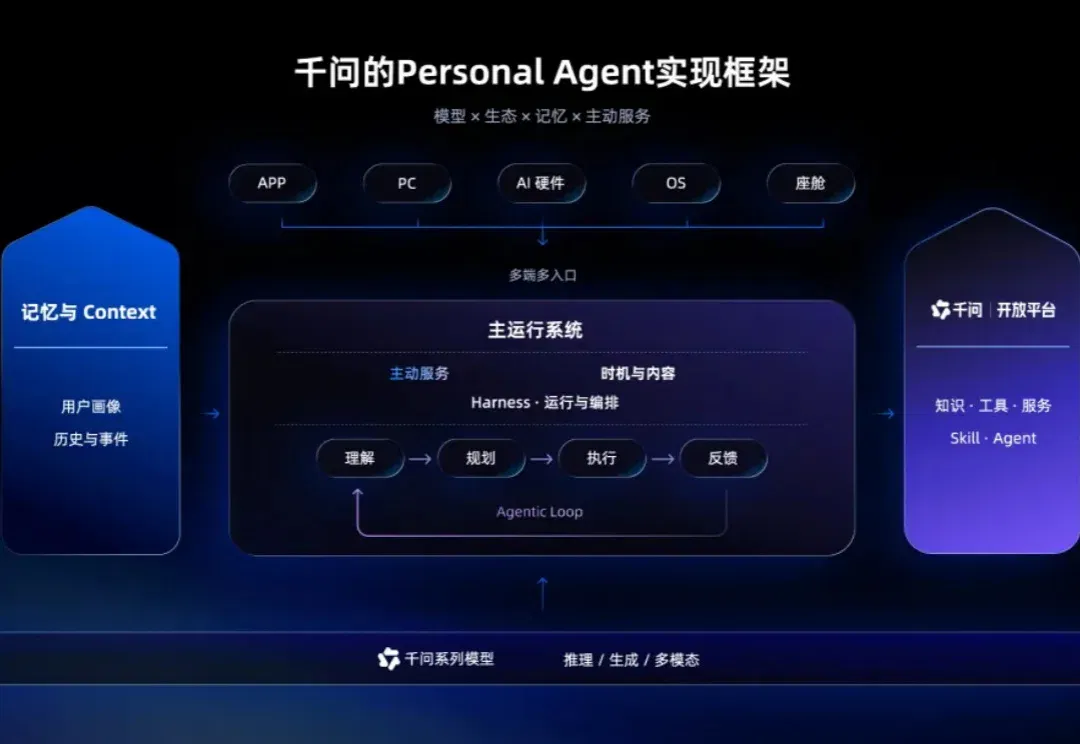
对谈千问蒋冠军:从模型、记忆到生态,Personal Agent的技术架构如何搭建? (opens in a new tab)
蒋冠军介绍邀测中的千问 Go!如何把模型、个人记忆和服务生态结合起来,包括按场景训练、压缩上下文、更新记忆和授权操作。航班现金理赔是受访者举出的单个案例。

AutoGen 早期作者推出 s.space,让不同用户的 Agent 在群里协作 (opens in a new tab)
AG2 团队把个人 Agent、共享房间和协作文档结合起来,支持邀请外部 Agent,并按房间配置调用权限。文中消息规模来自团队观察的小型协作网络。