AI product shutdowns and changes: integration, delays and restructuring differ
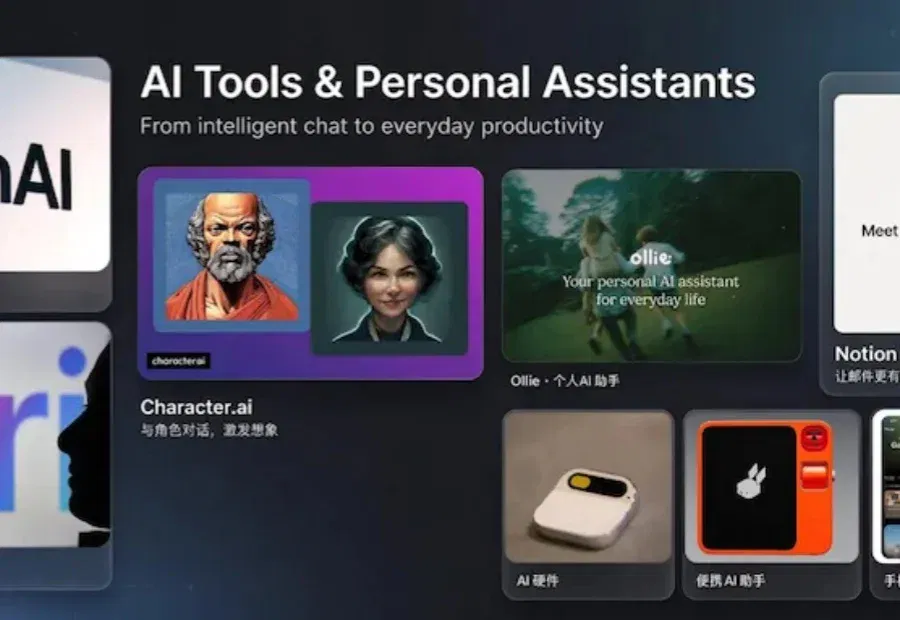
Zhidx reviews AI app shutdowns, feature integration, delays and business difficulties. Some standalone services have closed, while Siri and Recall still offer features; Character.AI entering Chapter 11 does not mean its chat service has already shut down.
Editorial correction (November 18, 2026): Shutdown, feature integration, delay and Chapter 11 restructuring are different statuses. Character.AI's filing date and financing year have been corrected, and unverified HFS statistics are not used to support conclusions. The original illustrated lists are retained from the source material and do not establish that every product has stopped operating.
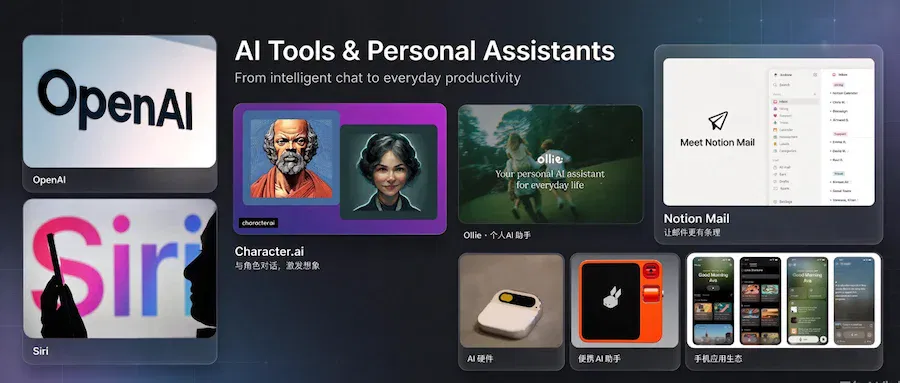
Even star companies are struggling.
A Zhidx report dated November 17 compiled 13 cases involving AI applications or projects facing shutdown, a change in direction, delays or business difficulties. These cases span different years and statuses and cannot be interpreted as 13 products all ceasing operations this year.
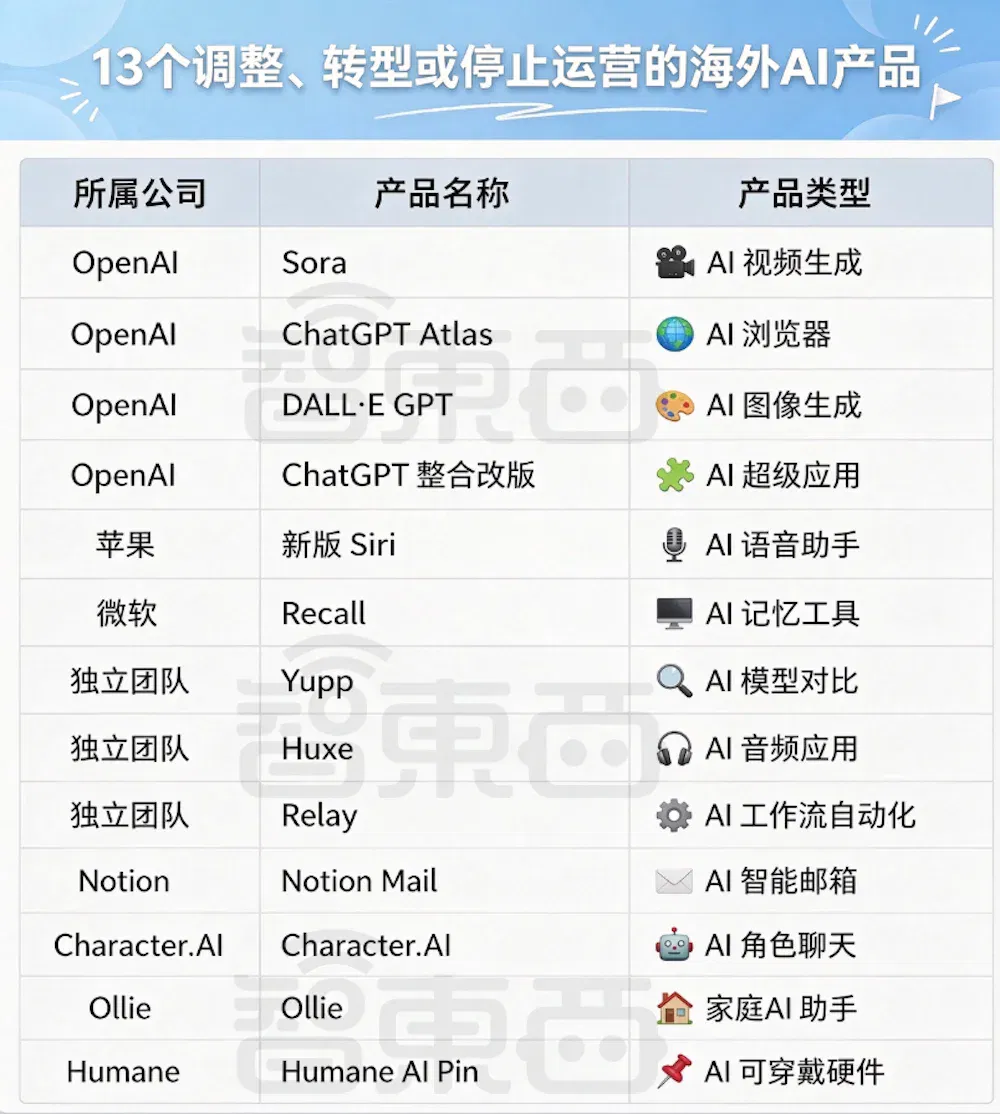
▲13 AI applications or projects undergoing changes, a shift in direction or cessation of operations (Table: Zhidx)
Among technology giants, AI projects have had very different fates. ChatGPT has continued expanding its features to become one of the world's most representative AI applications, while fellow OpenAI product Sora went from topping the App Store download chart to shutdown, and the AI browser Atlas stopped serving users less than a year after launch.
After delays, Siri AI launched an English-language beta for supported users in September. Recall also offers preview features on eligible Copilot+ PCs. Questions about product delivery or privacy do not mean either service has exited the market.
Startup products also face different circumstances. Character.AI has entered Chapter 11 proceedings and is seeking a transaction, but filing for bankruptcy protection does not itself mean the chat service closes immediately.
Humane AI Pin, once expected to replace the smartphone, also stopped selling less than a year after launch. These products shared the spotlight with other emerging AI offerings, but have now reached different outcomes.
Enterprise AI projects still need their effectiveness evaluated as they move from pilots into production. This article has not obtained the original report to verify the HFS study's 100-company sample and figures of 26% and 43% cited in the original draft, so it does not use them to infer an industry-wide failure rate.
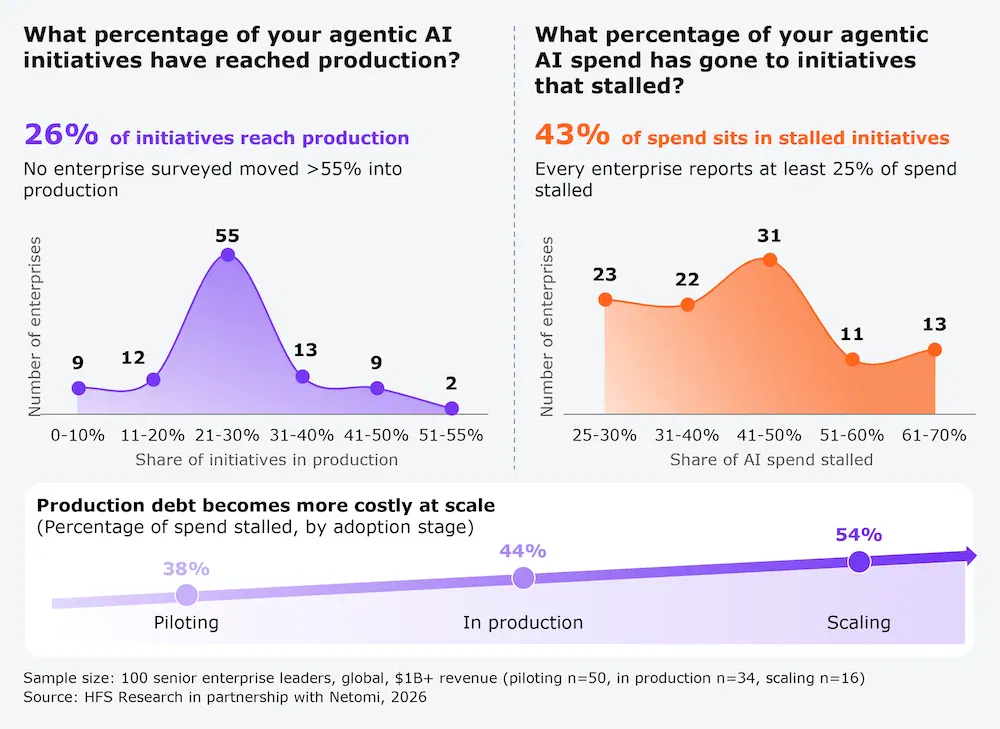
▲Research published by HFS
The reasons behind these 13 cases, from product shutdowns and strategic changes to delays, vary. Some could not sustain high operating costs, some failed to retain users, and others remained unable to launch because of safety or security issues.
As the AI industry expands rapidly and new applications and startups continue to emerge, some once-promising products have fallen quiet—an outcome they may not have anticipated when they first captured the market's attention.
01.
Technology giants keep adjusting AI applications
Platform integration and implementation challenges emerge
AI applications from major companies can also face shutdown, feature integration, redesign or delay. The six cases listed by the source include events from different years and should not all be classified as products that exited this year.
These applications and features come from technology giants including OpenAI, Apple and Microsoft, spanning office work, content creation and intelligent interaction.
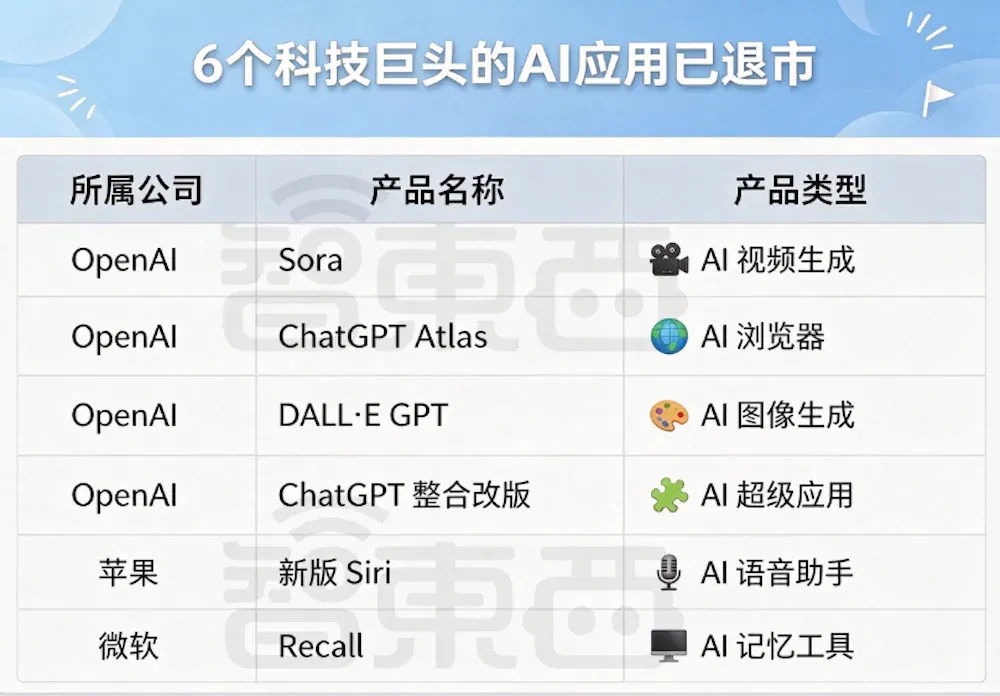
▲Six technology-giant product changes, including shutdowns, redesigns and delays; not all have stopped serving users (Table from source)
Since the start of this year, OpenAI has repeatedly adjusted its AI product lineup: in March it announced Sora's closure, formally ending web and app services on April 26. On July 9, it redesigned the ChatGPT desktop app to integrate Chat, Codex and Work, but criticism of a complex interface and poor user experience led it to reverse some changes. It stopped service for the standalone AI browser Atlas on August 9 and retired the official DALL·E GPT on August 30, leaving ChatGPT Images as the route for image generation.

▲ChatGPT Atlas browser interface
Among these, Sora was OpenAI's flagship product in AI video generation. OpenAI first introduced the Sora video-generation model in early 2024, rapidly attracting industry attention. In 2025, it introduced Sora 2 and launched iOS and Android apps; the iOS version briefly topped the App Store download chart. Sora also gradually shifted toward a video social platform described as 'an AI version of TikTok'.
Sora's popularity did not last long. After Meta launched Vibes, a similar AI-video social product, Sora had to compete not only with other AI-video offerings but also with established short-video platforms such as TikTok and Instagram. In March 2026, OpenAI ultimately decided to close Sora and direct resources to other businesses.

▲Sora shuts down
Apple's eagerly awaited new Siri also failed to launch as originally planned.
Technical problems during engineering development led to repeated delays. Apple originally planned to release the feature in spring 2025, but did not add it to the iOS 27 beta until July this year. According to an announcement on Apple's website, Siri AI began serving users as an English-language beta on September 14, with French, Japanese, Korean, Portuguese, Spanish and other languages rolling out from October.
Microsoft Recall faced two rounds of security controversy, before and after launch.
At its Build developer conference in May 2024, Microsoft first announced Recall, an AI-memory feature for Windows PCs. Before launch, it sparked controversy over user privacy and data-security issues.
Facing criticism, Microsoft repeatedly delayed Recall and redesigned its security and privacy protections. It did not begin rolling out Recall in preview to eligible Copilot+ PC users until April 25, 2025, nearly a year later.
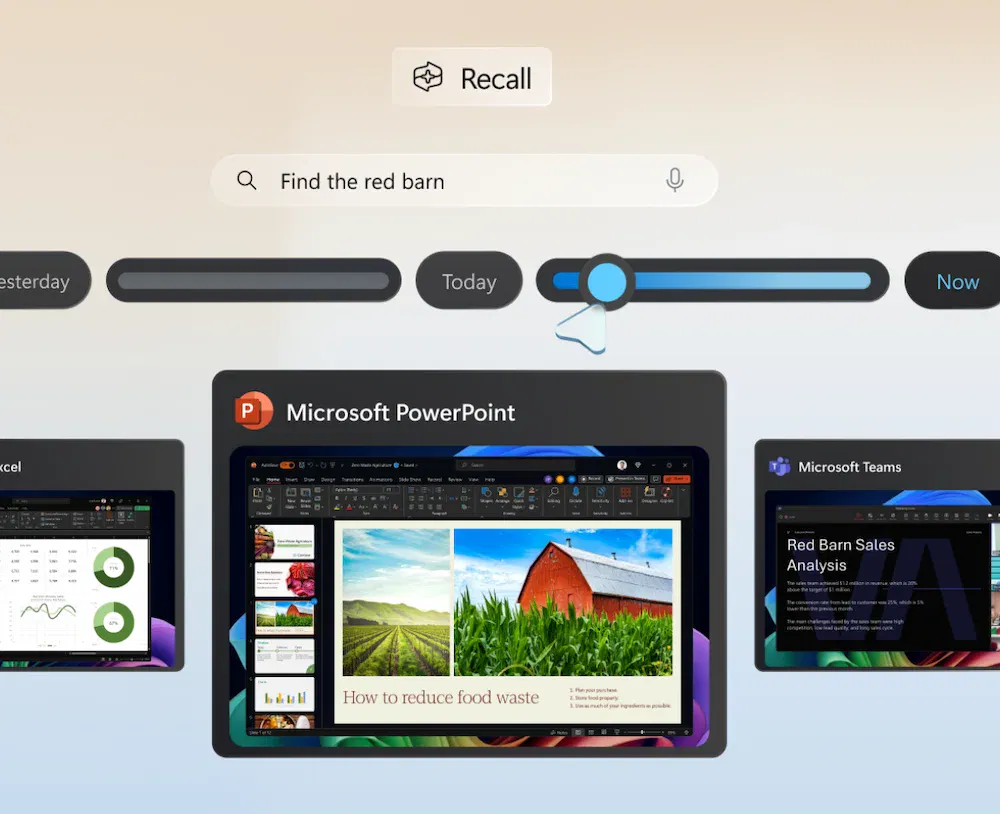
▲Recall interface
The security controversy did not end there. On April 15 this year, cybersecurity researcher Alexander Hagenah developed TotalRecall Reloaded, a tool that could extract and display data stored by Recall, once again prompting questions about its security.
These examples show that even technology giants' AI applications are not immune to delays, changes or shutdowns.
The reasons include changes in product strategy, as well as practical problems such as immature AI technology and inconsistent product experiences. Privacy and security risks can also weaken user trust and hinder adoption.
02.
Even star startups face an exit
Pressure mounts on independent AI ventures
Alongside major companies' continuing shifts in AI strategy, many independent teams and AI startups are struggling. Some once-prominent products have stopped operating, some have begun bankruptcy proceedings, and others are gradually losing ground amid intense competition.
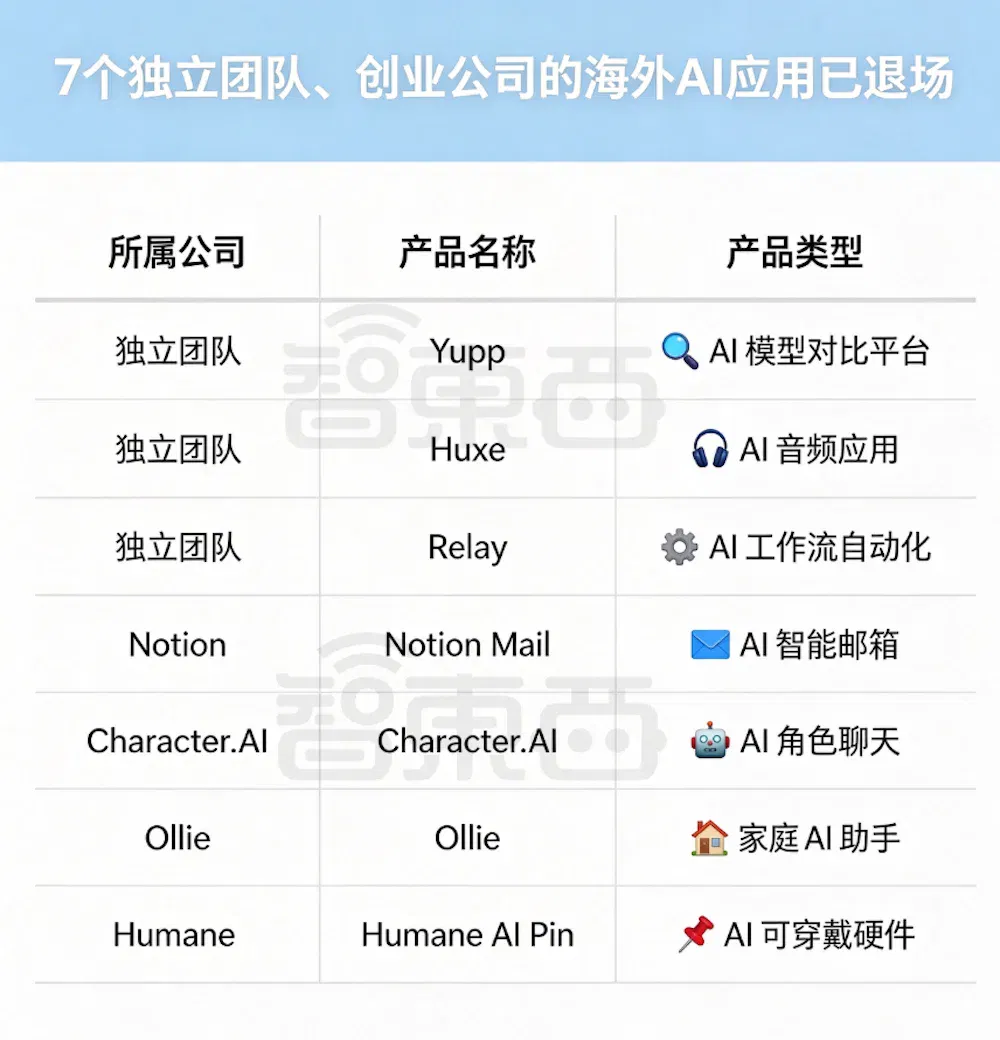
▲Seven independent-team and startup-product cases involving service closure, changes or restructuring; they should not all be treated as having exited the market (Table from source)
Character.AI, for example, went from star unicorn to a bankruptcy filing in just five years.
Founded in California in 2021, Character.AI was one of the most prominent unicorns during the early AI-chatbot boom in 2023. At its peak, its traffic was second only to ChatGPT. Its founders were Noam Shazeer, one of Google's most important early employees, and Google AI specialist Daniel De Freitas.
Character.AI was valued at about $1 billion when it completed a $150 million Series A in 2023. The figure of 20 million monthly active users cited in this article comes from historical reporting and does not represent its current active-user count.
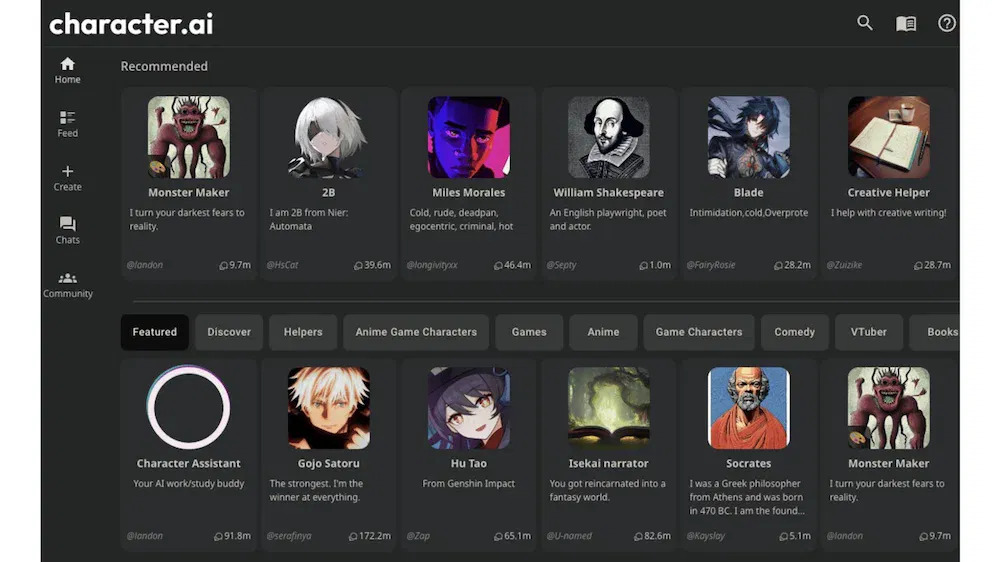
▲Character.AI interface
In August 2024, Google obtained a nonexclusive license to Character.AI's large-model technology and hired both co-founders and about 30 researchers. Character.AI remained independent after the deal, with the remaining team continuing to operate its existing product. However, the departure of its core founding team affected its ability to develop foundation models independently.
Despite its large user base, Character.AI never became profitable. Compute and employee expenses left the company losing about $8 million–$9 million a month, approximately RMB 53.76 million–RMB 60.48 million. It also faced multiple lawsuits involving minors' use of AI chatbots, adding to its operating burden.
Character's official November 5 transaction notice states that the Chapter 11 filing was submitted on October 12 US local time, while the Disney-related stalking-horse transaction agreement was dated October 13. Bankruptcy proceedings must be distinguished from asset-licensing transactions. This article does not conclude that the chat platform has closed or that Disney has taken it over.
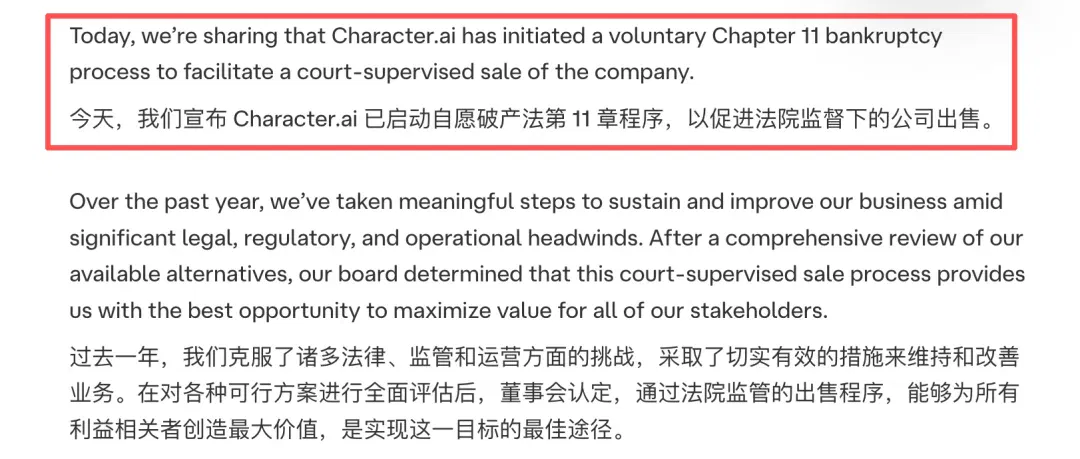
▲Character.AI announces bankruptcy
Another company, AI-notes unicorn Notion, co-founded by Chinese entrepreneur Ivan Zhao, closed its AI email application Notion Mail on September 22, 2026. Launched in April 2025, it focused on using AI to categorize and organize email automatically.
Notion said more than half of Notion Mail users could already use AI agents to summarize, reply to and organize email without opening their inboxes. It therefore decided to concentrate resources on AI agents and formally ended Notion Mail service.
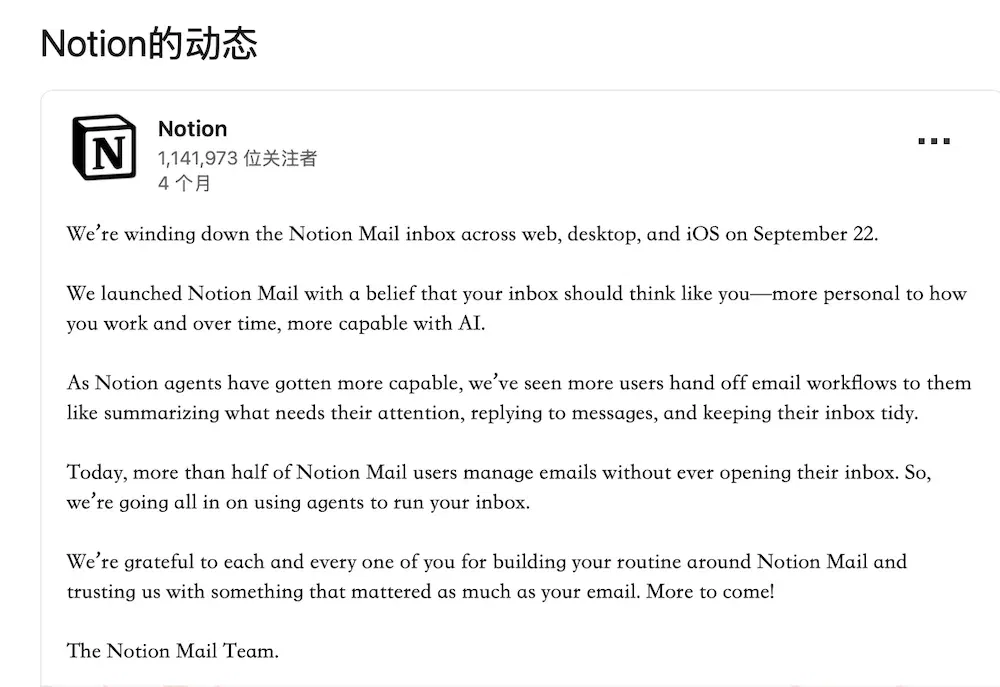
▲Notion Mail service ends
In home AI, some startups have also left the market because of weak user growth and financing difficulties. Privacy-focused Ollie was one of them.
Ollie raised $5.5 million, approximately RMB 36.96 million, in 2023, followed by $2 million, approximately RMB 13.44 million, in 2025, bringing total funding to $7.5 million, approximately RMB 50.4 million. But as Personal Agent apps such as Muse and Instinct entered the market, Ollie failed to expand its user base and struggled to obtain the funding needed to keep operating.
On October 30, 2026, Ollie co-founder and CEO Bill Lennon announced on X that it would formally end service on November 6.
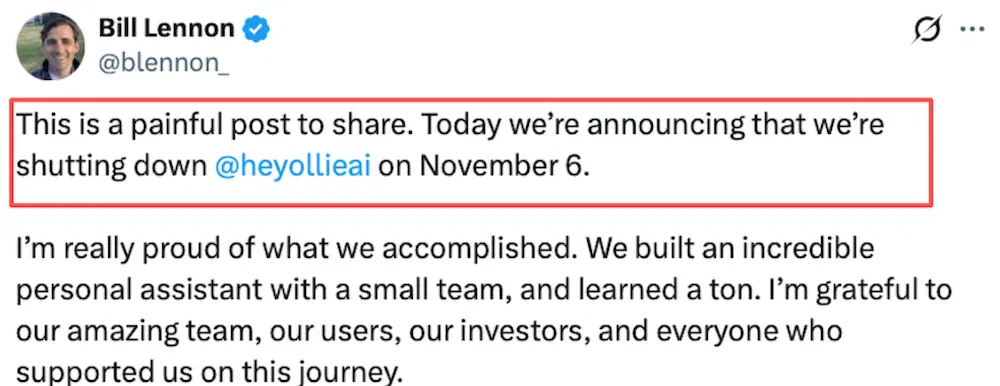
▲Ollie service ends
Prominent AI-hardware startups have also been unable to avoid failure. Founded by former Apple employees Bethany Bongiorno and Imran Chaudhri, Humane hoped AI Pin could explore human-computer interaction beyond the smartphone.
AI Pin went on sale in April 2024, priced at $699, approximately RMB 4,697, with users also required to pay $24 a month, approximately RMB 161, for a subscription.
This expensive piece of AI hardware, however, received widespread negative reviews after launch.
Early users and reviewers commonly reported that AI Pin was slow to respond and had limited practical usefulness. That same year, users were also told to stop using its charging case because of the risk of battery overheating and fire.
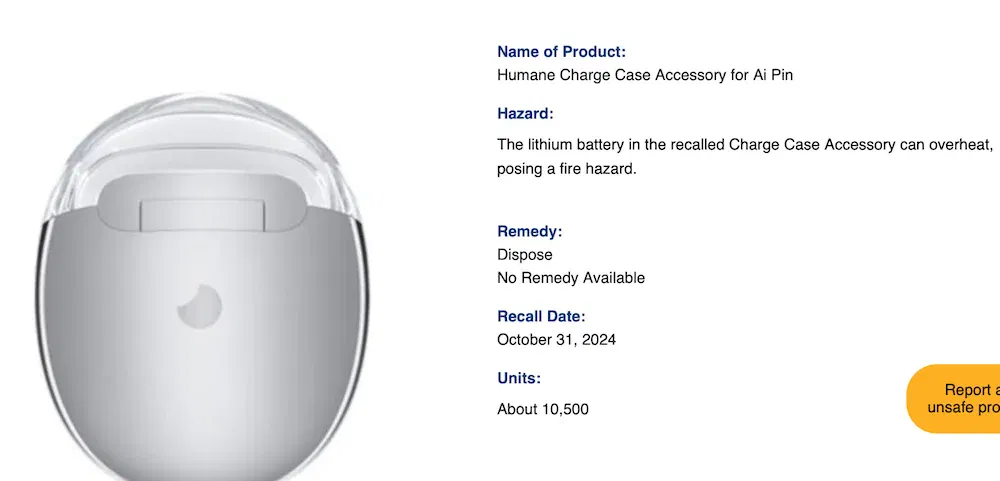
▲AI Pin recalled
On February 18, 2025, Humane announced it would sell most of its assets to HP for $116 million, approximately RMB 780 million, and immediately stopped selling AI Pin. The device's cloud services formally closed on February 28.
Among these cases, some independent services have closed, while others involve feature integration, delayed launches or corporate restructuring. Competition, resource constraints and operating costs may affect a business, but the cases cannot all be described as failures to keep operating or reduced to one cause.
As technology giants integrate AI features into mature platforms, standalone apps' competitive advantages weaken. Some startups have redirected resources because business returns fell short of expectations. High model-development and operating costs that user payments cannot cover also make certain applications difficult to sustain.
For AI hardware, safety risks and poor user experiences can also damage trust, subsequently hurting sales and ongoing operations.
03.
Conclusion: older products leave
While new applications keep emerging
From OpenAI's closure of Sora to Character.AI's bankruptcy and Humane AI Pin's withdrawal, these cases reveal another side of the AI industry. Model capabilities evolve rapidly and user needs keep changing. Standalone products once viewed as new directions may quickly be integrated into more mature platforms, while hardware and apps that once attracted strong market interest may reveal problems in actual use.
The departure of older products does not stop the AI industry's expansion. Technology giants continue increasing investment, and new startup teams keep entering the market. As technology and markets change, however, the products that first captured the spotlight may not remain at center stage.
Source: TechCrunch
This article comes from Zhidx. Author: Huang Fei.
After reading
Join the AINRK community
Read how to join the community and connect with people working in AI.
Related articles
Continue reading related topics and articles in this category.

姜宇辉的AI分身:知识助手与“另一个自己”之间 (opens in a new tab)
南方周末通过学者、用户与Second Me创始人的访谈及记者试用,观察AI分身的学术辅助、情感连接和商业化尝试,也呈现知识可靠性、人格边界、版权与隐私方面的疑虑。
智动未来据报完成亿元级Pre-A+融资,资金用于产线与服务机器人部署 (opens in a new tab)
机甲觉醒报道,智动未来宣布完成亿元级Pre-A+轮融资,由中美绿色基金领投、南曦创投联合领投,资金拟用于广州产线、服务场景部署和世界模型研发。“智子世界”仍属技术预览,商业化效果待更多应用数据检验。

范式智能介绍Phai-A1与Phai-M1,强调国产算力后训练优化 (opens in a new tab)
范式智能介绍面向代码与Agent场景的Phai-A1,以及面向真人影视的音画同步模型Phai-M1。公司展示了单卡运行和视频生成能力,并称模型在昇腾平台完成专项后训练优化。
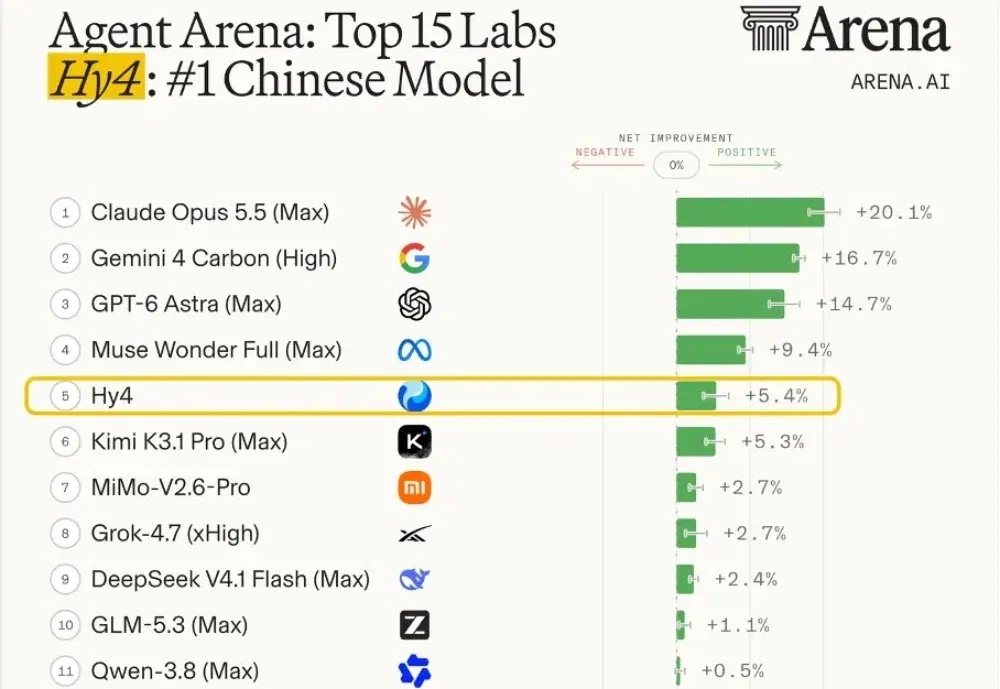
腾讯Q3资本开支814亿元,称WorkBuddy日Token用量居国内首位 (opens in a new tab)
腾讯三季报显示营收2073.36亿元、资本开支814.33亿元。公司称WorkBuddy日活超1000万,按用户每日大语言模型Token消耗总量居国内首位;报道还讨论云业务增收与AI投入对盈利、现金流的影响。

黄仁勋离任后:硅谷101访谈英伟达的技术、供应链与组织挑战 (opens in a new tab)
硅谷101采访半导体、科技与投资人士,讨论黄仁勋离任后CUDA生态、系统整合、供应链、开源投入和组织传承的潜在变化。产业放缓、估值折扣及人才流失判断属于受访者观点。