LangChain raises $300 million Series C for agent operation, improvement and governance
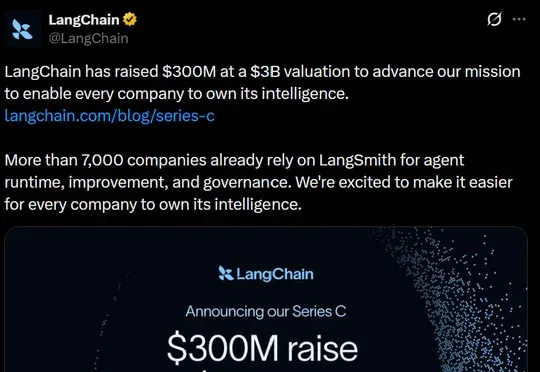
LangChain announces a $300 million Series C led by CapitalG at a $3 billion valuation. It is expanding LangSmith across agent operation, observability, evaluation and governance, and says more than 7,000 organizations use the platform.
Editorial correction (November 18, 2026): The financing announcement is dated November 13 on LangChain's website; the source report's November 17 date is retained.
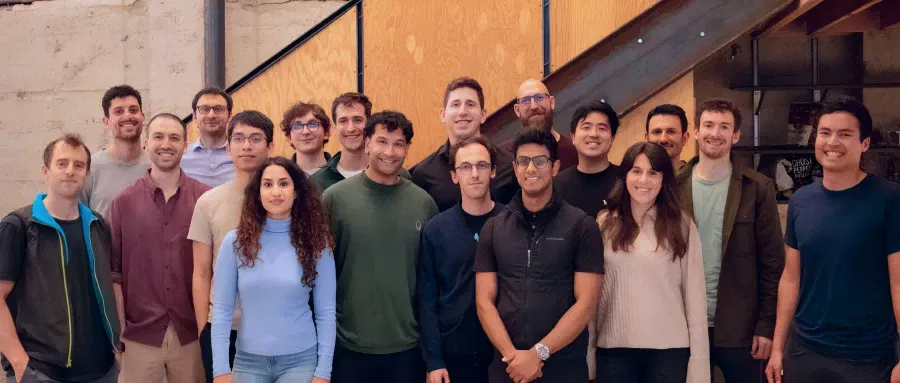
More than 7,000 organizations now use its products.
According to an announcement dated November 13 on LangChain's website, the company completed a $300 million Series C at a $3 billion post-money valuation. Zhidx reported the news on November 17, which remains the date of the source article.
The round was led by existing investor CapitalG, Google's investment firm, with substantial participation from new investors GIC and DFJ Growth, and follow-on investment from existing backers including IVP and Sapphire Ventures.
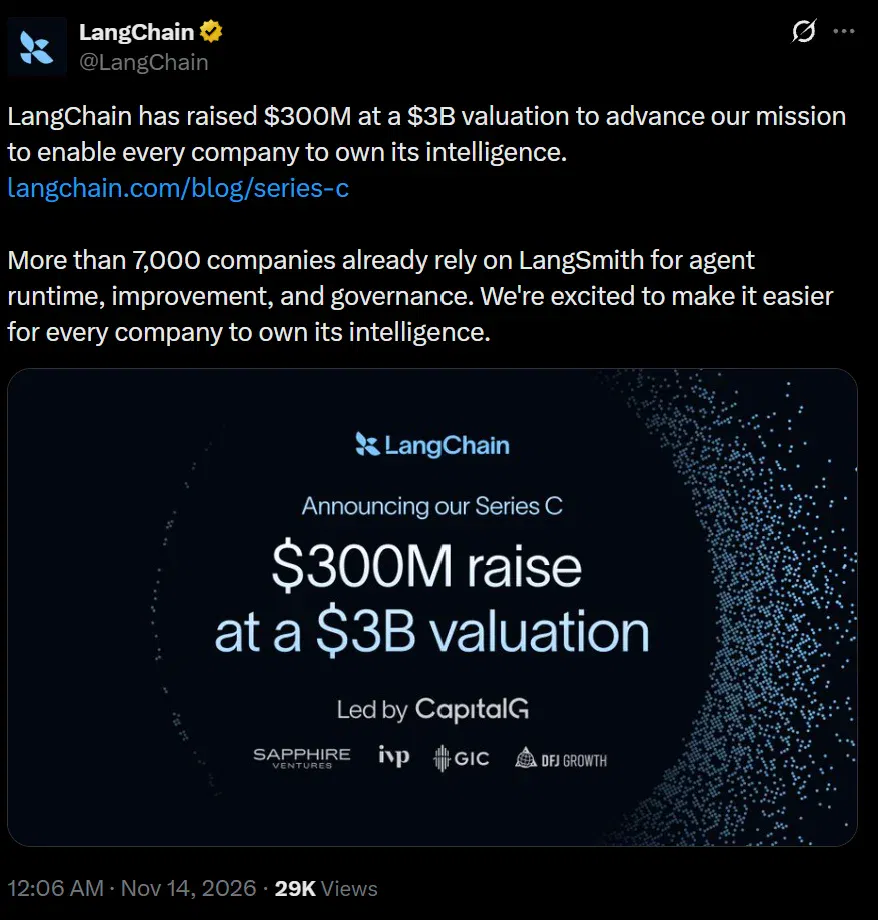
▲LangChain announces a $300 million Series C (Image: X)
In October 2025, LangChain raised $125 million, approximately RMB 834 million, at a valuation of $1.25 billion, approximately RMB 8.337 billion. Following the new round, its valuation has more than doubled from a year earlier.
LangChain began in late 2022 as co-founder Harrison Chase's personal open-source project, primarily helping early large language models perform difficult tasks such as searching the web, calling APIs and accessing databases. The company was formally established in early 2023 and is headquartered in San Francisco, with offices in New York, Boston and Amsterdam.
LangChain's products include development, deployment, evaluation and governance tools for large-model applications and agents. LangChain, LangGraph and LangSmith help enterprises connect models, data and external tools to build and manage production agent systems.
LangChain co-founder and CEO Chase graduated from Harvard University, majoring in statistics and computer science. He previously worked on machine learning for entity linking at financial-technology and data-analytics company Kensho Technologies, then became a machine-learning engineer at model-testing and validation company Robust Intelligence.
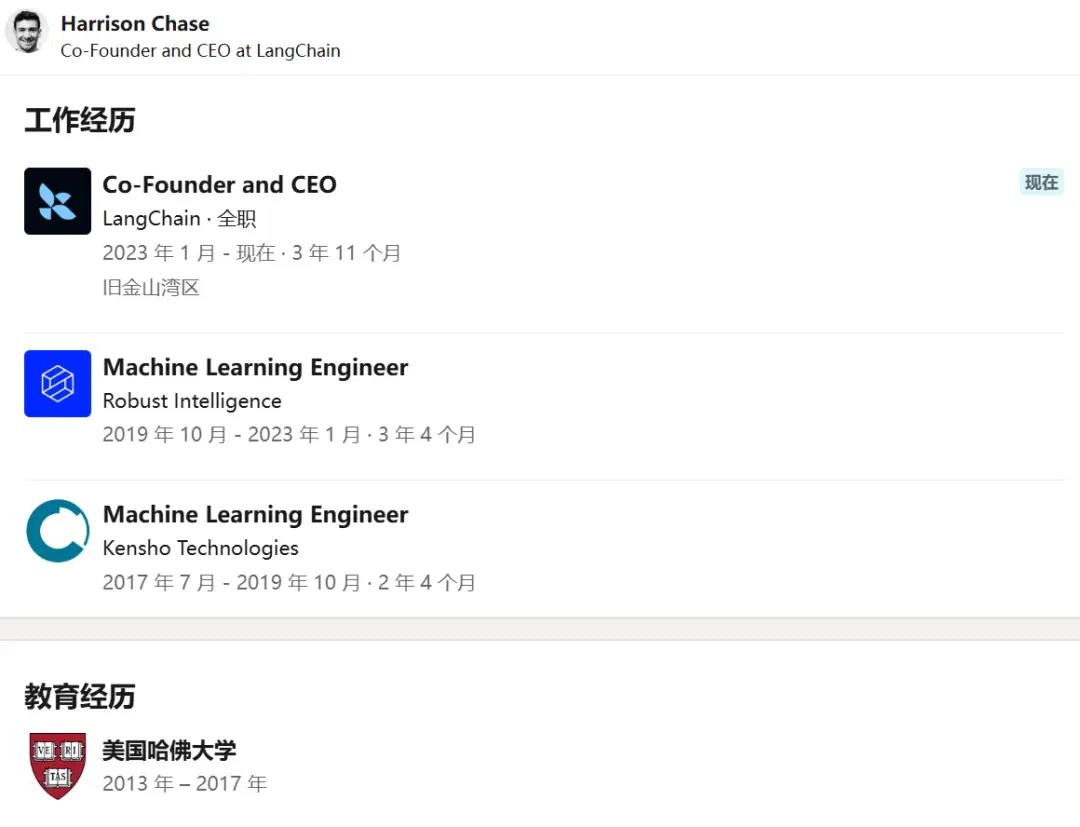
▲Harrison Chase's work and educational background (Image: LinkedIn)
LangChain believes agents will reshape the economy. Future agents will differentiate themselves through vertical expertise, enterprise data and user experience, and can be sold as standalone products or used to transform internal business operations.
In this environment, enterprises need control over their intelligent systems: choosing models suited to their business, controlling data and infrastructure, and continuously improving agents while meeting the security and governance requirements of large-scale deployment.
The company therefore introduced LangSmith, an AI development and management platform. LangChain says more than 7,000 organizations now use LangSmith, including AI startup Harvey, enterprise-software company Rippling, voice-based market-research company Listen Labs and Fortune 500 companies such as NVIDIA, Toyota and Salesforce.
LangSmith's product portfolio centers on three areas: agent operation, agent improvement and agent governance.
Agent operation provides the architecture and infrastructure teams need to run agents reliably. Deep Agents, LangGraph and LangChain offer agent architectures, model selection and context management. LangSmith Agent Server and Sandboxes support secure deployment in the cloud or teams' own environments. LangSmith Managed Agents and Fleet provide managed agent-building, deployment and operation services.
Agent improvement helps teams test, monitor and enhance agent performance. LangSmith Observability and Evaluation monitor behavior, test execution and assess quality. LangSmith Engine is a built-in agent that can automatically identify errors, write code and prompt fixes, and monitor production traffic for performance regressions. LangSmith Fine-Tuning turns execution traces into training data for fine-tuning and evaluating specialized models.
For agent governance, LangChain provides LLM Gateway and Tool Gateway to help enterprises centrally manage model budgets, model-fallback strategies, sensitive-data protection, tool-access permissions and authentication.
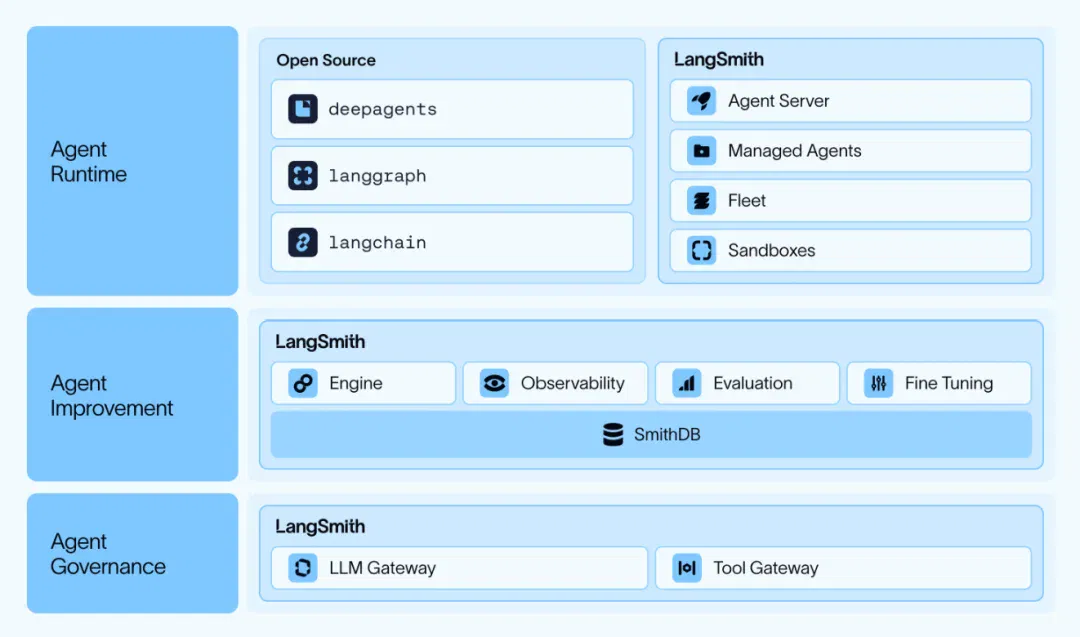
▲LangSmith's product portfolio (Image: LangChain)
LangChain says it will hold an online launch event on November 20 to announce multiple new LangSmith capabilities. It will continue developing its portfolio around agent building, deployment, evaluation and governance, lowering the barriers to developing high-performance enterprise agents.
Conclusion: enterprise-agent competition
Moves toward full-lifecycle management
LangChain's funding indicates that the enterprise-agent market is moving from exploring models and applications toward infrastructure and scaled deployment. Enterprises are increasingly focused on keeping agents reliable, improving them continuously and using them securely across teams and business environments.
As more enterprises put agents into production, demand around operational efficiency, effectiveness evaluation, data security and cost control will continue to grow.
Sources: LangChain, X and LinkedIn
This article comes from the Zhidx WeChat account. Author: Zhidx.
After reading
Join the AINRK community
Read how to join the community and connect with people working in AI.
Related articles
Continue reading related topics and articles in this category.
WorkBuddy日活破千万了,KroWork还在角落里吃灰,快手这张牌到底怎么打 (opens in a new tab)
4月30号,快手Krow团队推出了一款桌面端AI智能体KroWork,在这里你不用写一行代码,对着它说一句话,它就能自己写代码、调试、部署,最后交付一个能直接在桌面运行的应用。
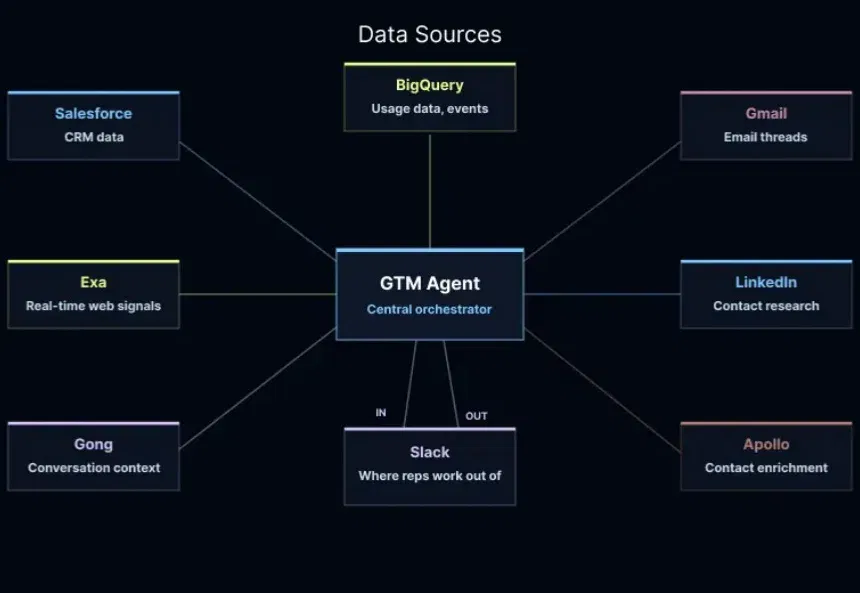
揭秘|LangChain团队用AI agent做销售和营销的最佳实践 (opens in a new tab)
你有没有想过,销售这件事可能会被彻底重新定义?不是那种换个 CRM 系统或者学几个销售话术的小改进,而是从根本上改变销售人员的日常工作方式。
刚刚,蝉联Future X全球榜首的MiroMind发布全球最强搜索智能体模型 (opens in a new tab)
凭借成功预测 Polymarket 题目,连续登顶 Future X 全球榜首的 MiroMind 团队,于今日(1 月 5 日)正式发布其自研旗舰搜索智能体模型 MiroThinker 1.5。MiroThinker-v1.5-30B 仅用 1/30 的参数规模跑出了比肩众多 1T 模型的性能表现,其 235B 的版本在多个搜索智能体基准测试中跻身全球第一梯队。
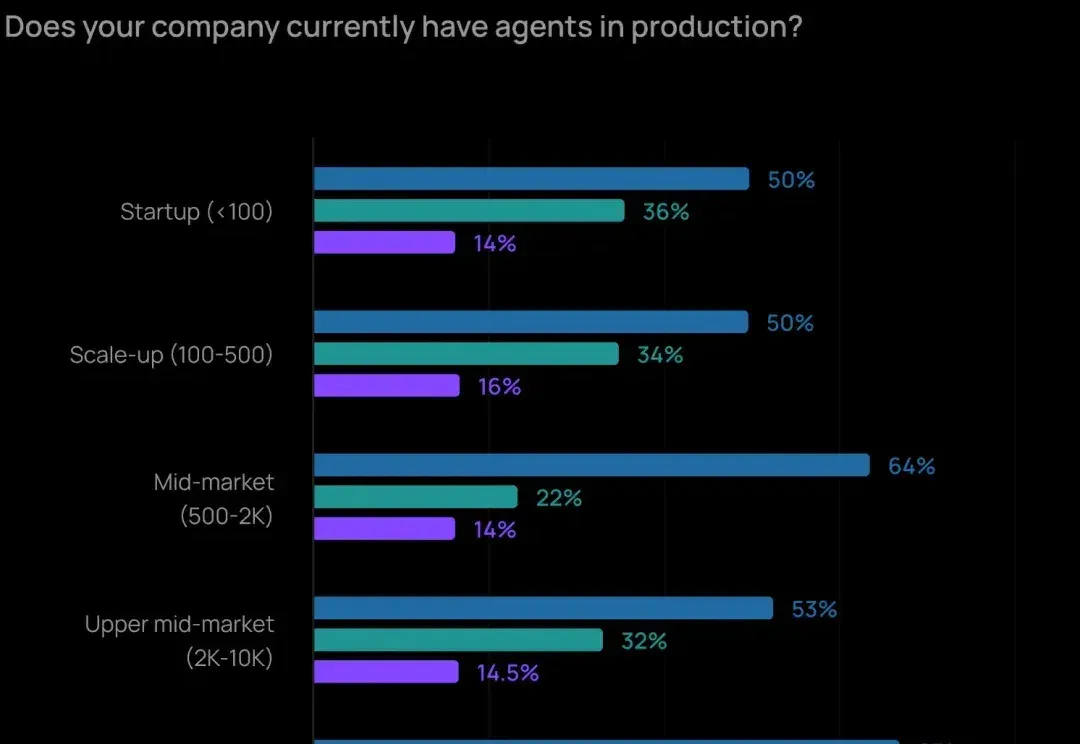
LangChain Agent 年度报告:输出质量仍是 Agent 最大障碍,客服、研究是最快落地场景 (opens in a new tab)
2025 年,让 Agent 实际投产、落地应用的最大障碍已经不再是成本问题了,而是「质量」。如何让 Agent 输出可靠、准确的内容,仍然是最难的部分。
LangChain完成 1.25 亿美元融资,投后估值 12.5 亿美元! (opens in a new tab)
本周,LangChain 宣布完成 1.25 亿美元融资,投后估值 12.5 亿美元。除了宣布其独角兽地位外,该公司还发布了里程碑式更新:经过 3 年迭代,LangChain 1.0 正式登场。而且,这并非一次常规的版本升级,而是一场从零开始的重写。