BIS announces remote advanced-compute rule with conditional licensing scope and timing
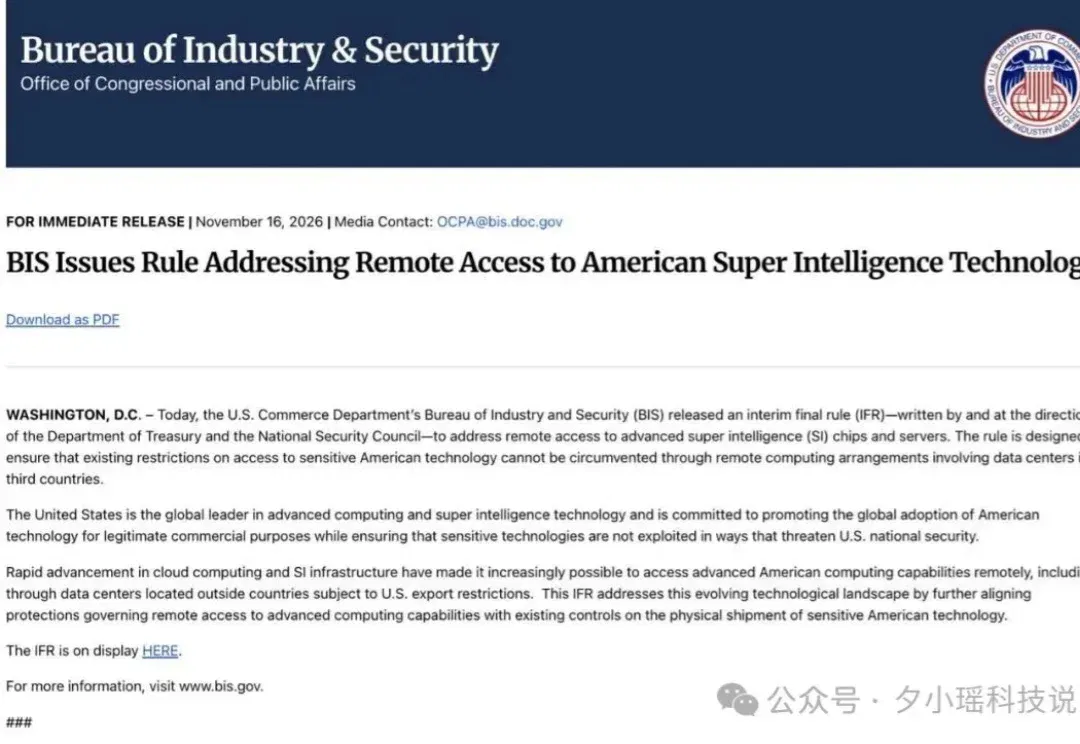
BIS announced an interim final rule on remote advanced-compute access on November 16, with publication scheduled for November 19. Its scope depends on chips, uses, end users and compute thresholds, with conditional exceptions and transition arrangements.
Editorial correction (November 18, 2026): Checked against the BIS announcement and Federal Register prepublication text as of November 18. Effective dates, applicability, recommendation-use exceptions and the ninety-day application arrangement have been corrected. The final official text governs specific cases.
Before the Nvidia controversy has settled, overseas GPU rentals face restrictions too.
Within the past twenty-four hours, the US Commerce Department’s Bureau of Industry and Security (BIS) formally announced a major interim final rule:
Where an overseas data center provides large-scale computing to entities with restricted headquarters or ultimate parent companies, the relevant chips’ export, reexport or in-country transfer requires a license.
How large is “large-scale”?
The rule uses a threshold exceeding twelve million aggregate total processing performance (TPP), alongside controlled-item classifications and specified end users. Roughly 750 chips is only the report’s computing-capacity analogy, not a substitute for legal classifications and calculations.
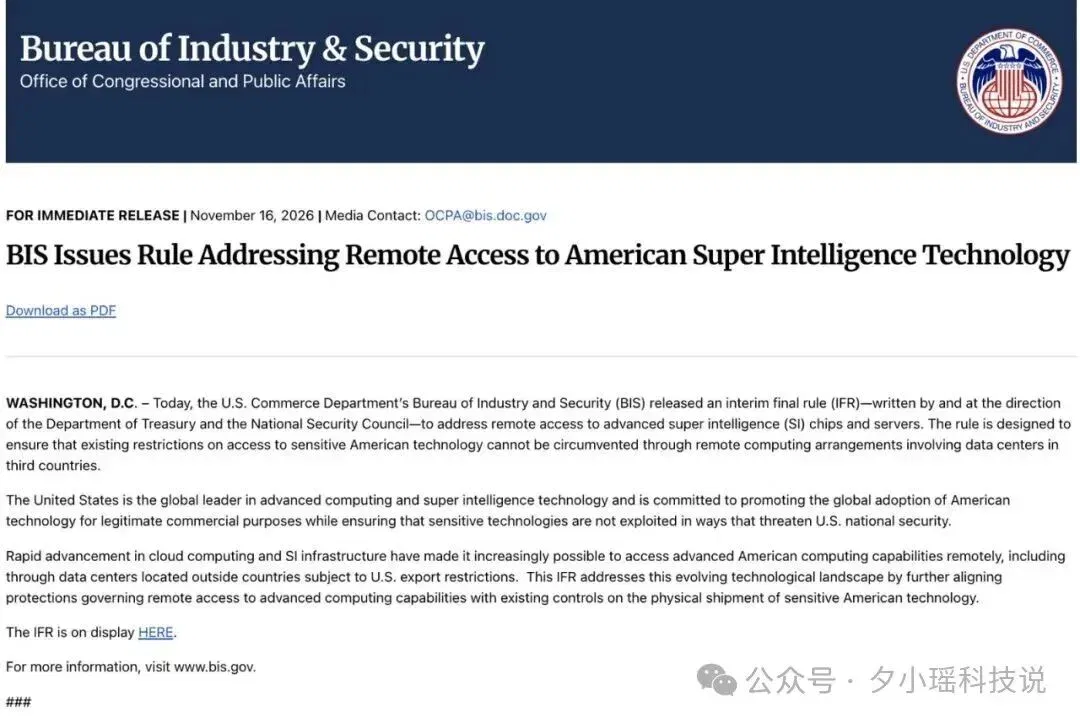
Document:
https://www.bis.gov/press-release/bis-issues-rule-addressing-remote-access-american-super-intelligence-technology
Restrictions previously focused on physical chip sales. They now address remote cloud access to computing.
Where, specifically, are the new boundaries?
Physically or digitally connected data centers operating as a unified resource may be aggregated under the rule. Chips spread across facilities are not automatically exempt, and calculation cannot be reduced to a single training task.
Requirements concern specified items, scale, end users and uses, including relevant headquarters or ultimate parents in Macau or Country Group D:5. Subleasing or intermediaries do not automatically remove applicability, but not every API call or overseas outsourced training task necessarily requires a license.
An exception covers certain items specifically designed and used for commercial recommendations, subject to reporting and other conditions. Generative models do not qualify for this recommendation-use exception. This does not mean all recommendation businesses need only report, or that every other legal authorization is canceled.
BIS announced the rule on November 16. As of November 18, the Federal Register prepublication page scheduled publication for November 19. The text takes effect upon publication; the announcement date is not the effective date.
For parties wishing to continue relevant existing services, the text requires a license application within ninety days after effectiveness; otherwise subsequent export eligibility may be affected. This does not mean connections must be unplugged after ninety days.
Beyond closing a cloud-access gap, the rule reshapes the global AI-infrastructure landscape.
Some advanced-chip transactions involving Singapore, Malaysia, Indonesia, Thailand and Brazil acquire licensing requirements, with conditional exceptions including certain US-headquartered end users. It is inaccurate to say all relevant transactions in those five countries require applications.
Over the past two years, Southeast Asia has become a major global computing-capacity intermediary.
Its location, inexpensive land and power and relatively accommodating trade environment have attracted an intense wave of data-center construction.
The original draft attributed the rule to the Megaspeed incident. The official announcement did not confirm that causal link, so this article discusses the rule and its publicly stated rationale instead.
Chip vendors and cloud providers face stringent know-your-customer due diligence under the rule—not just checking the contracting party, but tracing ownership and ultimate control.
Although announced by Commerce, the announcement specifically states that the Treasury Department and National Security Council helped write and guide the rule.
The announcement describes BIS collaborating with Treasury and the National Security Council. This provides no basis to claim those agencies were never involved in earlier controls.
The rule also repeals the January 2025 AI Diffusion Rule, replacing its complex country-tier and quota system with what the author describes as a blunt two-lock mechanism.
◈ A cat-and-mouse game
After the announcement, online commenters described the beginning of a cat-and-mouse game. That is because the company signing the contract, the one making the payment and the one ultimately using the computing power may not be the same company. Identifying the customers behind shell companies then becomes an ever-escalating contest between detection and evasion.
Although another layer of pressure clearly targets China, third countries also bear substantial pressure.
Singapore’s government has said it will not tolerate companies using the country to evade export controls, while protecting lawful companies’ access to advanced chips and compute. It is communicating with the US and affected businesses.
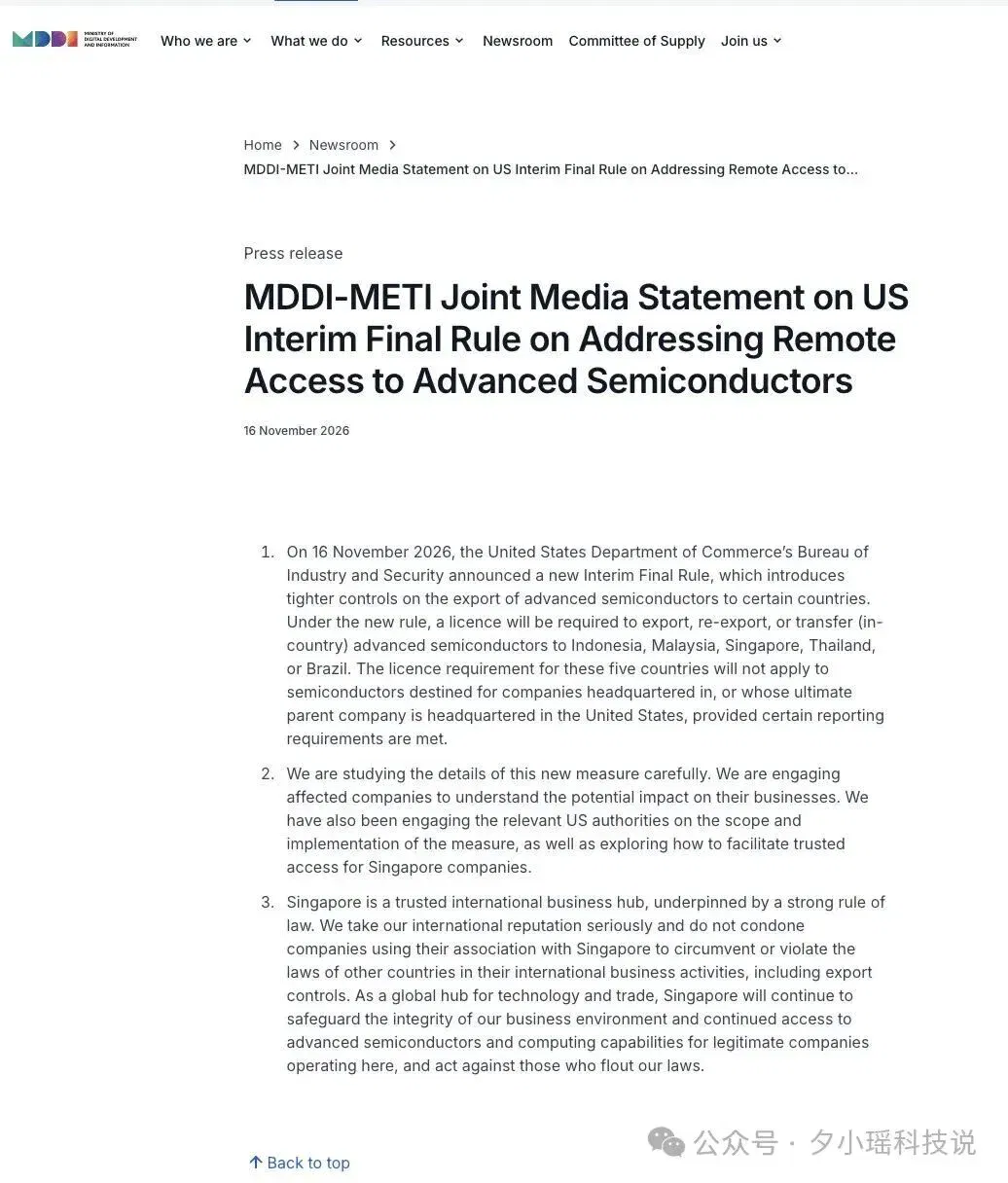
While the US closes gaps, Singapore still has its data-center business to run. Additional reviews, licenses and contract changes may raise operating costs.
The rule is expected to take effect November 19. Who receives licenses and how deeply overseas facilities can investigate ultimate users will depend on implementation.
This article was originally published by Xi Xiaoyao Tech Talk. Author: Luanma.
Related topics
After reading
Join the AINRK community
Read how to join the community and connect with people working in AI.
Related articles
Continue reading related topics and articles in this category.
国务院办公厅印发 AI 就业意见(附全文) (opens in a new tab)
国务院办公厅印发《关于适应人工智能技术发展助力构建就业友好型发展方式的意见》,从6个方面部署18项任务,提出拓展人工智能就业空间、减缓就业替代影响并健全风险评估和劳动者权益保障。
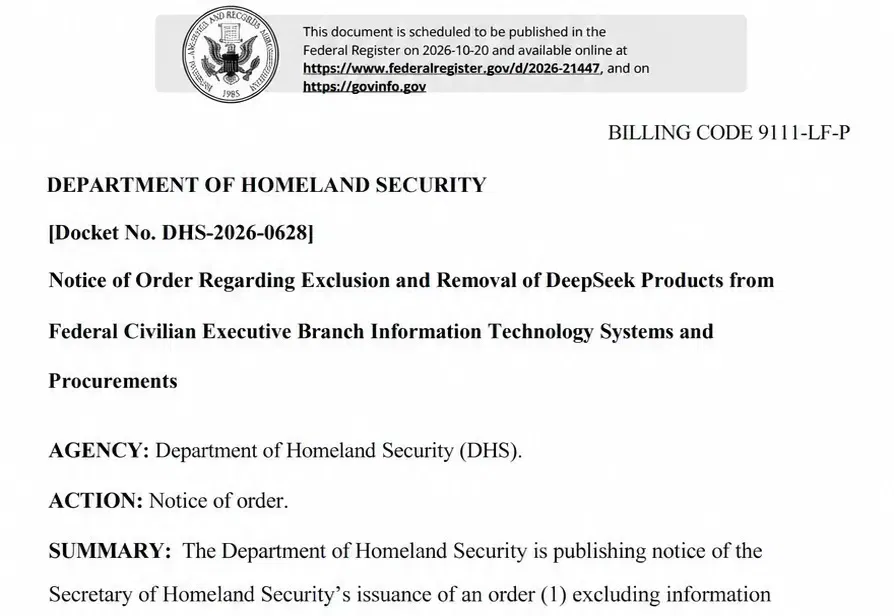
美国发布DeepSeek禁令 (opens in a new tab)
10月20日,美国国土安全部(DHS)发布通告: 要求美国所有联邦民事行政机构,全面禁止采购DeepSeek的产品,并从现有IT系统中彻底清退相关软件和服务。
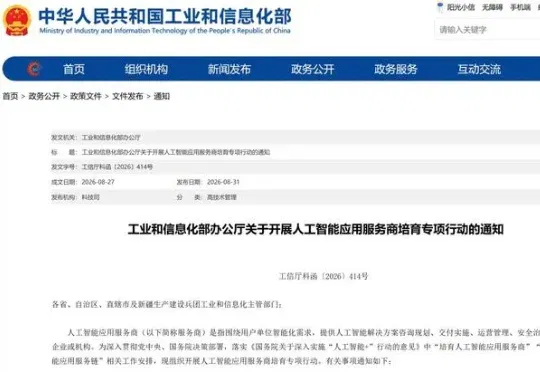
政策研究|工信部:“培育AI服务商”的政策机遇 (opens in a new tab)
工信部印发《关于开展人工智能应用服务商培育专项行动的通知》,明确到2027年底建成不少于3000家服务商的全国资源池,并通过资源池认证、应用服务团组建、"小快轻准"产品开发、采购与出海支持等举措,为民营企业提供明确政策机遇。
中日韩新四国AI标识监管规则比较 (opens in a new tab)
本文对比中日韩新四国AI透明度监管规则,分析各国在AI生成内容标识、可追溯性上的差异,为出海AI企业提供“统一底层能力、法域差异化配置”的合规思路。近期,Anthropic宣布在Claude生成的内容中加入机器可读取的标识:文本采用人眼难以察觉的水印,部分文件和图像则通过数字签名、内容来源元数据等方式留下来源信息¹。
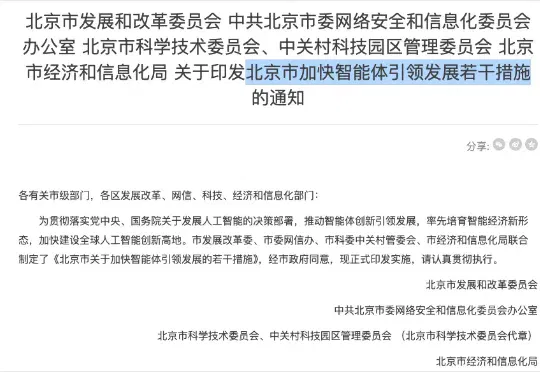
一文带你看懂刚刚发布的“北京智能体新政”,这是跟每个人都有关的10条。 (opens in a new tab)
刚刚,北京市发布了一份特别重磅的政策文件。《北京市关于加快智能体引领发展的若干措施》文件不长,一共10条。但我把它从头到尾看完以后,我的第一反应是,这份政策真的有点太新了。Agentic AI、Harness Engineering、AI OS、FDE、OPC、Token经济、TaaS、AaaS、RaaS、Token工厂、AIP。