MatOS opens materials-research agents built around scientific assets and stateful workflows
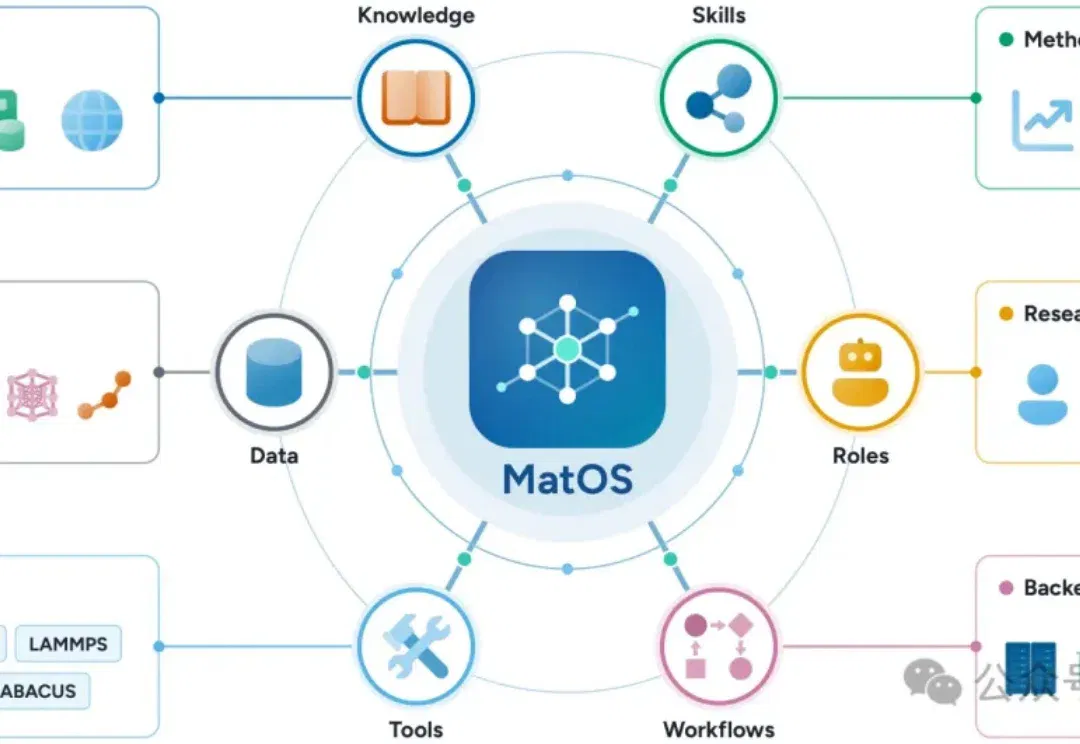
A team from two Zhongguancun institutions presents MatOS, organizing data, tools, skills and workflows as traceable assets, with three benchmarks and eight research cases. Screened candidates and computational predictions still require experimental validation.
Large-model agents can already search literature, invoke simulation software and even work with automated laboratories. But enabling them to independently complete an entire materials-research project remains challenging:
A study may involve progressively screening tens of millions of candidate structures or repeatedly searching hundreds of alloy formulations over several days, constantly adjusting plans to intermediate results. Connecting a new database or software package often requires rebuilding the process, and experience accumulated in one study is difficult to reuse in others.
To address this, Beijing Zhongguancun Academy and the Zhongguancun Institute of Artificial Intelligence, collectively the two Zhongguancun institutions, released an annual research advance this September: MatOS, a scientific-agent system for materials R&D.
Built by the institutions' AI Materials Institute team, the project organizes data, knowledge, tools, skills, roles and workflows uniformly as scientific assets, allowing researchers and MatOS itself to build new capabilities on existing assets. It executes research through stateful workflows and applies checked and reviewed asset revisions to subsequent studies, enabling research capabilities to evolve through use.
MatOS's asset library currently includes 3,135 datasets, 386 skills, 104 workflows and 51 expert roles, integrating 48 materials-computation software packages. Its technical report is on arXiv, and its code is open-source on GitHub.
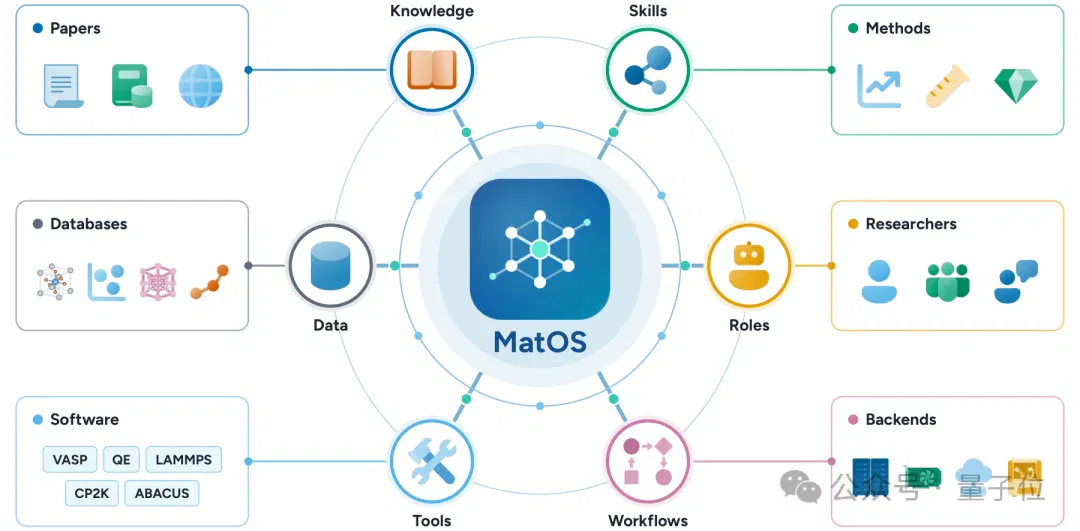
Across three agent benchmarks and eight research cases, MatOS completed tasks spanning end-to-end autonomous research, tool use, large-scale screening, formulation design and new-method development. Examples include:
On ResearchClawBench, an end-to-end autonomous-research benchmark, its average score was 33.6% higher than Codex CLI using the same foundation model, and its materials-task score was 80.8% higher;
On MatTools, a materials-software benchmark, it achieved a full-problem success rate of 97.96%, the highest among MatOS, Codex CLI and Claude Code using the same foundation model;
It built a hierarchical screening process that selected 97 solid-electrolyte candidates from more than thirty million structures;
It supported development of the alloy melting-point prediction model DuoCompNet, reducing mean absolute error on a fixed test set to 3.18°C, 13.6% below the next-best model.

From answering questions to conducting research and continually producing high-quality scientific assets
Recent work such as ChemCrow and LLaMP has enabled large models to use specialist tools, while systems such as MARS connect agents with automated experiments. Scientific agents are moving from answering questions to conducting research.
Materials research places three requirements on agent systems:
New databases, simulation packages and machine-learning potentials, which approximate interatomic forces with machine-learning models to accelerate simulations, continually emerge. Systems must integrate new capabilities without being rebuilt.
Research spans literature analysis, computation and experiments, requiring systems to preserve state and check results during long-running tasks.
Experience about simulation duration, sampling strategies and other matters largely comes from practice. Systems need to store and effectively reuse it in later tasks.
MatOS addresses these requirements through three designs: a hierarchical scientific asset graph organizes and expands R&D capabilities; stateful adaptive workflows invoke assets to execute tasks and preserve evidence; and evidence-driven asset evolution turns reusable experience into checked and reviewed asset revisions.
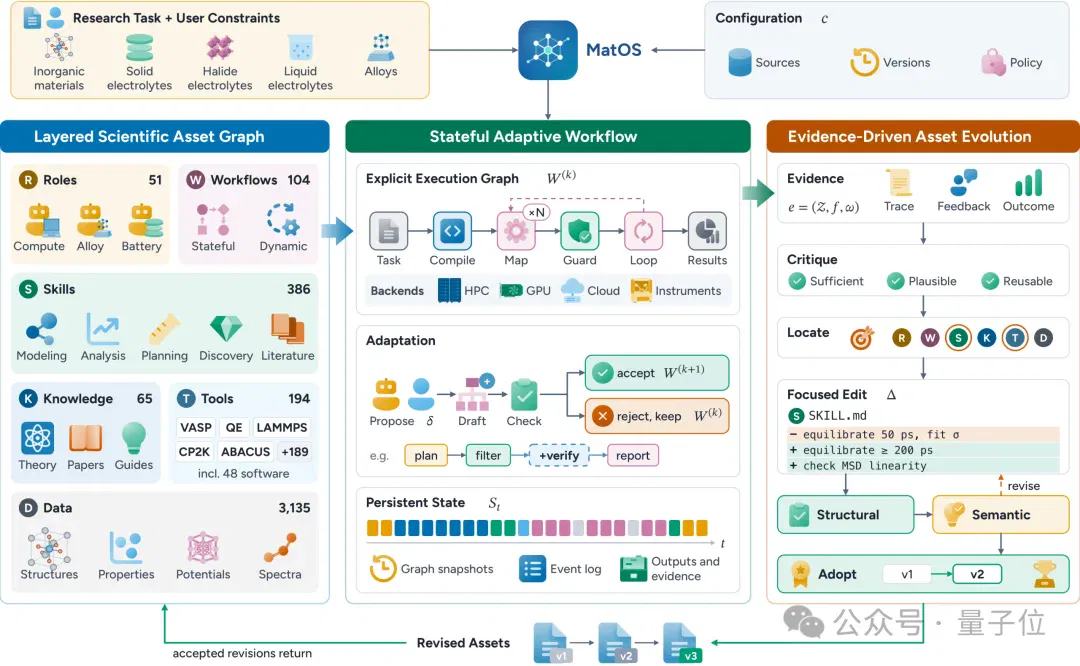
△MatOS architecture: a hierarchical scientific asset graph, stateful adaptive workflows and evidence-driven asset evolution.
Three designs: building, executing and evolving
Hierarchical scientific asset graph: combining existing capabilities to build new ones
MatOS organizes data, knowledge, tools, skills, roles and workflows into six categories of scientific assets.
Each asset has a unique identifier, declared dependencies and provenance. It can store content directly or refer to external databases or computational software.
Assets are connected through typed relationships such as dependencies, calls, evidence and validation. On receiving a task, the agent combines required capabilities along those relationships.
A skill functions like an operating procedure for a class of research problems, specifying when to use it, how to select methods, required preconditions, execution and result checking. Roles are expert agents defined by responsibilities and callable assets. Workflows describe connections between research stages. Multiple roles can use the same skill, and one role can participate in different workflows.
Both researchers and MatOS itself can build new capabilities on existing assets.
Researchers can register databases, software or methods as assets and combine them into skills, roles or workflows through interfaces and dependencies. MatOS can also create or revise assets based on task evidence for later reuse after checks and review. Asset use and revisions are recorded, making every improvement traceable.
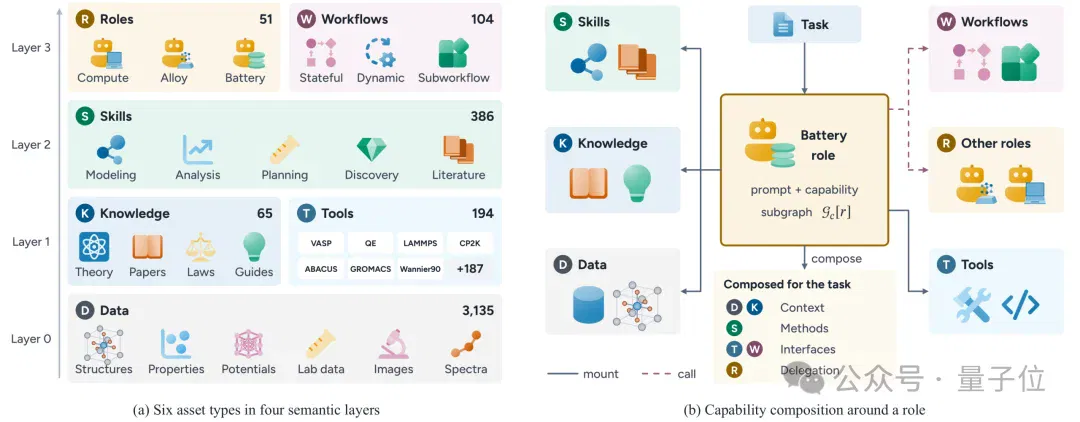
△Organization of MatOS scientific assets: (a) Six asset types occupy four semantic layers, progressively abstracting data, knowledge, tools and skills into roles and workflows. (b) A battery role illustrates how roles select and combine data, knowledge, tools, skills and workflows from the asset graph.
Stateful adaptive workflows: reliable execution and adjustment as needed
A workflow asset is a reusable process description; a particular study runs through an execution graph. Every node specifies its objective, inputs, outputs, completion conditions and referenced assets. The system schedules and checks according to the graph, delegating only judgment-dependent steps such as method selection, plan adjustment and exception interpretation to the agent. Steps requiring researcher confirmation can be designated human nodes.
Because large models can produce different outputs for the same input, decisions in long tasks may drift from the objective as context changes. MatOS therefore uses explicit steps and checking conditions to reduce dependence on model conversations and lower the risk of drifting from research goals during multi-step execution.
Execution-graph snapshots, node states, results and event records are preserved independently of the model conversation.
Computations taking days run in the background. The system proactively notifies the agent when they finish, require input or stop responding. Tasks awaiting external results or human input retain their progress and resume later. Every output links to its producing node and execution attempt.
Intermediate results may require later steps to change, such as adding validation before subsequent analysis proceeds from its results. In that case, the agent or researcher can propose adjustments to the execution graph, adding or modifying nodes and changing dependencies. Adjustments must pass structural, policy and compilation checks before creating a new graph version; if they fail, the original continues running. Each proposal, check result and adoption decision is recorded, fully tracing the graph's evolution.
Adjustments to the execution graph first serve the task currently in progress. Among these adjustments, process improvements that have value for reuse enter asset evolution as evidence; after checking and review, they are used to revise the corresponding workflow assets so that subsequent tasks of the same kind can call upon them.
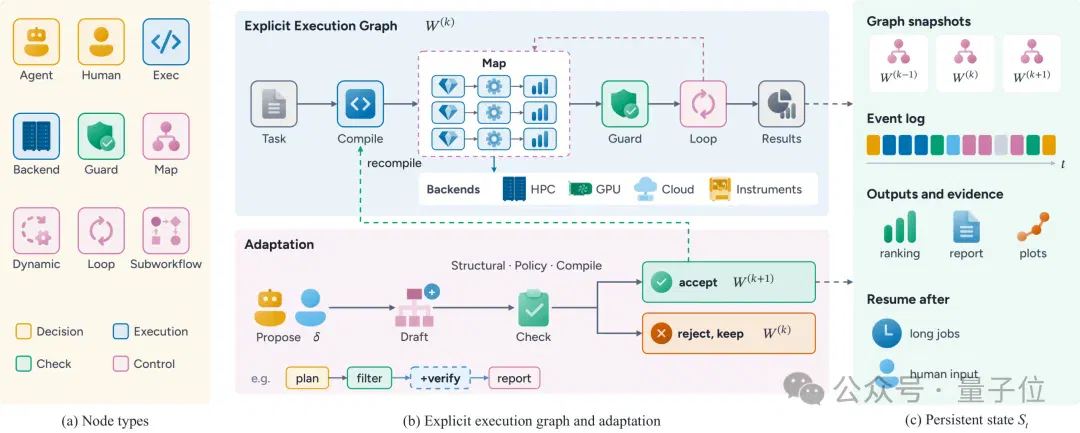
△Stateful adaptive workflows: node types, execution graphs and dynamic adjustment, and persistent state.
Evidence-driven asset evolution: continual improvement through use
User corrections, failed tool calls, recurring operations and workflow results may all indicate an asset needs improvement.
MatOS first assesses whether evidence is sufficient, the problem is valid and the experience reusable, then locates the responsible asset. Incorrect method selection may require revising knowledge or skills; incorrect tool behavior requires tool repair; missing research steps require workflow revisions. It may also create new assets or revise several linked assets together.
For example, if feedback indicates insufficient equilibration time in molecular-dynamics simulations, the system may change the corresponding skill's equilibration duration from 50 ps to at least 200 ps and add a check confirming atomic diffusion has reached a stable regime.
Candidate revisions undergo structural checks and model-based semantic review. Structural checks mainly assess whether new structural, interface or composition errors are introduced. Semantic review assesses whether the revision addresses the original evidence, preserves the method's applicability conditions and remains consistent with related assets.
Only revisions passing both checks and review are adopted, with subsequent task results becoming evidence for the next evaluation round. This experience is stored in assets outside the model, leaving the foundation language model's parameters unchanged. Assets are also model-independent: the same MatOS system was evaluated with GPT-5.4 and DeepSeek models.
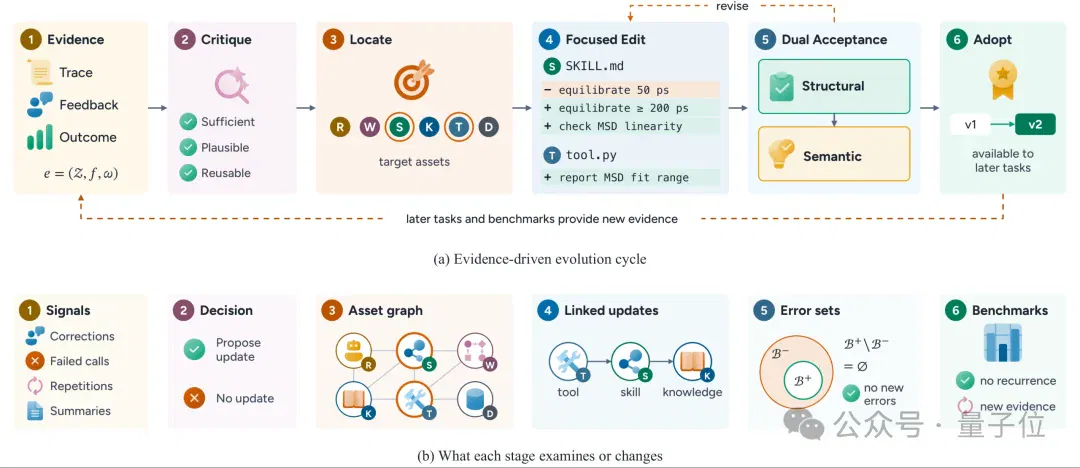
△Evidence-driven asset evolution: evidence assessment, target identification, local revision, structural checking and semantic review, and version adoption.
Benchmark results
ResearchClawBench asks systems to conduct research from literature and raw data and submit reports. The team selected twelve chemistry, energy and materials tasks and compared MatOS with seven GPT-5.4-based research agents, including MIRA, ResearchClaw, EvoScientist and Codex CLI.
With GPT-5.4, MatOS averaged 19.46, 11.15% above the best baseline MIRA and 33.6% above Codex CLI. Its materials-task performance was stronger still: 18.7% above MIRA and 80.8% above Codex CLI. With the cheaper DeepSeek-V4-Flash, MatOS averaged 19.20, also exceeding all baselines.
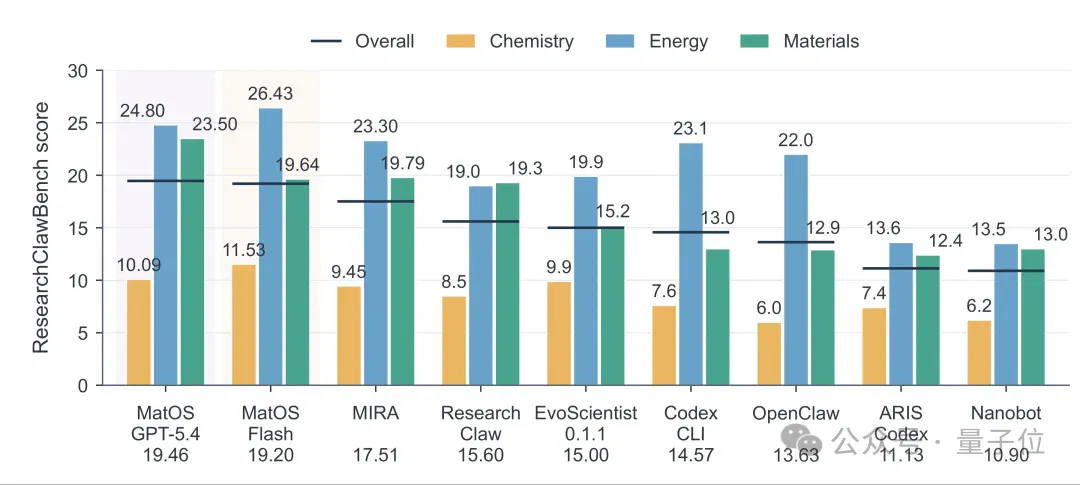
△Domain-specific and overall average scores for chemistry, energy and materials tasks on ResearchClawBench.
The DeepSeek-V4-Flash configuration cost approximately $0.85 per task, less than a third of Codex CLI's $2.70, while scoring higher. The GPT-5.4 configuration achieved the highest score at approximately $3.78. Together, the two MatOS configurations extended the cost–score Pareto frontier in this evaluation: a set of optimal choices with different tradeoffs, none comprehensively outperformed by another across the objectives.
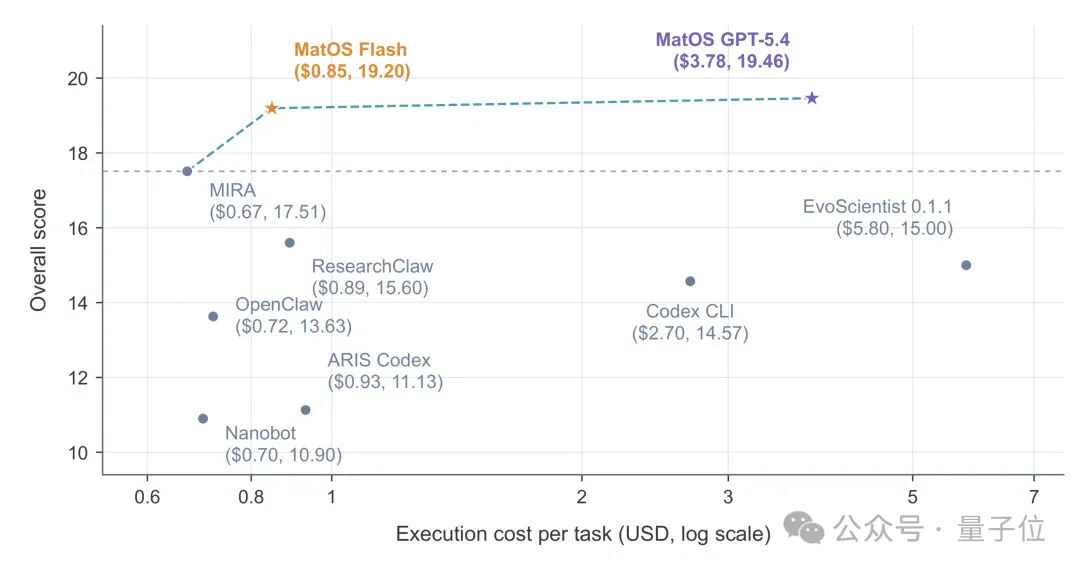
△Average cost and score per task for each system; cost uses a logarithmic axis.
On the MatTools materials-software benchmark and SciAgentGym multi-step tool-use benchmark, MatOS, Codex CLI and Claude Code all used DeepSeek-V4-Pro as their foundation.
MatOS's full-problem success rate on MatTools was 97.96%, above Codex CLI's 95.92% and Claude Code's 89.80%. Its subtask success rate was 97.10%, versus 95.65% and 91.30% respectively. On SciAgentGym, MatOS's case success rate was 59.5%, above the other two systems' 57.1%.
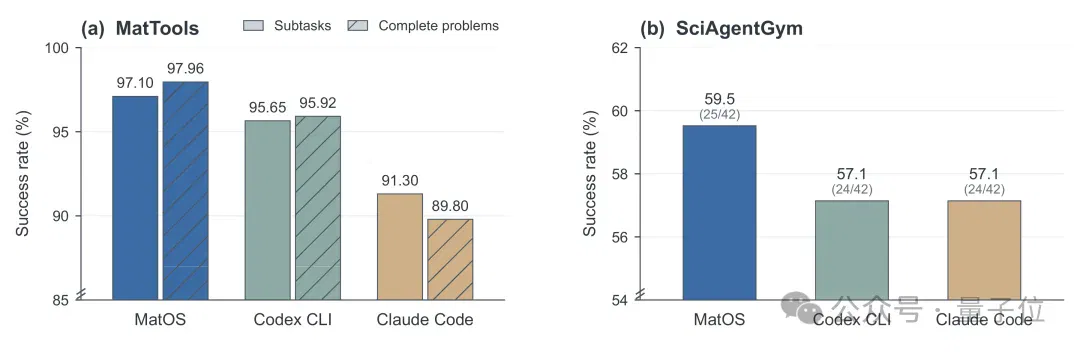
△Success rates on MatTools and SciAgentGym for three systems sharing DeepSeek-V4-Pro as their foundation.
Research cases: from large-scale screening to new-method development
Eight research cases cover machine-learning potentials, solid and liquid electrolytes, alloys and other materials, extending into fluid mechanics. Tasks include large-scale screening, molecular simulation, formulation design and new-method development.
For large-scale screening, MatOS followed Du and colleagues' hierarchical framework: rapid coarse screening with a composition-only model, finer screening with a graph neural network predicting properties from crystal structures, and finally molecular-dynamics simulation of ion motion to progressively examine conductivity, electrochemical stability and mechanical properties. It selected 97 solid-electrolyte candidates from 30,364,908 initial structures, with computed conductivity reaching 59.0 mS/cm.
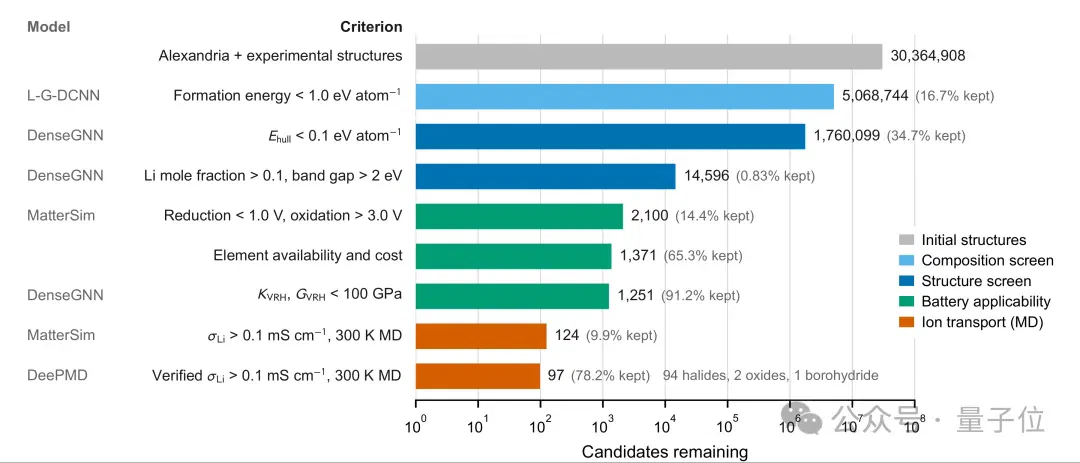
△Progressive solid-electrolyte screening: 30,364,908 initial structures narrowed to 97 candidates.
For formulation design, MatOS searched for semiconductor-packaging alloys that begin melting near 300°C over a narrow temperature range. The large model proposed candidate formulations in four parallel groups. A surrogate model, which provides fast approximate calculations, predicted solid and liquid fractions at different temperatures, with scores guiding the next search round.
Across 286 evaluated formulations, the best score rose from the initial formulation's 0.534 to 0.927. The top-scoring Pb–Ag–Pt–Sn alloy was predicted to begin melting at 297.75°C and reach an 80% liquid fraction after a further 4.55°C increase.
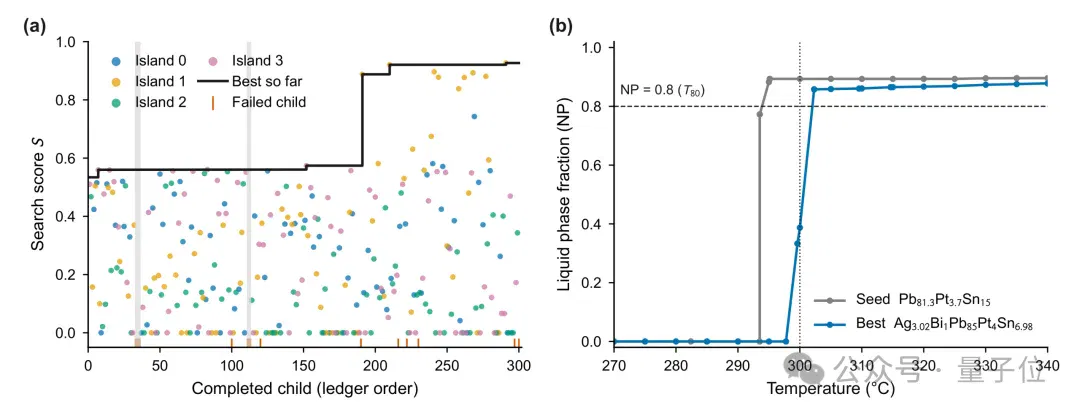
△Alloy-formulation search targeting melting near 300°C: (a) Scores in four parallel searches, with the black line showing the current maximum. (b) Predicted liquid fractions near 300°C for the initial and highest-scoring formulations.
For new-method development, the researchers used MatOS to build an active-learning workflow. The system selected alloy formulations for thermodynamic calculations, retraining the model when results returned so data and model expanded together.
DuoCompNet, developed in this process, predicts the midpoint between the onset and completion of melting in tin-containing alloys. As training data increased, its mean absolute error on a fixed test set fell from 28.40°C to 3.18°C, the lowest among six compared models and 13.6% below runner-up Roost. The test set contained 1,401 binary or ternary tin-containing formulations with melting-interval midpoints between 200°C and 400°C. Reference values came from thermodynamic calculations.
RarityGuard-MP, a training-data selection method developed with MatOS, selected 100,000 of approximately 1.26 million structures for training machine-learning potentials. At the same data volume, the trained model's combined energy, force and stress error was 3.10% lower than with DIRECT.
Summary and outlook
MatOS connects capability building, task execution and asset evolution:
Researchers can integrate their own data, software and methods, while the system can propose asset revisions from task evidence. New assets and revisions adopted after checks and review become directly callable capabilities for subsequent studies, so new research need not start from zero.
Next, MatOS will connect instruments and experimental procedures, linking evidence from computational screening through experimental validation within the same system.
Technical report: MatOS: An Agent Operating System for Materials Research Report: https://arxiv.org/abs/2610.34203 Code: https://github.com/DingyangLyu/MatOS AI Materials Institute contact: aimaterials@bza.edu.cn
This article was originally published by QbitAI. Author: Yunzhong.
Related topics
After reading
Join the AINRK community
Read how to join the community and connect with people working in AI.
Related articles
Continue reading related topics and articles in this category.
陆子恒:我们用AI穷举了20万种材料,知道了一个价值10亿的问题 | AI for Science沙龙 (opens in a new tab)
材料研发的“试错时代”,正在被AI加速改变。5月21日,未来光锥「AI for Science 创变者说」第二期沙龙“AI+材料的千亿级机会”,邀请了三位学界与产业一线嘉宾,共同探讨AI+材料科学的前沿与实践。
OpenAI前高管用Kimi训出万亿参数模型,部分能力超GPT-6,已接入材料实验室 (opens in a new tab)
近日,一家由 OpenAI 和 Google DeepMind 前研究人员创办的公司公布了过去一年的多项进展。
蚂蚁与西湖心辰介绍Duo v1,探索全双工视听交互 (opens in a new tab)
Duo v1通过Intent与Realization模块衔接交互决策和音视频生成。文章报告30组交互、180项检查中通过168项,内容响应度为73.3%;复杂意图理解与长程一致性仍是团队后续优化方向。
EgoExplorer captures mobile manipulation with five trackers and a camera (opens in a new tab)
Shanghai AI Lab presents a wearable capture system using trackers, gloves and a camera, plus C³ motion reconstruction, and releases 100 hours of data and code. Reconstruction and multimodal generation are assessed separately; humanoid transfer is shown only in simulation.

ConvexLLM connects speech to language models through frozen text embeddings (opens in a new tab)
Researchers at CUHK-Shenzhen and Microsoft propose C-Gate, mapping audio into convex combinations of frozen text embeddings. The paper reports VoiceBench gains against its listed open-model baselines, while audio understanding and transcription still involve trade-offs.