Geodesic releases NovaAtom-Lite and reports all-atom structure-prediction results
Geodesic reports antibody–antigen and protein–ligand benchmark gains with NovaAtom-Lite and tests hints and multi-candidate sampling. Structure-prediction scores do not establish drug approvals, clinical effectiveness or a timetable for curing diseases.
Editorial correction (November 16, 2026)Structure prediction, drug development, clinical validation and curing disease are different measures. Four years is an R&D aspiration, not a deadline for curing cancer. The team reports these benchmarks through its model card; some baselines use different sample counts and inference budgets. Each seed includes five samples, and the main figure's selected single-run results must be distinguished from sampling-curve averages.
Recently, Anthropic CEO Dario Amodei made a statement:
Timelines for AI accelerating biology are public forecasts, not validated deadlines for overcoming diseases. Cancer, Alzheimer's disease and heart disease each also encompass different types and clinical pathways.
It sounded bold, though many people felt it was merely something to listen to.
The four-year goal recounted here concerns shortening drug development. It cannot be rewritten as curing cancer within four years or guaranteeing approval of any particular drug.
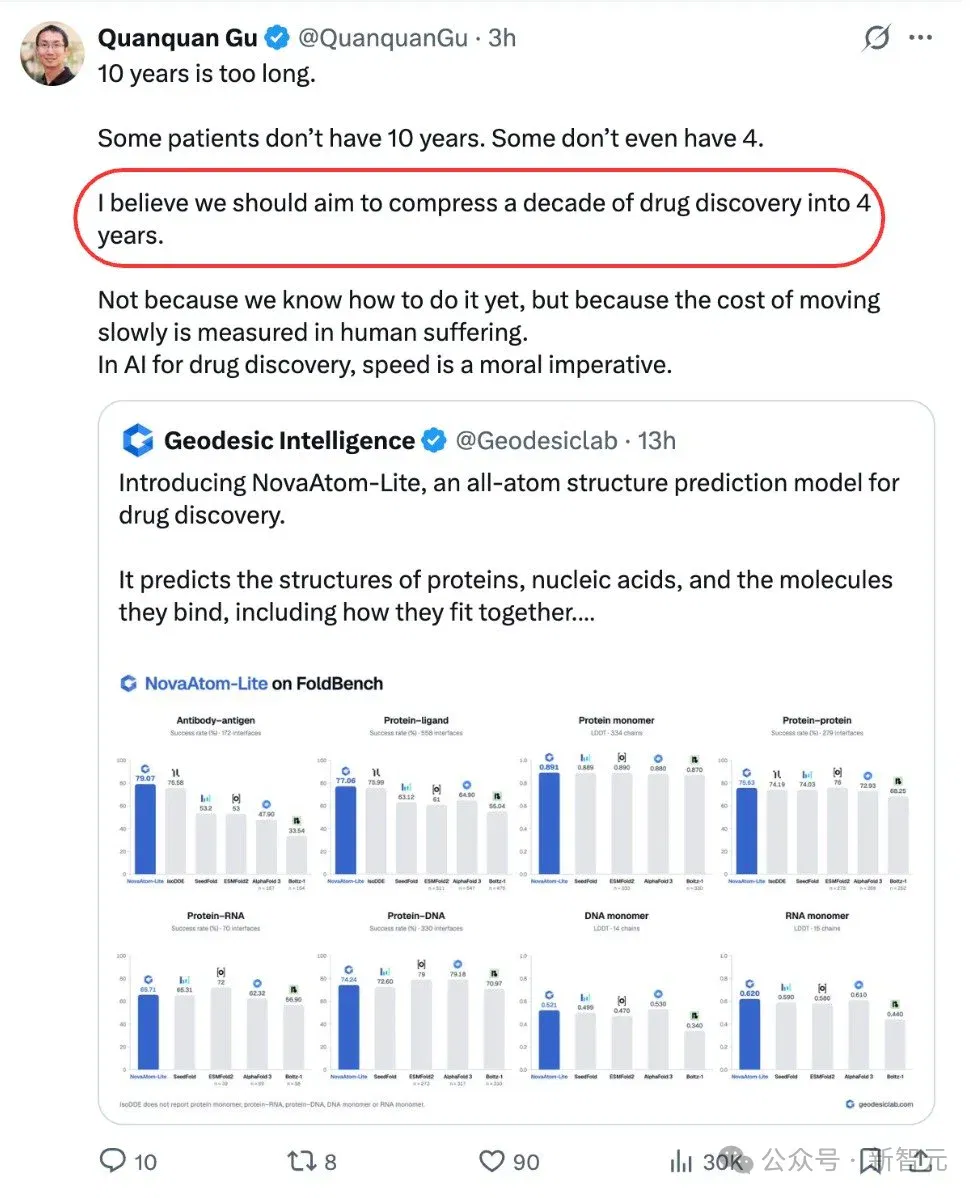
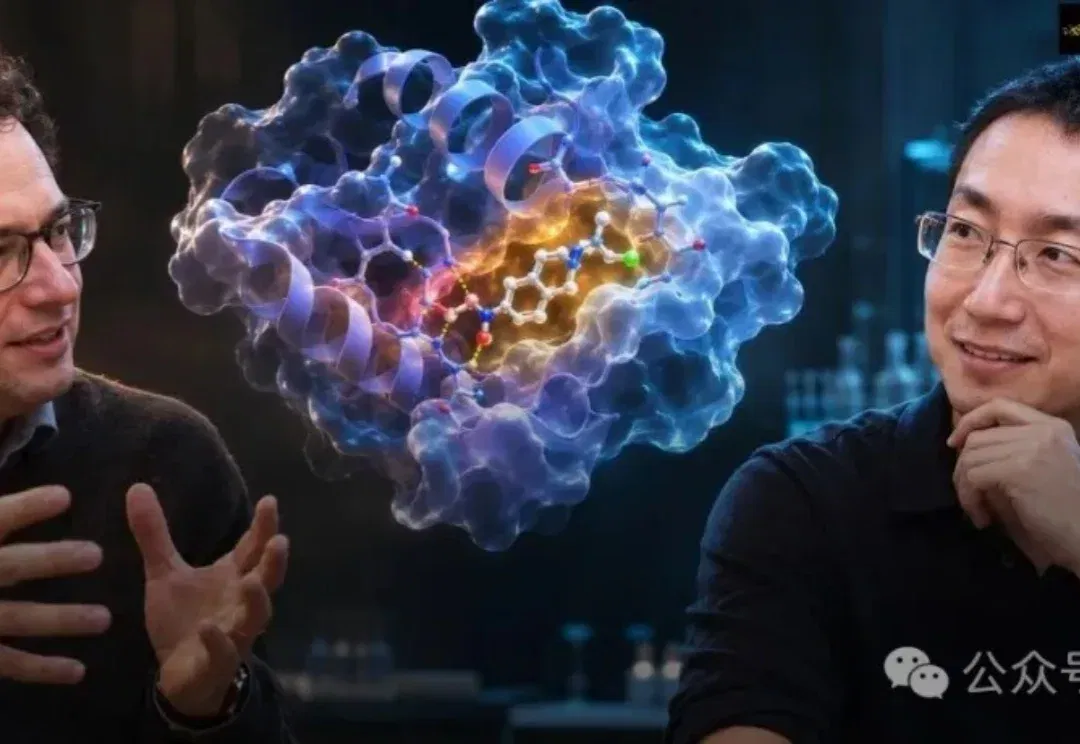
On November 10, Geodesic Intelligence, founded only five months earlier, released its all-atom structure-prediction model NovaAtom-Lite.
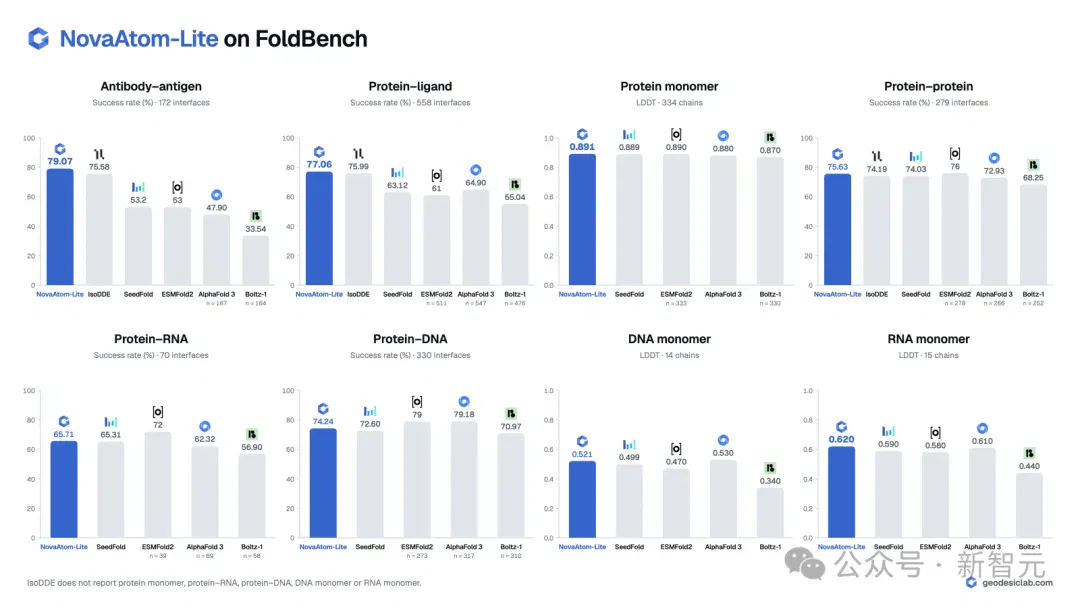
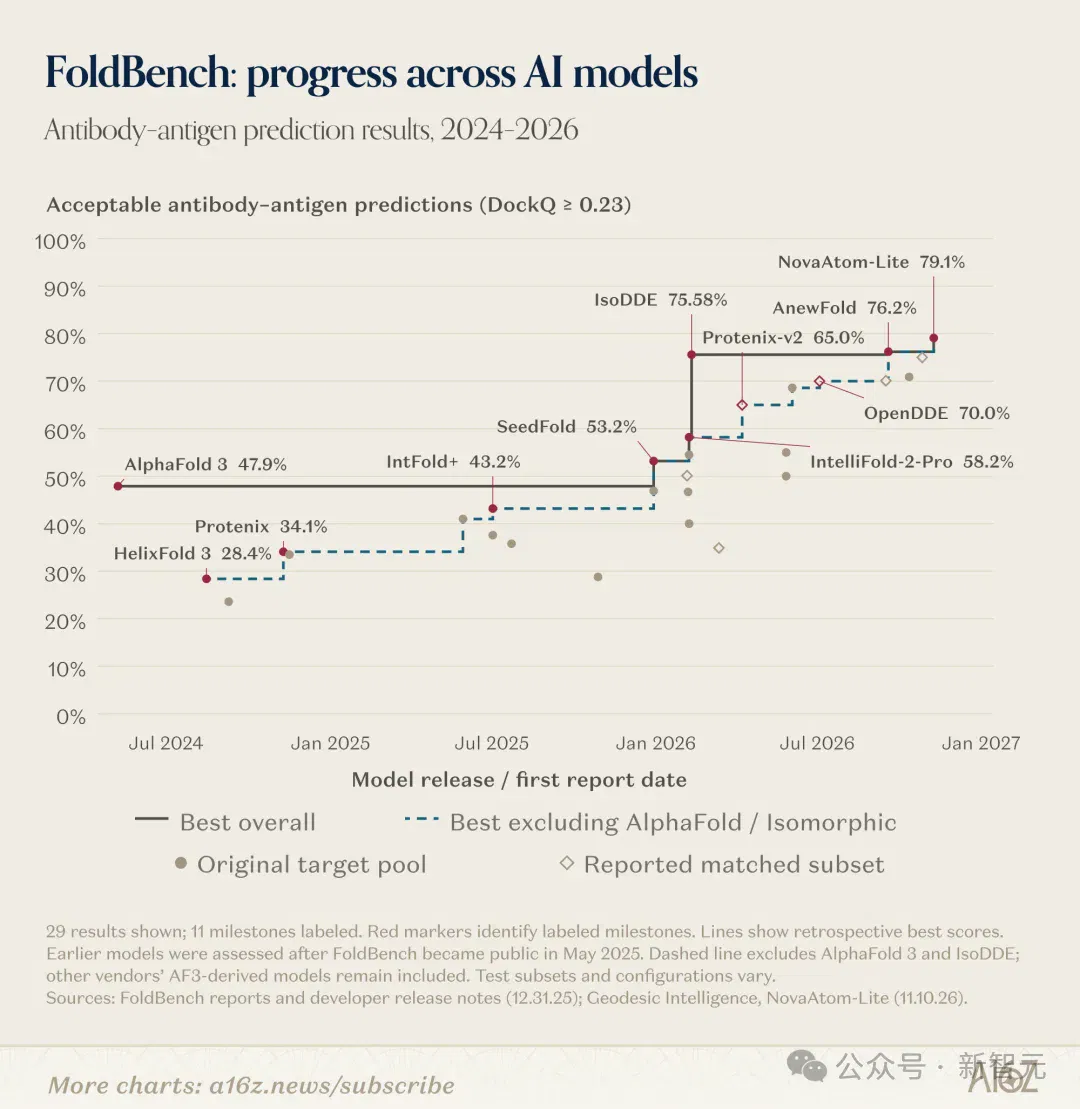
On FoldBench, described as the world's toughest biomolecular-prediction benchmark, NovaAtom-Lite displaced IsoDDE, the flagship of Google DeepMind's Isomorphic Labs.
It topped multiple biopharmaceutical benchmark categories!
Model card: https://www.geodesiclab.com/news/introducing-novaatom-lite
A fifteen-person startup, a few hundred GPUs, five months. Opposite it was Isomorphic Labs, with $2.7 billion raised and negotiations for another round at a $40–50 billion valuation.
X erupted.
One commenter said: "Dario Amodei predicts cancer can be overcome within ten years, while NovaAtom's founder says just four."
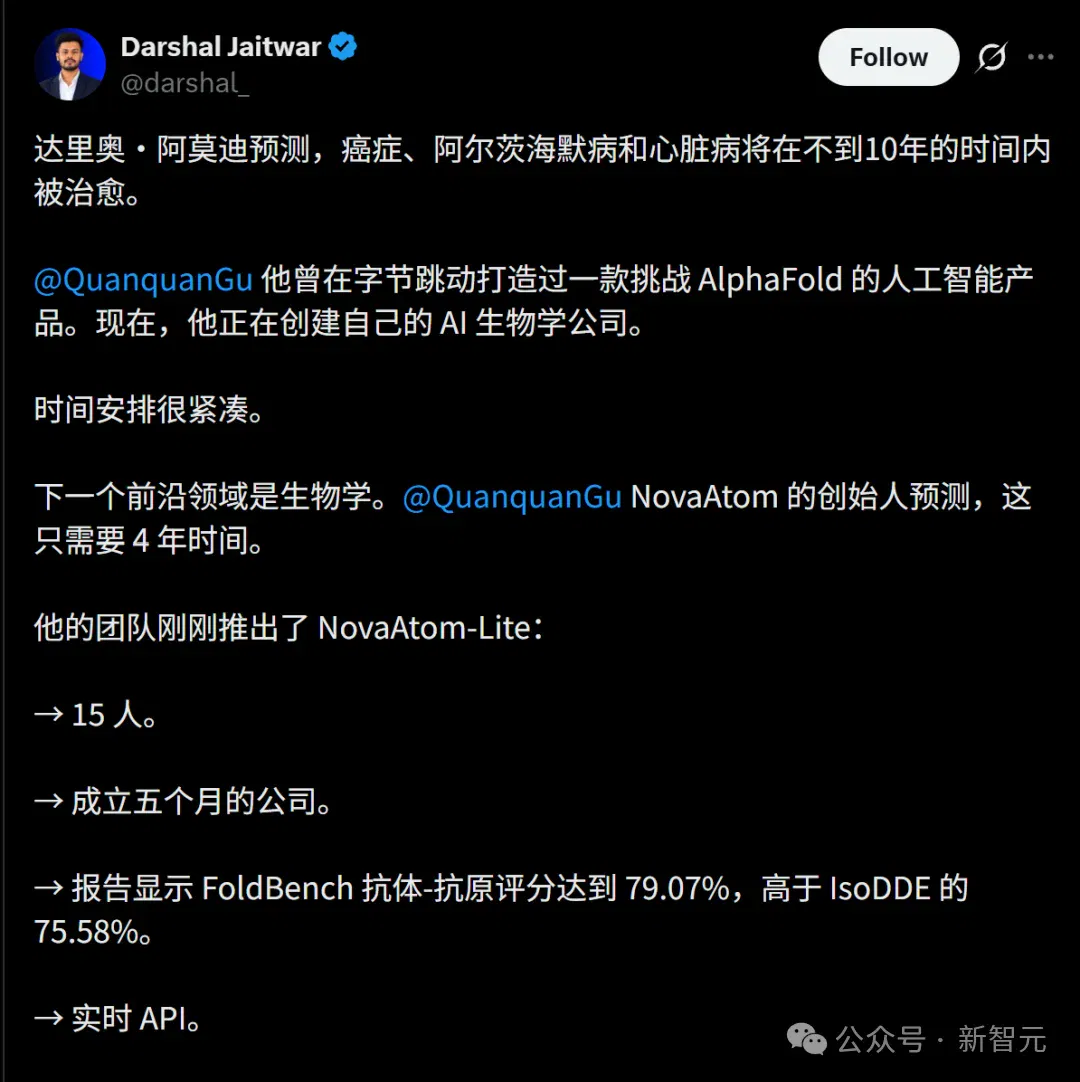
Another calculated: "Google DeepMind spun out Isomorphic, spent billions and is discussing a valuation above $40 billion. A UCLA professor's fifteen-person startup surpassed it in five months."
This was not Quanquan Gu's first such result. At ByteDance he previously led the team that created SeedFold, the first model to surpass AlphaFold 3 on FoldBench.
SeedFold's arrival prompted Isomorphic Labs to unveil IsoDDE and reclaim the structure-prediction crown. NovaAtom-Lite has now displaced IsoDDE again.
More strikingly, Gu said on X that NovaAtom-Lite is only the beginning, with a larger, stronger NovaAtom-Pro waiting to follow.
Even if Isomorphic Labs soon releases a stronger counterattack, it may face another challenge from NovaAtom-Pro.
Gu has won two rounds in this structure-prediction contest and still holds his next card.
This release supplies experimental structure-prediction results, insufficient to establish a revised, definite timetable for curing particular diseases.
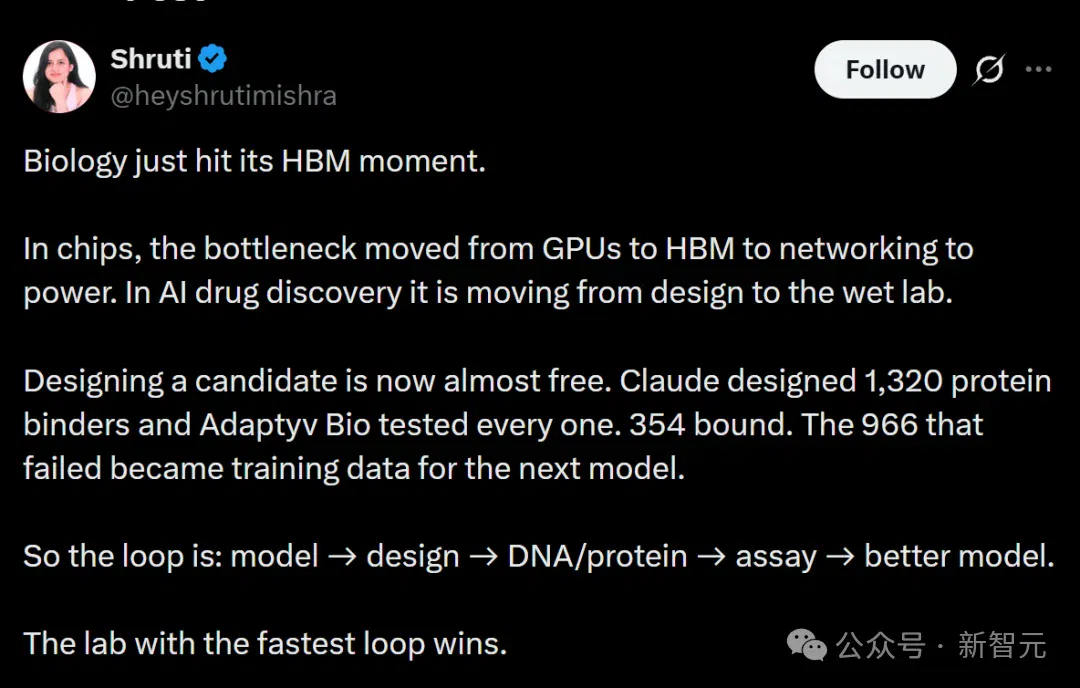
Biology has reached its HBM breakout moment, an investor remarks.
What does NovaAtom-Lite actually do?
Why are drugs so hard to develop?
Molecular binding and structure matter for understanding many drug mechanisms. But effectiveness also involves exposure, selectivity, metabolism and safety, and cannot be determined by binding pose alone.
Antibodies must attach to antigens, while small-molecule drugs must fit into protein pockets.
This fit occurs at the atomic scale, measured in ångströms, Å. One ångström is one ten-billionth of a meter.
Prediction errors can affect subsequent analysis, but a small coordinate error cannot simply be equated with inevitable drug failure.
Traditional methods test possibilities individually in wet labs. On average, a new drug takes thirteen years from laboratory to market, costs nearly $2 billion and has a success rate below 5%. AI's value is simulating this fit computationally first, greatly shortening trial-and-error cycles.
That is what NovaAtom-Lite does:
Given protein, DNA and RNA sequences and small-molecule ligand information, it predicts 3D coordinates for every heavy atom, meaning non-hydrogen atom, in the complex.
It outputs heavy-atom coordinates and confidence. This describes prediction resolution, not experimental determination of every atom's exact position.
Nor is it merely a rigid calculator.
NovaAtom-Lite adds an engineering-oriented system of constraints and hints.
The model card distinguishes input structural constraints, such as cyclic structures and covalent bonds, from contact-residue and binding-pocket hints that the model weighs. They cannot all be described generically as soft references.
The output is more than coordinates.
The model returns local structural confidence, pLDDT; expected inter-residue error, PAE; and interface reliability, ipTM. In simple terms, it supplies both an answer and an indication of confidence.
Two major results: 79.07% and 77.06%
Pharmaceutical research has two central tests for structure prediction: antibody–antigen binding prediction and protein–ligand binding prediction.
The former matters for large-molecule drugs such as anticancer antibodies: understanding precisely how the antibody locks onto its target. The latter is central to small-molecule targeted drugs, which must fit into protein binding pockets.
Both directions are difficult.
FoldBench uses structures after the training cutoff and filters for similarity to reduce contamination. Date-based splitting alone cannot eliminate every leakage, homology-similarity or evaluation-adaptation risk. Different baselines also have different evaluable sample counts.
First: antibody–antigen. FoldBench contains 172 antibody–antigen interfaces.
The criterion is DockQ, measuring how closely a predicted binding pose resembles the actual structure. At least 0.23 counts as success; higher is better.
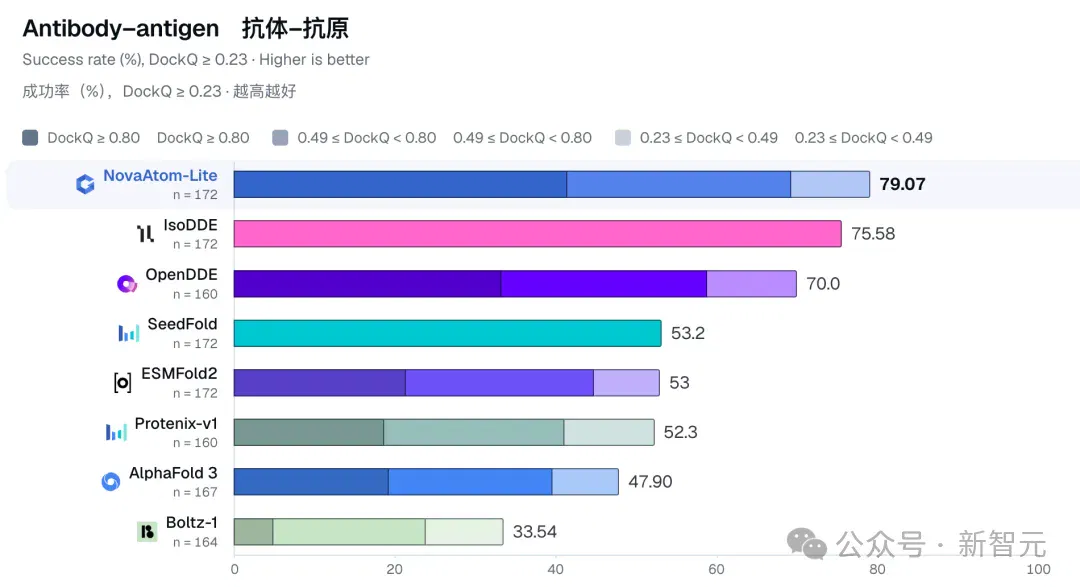
A five-month-old company scored thirty-one percentage points above AlphaFold 3 and 3.5 points above Isomorphic Labs, which had raised $2.7 billion.
At the stricter DockQ ≥ 0.80 threshold requiring high precision, NovaAtom-Lite's success rate was 2.2 times AlphaFold 3's.
Second: protein–ligand. This test covers 558 binding interfaces with stricter criteria: the predicted ligand position must differ by less than two ångströms, ligand RMSD < 2 Å, and surrounding protein-contact details must also align closely, LDDT-PLI > 0.8. Both conditions must hold.
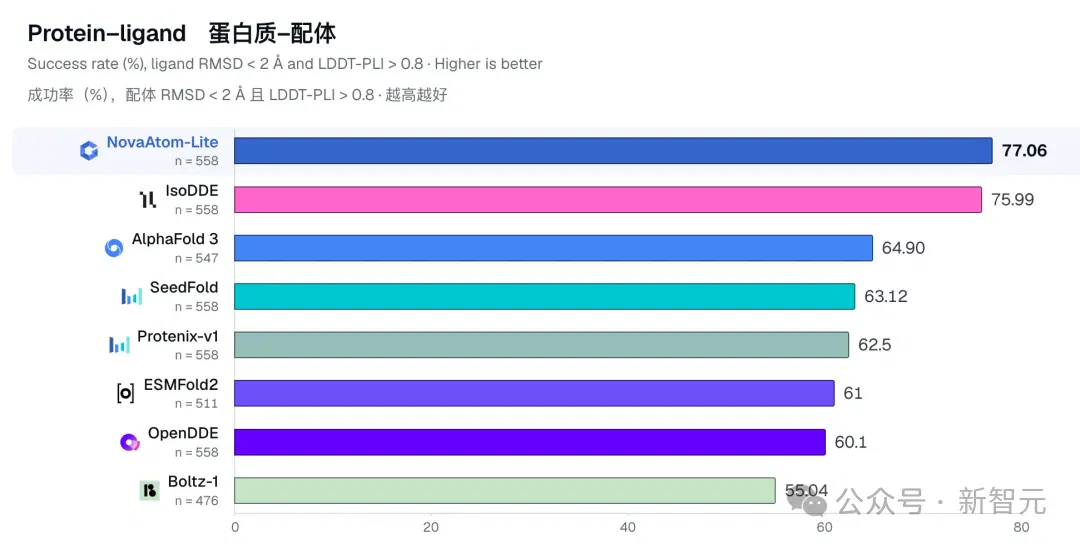
First place on both core metrics.
Does it understand physics or merely memorize answers?
Whenever a model tops a leaderboard, the first question is: did you peek at the answers?
This skepticism is entirely reasonable. The training data fed to structure-prediction models come from databases of known protein structures. If a model has merely memorized what it has seen, then no matter how high its score is, it is useless: once it reaches the front lines of drug R&D, the molecules it faces are all new ones it has never seen before.
An exacting test of memorization is Runs N' Poses. It divides samples into eight groups by similarity to training data, from familiar-looking to completely unfamiliar, progressively exposing the model.
In the lowest-similarity 0–20% group, containing sixty-three ligands described as unrelated to the training set, like out-of-syllabus exam questions, the results were:
AlphaFold 3 dropped to 24%, while NovaAtom-Lite remained at 47.6%, nearly twice as high.
In the highest-similarity 80–100% group, the gap narrowed to 91.0% versus 88.2%.
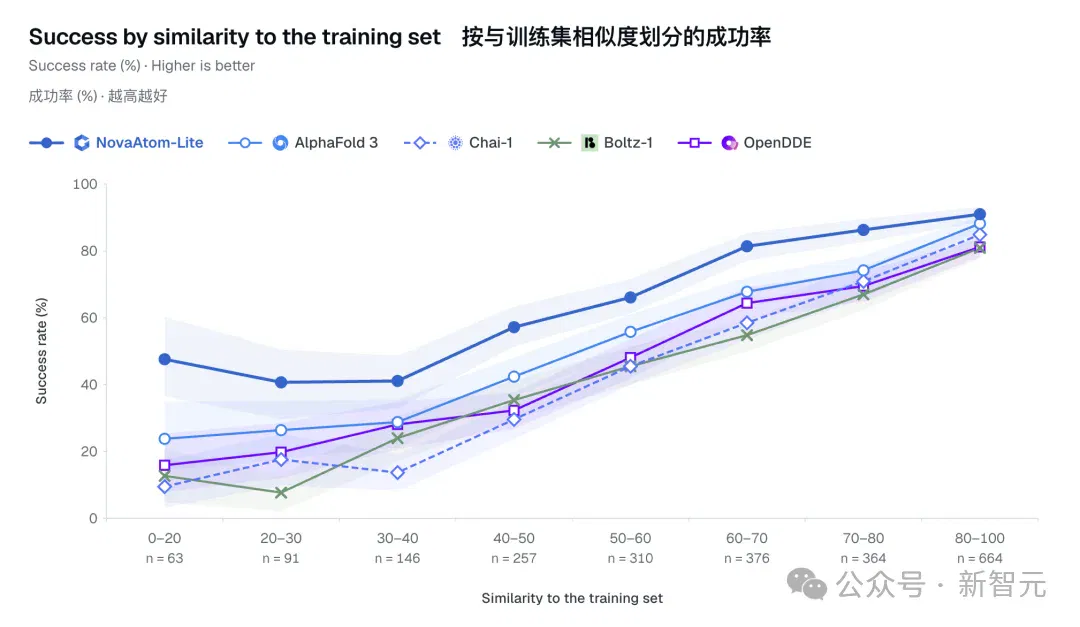
This indicates that NovaAtom-Lite's advantage grows as molecules become less familiar.
Low-similarity performance supports further study of generalization. Benchmark scores alone cannot prove complete mastery of underlying physical laws or exclude all memorization effects.
More time to think, better performance
Additional inference sampling or compute can sometimes improve the chance of selecting good candidates. Gains are not necessarily monotonic for every task, model and budget, and depend on selection and ranking methods.
Large language models have already demonstrated this, and NovaAtom-Lite shows it can also apply to biomolecular prediction.
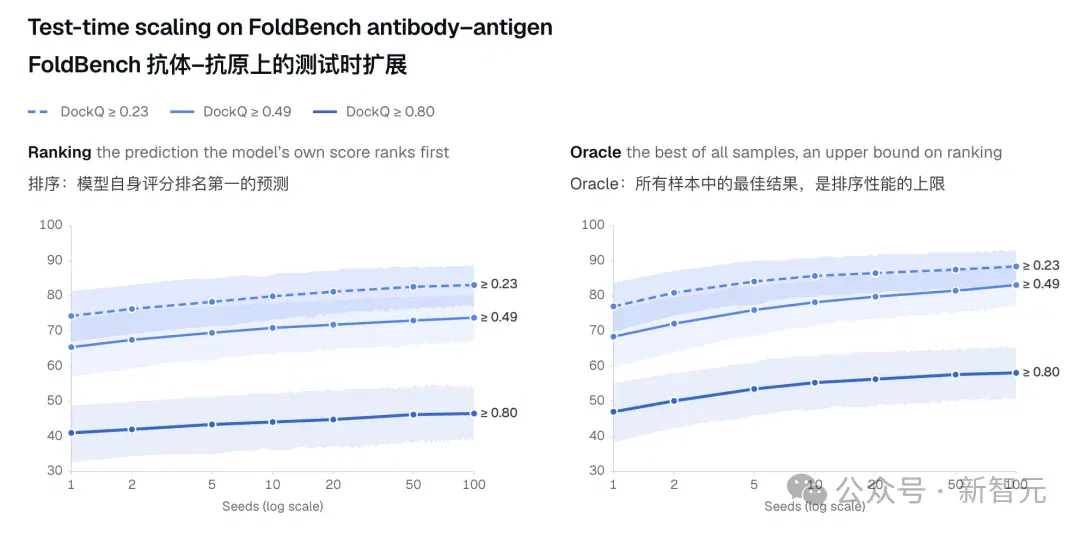
The team conducted an elegant experiment on the same 172 antibody–antigen interfaces:
- One random seed: 74.3% success in this setting. Seed count does not mean only one candidate was generated and must be read alongside the sampling budget per seed.
- Five random seeds: 78.3% average success across random subsets on the curve. The selected single run in the main figure scores 79.07%; the statistical bases differ.
- The current model-card curve table reports 81.2% average success for twenty random seeds. Points come from random-subset statistics and should be read with their confidence intervals.
- One hundred random seeds (deep inference): 83.1%
- Oracle upper bound (choosing the best result afterward using experimental answers): 88.4%
Increasing sampling alone raised success from 74.3% to 83.1%, nearly nine percentage points.
That gives the system considerable flexibility.
The gains obtained with this set of sampling budgets cannot prove that the model's capabilities have no upper limit. Adding more computation still requires consideration of diminishing returns, the reliability of candidate ranking and subsequent experimental validation. Computational results cannot replace clinical judgment.
This scalability is highly exciting.
A hint can make a major difference
More computation alone is not enough.
In real drug R&D settings, scientists often already have some clues in hand. For example, they may know roughly where an antibody and an antigen come into contact, or approximately which pocket in a protein a small molecule fits into.
Can the model understand and effectively use those hints?
NovaAtom-Lite's answer: yes, with striking results.
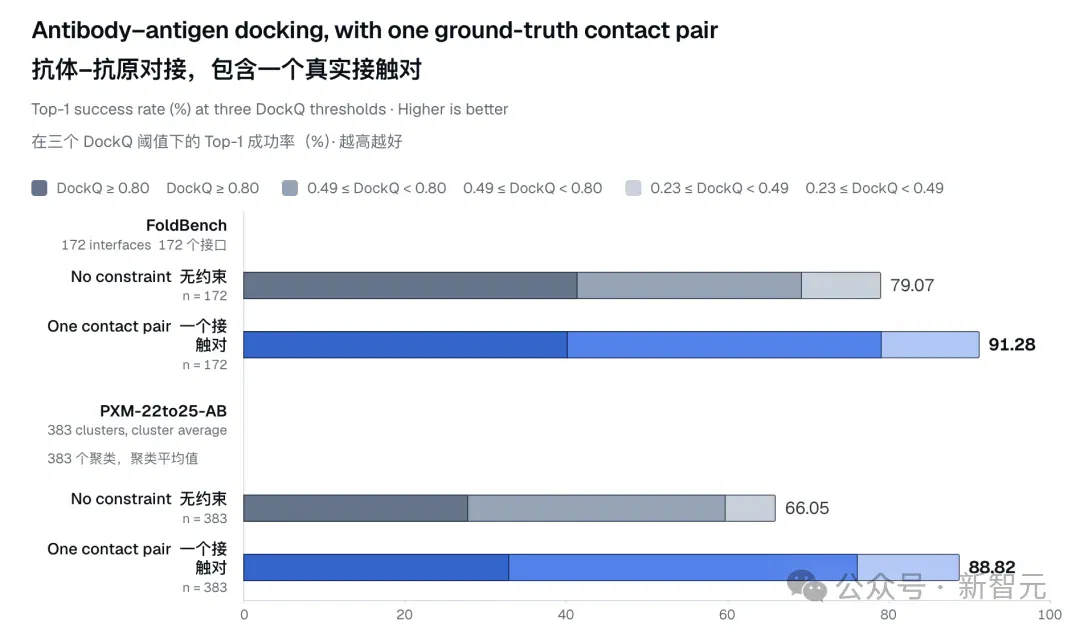
On FoldBench's 172 antibody–antigen interfaces, no-hint success is 79.07%. Providing one contact-residue pair (telling the model these residues are close) raises success to 91.28%, twelve percentage points higher.
On the larger PXM-22to25-AB antibody–antigen set, comprising 383 clusters, success rises from 66.05% to 88.82%, nearly twenty-three percentage points higher.
Protein–ligand results are also interesting.
On Runs N' Poses, the team tested four progressively informative settings: unconstrained, one contact pair, four pocket residues and the full pocket.
Hints help most on the hardest samples: In the lowest-similarity 0–20% range, full-pocket hints raise success from 47.6% to 63.5%, nearly sixteen percentage points. In higher-similarity ranges above 60%, gains are only two to five points.
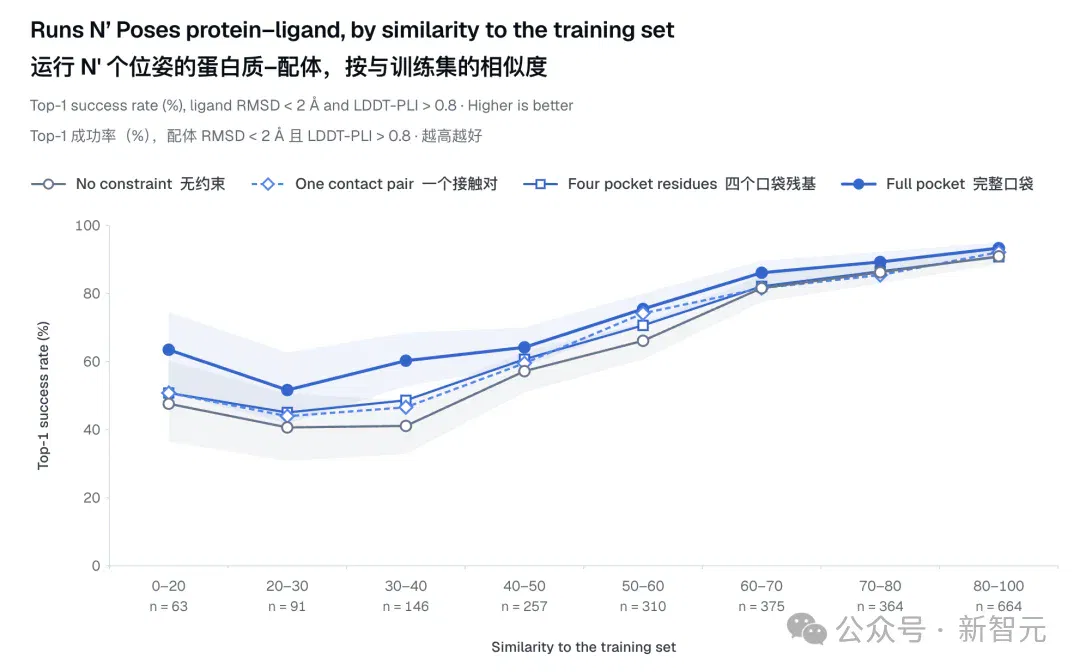
Some contact and pocket hints helped in these tests, but accuracy, information content and task type affect results. Arbitrary additional hints cannot be guaranteed to improve accuracy.
Two striking cases: from a molecular lasso to a hidden doorway
Beyond impressive numbers, drug developers ultimately ask whether the model can solve difficult real structural problems.
Case one: a sharp freeze-frame of a flailing molecular lasso
The MERS virus is a formidable opponent. Scientists identified nanobody VHH-T148 against it, whose key element is a twenty-two-amino-acid CDR-H3 loop.
Imagine a flexible whip moving through three dimensions. Its flexibility and lack of evolutionary covariation signals make prediction exceptionally difficult.
It is widely recognized as a difficult structure-prediction problem.
NovaAtom-Lite generated twenty-five candidates, all successful. DockQ reached 0.839, with CDR-H3 prediction error of only 0.56 Å, covering every one of the eighteen epitope residues.
0.56 Å is approximately a third of a carbon atom's diameter: a freeze-frame from a molecular-scale SLR camera.
Case two: opening a hidden doorway in a locked cancer target
KRAS is a notoriously difficult cancer target.
Its smooth surface leaves drugs few places to bind.
Some inhibitors act through its hidden switch-II pocket, but that pocket is normally closed.
In other words, AI has to do more than calculate how a small-molecule drug should be positioned. It also has to infer the protein's conformational changes from scratch—how that door opens.
In this case, structure 8UN5, the KRAS G13D mutant, OpenDDE produced ligand RMSD of 17.74 Å, placing the drug far away.
NovaAtom-Lite's ligand RMSD was only 0.98 Å.
Across all twenty-five samples, predicted switch-II regions differed from the crystal structure by only 0.4–0.6 Å, reproducing all twelve native polar contacts without any ligand–protein atomic clashes.
This is truly molecular-scale micro-sculpture.

a16z's prediction:
Pharma approaches its GPT-3 moment
Three days after NovaAtom-Lite's release, venture firm a16z published a major report: Big pharmaceutical companies could rival major software companies (Big Pharma Can Rival Big Software).

Several central judgments deserve attention:
First, AI drug development is entering its GPT-3 moment.
a16z says it believes the Bio × AI market is approaching GPT-3-level maturity. GPT-3 marked general AI's shift from usable to useful; a16z sees similar capabilities emerging in biological models.
Second, pharmaceutical companies may be valued like technology stocks.
The traditional logic for valuing pharmaceutical companies is to discount the cash flows from their existing drug portfolios, while the drug R&D engine behind them receives almost no recognition from capital markets. But if AI makes drug discovery “highly repeatable and predictable,” investors will be willing to pay for pharmaceutical companies' AI infrastructure, just as they pay for the platforms of SaaS companies.
That fundamentally changes valuation logic.
Third, a16z included the November 10 release of NovaAtom-Lite in the report.
A model that had been released only three days earlier was already written into an industry report by a leading investor. The speed of that response is itself telling. It really has been noticed.
More intriguingly, in the report's industry-landscape illustration, Geodesic Intelligence is the only company named.
The report divides AI drug-development startups into two groups. Vertical integrators such as Isomorphic Labs and Recursion develop drugs themselves, taking high risks for trillion-dollar potential. Tool providers supply models, laboratory automation, agents and molecular-design platforms.
Geodesic is clearly positioned at the leading edge of the latter category. Through Geodesic API and NovaDDE, NovaAtom-Lite's capabilities are being made available to pharmaceutical companies and research teams.
It is not yet known whether Geodesic Intelligence will enter drug development itself. But judging by the competitiveness its models have demonstrated, it clearly has an opportunity to extend its boundaries beyond being a supplier of models and tools and into drug R&D itself.
a16z's view is not merely theoretical. Industry figures are already reflecting the trend.
GenScript's AI drug-development business doubled across three consecutive half-years, while Twist Bioscience's AI discovery orders grew at a triple-digit rate.
Major drug companies are competing for agreements. Isomorphic Labs' Novartis and Lilly partnerships alone total nearly $3 billion. Anthropic has opened a wet lab, and OpenAI has acquired a biotechnology company.
The industry's underlying logic is changing: AI is becoming pharmaceutical infrastructure rather than merely an auxiliary tool.
The shortest path
Return to Geodesic Intelligence's story.
Quanquan Gu is a UCLA computer-science professor known in AI for Science. In June 2026 he founded Geodesic Intelligence with one goal:
Build AGI and find the shortest path from biology to medicines.
Five months later, his fifteen-person team delivered its first result.
This is only the start. The company says NovaAtom-Lite is the first family member, with larger, stronger models on the way.
Geodesic's full plan is a three-part loop: NovaAtom predicts structures, NovaDDE provides scientific reasoning and the drug-discovery workbench, and NovaLab handles wet-lab validation.
From biological questions and computational structural analysis to experimental validation of candidates, the process connects end to end.
That recalls a16z's closing statement: developing medicines faster and more cheaply will be among AI's most consequential applications.
The accelerator for drug-development timelines has arrived.
This article was originally published by AI Era. Authors: Aeneas and Solomon.
Related topics
After reading
Join the AINRK community
Read how to join the community and connect with people working in AI.
Related articles
Continue reading related topics and articles in this category.
前字节AI4S大牛归来,Geodesic Intelligence首个模型发布,剑指制药界AGI (opens in a new tab)
前字节跳动Seed AI4S团队核心成员顾全全成立AI4S公司Geodesic Intelligence,一次性推出科学推理智能体NovaDDE与结构预测模型NovaAtom-Lite-Preview,目标是构建从生物学到药物最短路径的AGI。

姜宇辉的AI分身:知识助手与“另一个自己”之间 (opens in a new tab)
南方周末通过学者、用户与Second Me创始人的访谈及记者试用,观察AI分身的学术辅助、情感连接和商业化尝试,也呈现知识可靠性、人格边界、版权与隐私方面的疑虑。
智动未来据报完成亿元级Pre-A+融资,资金用于产线与服务机器人部署 (opens in a new tab)
机甲觉醒报道,智动未来宣布完成亿元级Pre-A+轮融资,由中美绿色基金领投、南曦创投联合领投,资金拟用于广州产线、服务场景部署和世界模型研发。“智子世界”仍属技术预览,商业化效果待更多应用数据检验。

范式智能介绍Phai-A1与Phai-M1,强调国产算力后训练优化 (opens in a new tab)
范式智能介绍面向代码与Agent场景的Phai-A1,以及面向真人影视的音画同步模型Phai-M1。公司展示了单卡运行和视频生成能力,并称模型在昇腾平台完成专项后训练优化。
腾讯Q3资本开支814亿元,称WorkBuddy日Token用量居国内首位 (opens in a new tab)
腾讯三季报显示营收2073.36亿元、资本开支814.33亿元。公司称WorkBuddy日活超1000万,按用户每日大语言模型Token消耗总量居国内首位;报道还讨论云业务增收与AI投入对盈利、现金流的影响。