Zaowutan reportedly raises tens of millions of yuan for hardware R&D agent Xiaotanzi

Z Potentials describes Zaowutan’s electronics model, engineering-object ontology and digital workers, alongside a robot prototype’s design and initial build. Funding will support models and enterprise delivery; broader developer access remains planned.

Z Potentials has exclusively learned that Zaowutan recently completed financing of tens of millions of yuan, led by Jiaming Haochun with participation from a state-backed strategic guidance fund and industrial investors in intelligent manufacturing. The proceeds will mainly support training and iteration of its proprietary electronics-industry model, continued development of its engineering-object ontology, enterprise product delivery and market expansion.
Its core product, Xiaotanzi, combines professional AI digital workers with a proprietary electronics model to create an AI-native hardware-development environment. Design work formerly scattered across electronics, software and mechanical roles and specialist tools becomes a continuous process organized around the same product objective.
Lead investor Jiaming Haochun said: “Zaowutan turns experienced engineers’ expertise into deliverable, verifiable digital R&D workers, bringing practical certainty to manufacturing development. We value the team’s distinctive combination of AI and engineering and hope it becomes a leader in intelligent manufacturing R&D.”
01 Hardware development awaits its own “GPT moment”
Over recent decades, China has built a world-leading hardware-manufacturing system. Mature supply chains, from components and PCB prototyping to complete-device production, make manufacturing increasingly efficient. Before manufacturing, however, converting an idea into reliable engineering still requires collaboration among electronics, software and mechanical engineers through design, reviews, prototypes and repeated validation.
Large models are changing that. Advances in reasoning and tool use have brought AI into circuit design, PCB layout and 3D mechanical modeling. What form will hardware development’s “GPT moment” take?
In November 2026, Anthropic released Claude Fable 5.2 and disclosed three devices developed with Diode Computers. From brief requirements, Claude selected components and designed circuits, four-layer PCBs, 3D enclosures and firmware; Diode manufactured working prototypes. In PCB Gym, its task pass rate rose from its predecessor’s 25% to 69%, and all three prototypes operated without circuit modifications. Frontier vendors are expanding capabilities rapidly, but a complete engineering-validation process still separates a working prototype from a production line.
That gap is Zaowutan’s starting point.
02 Specialist models and digital workers bring AI into hardware R&D
Anthropic's experiment shows what kinds of hardware design tasks frontier models can complete. Zaowutan goes a step further, focusing on how to turn this capability into R&D products that can be used on an ongoing basis. Achieving this requires AI to truly understand the design logic of hardware products and to keep advancing engineering tasks across different professional tools.
Zaowutan has built an engineering-execution system around its proprietary electronics model and specialist digital workers. The electronics industry model focuses on deepening its understanding of specialized design knowledge, engineering constraints and technical judgments. Digital workers turn design objectives into executable tasks, using professional tools to carry out actual design work and engineering checks. The key connecting the two is the engineering-object ontology developed in-house by Zaowutan. In traditional R&D, circuits, PCBs and three-dimensional structures often reside in different software applications and files. Through a unified description of engineering objects, Zaowutan organizes the design elements in a product and the relationships between them, allowing AI to understand the constraints and effects between designs in different disciplines for the same product. In this way, model capabilities, engineering knowledge and professional tools are consolidated into reusable capabilities within an R&D product, enabling Xiaotanzi to carry out design, modifications and engineering delivery continuously around real hardware products.
A software engineer without a specialized hardware design background used Xiaotanzi's professional AI digital workers and its in-house electronics industry large model to complete the core electronic and structural design of a quadruped robot prototype within hours. This produced editable engineering files including a BOM, schematics, a PCB and a three-dimensional structure, at a model-call cost of about RMB 30. The design has completed its first round of physical prototyping. The prototype has now been powered on and put into operation, and its core functions have been validated.
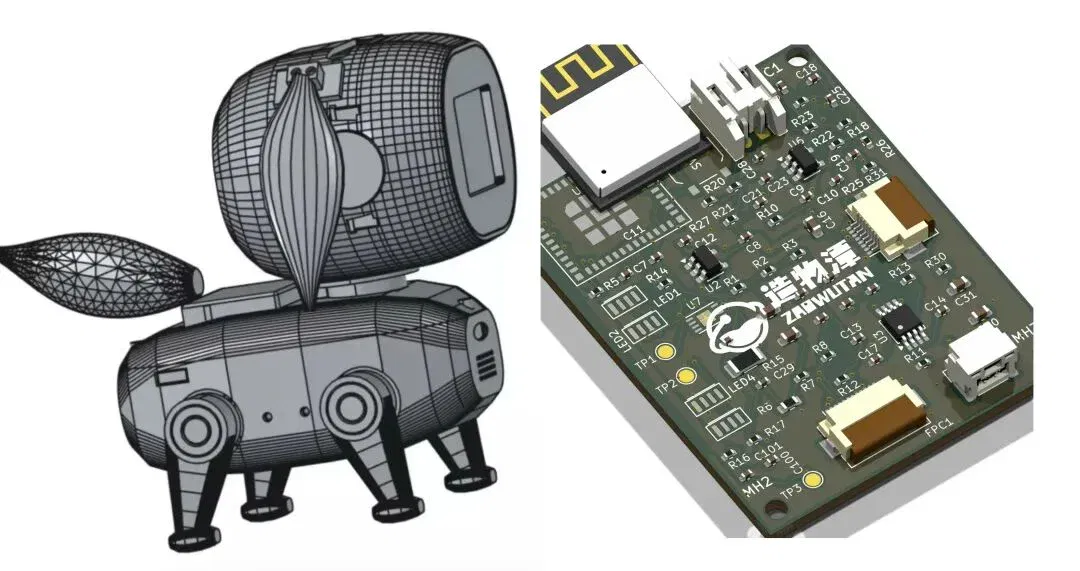
Left: the quadruped prototype designed by Xiaotanzi in 3D. Right: its 3D main-controller board.
03 From foundation models to digital workers: continually evolving expertise
Zaowutan's technology system consists of three layers that build progressively on one another. Foundation models provide general intelligence and continually raise the starting point of capability. Industry models take general capabilities deeper into the specialist field of hardware R&D. Digital workers complete real engineering tasks and feed the experience generated in practice back into the entire system.
The first layer is foundation models, continually improving the starting point for specialist intelligence. Progress by foundation models worldwide in complex reasoning, task planning and tool use is continually expanding the boundaries of the engineering tasks AI can undertake. The higher the starting point, the more complex the specialist problems that industry models can explore in depth, and the broader the range of R&D work that digital workers can take on.
The second layer is the electronics industry large model developed in-house, which builds an ever-deepening capacity for engineering judgment through the accumulation of specialist knowledge and engineering experience. Zaowutan has accumulated millions of items of specialist engineering data and design assets. Meanwhile, the engineering decisions, design modifications and validation results produced by R&D tasks are linked to these assets through the engineering-object ontology. This allows the model to understand both specialist design knowledge and the reasoning behind engineering judgments. Experience that has been authorized, filtered and evaluated continually flows back into the system, forming a recursive path of evolution. The model participates in design, engineering results are validated, effective experience is used to optimize the model, and the enhanced model is then put to work on new R&D tasks.
The third layer is specialist digital workers, accumulating engineering skills through actual execution. Xiaotanzi's digital workers rely on the industry model to do their work, calling professional tools, handling engineering objects and completing design tasks. Validated workflows, methods for handling problems and strategies for using tools have been consolidated into reusable professional skills, enabling the digital workers to undertake more complex design work in subsequent projects.
The industry model grows in understanding and judgment; digital workers improve methods and efficiency. Real engineering practice lets them reinforce one another. As more hardware projects continue to enter this system, model capabilities, specialist experience and digital-worker skills form a cycle of ongoing reinforcement. Xiaotanzi is developing the ability to design more complex hardware products.
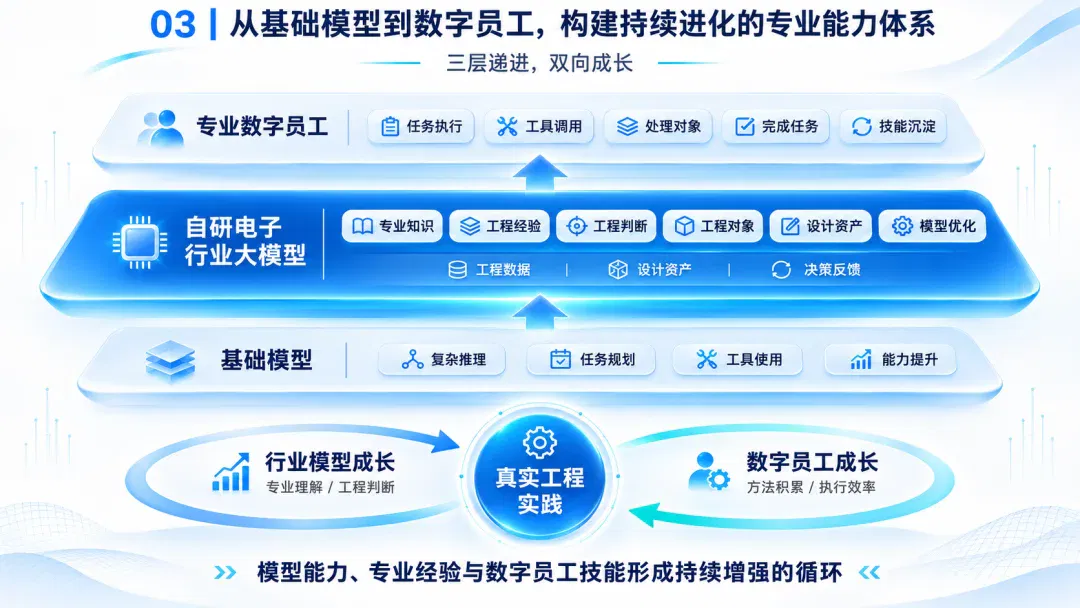
Xiaotanzi model-system architecture
04 From enterprise R&D to professional creators: a new hardware-AI market
At present, Zaowutan has already begun applying its system in the R&D settings of electronics manufacturers. Focusing on specialist tasks such as hardware design, engineering reviews and the processing of R&D materials, it uses digital workers to help companies handle frequently recurring R&D work and improve the efficiency with which they use engineering knowledge and design resources. This forms the commercial foundation at the current stage: taking real R&D needs as the starting point to provide companies with AI products and services capable of completing specific professional tasks. In fields such as power electronics and industrial control, Zaowutan is exploring design proposals and engineering reviews for specific products. It is trying to incorporate industry standards and engineering documentation into digital workers' task workflows so Xiaotanzi can participate in more continuous R&D work.
Next, it plans gradual developer access to Xiaotanzi, inviting professionals into hardware projects and exploring regional flexible-manufacturing connections so generated designs can proceed through prototyping and production in one place. From enterprise R&D to independent product creation, Zaowutan hopes to establish a product path covering needs at different scales and levels of complexity. As specialist engineering capabilities become increasingly accessible, the creation of hardware products also has an opportunity to expand from the work of a small number of professional teams into an activity in which more innovators can participate.
Zaowutan believes that a company's creativity should not be limited by its existing accumulation of expertise or its organizational boundaries. Let AI continue to grow through real engineering practice, and let companies' creativity no longer be constrained by boundaries.
Zaowutan founder Wen Kun said: “Today, when a company conceives a new product, it often has to ask first, ‘Do we have the ability to build it?’ The future Zaowutan looks forward to is one in which more companies can first ask, ‘What exactly do we want to create?’”
Supporting the realization of this vision across the entire process is a founding team that combines expertise across disciplines. Its members include executives from established technology giants who have led complex projects on a scale of tens of millions and have extremely strong business-development capabilities. There are also seasoned engineering experts deeply involved in manufacturing digitalization, with an intimate understanding of production-line pain points and the limits of manufacturing processes. In addition, there are hands-on practitioners who have repeatedly led large-model deployments and are familiar with the engineering applications of frontier technologies. This combined background spanning business, engineering and AI not only enables Zaowutan to identify customers' real needs accurately, but also ensures that the team can turn frontier technologies into productivity that can be delivered.
This article was originally published by Z Potentials. Author: Z Potentials.
Related topics
After reading
Join the AINRK community
Read how to join the community and connect with people working in AI.
Related articles
Continue reading related topics and articles in this category.
市值30亿,珠海冲出一家AI数字员工IPO,高瓴、温氏股份押注 (opens in a new tab)
AI产业的发展遵循着典型的“基础设施→核心技术→行业应用”的科技产业化路径。当下,AI产业正在经历从“技术突破”转向“应用落地”的关键阶段。
3500万美元押注一个疯狂想法:Viven让每个员工都有数字分身 (opens in a new tab)
Viven 的核心创新在于,它为每个员工创建了一个个性化的大语言模型,实质上就是一个数字分身。这个分身通过访问员工的内部电子文档,包括邮件、Slack 消息、Google Docs、会议记录等,学习这个人如何思考、如何沟通、拥有什么知识。关键是,这个学习过程是自动进行的,不需要员工做任何额外工作。你只需正常工作,你的数字分身就会不断更新和进化。
姜宇辉的AI分身:知识助手与“另一个自己”之间 (opens in a new tab)
南方周末通过学者、用户与Second Me创始人的访谈及记者试用,观察AI分身的学术辅助、情感连接和商业化尝试,也呈现知识可靠性、人格边界、版权与隐私方面的疑虑。
智动未来据报完成亿元级Pre-A+融资,资金用于产线与服务机器人部署 (opens in a new tab)
机甲觉醒报道,智动未来宣布完成亿元级Pre-A+轮融资,由中美绿色基金领投、南曦创投联合领投,资金拟用于广州产线、服务场景部署和世界模型研发。“智子世界”仍属技术预览,商业化效果待更多应用数据检验。

范式智能介绍Phai-A1与Phai-M1,强调国产算力后训练优化 (opens in a new tab)
范式智能介绍面向代码与Agent场景的Phai-A1,以及面向真人影视的音画同步模型Phai-M1。公司展示了单卡运行和视频生成能力,并称模型在昇腾平台完成专项后训练优化。