Andrew Ng’s four AI-engineering capabilities: applications, foundations, agents and product judgment

An edited Neo4j interview emphasizes cost, latency, reliability and security trade-offs, alongside the business context and governance needed for agent-ready enterprise data. The four-part skills map draws on job descriptions and interviews.

Andrew Ng: We used to perform quality checks for coding agents. They can now perform more checks themselves.
Andrew Ng: Skilled AI engineers remain scarce, especially people able to handle judgment tasks without a single correct answer.
Andrew Ng: AI engineering means helping decide what to build and how, not merely implementing requirements.
At Neo4j’s NODES 2026, cofounder and CEO Emil Eifrem served as moderator and asked Ng: after a year of rapid coding-agent change, what should AI engineers still learn?
Ng’s answer was not another tool.
His team studied over twenty thousand job descriptions and conducted interviews, organizing AI-engineering work into four categories: building/deploying AI applications, software-engineering foundations, using coding agents and helping decide what products to build.
This capability map is not only for people whose job title is AI engineer. Software developers, data scientists and operations engineers will also encounter the work it contains.
Agents can write code and run checks, but cannot answer every open-ended question a team faces.
Ng discusses coding agents performing more quality checks themselves
The following is translated and edited from the original interview.
Code becomes easier to verify; enterprise problems have no answer key
Ng believes that models progress quickly on tasks whose results are easy to verify. Code can compile, tests can pass, and math problems have answers; coding agents can therefore advance the cycle of finishing the code, checking it and correcting it. In enterprises, however, many decisions cannot be judged right or wrong by a single test.
Ng: AI is very good at tasks with verifiable results, such as programming and mathematics. Questions that require judgment usually have multiple good answers as well as multiple answers that are not so good. It is difficult for us to build equally clear rewards and testing environments for them.
He connects the shortage of AI engineers to these tasks: faster development still requires people to judge requirements, data and business fit. “Shortage” is his interview observation, not a labor-gap statistic derived from the twenty thousand descriptions.
Ng on skilled-engineer scarcity despite coding-agent efficiency
A four-part capability map
Ng said the team studied more than 20,000 job descriptions and drew on interviews and surveys before organizing the relevant tasks into four groups. These are not four independent exams, but capabilities that an application repeatedly requires as it moves from an idea to deployment.
Ng: They are building and deploying AI apps, engineering foundations, coding-agent use and deciding what to build. Strong practitioners help drive development rather than merely implement specifications.
Building and deploying AI applications involves turning a prototype that can be demonstrated into a product that can run continuously. Models need to connect to tools and data, errors need to be detectable when they occur, and someone needs to track how the system is running.
Software-engineering foundations determine whether this product can continue to be used reliably. Developers still need to understand system architecture, interfaces, testing and security. These issues do not disappear just because the code is generated by an agent.
Using coding agents also means more than simply having them write more code. Developers need to explain the goals and context clearly, understand what changes the agents have made, and check whether the results meet the requirements.
Helping decide what to build takes place before hands-on work begins and throughout the development process: What problem does the user have? Which requirements are worth implementing? How far should AI go? If these judgments are not thought through, however fast development may be, it may only mean producing something nobody needs more quickly.
Ng describes the team’s AI-engineering map based on over twenty thousand job descriptions
Using agents requires understanding their choices
Why learn computing fundamentals if agents code? Ng’s answer centers on “trade-offs”.
Ng: Having a coding agent write programs when you do not understand the fundamentals sometimes amounts to letting it choose among cost, latency, reliability and security on your behalf. You may not even know that there is a choice to make.
The code written by an agent can run, and the tests have passed, yet the solution may still be unsuitable for deployment. If cache lifetimes are set too long, users may see stale data; if API permissions are too broad, information that should not be accessible may be exposed; if concurrency is handled improperly, the same operation may be executed twice. Developers must understand these issues to see what trade-offs the agent has made and judge where changes are needed.
He does not demand memorizing all old knowledge.
He increasingly lets agents handle syntax he rarely writes manually. The difference is this: for a small one-page utility with modest requirements, it may be enough for the agent to simply pick a workable solution. But for enterprise applications with higher requirements for permissions and reliability, developers who cannot understand the underlying choices will find it difficult to guide the agent toward an appropriate implementation.
Ng on engineering choices developers may miss without fundamentals
Reading a field does not explain why a company defines it that way
Later, the moderator asked about ontology.
The term sounds abstract. Put simply, it means establishing a clear vocabulary for business concepts and the relationships between them: does "customer" in the system mean an individual or a company? How are orders and contracts linked? Do entries called "status" in different systems have the same meaning?
Without clarity, agents may misinterpret fields or connect information incorrectly despite reading the data.
Ng believes people hold extensive context models do not have. He gave one example: when chatting with a customer, the expression on their face when they hear about a particular feature may tell you whether that feature is actually welcome. Information like this may not necessarily make it into a requirements document, but it affects how the product and data are organized.
Ng: People who build applications have a great deal of context that coding agents lack. We know our own business, where the data comes from, and which data is useful. We may even forget to tell the agent these things.
Ng on developers’ business context unavailable to models
He supports AI helping construct concepts and relationships; his own team is also researching this. But from what he has observed, fully automatic generation currently does not work as well as human participation and guidance. When working on data-science projects, he has seen AI reason all the way up from the underlying data and end up making clearly incorrect assumptions about that data. It was only after the higher-level concepts were corrected that the results started to look respectable.
Ng: Automatically organizing these relationships is a direction worth continuing to research. But at present, having people participate and guide the agent in building the structure still produces better results. AI sometimes makes materially incorrect assumptions about data.
Ng on AI misunderstanding data when organizing business relationships
Agent-ready enterprise data requires more than one repository
The moderator calls links among people, projects, data and business rules an “enterprise world model.”
Ng describes a common enterprise question: how should architecture originally for people and analysts be adapted for agents?
Ng: Making enterprise data suitable for agents to use involves permissions, governance and security, as well as the data architecture of the entire organization. Graph data, structured and unstructured data, and data from business transaction systems often need to be considered together.
Ng on permissions, governance and varied data in agent-ready architectures
He also does not believe the solution is to let one vendor take all of an enterprise's data. In large organizations, orders, contracts and customer-service records are scattered across different systems, each with different access permissions. Rather than "pouring it all into a single database," it is better first to clarify where each piece of data comes from, who can use it, and how to trace it back when something goes wrong.
Ng: Every vendor wants to say “give me all your data and I will clean it,” but large enterprises will not. We must consider how architectures combine.
Ng on why one supplier cannot organize all enterprise data
Ng mentioned that in some enterprise projects he has encountered, a great deal of time is spent cleaning and connecting data. Only after the data foundations are gradually put in order do subsequent projects have the opportunity to move faster. This is his project experience, not an efficiency measurement that holds true for every enterprise.
Closing thoughts
Return to the customer-service agent that needs to check orders and decide on refunds. The fact that code can be written and tests can be run shows only that part of the work is complete. Before deployment, the team still needs to confirm who defines the refund rules, which system is authoritative for order status, what customer information the agent can see, and which situations must be handed over to a human. When something goes wrong, it must also be possible to find which data the agent relied on.
The four groups of capabilities Ng listed carry weight when placed in a project like this: someone uses agents to advance development, someone understands the engineering trade-offs, someone connects the AI application to real services, and someone decides exactly what it is allowed to do on users' behalf. The work of AI engineers has not disappeared as code generation accelerates; the difficulty has shifted to these areas where the details need to be clarified together and the work assessed against requirements together.
Reference:
https://www.youtube.com/watch?v=Q9SFGkVO8mo
This article was originally published by 51CTO Tech Stack. Author: Jiang Pian.
Related topics
After reading
Join the AINRK community
Read how to join the community and connect with people working in AI.
Related articles
Continue reading related topics and articles in this category.
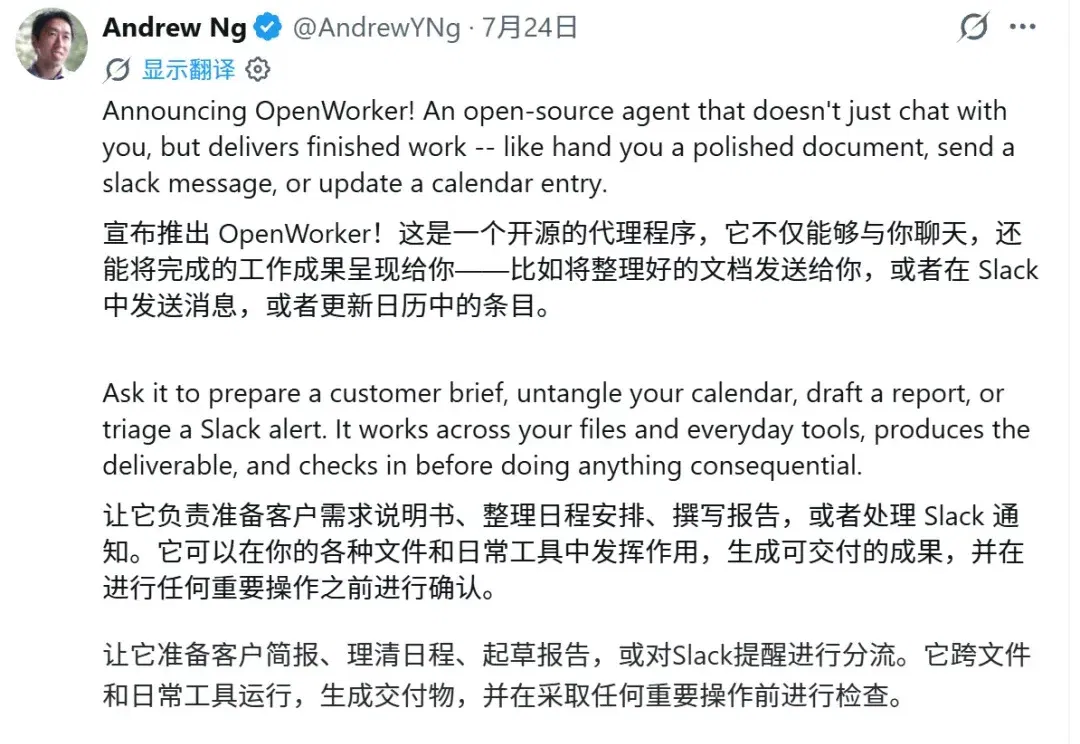
吴恩达开源的OpenWorker,为什么「不 Work」了? (opens in a new tab)
指望 Agent 替人上班之前,它们还得自己先去上个班
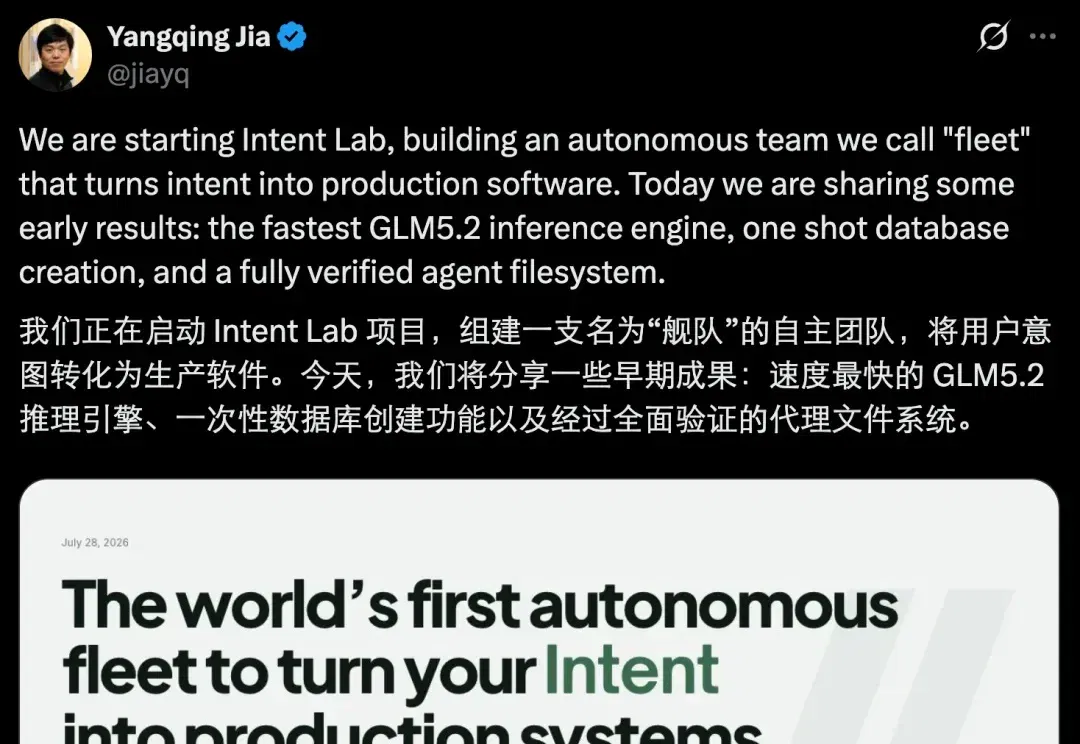
同一天,贾扬清、吴恩达等分别官宣创业,Agent有了新方向? (opens in a new tab)
今天,AI 创业圈格外热闹 —— 贾扬清、吴恩达以及 Sonia Joseph( Meta FAIR JEPA 团队核心研究员)在同一天官宣创业。

吴恩达发了个免费「AI同事」,我让它替我干了一天活 (opens in a new tab)
7月23日,吴恩达在GitHub上发布了一个叫OpenWorker的开源工具。7天,9.7k个Star。
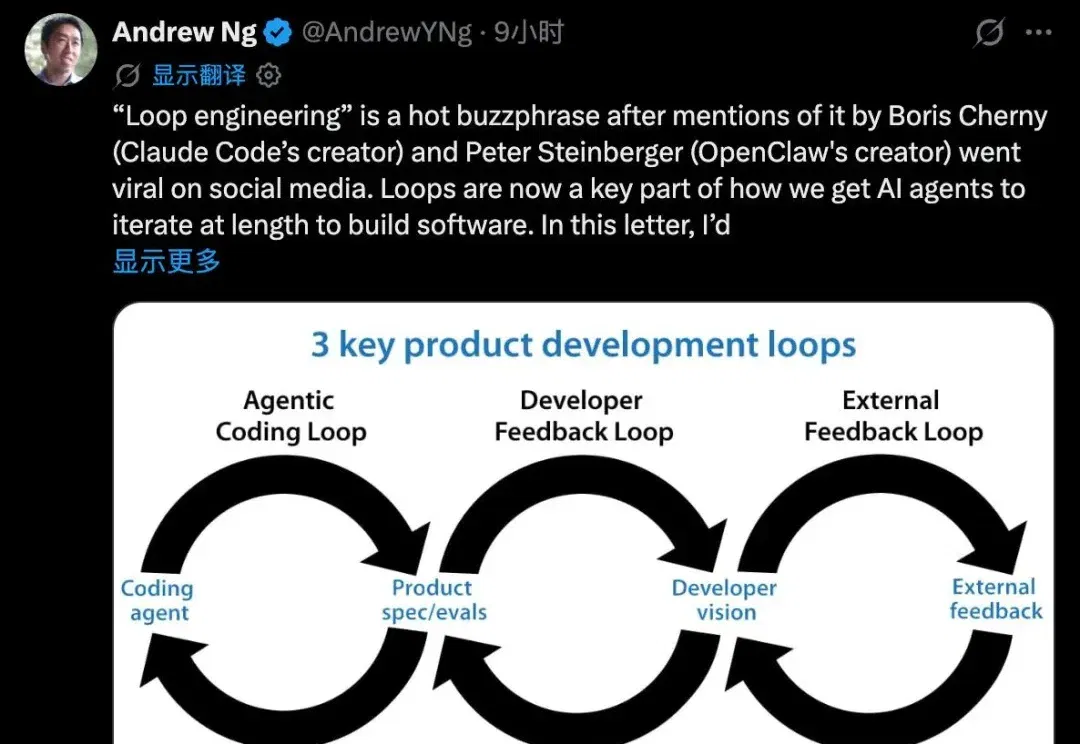
吴恩达对 Loop Engineering 的理解真犀利。 (opens in a new tab)
Andrew Ng 对 Loop Engineering 的理解好深刻。 上午一到公司,就看到他在 X 上发了一篇长文,讲了自己最近的一些判断。 我一直觉得大家最近聊 Loop Engineering,更多还是在聊工程上的 loop,比如 Agent 怎么自己写代码、自己调试、自己修 Bug。 但 Andrew Ng 把这个概念又往外扩了一层。 他觉得,当 AI 能够自主写代码之后,真正发生变化的不是工程效率,而是整个软件开发开始变成三种不同时间尺度的 Loop 同时运转: 最里层是 AI 自己不断迭代代码,中间是开发者持续修正产品方向,最外层则是真实用户和市场环境不断修正开发者的判断。 这三

吴恩达戳破AI幻象:炒作过头了,未来公司是10人小队+Agent重做数据架构 (opens in a new tab)
近期,在 LangChain 举办的智能体大会 Interrupt 上,吴恩达与 LangChain 创始人 Harrison Chase 进行了一场关于 AI Agent 的对谈。整场交流的核心并不是简单讨论 Agent 有多强,而是围绕一个更现实的问题展开:当 AI Agent 让软件开发变快之后,真正的瓶颈会转移到哪里?