US data-center construction: builders, investors and residents discuss permits, costs and demand

Silicon Valley 101 interviews builders, investors and residents about post-election regulation, energy and community needs. Guests differ on supply delays, demand and market pricing; cost estimates, policy expectations and investment views remain attributed judgments.
Editorial correction (November 16, 2026)This article is a multi-party interview. Discussion of costs, demand, stock prices and regulatory direction includes guests' estimates and personal judgments and does not constitute certain outcomes. The federal bills mentioned are proposals, not prohibitions already in force.
After the US midterm elections, market expectations for AI and data-center regulation changed. Interviewees discuss the relationship between these changes and stock-market fluctuations. Many factors affect stocks, and this decline cannot be attributed solely to one cause as though it had been established.
After Democrats won control of both the House and Senate, markets worried that regulation of data-center construction and AI safety would tighten further. On November 5, both the Nasdaq 100 and the Philadelphia Semiconductor Index suffered their largest one-day declines since March 2020.
What worries people more is this: does it mark a formal turning point in the AI narrative?
In the past, whether a data center could be completed on time mainly depended on sufficient electricity and equipment delivery. Now companies must answer another set of questions: who pays for grid upgrades, who bears residents' higher water and electricity bills, and how many long-term jobs can the community obtain? In some places, failure to meet the conditions alone could veto a project. In this conversation, our guests estimate that costs could rise 10% to 20% in a relatively bad scenario.
But construction being blocked does not mean compute demand disappears. If demand remains strong, companies that already possess capacity may gain even greater pricing power. Is Wall Street worried that data centers cannot be built, or that enterprises no longer want to spend on AI? Those two judgments lead to entirely different outcomes.
Meanwhile, many local Americans care about more concrete matters: whether rent remains affordable, whether electricity bills rise, and how many jobs remain when construction ends. As Bruce, CEO and CIO of Jirong Investment, repeatedly reminds us: "Do not underestimate voters' opposition to this."

In this article, we speak with professionals working on the front lines of energy strategy and data-center construction, and Wall Street investors who have long followed US AI hardware, about how policy changes affect construction, costs, financing and compute demand. We also interview three local residents to hear the concerns behind referendums, housing and community life.

AI's demand for compute has made data centers an important destination for capital. Companies up and down the GPU, CPU, optical-communications, storage and electricity supply chains have attracted intense investor enthusiasm over the recent period.
If AI regulation first blocks data-center approvals, requires builders to bear more expenses and taxes, or even revokes construction permits, all of those would damage the AI supply chain. Let us begin with the costs behind AI regulation.
Ethan Xu (Xu Yixing): The data-center delay risk we have worried about for several months has, in effect, fully materialized after the midterms. It is even more serious than we previously expected.

We previously expected the largest implementation risks to come from electricity supply and delivery of power equipment. Policy restrictions or public opposition were secondary. After the midterms, however, the clear positions of several elected Democratic governors have turned those secondary factors into primary ones that may matter even more than power delivery and equipment supply.
So we can almost certainly say that a substantial amount of data-center delay over the next one to two years is virtually a foregone conclusion. How substantial still depends on the particular policies each locality develops.
At this point, what is clear is that risks are growing, but nobody knows by how much. I believe even the incoming Democratic governors themselves do not know. They know rules must be stricter than before, but determining how strict requires deeper discussions with local legislators, including the Texas House and Senate, and with residents.
For example, Texas's newly elected governor says residents must have a seat at the table alongside data centers and government to decide whether a data center can be built in their community. They have veto power. That means a substantial portion of planned projects could be rejected because residents are dissatisfied.
This is also the situation we were relatively worried about before: not merely delays, but some data centers potentially being canceled altogether. That is more serious than before. Previously, we thought that if supply-chain and power-supply problems could be resolved, even delays could be kept within a relatively controllable range. But now other conditions must be met, including ensuring local residents are completely satisfied with the data center being there. That means very deep and comprehensive negotiations between data centers and residents.
Besides fully covering electricity upgrades and higher rates so household bills are unaffected, will the companies behind these data centers also need to pay to upgrade the entire city's water system, ensuring residents have adequate water, perhaps even better service than before?
Beyond that, must they help improve roads, hospitals, schools, training centers, unions and other public infrastructure? Must data-center companies bear every one of those expenses? I think these questions will certainly be put on the table for systematic discussion. Some places will inevitably demand a great deal, and failure to meet those demands will be enough to veto a project.
Even if developers accept higher costs than before to keep projects alive while removing residents' concerns, some of those concerns are genuinely reasonable, such as protecting residents from electricity-rate increases.
But now that residents have this opportunity, might many want still more? That is another major concern. Higher cost is one issue; meeting all those demands also takes more time. Delays will therefore certainly be more serious than before.
To summarize, an almost inevitable result of the midterms is longer delays and outright cancellation of some projects in many regions, led by Texas.
Texas may be the most representative state. At present, the United States has two particularly large centers for data centers. One is Virginia, currently the largest concentration. As for the next, future center, everyone recognizes Texas. In that sense, Texas really is the future of data centers.
But if that future becomes highly uncertain, with more serious delays and cancellations, other states such as Ohio and Georgia face major policy changes too. They are watching how Texas negotiates with residents, develops policy and finds the best balance. What happens there will be a very important reference for the measures other states subsequently adopt.
That is why I expect Texas may be the focus of the entire industry over the next six months. Why six months? Under the Texas legislative schedule, many data-center bills can begin being submitted now. January through May next year is the main period for legal negotiations, votes and confirmation; the new laws take effect in September.
This is a long timeline, not something resolved in a month or two. It may only start being resolved next September. Until May, negotiations and voting may be extremely intense. During that process, I believe very large market fluctuations are quite possible.
For elected legislators, it is necessary to demonstrate loyalty to voters and deliver what they promised to do once elected. At the beginning, we may well see many very radical proposals to constrain data centers and AI development brought onto the table for discussion, causing a certain degree of market panic.
For example, proposals from US Senator Bernie Sanders have audiences in different places. Some are very extreme: entirely banning data-center construction, even prohibiting AI research and sentencing people engaged in it to prison.
But we do not believe Texas, which has been strongly pro-business for decades, will ultimately adopt such extreme legislation. More radical bills may be proposed and debated for months. After negotiation, people may calm down, reassess the advantages and disadvantages of data centers and find a relatively moderate middle point.
Our personal view is that there will be substantial volatility over the coming months, but the eventual outcome may not be as frightening as people fear. It may be a relatively balanced compromise.
However, this timing is extremely unfavorable for the entire data-center industry, because the legislative cycle is so long and implementation may wait until September 1. Even before that date, we may see temporary prohibitions continue in Texas and elsewhere until the new laws appear. Those risks are substantial. That is also why stocks across basically the entire data-center supply chain have been plunging.
Over the next few months, continued major volatility is very possible. Seeing bad or extreme proposals attract considerable public support may make people even more fearful.
If incoming Democratic legislators instead say data centers can connect once they meet conditions such as fully bearing grid-upgrade and higher-electricity-cost risks and ensuring residents are satisfied, I think that is entirely reasonable. Data centers should pay those costs.
If the proposed conditions are comparatively controllable and achievable, the market may turn around and think the situation is not actually so extreme. It could therefore remain in this repeated fluctuation for several months, until a relatively moderate solution takes shape and everyone reaches consensus.

Chen Qian: Ethan, if data centers ultimately have to compensate residents for electricity and water, those obligations may appear in separate bills. From the most unfavorable legislation to relatively moderate bills, roughly what range of additional costs could they face under different conditions?
Ethan Xu (Xu Yixing): There is a range people have in mind now, but it is quite broad. If it only concerns electricity bills, that is relatively easy to solve. Every data-center company has already promised that all future construction-related power infrastructure, generation, risks from rate increases and additional expenses will be borne entirely by the data center. That portion is completely acceptable and not what data centers worry about. Adding water bills and similar items might raise costs 5% to 10%, which is still entirely acceptable.
Some larger burdens may be harder to accept. Taxes, for instance: as we discussed in an earlier episode, a 1 GW, or gigawatt, data center may cost $50 billion. Paying normal local sales and property taxes could be very expensive. Sales-tax rates in many US regions may be 6% to 10%. Applying those could add much more. We have assessed it: in a relatively bad case, costs could increase 10% to 20%.
Chen Qian: Christina, do you have anything to add?

Christina Xu: Ethan explained policy very well. There are three levels: state, federal and local. The quickest restrictions a governor can impose concern permits not yet issued. Texas's August 3 halt to grid-connection progress and September 21 environmental-permit suspension came through that route.
Taxes and incentives are another large portion, as just discussed, and must go through legislatures. Equipment-tax exemptions are the biggest lever, potentially differing by billions of dollars per GW. Electricity rates and interconnection terms fall under public utility commissions.
I worked on a Texas project with many approvals, and state, local and federal approvals are separate. Texas is tightening on-site generation permits, while federally rules are being developed to relax some gas-generation permits. The state tightens while the federal government loosens.
I think the most important impact is probably changes to commissioning dates. That is where the effect is greatest. What effects can a data center have?
The biggest objection now is, first, higher electricity bills. That argument really is well-founded. We have previously seen rate increases attributable to data centers around 10%. If developers cover them, the scale is roughly that.
Second is water: higher bills or insufficient supply. That argument may be somewhat less convincing. For example, we invested in a company building data centers in Texas that also builds for OpenAI. One of its data centers is 140 megawatts and now uses recirculating water for cooling. The amount it uses is equivalent to ten households' water consumption. There is very little water loss.
Beyond that, I think more public opposition comes from employment pressure. What we see now is some replacement of white-collar workers by AI, but a substantial increase in blue-collar jobs. Among our investments, one 1 GW Texas data center needs nearly seven thousand employees, mostly blue-collar. To support their needs, the project also builds surrounding infrastructure such as highways and schools. It accounts for roughly one-third of local tax revenue, so there are benefits to some extent.
In my view, most opposition may be more about public sentiment during elections. Politically, I do not see a real incentive to suspend these projects on a large scale. Second-quarter GDP grew 2.2% year on year, of which AI investment contributed 1%, high-income people 1%, and everything else together only 0.2%.
Therefore, whether we look at the three policy levels, actual construction or macroeconomic data, I think this may be short-term sentiment rather than a genuine long-term decision to stop building data centers.
Ethan Xu (Xu Yixing): Regarding Christina's point, major technology companies have already started paying to upgrade public infrastructure in some American towns. Grid upgrades will certainly happen. I believe companies including ours, as well as others, have begun paying to upgrade entire cities' water systems too.
This is quite interesting. It effectively means a private enterprise covers the entire cost of upgrading a city's grid and water system. It pays for all the upgrades. Once they are finished, some capacity is provided free to local residents, and the rest is used by the data center.
Take a simple hypothetical. A technology company spends $30 million upgrading a small town's water system, allowing another five million gallons a day. Of those five million gallons, perhaps half goes to the town free and the other half to data-center cooling. The town effectively gets a better water system without spending a cent. That approach can also help win approval for the data center to operate locally.
US infrastructure has barely changed over the past twenty years, so this is an opportunity for communities too: technology companies take on the burden, systematically upgrade infrastructure and benefit both themselves and residents.

Bruce Liu: I have a question about employment. Christina just said the project creates seven thousand jobs, but there is a debate here: do those jobs arise only because of the construction cycle? During construction we create many blue-collar jobs. When that cycle ends, the jobs disappear too. They are one-time jobs.

Operating a data center, on the other hand, is now basically automated and does not require many people. I would like to hear your frontline experience from actually doing these projects: what exactly is the local impact in terms of long-term, sustainable job creation?
Residents welcome a project that creates permanent jobs. But if employment is temporary, builders leave and the place becomes a ghost town, people will object.
Ethan Xu (Xu Yixing): Bruce is basically correct, and we must acknowledge it. A large data center can take two or three years to build and employ thousands, averaging perhaps two thousand on site. Once completed, it may need only dozens to operate. That many people really are not needed permanently.
That is fundamentally different from a car factory employing two thousand. It is completely understandable that residents welcome that factory rather than a data center employing two to seven thousand for three construction years and only dozens afterward.
But one point may not yet be appreciated: this construction is not limited to a few years. At least from what we see now, large-scale US building over the next five years is highly certain. It may continue beyond 2030. This is a major construction cycle.
Suppose two thousand workers finish one data center in two or three years. They may then move to another county or city in the state and build another for two or three years. Workers do migrate, but the industry cycle may last five to ten years and remain relatively stable.
Like housing or highways, it has a construction cycle. If that cycle is long enough, workers have relatively high certainty over the next decade and earn good money. It may not be as good as a two-thousand-person car factory, but it is still very good.
These industrial workers earn well, and abundant public data show it. A high-school graduate trained as an electrician can relatively easily earn well over $100,000 or around $200,000 annually in data centers. Overall, it benefits the locality and labor market, especially blue-collar workers.
Christina Xu: That is right. We can offer relatively senior electricians $300,000 annually, perhaps five times their previous earnings.
Employment may become a concern fifteen years from now, or at least five years from now. Frankly, though, people in every occupation may worry about employment five years out.
Richard: Christina, from actual construction experience, have you encountered real community negotiations? What do residents most want? Which political promises help them most, and which direction might things take?
Christina Xu: Every project must go through something like hearings, often several rounds. Different issues come up every time. The most common include pollution, increased electricity bills, water resources, noise and traffic impacts locally. The construction company has to resolve them one by one.
For example, to address local congestion, Crusoe built many highways in Abilene, Texas, and also has to build supporting data centers. As Ethan mentioned, developers cover many local costs. Even after installing behind-the-meter self-generation, my electricity must still support local emergency needs to some extent. The hearings have to resolve these questions step by step. Of course, considerable lobbying is involved too. I wonder whether your experience is similar.
Ethan Xu (Xu Yixing): Yes. We have dedicated teams. Every project involves contacting residents, holding many meetings, communicating extensively and negotiating what they want and what we can give.
Christina Xu: Usually several votes are needed, perhaps two or three rounds or more. Making progress is quite challenging.
Richard: For builders, which costs may be the largest?
Christina Xu: The largest construction cost is still compute. From what we see, if a data center costs $50 billion to $60 billion per GW, compute accounts for roughly half to 60%.
That is why all major model companies develop their own chips: it cuts a large portion of expense. Even though Amazon Trainium was previously criticized as difficult to use, more companies are now using Trainium and TPUs.
Richard: I meant extra community-negotiation or construction costs, such as water, electricity and traffic congestion. Which are the major items?
Christina Xu: Those have largely already been included in infrastructure costs. Building highways, for example, is not cheap. Developers must also cover a roughly 10% local electricity-bill increase.
But compared with compute, these are one-off construction expenses. An entire campus, like our 5 GW Texas site, perhaps larger, incurs them once. Chips, however, must be costed for every GW.
Richard: States differ too, and each cost depends on the particular project, right?
Christina Xu: Yes, exactly.
Ethan Xu (Xu Yixing): Not just states: every community negotiates different points. Broadly, these may include upgrading the entire grid, higher electricity costs, upgrading the whole water system and roads and other infrastructure.
Local sales and property taxes are another major expense. Hospital, school, training-institution and union-related upgrades may also be required. Together, they are substantial.
We just gave a very rough estimate that overall costs could increase 10% to 20%.
Bruce Liu: Take Texas: voters criticize the previous governor for giving Tesla ten years of large property-tax reductions while cutting many school-district expenditures. Voters are raising those issues now, and they are among the questions that must be faced later.
Christina Xu: At the same time, although costs may be 10% to 20% higher, less available compute capacity also means relatively stronger pricing power.

Much of this downward shift in sentiment comes from changes in state governments.
In Texas's November 3, 2026 gubernatorial election, Democratic state representative Gina Hinojosa defeated incumbent Republican governor Greg Abbott. It was the first Democratic gubernatorial victory there in more than thirty years, putting Texas in the spotlight of negotiations between capital and politics.
Abbott had already directed a pause in some environmental permits in September. Gina went further, proposing that new approvals remain suspended until legislation protects communities.
Beyond state government, there are federal moves. In March, Bernie Sanders introduced Senate bill S.4214, proposing a pause on new AI data centers until more comprehensive protections exist. In September, he introduced S.5493, the Prohibition of Artificial Superintelligence Act, seeking to restrict superintelligence, suspend some advanced-AI research and impose penalties for violations, including up to twenty years in prison for individuals.
These are still proposals. Their radical nature also makes eventual passage unlikely; they may serve more to express political positions and attract votes. But they show that congressional forces seeking to control AI's development speed cannot be dismissed.

Federal government is involved in environmental laws, interstate commerce and AI safety. State government can influence public utility rates, tax incentives and numerous administrative approvals. Local government, through land planning, hearings and community conditions, affects whether a project can actually be implemented. Policy pressures at these three levels create greater uncertainty for AI compute markets.
Rob Li: I would offer several observations from the perspectives of policy, political figures and markets.

Looking back at market futures on election night, the response was not particularly dramatic when Democratic control of the House and Senate had become a foregone conclusion. Prediction markets had already treated both chambers going Democratic as something that would naturally happen before the election. So there was not much reaction.
The real downward turn, especially in overnight futures for AI and infrastructure stocks, came when Gina won the Texas governorship. Her pre-election probability was under 40%, relatively low. From a regulatory-policy perspective, she has therefore become a reference point.
Christina mentioned that with Trump still president and retaining a veto, federal policy will not change greatly over the next two years. Governors, however, have considerable power. Texas happens to be the biggest destination for the industry's next move, so her statements attract the most attention.
We call those days of sharp declines last week the release of Gina Risk. But examining her background and past statements, including her CNN interview on the evening after election, reveals something interesting.
First, her family background. She does not come from an ordinary family: her father chaired the Texas Democratic Party for nearly ten years from 2015. Looking at his record, he is unlike Bernie Sanders and belongs to the party mainstream. In recent cycles he firmly backed Hillary Clinton, effectively opposing Sanders. His style is not particularly far left, but relatively centrist and close to Clinton's approach.
Of course, a father's politics are not his daughter's. But she grew up under his influence and has always moved in political circles. Now that she is governor-elect, I believe her father's influence remains considerable.
Second, looking at her platform, she clearly states two core demands: first, money; second, protecting jobs. Those are things any politician would say. Ethan and Christina have already explained the money side very clearly.
For jobs, her and her father's main voter base comes from local unions. Look at the transition committee she is forming and her first post-election press conference: an important figure beside her is a local union leader, an electrician by background.
An electrician's job is obviously closely connected to data centers. If I want to protect jobs, my main constituency is unions and an electrician stands beside me, am I really going to eliminate all AI and prohibit every Texas data center? Even if she wanted that, I think the people behind her, her core supporters and especially unions, would struggle to permit it. Their economy and livelihoods need protection.
Mainstream Democrats understand that Trump's mishandling of the economy drove this landslide. If they now drag the economy down by stopping AI, returning US growth to 0% or 1%, what do they do in 2028? That is a thorny issue.
Third, Sanders was delighted and immediately said it was time to ban all AI data centers. Gina could have said the same, but did not. She took a vaguer position, returning to her platform: I did not say I oppose data centers, but I demand more regulation so they truly benefit people rather than merely making money for wealthy Silicon Valley people.
That attitude is intriguing. She could say, I won and will now honor my promise by eliminating data centers. Instead she said something else, indirectly showing another side of her position.
From my personal perspective, I do not think Gina is a Bernie Sanders. Her style may be closer to the center, more like Hillary, and she will not destroy Texas's economy.
Returning to markets, I fully agree with Ethan and Christina: delays, cancellations and some projects being forced to rebuild elsewhere are quite likely.
But after these two days of plunging prices, the market is no longer discussing how long delays will be. It thinks the AI story is finished, the bubble burst, no more data centers can ever be built and everyone is doomed.
Valuations across semiconductors may return to low-teens price-to-earnings ratios, under fifteen, which is low. Conversely, many consumer-durable valuations already exceed 2022 and are at ten-year highs.
In 2022, software shares fell sharply. People decided software and technology were finished and shifted money into consumer durables. Those valuations now exceeding 2022 also confirm, from a market perspective, that investors see the AI story as gone rather than merely delayed.
The market has essentially no expectation left that data centers or AI can continue. Ethan made an interesting point: if Gina's ultimate position is better than expected, anything short of eliminating the industry is good news. From our perspective, markets have already absorbed a substantial amount of bad news.

Bruce Liu: Let me add a few points. First, voter concerns and objections are not just a Democratic issue; both parties face them. Grassroots Republicans oppose data centers too. On responding to voters, the parties are aligned.
Before the results, I think markets retained an illusion: Trump was still in the White House, and unless losses were too severe below him, his policy would prevail. So the issue had not fully developed.
But the historic Democratic landslide suddenly highlighted that conflict, prompting people to reprice data-center delays and their effects at a deeper level. Delay is not a new issue; people were concerned before. The election result simply made it a little more extreme.
Second, I hope people do not underestimate voter opposition. This election concretely shows that votes can change policy direction. Newly elected politicians must adapt to voters and answer their demands.
I think neither party educated voters well, or their communication was poor. There are long-term examples, such as Richmond. Federal Reserve economic commentary has consistently described it as one of America's strongest regions, substantially because of jobs and growth from data centers. Those benefits exist, and there are data to explain them.
But throughout the campaign they were poorly publicized, while negative impacts and sentiment were greatly amplified. Yet impacts on water, environment and rates are also very concrete.
The previous Sunday evening, I dined with XXX, whose name is withheld at the guest's request. She visits constituencies during campaigns to see conditions firsthand. More than three times she warned me not to underestimate opposition. She sees grassroots elections and voters, whose attitudes are indeed very negative.
I also believe Rob's point that people will not act irrationally. The Democratic Party is evolving. Its landslide largely happened because Trump messed things up, and a major reason was excessive living costs. Besides Iran and tariffs, the third cause voters blame is data centers.
Of approximately forty-seven data-center ballot measures, only one passed. All the others failed, concretely reflecting opposition.
There are two new forces within the party. One is the so-called DSA, Democratic Socialists of America, wing, represented by Michigan's Sayed. It is somewhat radical, though less so than AOC or Sanders, and still relatively rational, but socialist-leaning.
John Ossoff, Texas's James Talarico and Gina seem to me to represent rapidly growing centrists. In contrast, the older establishment, whether figures backed by Nancy Pelosi, Obama or Chuck Schumer, did poorly.
I think these new centrist forces will, as Rob said, make relatively rational policy choices. But that takes time. Conveying confidence to voters while also making them genuinely feel they can benefit from this process takes time.
For example, developers may feel wronged: I pay all these taxes, government receives them, so should government pass some benefits to voters? There is substantial bargaining in between.
I am hopeful. But we must also examine short- and medium-term risks. Semiconductor companies, including AMD's Lisa Su, sound confident about earnings next year and afterward. When making forecasts, we must speak with customers and even their customers to confirm real growth.
If an extreme situation prevents previously expected data centers from being built, short- or medium-term profitability weakens. We have to acknowledge that.
At this point, whether the market has already fully digested the risk is a very complicated question, in my view. At least I personally lack confidence saying so. The negatively affected portion particularly needs more time to absorb it. From a market perspective, managing risk is instead the more important matter for me now.
I am very optimistic long term and think the economic stimulus is effective. But in the short and medium term, with these changes and especially Democrats' strength, data centers remain local issues. Communicating with and persuading residents takes time.
At the federal level, I met XXX, unnamed at the guest's request, at a private dinner we sponsored. He is one of the leaders of the House AI task force. I think party leadership understands both voter sentiment and AI's benefits.
He said they want an AI-safety bill. His position is: let development, construction and research proceed, but require a kill switch, an emergency shutdown mechanism. If AI escapes control, a switch must shut it down immediately.
This is a bipartisan bill. I think data centers are largely left to local authorities, while the federal focus is more on safety. That is my strongest impression from research during the past month or two.

Richard: Ethan, you said earlier that many data centers have not obtained all their permits. Looking at different categories, which permit is most troublesome? Whether measured in time or money invested, which is hardest? Are there signs that new kinds of permit requirements may appear?
Ethan Xu (Xu Yixing): That is precisely what residents, developers and politicians will keep discussing over six months: what regulation and permits should limit companies?
The three hardest currently are grid-connection permits, air-pollution permits and land approval. Other issues will probably follow, such as noise, visual pollution or residents thinking taxes and rates are too low. These require continuing negotiations.
Richard: I remember Musk once complaining during SpaceX rocket launches that regulators worried about noise affecting seal reproduction and similar issues. In data centers now, are there comparable examples that sound very dramatic to us but are genuinely happening?
Ethan Xu (Xu Yixing): Very many. More than once I have heard that building a data center requires clearing trees and occupying land, and local environmental groups believe the changes seriously affect a particular species' migration route, perhaps a turtle's. These examples occur across America. If a strong-regulation trend emerges, there will be more of them.
Some resident concerns are very reasonable and must be addressed before operation. Grid upgrades and electricity bills, for example, are entirely reasonable.
But historically, why do we resist too much regulation? Once oversight is allowed, agencies often expand into excessive regulation. It is not easy to keep regulation at the proper point; it often develops into overregulation.
The probability of extremely excessive regulation is not zero. We may see situations like those mentioned: could a rocket falling into the sea hit sharks or seals? Extensive studies to rule those out consume time and effort and severely delay engineering.
I hope government can regulate as appropriately as possible and avoid overregulation, because the ultimate purpose of this industry's development remains benefiting society as a whole. Many Americans' pensions are in 401(k)s containing substantial technology-stock holdings. Falling share prices also have a major effect on their own retirement money.
Finding the right regulatory point can certainly produce a win-win. But excessive oversight may hurt technology companies first, and eventually negatively affect the whole stock market, economy and ordinary people. That is something I hope politicians will consider more rationally in the future.

Why do changes in data-center regulation ultimately reach Wall Street? This supply chain is priced on construction and compute demand over the coming years. Upstream companies deliver chips, optical modules, storage and power equipment according to commissioning plans. Large cloud companies exchange capital expenditure for future revenue. Emerging cloud companies must additionally depend on long-term customer contracts, equipment collateral and external credit financing.
Restrictions on construction do not automatically mean demand collapses across the industry. If users still need compute and short-term supply falls, existing data centers may become scarcer and gain more pricing power. If future cloud revenue can only materialize through new data centers, however, delays slow the realization of that growth.
For upstream hardware, risks may be more direct: orders expected to be delivered are postponed and earnings forecasts may be revised down. For credit markets, the crucial point is project cash flows arriving later, prompting creditors to demand higher premiums. Different companies do not have the same financing capacity.
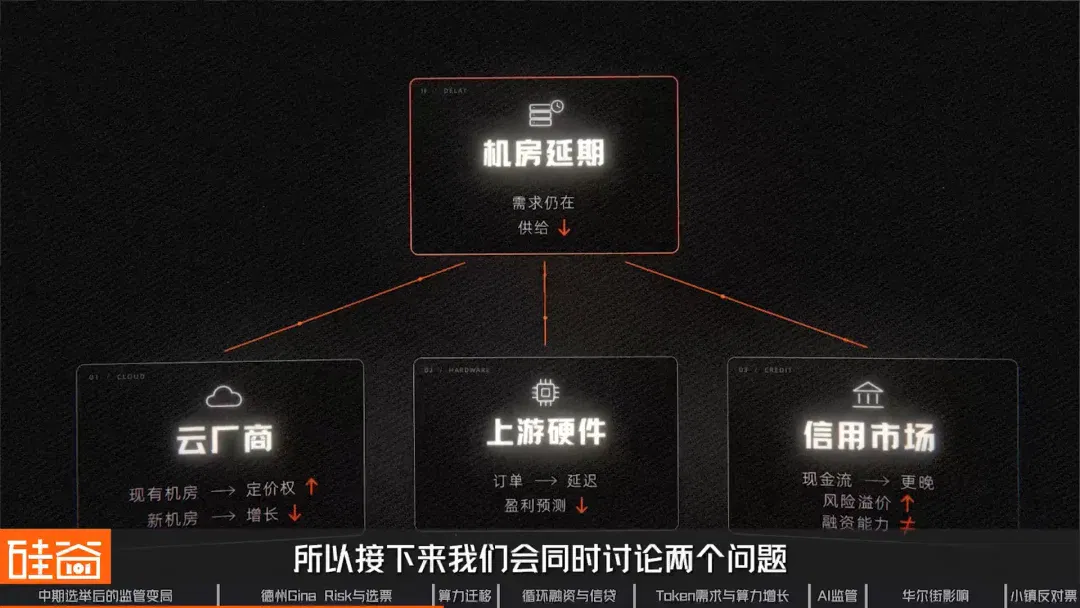
Is the market repricing supply delays or doubting real AI demand? The answers may differ for technology giants, neoclouds and chip, optical-communications and storage companies.
Richard: The most pessimistic view says the US could go from token exporter to importer. From 2028, for example, much new capacity might move to Southeast Asia because war in the Middle East presents problems.
If the period through 2027 is unaffected, what happens after 2028? What do you forecast, or which early signs do you see?
Rob Li: First, current construction cannot finish in 2027. We need not consider the next wave until at least summer or the third quarter of 2028. Thus the real question for new, unapproved projects still in planning comes after 2029.
Even if every Democrat and Republican said approved projects can proceed but no new ones may be built, there would still be roughly two years to respond.
Second, whether people discuss Southeast Asia or Musk's suggestion of spending more to build in space where nobody regulates, I think those ultimately become bargaining chips.
Think of the trade war: would it last six months or ten years? If ten, should Chinese factories close and relocate to Southeast Asia, elsewhere or back to America? Many said that a year and a half ago when it began.
More than a year since April 2025, the share of total capacity actually moved from China to the US, Southeast Asia or elsewhere remains very small. I think that is a useful comparison.
From the perspective of corporate decision-making, this is a relatively long cycle. Going to Southeast Asia also involves electricity, land, water and local government. Indonesia is currently in a relatively unstable political situation. How many people would say, stop all American construction now and move every resource to Southeast Asia? I think very few CEOs would make that decision.
That resembles decisions a year and a half ago. Few dared abandon Chinese factories immediately, stop building there and move everything to Southeast Asia or America. Even today, few do so.

Christina Xu: I strongly agree. Let me add something. Because America is restricted, companies such as Nebius have already expanded extensively in Europe and begun developing more electricity resources in Israel. Electricity is relatively less scarce there. As relatively large neoclouds, if they ensure chip access, they can benefit on both sides even if America is constrained.
For Southeast Asia, I hear some Silicon Valley startups suggest using more chips there because restrictions are lighter. Large training and inference companies certainly still favor domestic operations.
Despite restrictions, no very clear migration has emerged. I agree with Rob: much is said, but actual implementation in Southeast Asia remains difficult.
Richard: AI data centers have always been central to the circular-financing model. If the midterms change expectations and lower valuations or postpone IPOs for core companies such as Sorby, what chain reactions result? That could be a very bad change for neoclouds. Which part might tighten credit, and could it trigger greater contagion, even collapse?
Rob Li: We discussed industry-collapse claims with some clients last week. The core is demand, not supply.
Assume the demand curve has not changed. Whether current policy cancels or delays data centers, it only slows supply growth. If demand remains unchanged and supply grows more slowly, intermediaries already holding compute may actually benefit. Demand is still strong, but supply falls further behind than before, so my pricing power increases and I can charge more. The heart of this story is demand.
If demand collapses completely, everyone from NVIDIA to hyperscalers faces trouble.
On the first day last week, people wondered why infrastructure fell while hyperscalers such as Amazon rose sharply. The explanation was: without data centers, sellers of picks and shovels lose business, but Amazon has existing centers that earn money, possibly at higher prices, so it should rise.
Looking further ahead, Amazon reported just before the election and Andy Jassy gave long-term guidance for the first time. Previously it was quarterly. He said he understood dissatisfaction with this quarter's 39% growth, but 2027 would accelerate to at least 40%, with 40% again in 2028.
That gives markets a two-year strategic expectation. In other words, he expects cloud demand to double. Confidence comes from AI, not normal enterprises moving from on-premises systems to cloud.
If construction stops now, prices can indeed rise short term because demand remains and supply falls. But further out, Amazon's current centers and compute infrastructure are nowhere near sufficient for demand doubling in two years.
If no more US data centers can be built, that goal is clearly unattainable. Suppose yearly growth falls from 40% to only 12%. A CEO just promised 40%, then suddenly delivers 12% next year and 12% afterward. Should the company's shares and valuation go up or down?
This shows markets themselves lack clarity and are thinking short term. Ultimately demand is central. If demand is sound, faster or slower supply growth can eventually be resolved.
But if demand is false, enterprises later stop spending because there are no investment returns and tokens are unnecessary, that disproves demand and ends the whole story. I think that is the most important question.

Richard: Bruce, what is your view? Could the midterms change the existing circular-financing model for data centers?

Bruce Liu: I do not particularly agree with the concept of circular financing. An important economic concept is monetary velocity: money must circulate. My expenditure is your income. After passing through ten people and returning, the same dollar may have produced ten dollars of GDP. The AI circle's chain simply happens to be very short.
I think investing in these companies is fine as long as genuine revenue grows. Why was the internet bubble called a bubble? Profits were falling while stocks kept rising, without real revenue support. Looking back and comparing today's data, the situation is the opposite. I would not approach it that way.
But AI construction is asset-heavy and certainly requires capital-market support. That is the consensus.
Capital markets, especially credit, have changed greatly over the past two months. We have experienced repricing of bond-credit risk, through a relatively complex chain.
My understanding is that the root was July 7, when Trump tore up the MOU, memorandum of understanding. Treasuries moved first, rates rose sharply and MOVE, the US Treasury-market volatility index, spiked. Once Treasury and interest-rate markets move, credit must be affected. That is financial-market transmission.
Initially credit markets had no problem. But by September, Treasury volatility also made credit investors worried. Your costs rise. Previously, all else equal, I was willing to lend for 8% interest. Now I may need a higher rate before I am willing to lend.
That is the bond buyer. Supply also matters. Large issuance in May and June was followed quickly by attempts to issue again in September. Digesting all of that within a short time takes markets time.
Consider the week CoreWeave's financing was affected, whether September or early October, I forget. Everyone focused on AI debt, but Skydance issued $80 billion and suddenly clogged the whole credit market.
Mixed together, those factors create credit-market problems. It is not that debt cannot be issued, but the price at which it can be issued.
After that week of congestion, Musk said all issuance had stopped. That was a short-term blockage. The same weekend, BlackRock and other institutions were rushing to sign new deals because they could negotiate better terms.
Recent companies seeking funding have obtained it whenever credit was good enough. There is no universal inability to borrow. It changes with financing conditions and depends on the company's fundamentals.
Meta, for example, may now pay slightly higher interest but can certainly issue debt. Amazon can too. For CoreWeave or smaller neoclouds, however, post-election uncertainty over whether construction can proceed and when it finishes is so high that debt buyers require more risk premium.
For example, I once lent at 16% and now require 20%. If CoreWeave expects a 40% return, does it issue? Perhaps it does. If calculated returns are only 20%, it certainly will not.
Ultimately, the gap between returns and financing costs must be suitable. Bond buyers will price according to future certainty, and the supply side may also need corresponding adjustment.
Overall, AI needs financing. Depending entirely on its own cash flow seems unrealistic. That would be ideal if achievable, showing extraordinary industry and model capabilities. But there must be a period when spending and capex greatly exceed revenue growth. Capital markets must support that gap.
They can support it. The question is at what price.

Richard: I want to ask Ethan about one detail. SemiAnalysis suggests that by the end of 2028 global data-center capacity could exceed chip supply by more than ten GW, meaning chip output falls short of expected construction. How do you view that gap? Could current construction delays alleviate it to some extent?
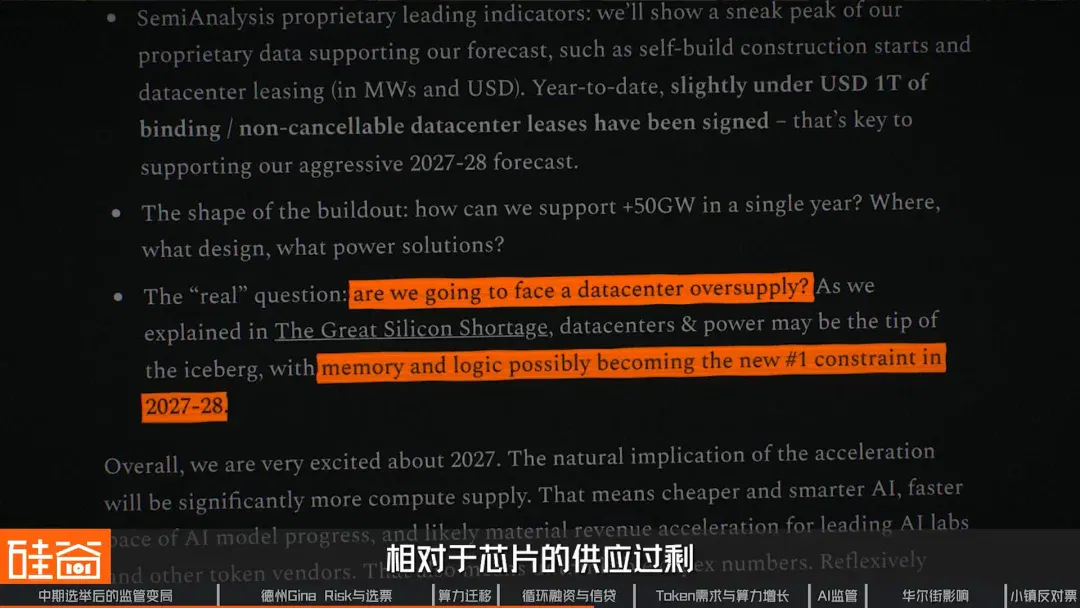
Ethan Xu (Xu Yixing): I agree with much of SemiAnalysis's semiconductor research, but not its recent article on 2027 and 2028 compute growth. Its forecast of 38 GW coming online in the US in 2027 is far above my personal judgment. I also reject its conclusion of excess data centers and insufficient chips in 2028.
I think both 2027 and 2028 will bring serious US data center shortages. Globally there may be places with buildings but no chips, most likely because of advanced-chip export restrictions rather than overbuilding and chip growth failing to keep up.
For the US alone, I do not expect that much capacity next year. The election has added unexpected risks and obstacles, many impossible to quantify now. How much each town opposes construction, for example, is difficult to quantify. Under those conditions, I am even less convinced that scale can be reached, or that the following year brings more.
I think next year and the year after will probably both have too few data centers, while chips are sufficient or even excessive. In that situation, compute becomes an exceptionally scarce resource.
I differ from Rob on another point. I think most projects, including Texas projects, have not secured every approval. There may not be many fully approved projects that can proceed all the way to completion.
Tens of GW have been stopped during Texas's initial approval process. A series of new reviews is required for grid approval. After the governor takes office, reviews only become more complicated. Legislation also adds greater costs, oversight and public-acceptance requirements. All of these sharply increase on-time completion risks for numerous projects without full approval.
So at least in America, I do not expect excess data centers in 2027 or 2028. Nor is it the global trend. Local cases may exist, but they should be individual exceptions rather than representative.
I am also thinking about whether existing compute owners, such as Amazon, necessarily perform particularly well. It may not be that simple.
Many compute contracts were signed one or two years ago for next year's or the following year's capacity, with prices and terms fixed. Would Amazon renegotiate, tear them up or default in order to sign higher-priced, more profitable deals? That involves reputation and long-term considerations.
On profit, then, I strongly agree with Rob. Markets have not worked out how to price this, producing shares that jump up and down. Regulatory and public-opinion risks may also swing repeatedly for as long as six months, so that volatility may continue.

Richard: There was a popular X discussion: DEX estimated from one day's DeepSeek traffic on OpenRouter that one GB300 rack could nearly serve all of it. Assuming that estimate holds, could token growth fail to create very large hardware-demand growth? What do you think of the estimate?
Rob Li: I have not examined the assumptions in detail and should not judge it correct or incorrect. But people have discussed this logic since DeepSeek first appeared.
If model compute efficiency improves greatly, and tomorrow one dollar of compute does ten times today's work, do we no longer need as much hardware?
The key remains whether a 90% reduction in compute prices creates more than tenfold demand growth. If prices fall 90% but demand grows only fivefold, hardware demand necessarily halves. If demand rises more than tenfold, however, hardware demand clearly continues expanding.
It comes down to elasticity as prices fall: is the response linear, with a 90% cut bringing tenfold demand, or is it lower or higher?
Bruce Liu: Let me ask sharply: from this point, what do you think demand looks like two years ahead?
Rob Li: Honestly, we ourselves have no answer. I do not know how Jassy arrived at so aggressive an expectation of doubled demand in two years.
He is not alone. Huang also says demand will grow at least 40% annually. Three memory makers expect at least 35% to 40% demand growth over coming years. Their numbers agree, but whether reality will agree is unknown.
Our understanding is that enterprise willingness to spend matters, not consumer demand. Spending 100 today, at least 140 next year and at least 200 afterward on tokens would validate the industry's extrapolation. Many CFOs and CIOs may not know their own budgets for next year yet. We must keep watching.
Here are some reference points. Follow data-infrastructure companies such as Snowflake and Databricks, because they see actual, real-time enterprise demand.
Most enterprises now buy tokens through Databricks and Snowflake rather than directly from OpenAI and Anthropic. Those platforms pass demand to Amazon, Microsoft and Google, consuming their compute.
Who sees live enterprise token demand? Databricks and Snowflake do, and Amazon, Microsoft and Google do too. But they see the present, not fully what enterprise clients will spend in two years. I think nobody knows. It needs continued observation.
Bruce Liu: I think recent market pressure is not just about supply. You can certainly say scary stories multiply when markets fall. But confidence in demand really is lower now than when agents appeared early this year. That is part of market pressure too.
I agree that this number cannot be forced out of a calculation. It cannot be calculated, and forcing it basically means guessing.
Rob Li: I completely agree with Bruce. Markets clearly do not believe Jassy's doubled demand in two years and 40% yearly growth. They say: show evidence before I believe Amazon can deliver. Currently they do not believe it.
Ethan Xu (Xu Yixing): Bruce and Rob discussed demand. From what we see, I am less worried and think evidence permits estimates. How many orders are in hand, and how long would present growth take to fulfill them? The major cloud companies cannot finish existing orders over the next three years.
Amazon and other companies may be optimistic about future demand mainly because of contracts already signed. Even with 40% annual additions, they cannot finish them over the next three years. That is why they conclude they can be very confident about 40% annual growth. Essentially, this conclusion still rests on relatively certain supply-side signals.
From that perspective, should supply and demand not worry us particularly? Bruce mentioned demand concerns, and I would like to understand their source.
Bruce Liu: Rob already identified it: that growth rate. AWS must see orders to speak like that. The three companies have $1.5 trillion in combined backlogs, which is enormous, but those orders can be canceled.
If demand is weaker than imagined for some reason, orders gradually get canceled. AWS is not the leading indicator or first to see that change; by the time it sees it, it is late. Markets are trying to see earlier.
That explains why everyone cares about OpenAI and Anthropic ARR, annualized revenue. They see user growth first, and fast ARR growth removes market concerns. I think that is the logic.
Christina Xu: I would add something. Living in Silicon Valley, I speak with many startups. We often discuss why one cannot now look only at OpenAI and Anthropic ARR.
First, it lags. Second, only a limited proportion of their compute actually goes to inference. Third, we should track all token usage growth, not just these frontier labs.
Tracking all token use shows frontier labs' share falling somewhat. How do we track it? Rob mentioned Databricks. More simply, watch Fireworks and Baseten, which directly supply token services.
We see many startups, including many I invested in, using ten to thirty times more tokens this year than last. Of course, the overwhelming majority, more than 80%, still use frontier-lab models. Some have also begun post-training and hosting their own open models for greater cost control. But open or closed, as long as token usage rises, demand for compute is there. That is the logic.
Richard: Christina, what signs of RSI, recursive self-improvement, can you see in token growth? Or is it mostly earlier usage patterns?
Christina Xu: RSI contributes too. There are several directions: security, drug development and many GPU-kernel projects. Short term they seek revenue quickly. But observe those RSI companies and their first complaint is always insufficient compute.
We know the leading few have signed $400 million in compute contracts with Amazon, yet still search extensively for much larger agreements. Ultimately, they see competitive barriers in, first, who obtains more customers and creates more industry data flywheels, and second, whether sufficient compute can be secured.
Bruce Liu: An opposing point: if competition for compute is so intense and demand so strong, why do OpenAI and Anthropic need a price war?
Christina Xu: I think Anthropic's cut was unnecessary. Without lowering prices it could still grow well.
Our guess is that there may be listing pressure, so both sides decided to do this to make financial statements look better. OpenAI just completed this round. People may know its target valuation was $1.5 trillion, but it actually completed at $1.2 trillion and has not filled the round. Cooling market sentiment affected it too.
They took those steps under these conditions, but outcomes seem less than ideal. I think it may be strategic, without necessarily being very necessary or correct.
Bruce Liu: At least from a market perspective, a price war now, without obvious usage growth matching it, raises concern: did prices fall 90% without usage increasing correspondingly? Overall, it is still concern about slowing growth. That is why so many scary stories have appeared recently, and those narratives are not favorable for AI overall.
Christina Xu: I previously wrote on my Silicon Valley Non-Consensus WeChat account a point Gavin Baker also raised: those two companies may capture most economic value without accounting for most token usage.
A price war is therefore poor value for them. Most customers do not choose them for price sensitivity. I think it may be strategically wrong, but does not indicate weaker demand.
Richard: There is also the background that DeepSeek and Kimi are cheap. Without price competition, much demand could shift to inexpensive open models.
Christina Xu: My view is that many choose open models primarily for data security, privacy and similar concerns, rather than cost.
That is why Silicon Valley post-training companies are growing fairly well. Thinking Machines Lab previously wanted frontier models, then discovered it was not quite so frontier and began post-training too, a way to generate revenue. Most clients mainly consider data security. I therefore do not think a lower price immediately wins those users away.

Bruce Liu: What about alternative states such as Louisiana or North Dakota? How feasible are they? Can data centers move quickly, or is it less straightforward?
Ethan Xu (Xu Yixing): I believe every compute company is considering that, and most already examine opportunities there. But moving something originally planned for Texas is not easy.
Data centers look beyond power to whether enough labor exists. Construction may require thousands, and they cannot all be workers without data-center experience. They may come from developed neighboring areas. Will they go to North or South Dakota for two or three construction years? Labor relocation itself is a challenge.
Most American fiber systems follow major cities and economically developed regions. Extending an existing network a little is fine. But laying an entirely new backbone to a new state with sparse population, abundant land and plentiful electricity also takes years. It is not easy.
Local laws and stable government and public attitudes also matter. You do not want to move, build smoothly in year one and see attitudes reverse in year two. That is another political risk.
It is indeed less simple than imagined. But every company is preparing alternatives and considering nearby regions with less regulation and risk. They have begun doing so.
Christina Xu: Ethan is right; we are doing it in practice too. Moving is harder than expected because power permits are not immediate. You can build the shell, but without a power connection must generate electricity yourself.
People now say every data center should bring its own power. Previously, only 25%, one-quarter, of planned US capacity did so. Operating behind-the-meter projects may be only 2 GW; I do not know whether Ethan has the same number.
Expanding that to 40 GW would still present generation problems. SpaceX discusses building its own gas turbines, plus Tesla battery support and many interconnection plans, before saying behind-the-meter problems might be partly solved. This is a major issue too.
SemiAnalysis tracks much data, has many channels and satellite images. But based on my operating experience, the interval between construction completion and power connection can be indefinitely long and is also restricted by current policy. Earlier New Jersey projects and some neoclouds experienced long delays. Delays will clearly remain, and from this perspective I think existing compute benefits greatly.
Returning to neoclouds, many companies still have reasonable financing costs, perhaps only 7% to 8%, and high cash proportions. They differ, and many may actually gain new opportunities. Their financing involves NVIDIA allocations, long customer contracts and buildings. Those are generally powered shells, equipped with electricity and other infrastructure. Many companies lease rather than build them. If not leased, they may be financed separately, because depreciation can extend twenty years.
Previously, NVIDIA allocations alone could obtain loans quickly. That no longer works: customer long contracts are required too. On-demand billing is not accepted by those financing structures, even if rates are three to four times long-contract rates. They must have long contracts.
Neoclouds therefore face a renewed choice: keep signing relatively cheap long-term contracts to obtain financing? CoreWeave previously signed the most long contracts and now wants short-term high prices, but lacks much leverage for on-demand billing. That may be its largest challenge, a relatively unfavorable cycle.
By contrast, some neoclouds may benefit from these circumstances. Those are my observations.

Chen Qian: I want to follow up with Bruce and Ethan. We discussed government regulation, first of data centers, but AI-safety regulation may be more serious because it affects frontier-lab R&D speed. Do you think risk currently priced by markets remains at the data-center level, or already includes AI safety and research?
Bruce Liu: Frankly, I do not think markets can distinguish it that finely and say one portion is priced and another not.
For safety, a bipartisan bill is at least coming soon. Broadly it supports development but requires safeguards and an emergency shutdown mechanism. I think that is being priced. I do not sense regulation intends to forcibly obstruct AI development.
If it moves in the extreme direction of Sanders and some legislators, markets certainly have not priced that. I remember Zuckerberg saying when safety became an issue that model development already considers it; it is not an independent problem.
Such discussions will grow, and regulatory measures and pressure will certainly appear. At the federal and House legislative level, this will come first because it is urgent and higher priority.
Ethan Xu (Xu Yixing): My view is similar to Bruce's. Markets remain more concerned about data center regulation or overregulation.
Every frontier lab, including Google, considers safety oversight. Google released its latest model earlier but did not quickly open it fully to the public. Limited users received it first because of possible safety concerns. It wants risks controllable, even assurance that no major problems exist, before releasing to everyone.
That is relatively addressable within AI: while developing models, develop corresponding safety mechanisms. It is comparatively manageable. Data-center development instead involves many things technology companies cannot control at all, and the risks are substantial.
Bruce Liu: One more point. Finance and automobiles have developed for years with corresponding safety regulators. I think AI will inevitably have its own institution responsible for industry-wide safety at some point too.
Chen Qian: Trump recently signed an agreement with major AI-company leaders, asking companies to bear their own corporate responsibilities.
That disciplines companies through markets: if AI goes wrong, reputation collapses, consumers leave and the company itself may fail. To avoid that, companies strengthen safety and ensure products work properly.
Will Democratic control change that into strong government oversight? If the approach changes, what happens to R&D speed?
Bruce Liu: At least from my most recent conversations, I do not think that is the leadership's overall attitude. It supports development while requiring serious attention to safety, and not merely attention but concrete means.
Does that count as strong regulation? I find it an entirely reasonable requirement. Debate may eventually find a balance, but it is fundamentally different from restricting data centers.
In broad terms, everyone realizes AI is indispensable if America and its economy are to develop, so support remains the premise. Of course, later debate can change. When Democrats actually enter both chambers next year, issues may evolve with discussion. But at least for now, the latest information I receive points in this direction.
Ethan Xu (Xu Yixing): I agree too. Safety is one development step. As models strengthen, everyone spends more time before release confirming safety. The process should slow appropriately, and that may already be the consensus among technology companies.
If you develop an extremely strong model and are not confident yourself, withhold it temporarily, test internally, test externally, then release. I think that reasonable slowdown is appropriate.

Chen Qian: Will sentiment and responses differ across segments such as GPUs, optical communications and storage? Which upstream or downstream areas are more fragile or resilient? How can companies respond to macro changes, and who survives?
Bruce Liu: I think differences are substantial. Upstream may be somewhat more vulnerable.
NVIDIA's revenue expectations for next year, for example, may assume two years of data center delivery. If 20% cannot arrive, revenue and profit growth are naturally affected, and the company cannot fix it. You can cite strong demand repeatedly, but without supply, EPS, earnings per share, cuts become likely and necessarily affect markets.
So I think next year's greatest AI-sector risk comes from upstream hardware: how far must earnings be revised down? The biggest risk is not valuation. Multiples really are low now, and markets have priced many risks after this decline.
If Iran's situation ends and inflation improves next year, valuations may instead gain support. The biggest risk is the degree, magnitude and speed of affected industries' EPS cuts. Theoretically, upstream hardware faces the largest risk. You can say shares have already fallen greatly, but calculate it: could they fall further? Yes.
Conversely, existing compute owners gain pricing power and are relatively comfortable at this stage. As long as demand is unchanged, they have leverage with customers and suppliers alike.
Rob mentioned supply shortages preventing expected growth next year. If everyone clearly sees very strong demand, entirely constrained by too few data centers and limited compute, what will markets think? That is debatable.
Personally, if demand flourishes, I do not think markets will excessively penalize companies merely for supply constraints.
Ethan Xu: I think demand faces little risk over the next two years. Risks come from data center supply. The bottleneck in data centers determines upstream shipment bottlenecks.
But upstream products differ. I worry about GPUs, optical communications and modules, because their supply is relatively sufficient so far. If data center volumes fail to grow, with 20% delayed and some canceled, that shipment volume may disappear or be postponed, unfavorable for GPUs and optics.
Some upstream supplies, such as storage, are already severely insufficient. Even fewer data centers might simply change severe shortage to relative shortage. They remain scarce.
I also follow power equipment, and the situation may be similar. Transformers, for instance, now have three- to four-year queues. Even if reduced data-center supply cuts that to two or three, it is hardly abundant supply. I therefore think some differentiation may emerge.
Bruce Liu: Yes, as you said, memory may be the clearest example. But memory's gains are really driven by price increases. Usage has not risen particularly sharply; prices have. Fewer data centers could break that price-increase logic too. From a stock perspective, I still see considerable risk.
Ethan Xu (Xu Yixing): So company profitability may weaken, correct?
Bruce Liu: Yes. That is the core driver of share prices, not simply volumes. Weaker pricing power must be reflected in market prices.
Richard: Bruce, which indicators would you most watch over two or three quarters? Many M7 companies, including Google, are turning negative on free cash flow, with sharp declines over one or two quarters and high capex. Investment moves so quickly that AI profits have not caught up, creating a gap. Could missed expectations cause large declines over coming quarters? What would you track most?
Bruce Liu: To validate the industry, I would rather track upstream EPS downgrades and order cuts. Those matter most to me.
Hyperscalers spend the money. Negative free cash flow seems natural, and in a sense positive because it shows investment intentions. If upstream orders are cut, capex needs fall and cash flow improves immediately. Is that good for AI or bad? Difficult to say, though shares might perform somewhat better.
From an investment perspective, I do not think they are so fragile. Today's pain point is elsewhere: how hard and far upstream orders get cut. We have not actually seen downward revisions yet; markets fell first on concern. Material cuts afterward are the greatest risk.
Ethan Xu (Xu Yixing): For hyperscalers, I might follow their planned annual capacity deliveries.
Richard: Would those plans adjust in 2027, or only in 2028 once conditions are clearer?
Ethan Xu (Xu Yixing): I believe both 2027 and 2028 delivery plans will be below all the companies' original expectations. Problems will begin in 2027.

Ethan Xu (Xu Yixing): There is an interesting point. Our starting point in discussing data centers was public dissatisfaction. But before that is another starting point closely connected to Silicon Valley 101 and media.
I have noticed that over the twelve months since last year, mainstream American media have begun systematically attacking data centers, almost entirely with negative, demonizing coverage. The industry itself has advantages and disadvantages, but I have barely seen its benefits discussed. At least so far, I have not seen a single report or article lay out both sides for relatively objective, even quantitative discussion.
Why do Americans think data centers are so evil? How did this demonization occur? I find that an interesting question.
Most ordinary Americans have never encountered a data center in their lives. Their only contact is media coverage or a genuinely higher electricity rate. Most data centers have not actually been built; the cycle is only starting, with next year and the following year bringing major deliveries.
Why, then, such unanimous condemnation? I do not think data centers themselves have already harmed people that severely.
Frankly, a relatively extreme negative example was the Texas campaign claim that some residents paid an extra $600 annually for electricity. Their anger and dissatisfaction far exceed $600 a year.
How did this happen? It is worth thinking about. Why do American media report so negatively, and what are the underlying reasons? So far I have not seen a media outlet carefully, quantitatively and objectively analyze positives and negatives together. I think this may be the true starting point of the whole matter.
Bruce Liu: Ethan, your expectations are too high. Frankly, media follow public opinion. Americans' chief dissatisfaction is high living costs and struggling to get by.
Those costs are ultimately attributed to three things: war in Iran, the tariff war and data centers. The first two are inconvenient to discuss, leaving the third to criticize. It is that simple.
Ethan Xu (Xu Yixing): I strongly agree. My impression is that data centers have become a scapegoat for rising living costs, although the other two causes are substantial too.
Bruce Liu: Yes, those other two are far larger, and data analysis can quantify them. This year's main issue is especially the Iran war. The US economy should have performed well, but Trump's insistence on war caused oil to surge, inflation to restart and all financing costs to rise.
Talking about that in media is far less effective than criticizing data centers.
Richard: The current situation has negative or slowing signs in AI or Wall Street, yet technologically, METR's Anthropic report finds AI participation in R&D increases model-progress speed to 1.59 times its former rate.
I have always thought that if RSI truly works, token consumption and demand grow explosively. On one hand AI appears to be adjusting; on the other, technology and usage still accelerate unchanged. The whole market feels divided.
Bruce Liu: Go investigate institutions actually doing model research and speak with researchers: there is no sense of deceleration. Conversations with Google and similar companies show flourishing development. As agents emerge, more and more can be done. In recent conversations, there was also absolutely no sign of reduced capex.
But markets show something else. Even if data centers are restricted, I believe that in the short term, asking Silicon Valley researchers and startups would reveal no felt difference. They keep doing what they were doing. Markets, though, show an entirely different signal. That is why they are a leading indicator.
Chen Qian: Sometimes I wonder whether Silicon Valley is too enclosed in an information bubble. Here, AI seems to have transformed life greatly, demand shows no slowdown and RSI promises more growth.
But actual opponents may be people who never used AI, ordinary residents in small towns. Their power is enormous. As Bruce says, do not underestimate them. They have votes, each equal to the vote of every researcher in Silicon Valley. Perhaps the midterms teach Silicon Valley to consider how outsiders accept this and keep educating the market.
Ethan Xu (Xu Yixing): I strongly agree with what Bruce and Chen Qian just said. That is why I locate the story's beginning not necessarily in resident opposition, but in twelve months of media repeatedly telling residents to blame everything on data centers, completely demonizing them. Their understanding of AI comes almost entirely from those reports.
So my feeling is that Silicon Valley is one force, but another substantial force lies with media and the narrative they choose. Sustaining that narrative for twelve months genuinely can change a large part of America's view of an issue. Those views ultimately affect the whole industry through votes. I think this is another force no smaller than technological progress.

As our guests said, the data-center story is not merely about stocks, economics, AI and regulation. It concerns American society and affects many ordinary people. Bruce also said we must never underestimate the voices of residents who are not interested in AI.
We have followed this subject and interviewed three local residents.

Steven
Monterey Park resident
If data centers were really good, we would compete for them. But no city is competing to get them.
This is Steven, a Chinese-American director of Fresh Off the Boat, living in Monterey Park, ten minutes' drive from Los Angeles. On June 2, 2026, the city held a referendum at City Hall. Some 88% favored permanently prohibiting construction. It became the first US city to exclude data centers completely through a referendum. Steven was among those voting that day.
Steven
Monterey Park resident
If data centers really became the crown jewels major technology companies want, bringing revenue without noise pollution, depressed house prices or air pollution, while saving water and achieving energy and carbon neutrality, you would know it. Every city would compete for them, just as cities compete to host the Olympics.
That has not happened, and I do not think it will. Companies create demand themselves by forcing AI on us. We do not want AI, yet they put it everywhere. First they create demand, then say: look at this demand, we must build data centers.
Also, why must we compete with China? What does it matter if China's economy is bigger? I do not mind.
Mayor Elizabeth Yang drove the referendum. In November 2025, she received an Australian property company's application after it bought land for a data center.
Residents wrote to the city in protest as soon as the proposal appeared. She therefore asked whether the company would answer questions at a community meeting, but no clear reply came for a long time. The city ultimately decided to give residents authority over whether the project stayed or went.

Elizabeth Yang
Mayor of Monterey Park
We finally made it a ballot measure, essentially giving voters the decision. Meanwhile, the applicant's lawyers kept sending very strongly worded letters.
They hired Sheppard Mullin, one of Los Angeles's largest and most aggressive law firms.
They repeatedly wrote, essentially: if you ban data centers, we will sue, and you will certainly lose.
We therefore placed the decision with more voters. If residents vote for a ban, it is the voters banning data centers, not city government.
Would the law firm sue those residents? Its case would be less strong then. I think giving power to people was best.
She also believes the presence or absence of data centers would not fundamentally alter the city's economy.
Elizabeth Yang
Mayor of Monterey Park
Our city has done well for the past hundred years. It is more than 110 years old and has kept developing and prospering without data centers.
Continuing without them does not mean economic collapse. We can keep doing what we have always done.
Another resident we interviewed lives in Texas, repeatedly mentioned by the guests. His city is Abilene, a west-Texas city with only a little over one hundred thousand people. Yet it hosts Stargate, which Trump once called the most important project of this era.
This project once greatly excited Abilene's government. To keep Stargate, the city directly offered ten years of 85% city property-tax relief. But a few months later, the first changes residents experienced were not more prosperity, but housing that was harder and harder to find and rent that was increasingly expensive.

Steve
Abilene resident
Many people report higher rent, a major problem. People at the air base also say some Air Force personnel sleep in cars because they cannot find housing.
Many longtime tenants cannot obtain affordable renewals. Some discovered they must move only after landlords said they would sell.
First-time buyers I spoke with cannot find affordable homes either. The shortage also reaches local universities, where students cannot find places to live.
Steve is an Abilene resident who later created Save Abilene, a website for anonymous reports of data center-related impacts: rent, housing, roads, noise, anything.
Steve
Abilene resident
Nobody moved to Abilene to sit in traffic on the way to work. People came because they could reach the office in ten to fifteen minutes. Someone submitted to the website that residents sometimes cannot even leave their own driveway because data-center workers block the street where they live.
We are unwilling investors, and this has worsened our town's quality of life.
So I think all of us should receive a return on this investment. It is that simple. Whether actual tax rebates, Oracle and OpenAI genuinely repairing the community, our roads and schools, or simply a few thousand dollars for each person, something has to happen at this point.
Steve says Abilene residents bear the costs of technology companies moving in without enjoying the benefits. That also represents many Americans living near data centers. Around Midwestern towns and broad farmland, some have never used AI, but find themselves facing noise, high rents and rising water and electricity bills.
That is why data centers divide American society now.
The discussion reveals a contrast. Silicon Valley's technology and applications continue accelerating, while Wall Street reassesses whether data centers can be completed on schedule and when investments are recovered. Delays affect orders, earnings and financing, but that is not the same as demand disappearing.
Citrini's 2028 Global Intelligence Crisis imagined AI gains flowing increasingly to capital, damage to workers' income, weaker consumption and eventual harm to companies. Post-election restrictions do not prove that scenario has occurred, but at least show society asking who shares benefits and who bears costs.
Silicon Valley sees AGI; small-town residents care about electricity, water and lasting jobs. Their concerns change policy through votes, affecting investment returns. How far this building cycle goes also depends on whether all of society shares its benefits.
This article was originally published by the WeChat account Silicon Valley 101. Author: Silicon Valley 101.
Related topics
After reading
Join the AINRK community
Read how to join the community and connect with people working in AI.
Related articles
Continue reading related topics and articles in this category.

Google 调整美国 K-12 教育账户的 AI 与搜索设置,引发学区争议 (opens in a new tab)
报道聚焦 Google 计划在 2027 年初调整学校账户的 AI 开关,以及部分搜索功能与 AI 设置的关系。文章整理学区、教师与家长对搜索访问和学生使用的不同顾虑。

白宫把 2.9 万个政府网站,融合成了一个 AI (opens in a new tab)
白宫搞了场 AI 发布会,上线了 America.gov:把 2.9 万个政府网站,融合成了一个 AI 白宫对这事儿也发了一条推,说这是一个通往联邦政府的全国性“前门” 发布会上,特朗普如此说道:“我

特朗普给黄仁勋打电话聊AI,黄仁勋:你是对的 (opens in a new tab)
英伟达CEO黄仁勋在洛杉矶All-In Summit上接听特朗普现场来电,明确表示"绝不让AI减速",并就AI安全工程化、开源重塑中美AI竞争、英伟达向模型与基础设施两端延伸等议题展开近50分钟讨论,坚持放慢AI发展是错误策略。
赢麻了!半年83家独角兽诞生,六成是AI公司 (opens in a new tab)
据外媒TechCrunch 7月5日报道,截至今年6月底,美国已有83家获得风险投资支持的初创企业成功跻身独角兽阵营,其中与AI相关企业就有51家,半年累计融资金额超过520亿美元(约合人民币3532亿元)。

AI战争机器Palantir创始人彼得·蒂尔,今日举办绝密集会,反AI监管 (opens in a new tab)
黑暗启蒙运动在硅谷的标志性人物——彼得·蒂尔,将于这几天在罗马开展一系列绝密讲座,驳斥教皇观点,反对 AI 监管,这或许标志着 AI 竞争的终局较量已经拉开帷幕。各大巨头想要争夺的标的,已经超越了算力规模与爆款应用。他们真正在抢夺的,是对「未来秩序」的最终解释权。