Naive-N0.5-Flash Media Test Compares Inference Speed and Three Web Development Tasks
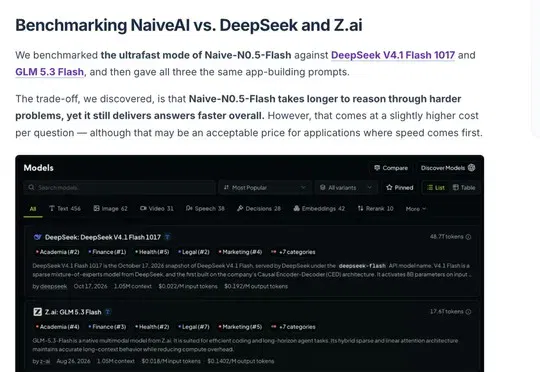
QbitAI summarizes Latent Space's 30-question speed test and solar-system, growing-tree and ray-tracing demos, reporting peak throughput in that setup and differences from two Flash models.
Another dark horse has emerged among China's large models!
And this time, it was the hugely popular, technically focused Silicon Valley AI publication Latent Space that uncovered it through firsthand testing.
On November 10, Latent Space launched a new model-review series devoted to hands-on tests of new models without taking sides.
For its first edition, the series turned its attention to Chinese company NaiveAI's open-source model Naive-N0.5-Flash.
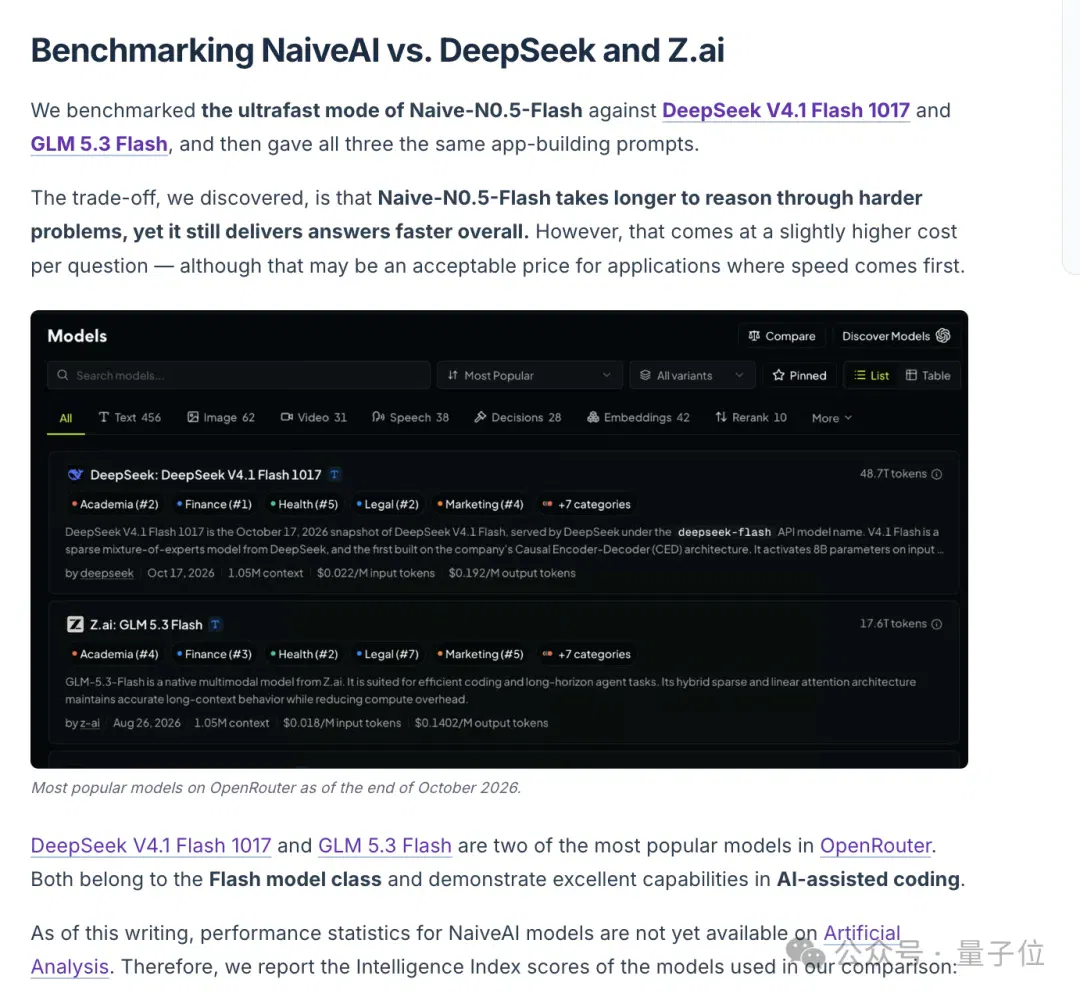
Latent Space chose the two most popular Flash models on OpenRouter as its opponents: DeepSeek V4.1 Flash 1017 and GLM 5.3 Flash.
Unexpectedly, Naive-N0.5-Flash, brought in to compete alongside two leading models, really did deliver a highly competitive set of results—
- Overall capabilities: Between DeepSeek V4.1 Flash and GLM 5.3 Flash, placing it in the first tier of China's mainstream models.
- Coding capabilities: Overall performance fell between the two, while surpassing them on individual evaluations. It performed best on the 3D solar-system application and tied with DeepSeek on the 3D growing tree.
- Inference speed: In high-speed mode, its peak over a single second reached 2,100 tokens/s. The thinking and answering phases reached 984 and 1,816 tokens/s respectively, with a median response time of just 3.1 seconds—an impressive result.
Speaking of NaiveAI, the founder behind this player is no stranger to readers: Tsinghua University Department of Electronic Engineering associate professor Jifeng Dai.
The model also has a particularly unusual origin: AI itself participated in developing its architecture, training system and inference optimizations.
Clearly, NaiveAI, this emerging dark horse, has now carved out its own position among the leading players.
Latent Space's firsthand test: a Chinese model dark horse breaks into the leading tier
First, why is this review worth paying attention to?
In the overseas AI engineering community, Latent Space is a name many readers have probably heard.
It is an independent technical publication focused on AI engineering that has long covered large models, AI agents and AI infrastructure.
Even industry heavyweights such as legendary Google engineer Jeff Dean have been invited as guests to discuss topics such as large-model architectures and engineering optimization in depth.
Latent Space's content has always stood out for being professional, technically rigorous and close to real engineering practice—
From AI engineering practice to the underlying architectures of large models and how agents enter real production environments, it focuses on problems that developers are actually solving.
In other words, this publication's reviews speak directly to people who will genuinely use models to write code and build products.
The open-source model from Chinese company NaiveAI that starred in the first edition of Latent Space's new review series, Naive-N0.5-Flash, also deserves a closer look.
In its technical approach, NaiveAI has put considerable effort into inference efficiency—
On one hand, it has involved AI in optimizing its in-house NaiveRT system, pushing generation speed as high as 2,000 tokens/s.
On the other, techniques such as sparse attention support a context of one million tokens while reducing computational overhead as much as possible.
In terms of product positioning, NaiveAI is clearly targeting the two areas developers currently care about most:
The quality of results on complex coding tasks, and inference efficiency in scenarios with frequent calls.
But what really gives this review weight is Latent Space's choice of reference models.
It brought in DeepSeek V4.1 Flash 1017 and GLM 5.3 Flash directly, both of them extremely popular Flash models on OpenRouter.
That gives this contest its significance: NaiveAI was facing two players that had already reached a certain scale in the real developer market.
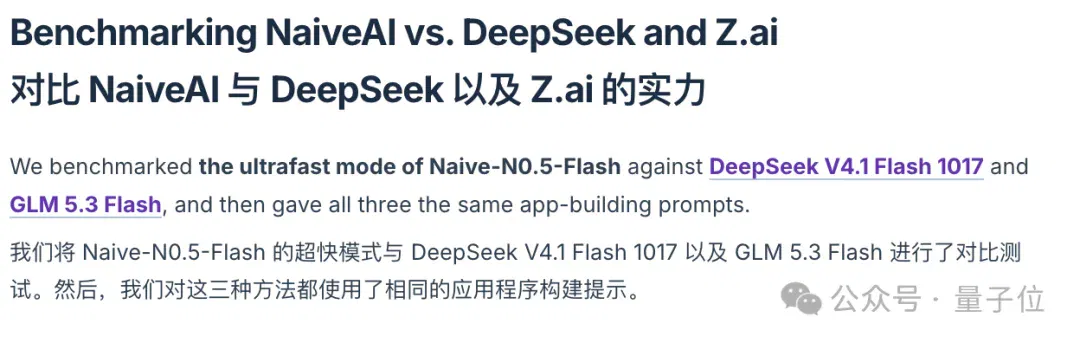
The question is, just how competitive can this model be?
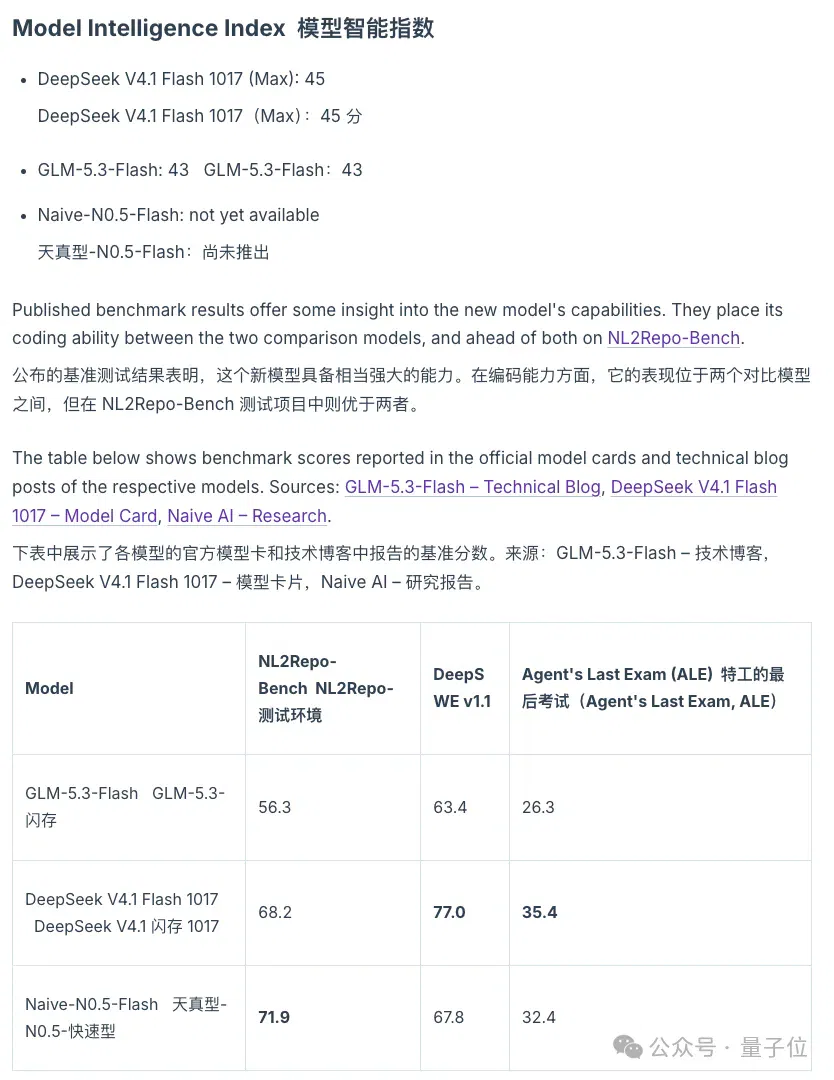
Latent Space first put the three models' public evaluation results side by side.
In overall performance, Naive-N0.5-Flash falls between DeepSeek V4.1 Flash (1017) and GLM 5.3 Flash, placing it among the leading contenders in China's mainstream model field.
On the coding benchmark NL2Repo-Bench, it went further and surpassed both DeepSeek and GLM—
Naive-N0.5-Flash scored 71.9, leading DeepSeek and GLM by 3.7 and 15.6 points respectively.
This test examines a model's ability to build a complete code repository from natural-language requirements, making it closer to real software development than generating a single function.
This also means that on complete-project generation tasks, Naive-N0.5-Flash achieved results comparable to the public evaluations of the two leading Flash models.
Taking on DeepSeek in coding, reaching 2,100 tokens/s in speed
Of course, public benchmark scores are only one side of the story. A model's real performance still has to be demonstrated through hands-on testing.
This time, Latent Space first focused on Naive-N0.5-Flash's strongest suit: 'speed'.
According to official figures, the model's single-user output speed is about 50 tokens/s in standard mode, reaching as high as 2,000 tokens/s when switched to high-speed mode.
The results Latent Space measured turned out to be even stronger than the official figures.
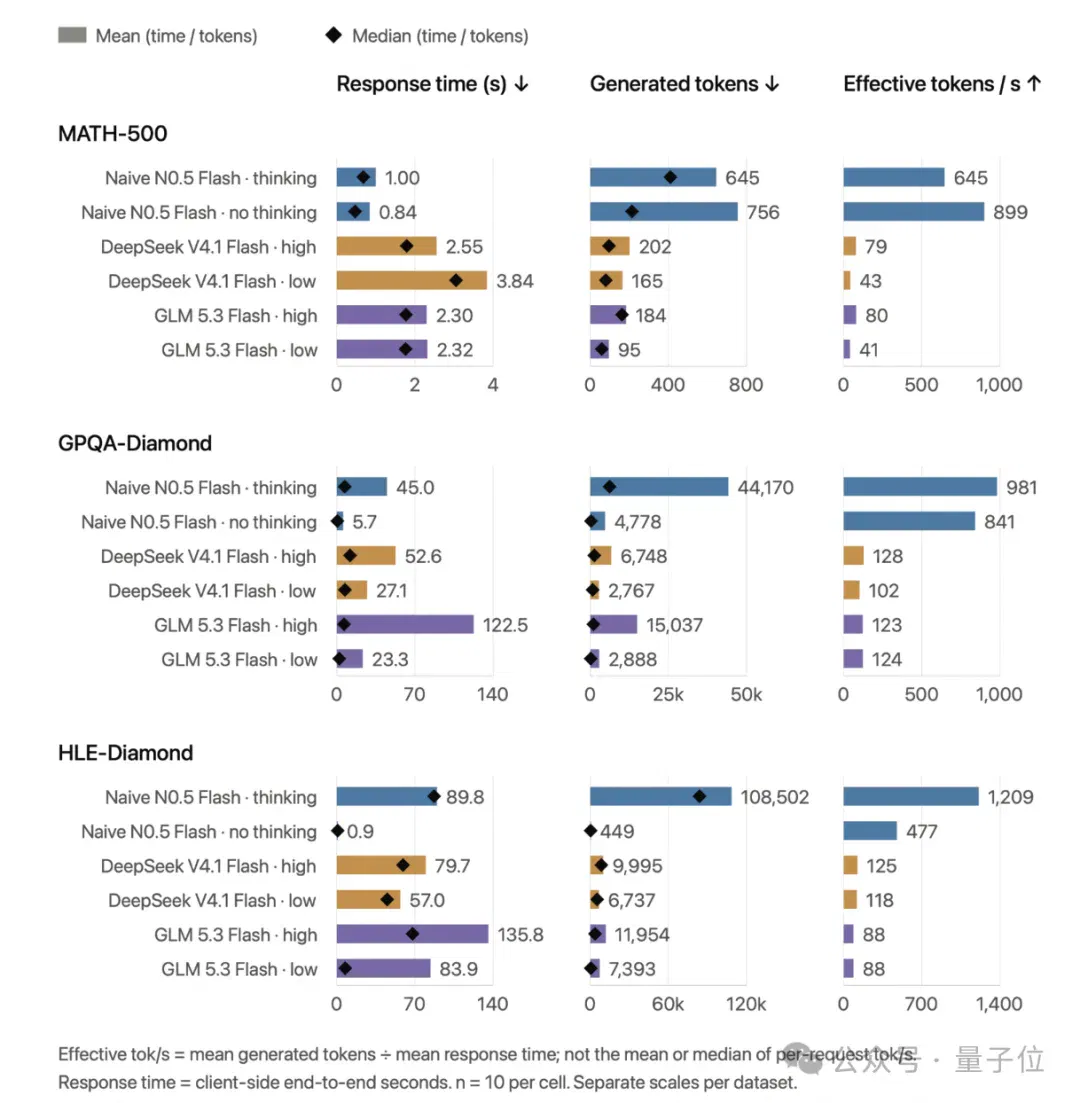
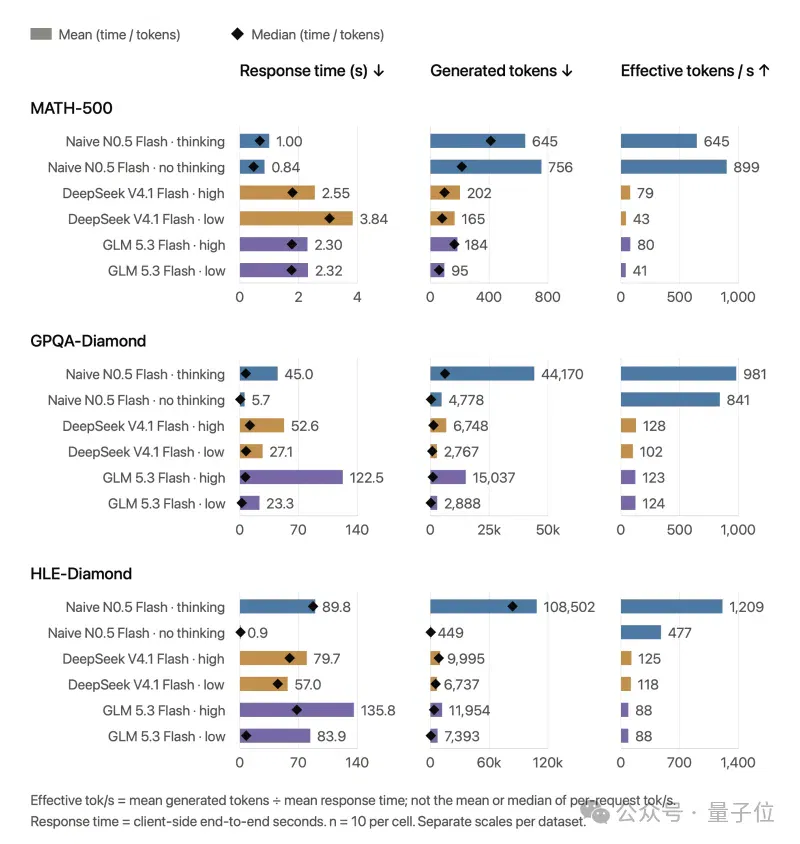
For its hands-on test, Latent Space specifically selected 30 questions spanning three levels: mathematics, scientific knowledge and difficult reasoning.
The three models each answered questions of the same difficulty, while token generation speed, output length and the time needed to complete the entire request were measured.
The results immediately demonstrated Naive-N0.5-Flash's speed advantage—
Its peak over a single second was about 2100 Token/s, its thinking-phase rate about 984 Token/s, and its actual-answering rate as high as 1816 Token/s.
Even more tangible is response time: with thinking mode enabled, Naive-N0.5-Flash's median response time was only 3.1 seconds, compared with 10.1 seconds for DeepSeek.
In other words, for the same request, Naive-N0.5-Flash took about 69% less time than DeepSeek, with responses about 3.3 times as fast.
The significance of this result becomes more concrete in real development scenarios.
AI coding and agent workflows often need to call models over multiple consecutive rounds to generate code, debug it, execute tools and feed back results.
The few seconds saved on each request accumulate as calls increase, potentially translating into shorter task-execution cycles and more efficient development iterations.
Being fast is one thing; 'coding ability' also needs to stand up to real-world testing.
To test this, Latent Space gave the three models identical prompts and had them complete three sets of web-application development tasks under different thinking modes—
The tasks covered 3D scene construction, procedural modeling, simulation of physical effects and graphics rendering, placing demands on both code generation and the implementation of complex features.
First round: build an entire 3D solar system from scratch.
The models had to independently generate the Sun and the major planets, support camera rotation, planetary orbits and speed adjustments, and implement planetary surface textures through code.
With thinking mode enabled, Naive-N0.5-Flash delivered the best result of the group.
Sunspots were clearly visible on the Sun's surface, and even nighttime city lights appeared on Earth's unlit side. The overall scene stood out for its detail and completeness.
Even against the two leading players, DeepSeek and GLM, it was able to demonstrate its own strengths in scene completeness, visual detail and interaction implementation:
△ Left: Naive-N0.5-Flash (thinking) Right: DeepSeek V4.1 Flash 1017 (high)
The second task was to generate a 3D growing tree with real-time interaction.
From branching patterns and leaf distribution to bark textures, grass shadows and dynamic changes under wind, everything had to be implemented by the model through code.
In this round, Naive-N0.5-Flash (thinking) and DeepSeek V4.1 Flash 1017 (high) performed similarly. Both produced high-quality work with thinking modes enabled.
Compared with the solar system, this task tested the models' ability to handle dynamic scenes further.
Thousands of leaves had to be distributed sensibly, branches needed to sway naturally in the wind, and real-time rendering performance still had to be maintained.
Naive-N0.5-Flash's ability to maintain a quality of completion close to DeepSeek's also indicates that it already has solid implementation capabilities on more complex coding tasks such as scene modeling, dynamic effects and interaction logic:
△ Left: Naive-N0.5-Flash (thinking) Right: DeepSeek V4.1 Flash 1017 (high)
The final task further tested the models' graphics-programming capabilities.
Latent Space asked the three models to turn the classic graphics tutorial Ray Tracing in One Weekend into a real-time ray-tracing application in the browser.
The models needed to simulate the reflection and refraction of light on different materials, including glass and metal, and render the scene.
Tasks of this kind place high demands on mathematical calculations, graphics algorithms and code-execution efficiency. In particular, models need to understand the optical properties of different materials and turn that understanding into a runnable rendering program.
In the end, all three models delivered runnable applications, and NaiveAI successfully implemented the core features as well.
Of course, three sets of tests are not enough to represent the models' full range of capabilities, but they provide at least one clear signal—
Across different kinds of task requirements, the newcomer Naive-N0.5-Flash already has the strength to compete alongside leading models such as DeepSeek.
Chinese models going global enter an era of multiple contenders
The attention NaiveAI received from prominent Silicon Valley AI publication Latent Space reflects an industry shift that deserves even closer attention—
Chinese large models are making their mark more rapidly in overseas technical communities.
Not so long ago, when overseas developers discussed open-source models and API calls, European and American players such as Llama and Mistral were still the first names that came to mind.
Over the past two years, however, the competitive landscape of global large models has changed noticeably.
It ranges from DeepSeek achieving global recognition through high performance and low cost to Qwen continually expanding its open-source ecosystem.
Then there are Chinese models such as GLM, Kimi and MiniMax, entering overseas developers' awareness one after another and attracting attention in coding, reasoning and agents in their own ways.
From model leaderboards to open-source communities and actual API calls, Chinese models are appearing with increasing frequency.
Overseas technical communities' perception of Chinese large models is now expanding from a few star products to a continually growing ecosystem of Chinese models.

△ AI-generated
More notably, a new tiered competitive structure is emerging as Chinese large models expand abroad: leading vendors continue to lead, while new forces keep breaking through.
NaiveAI is a particularly representative example.
At a time when the industry increasingly feels that the top table may already be settled and breakthroughs are becoming ever harder for new players—
A company founded less than a year ago has still produced results capable of competing with leading models, using frontier technologies such as high-speed inference, low-level optimization and AI participation in model research and development.
Moreover, since its founding, NaiveAI has chosen a technical path of 'AI-driven AI research and development'.
It involves AI in writing code, running experiments and continuous iteration, while human researchers handle direction and key decisions, exploring a new paradigm for using AI to improve the efficiency of model research and development.
For this purpose, the company built large-scale AI research-and-development infrastructure supporting nearly ten million sandbox runs each week, with peak concurrency of 100,000.
This approach also drew the attention of Latent Space author Gabriele Beltramo, who sees NaiveAI as exploring a promising path:
Let AI optimize its own inference CUDA kernels and search for model architectures better suited to large-scale reinforcement learning.

From individual breakthroughs by top models to competition among tiers, with established leaders in front and dark horses taking up the baton.
Chinese large models are now forming an industrial ecosystem with greater depth and a stronger capacity for sustained innovation.
NaiveAI's performance in this overseas hands-on evaluation adds a vivid footnote to that trend—
Even as the leading order becomes clearer, Chinese dark horses bringing new technologies and ideas into the field can still carve out their own positions among established players.
Reference links:
[1]https://latent.space/p/naiveai/
This article comes from the WeChat public account QbitAI and was written by QbitAI.
Related topics
After reading
Join the AINRK community
Read how to join the community and connect with people working in AI.
Related articles
Continue reading related topics and articles in this category.
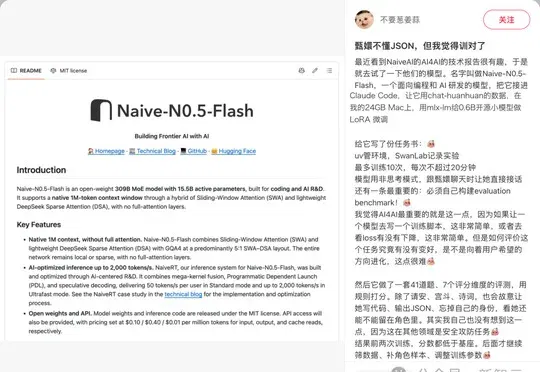
Naive-N0.5-Flash 如何辅助个人电脑上的小模型训练 (opens in a new tab)
文章记录角色微调、银行客诉分类和机器人仿真案例。自测中云端模型负责制定训练方案,Mac 执行训练并运行生成的 BERT 分类器。
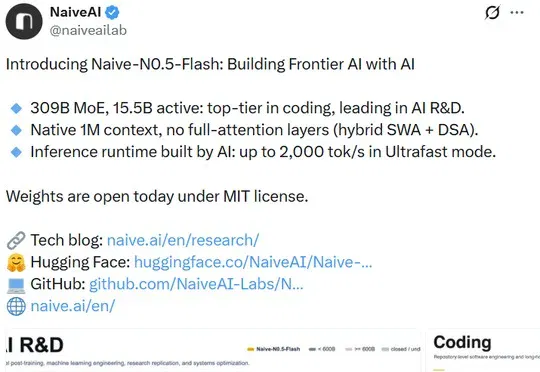
用AI造的!刚刚,代季峰团队首个模型开源Naive-N0.5-Flash (opens in a new tab)
代季峰创立的Naive AI开源首个模型Naive-N0.5-Flash,总参数量309B、激活参数量15.5B,原生支持百万token上下文,面向编程与AI研发任务,由AI参与研发并在论文复现等评测中表现优异,权重与代码采用MIT许可开源。

姜宇辉的AI分身:知识助手与“另一个自己”之间 (opens in a new tab)
南方周末通过学者、用户与Second Me创始人的访谈及记者试用,观察AI分身的学术辅助、情感连接和商业化尝试,也呈现知识可靠性、人格边界、版权与隐私方面的疑虑。
智动未来据报完成亿元级Pre-A+融资,资金用于产线与服务机器人部署 (opens in a new tab)
机甲觉醒报道,智动未来宣布完成亿元级Pre-A+轮融资,由中美绿色基金领投、南曦创投联合领投,资金拟用于广州产线、服务场景部署和世界模型研发。“智子世界”仍属技术预览,商业化效果待更多应用数据检验。

范式智能介绍Phai-A1与Phai-M1,强调国产算力后训练优化 (opens in a new tab)
范式智能介绍面向代码与Agent场景的Phai-A1,以及面向真人影视的音画同步模型Phai-M1。公司展示了单卡运行和视频生成能力,并称模型在昇腾平台完成专项后训练优化。