Hygon outlines agent compute architecture with separate orchestration, inference and memory nodes
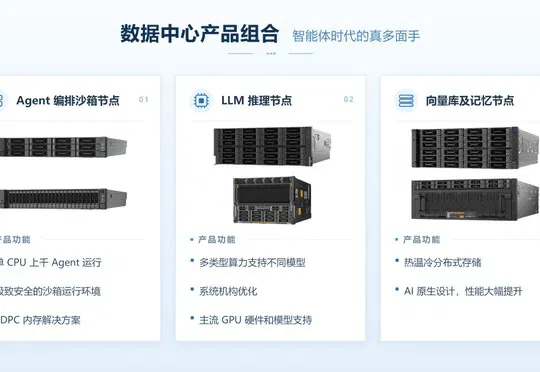
The report covers Chinese CPU/DCU platforms, modular data centers and AgentServer Flex private deployment, examining how to match resources to different agent workloads.
Editorial correction (November 16, 2026): Private deployment makes local processing possible, but actual data flows and compliance still depend on model connections, network egress, logs, permissions and business configuration.
Key characteristics of the compute foundation in the agentic era: a Chinese technology base, modular nodes and local deployment.
An application transformation driven by agents is setting in motion a restructuring of AI's underlying compute systems.
In September this year, IDC's 2026 China AI Computing Power Development Assessment Report offered a key forecast: the share of global AI compute demand that can be met would keep falling from 79% in 2024, bottom out at 71% in 2027, and only recover to 77% in 2030.
A simple relationship can summarize the change in compute consumption: token consumption ≈ multi-agent collaboration × resource consumption per agent × execution count per task. Agents' continuous operation is continually increasing the load pressure on AI's underlying hardware.
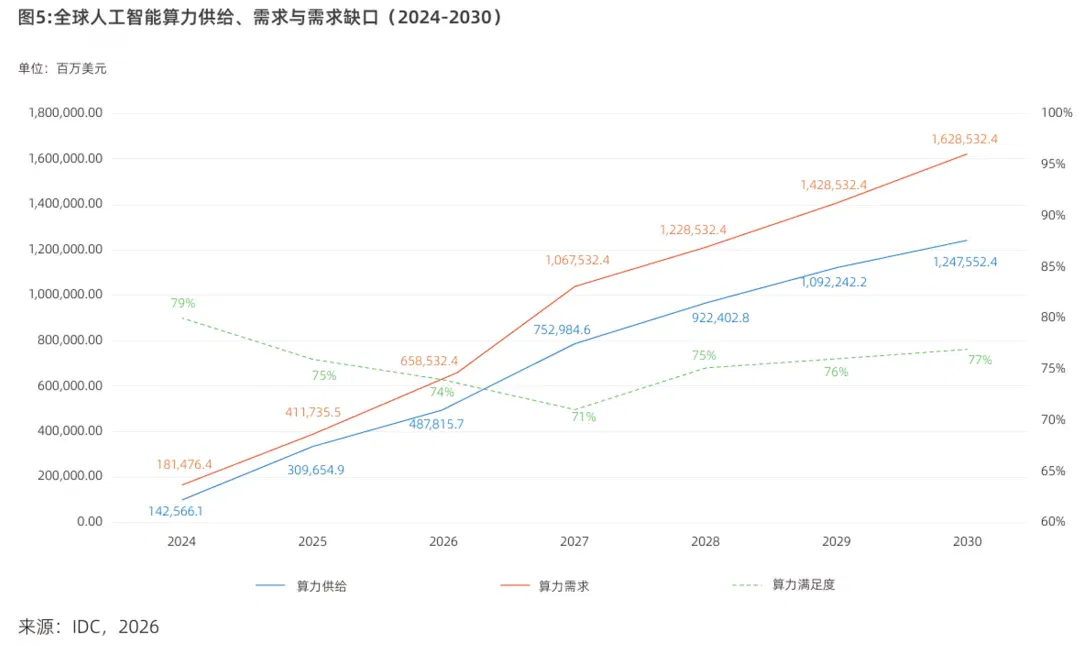
▲ 2026 China AI Computing Power Development Assessment Report (image source: IDC)
This creates a new tension between AI applications and the compute beneath them. Agents need long-running reasoning, repeated rounds of planning, frequent tool calls and dynamic scheduling of multiple tasks. These operating characteristics impose new, nonstandard requirements on AI infrastructure. The focus is no longer solely on peak FP16 compute; latency, throughput, memory access, task scheduling and stability must meet new constraints.
What kind of infrastructure, then, can provide the optimal solution for the agentic, or agent-native, era?
Agents' long workflows, repeated calls and frequent data reads and writes reinforce an earlier industry consensus: AI competition is no longer just a contest in single-chip compute. Beyond GPU clusters, the value of CPU nodes and storage nodes is being redefined.
Against this background, we are launching a series that follows the full chain of agent thinking, orchestration, inference, memory and execution. It will explore underlying questions such as the division of work across heterogeneous compute, security isolation, tiered storage, delivery formats and full-stack control, addressing the new challenges that deploying agents at scale poses for AI infrastructure.
Breaking down the agent's closed-loop workflow
The performance ceiling lies in five key components
Agents have already entered every aspect of our lives and work.
Take today's hugely popular personal AI assistants: give one a task, and it can break it down automatically and call tools to produce a complete report or slide deck. A coding agent can receive requirements in natural language and help develop an application in minutes. With just a few sentences of instructions, a video agent can handle script planning, visual generation and editing the finished video…
Compared with the period when hundreds of models competed, agent competition extends beyond models to the capabilities of an entire system. Infrastructure needs to accommodate different workloads separately.
The model layer is the agent's brain, responsible for perceiving information, reasoning and judgment, task decomposition and planning, and working out how to call tools; the Harness execution layer receives instructions from the model and handles task orchestration, memory management and tool scheduling; the knowledge base supplies the agent's informational nourishment, reading private enterprise data, documents and business materials to provide reliable factual support for model outputs; the tool layer is the agent's hands and feet for taking action, able both to call existing system capabilities and to generate new tools on demand; the sandbox serves as a security-isolation layer, separating the agent from real business systems.
On top of this architecture, agent operation forms a closed loop of receiving multimodal inputs, thinking and reasoning, orchestrating tasks, calling tools and retrieving memories, advancing through repeated cycles.
This brings three major changes to the workload characteristics faced by the underlying infrastructure.
First, a workload no longer ends after a single generation. Its tasks involve long chains and multiple rounds, accompanied by large amounts of state reading and writing. The sustained occupation of compute and storage differs completely from traditional large-model inference requests.
Second, task scheduling is uncertain. Execution branches emerge dynamically, making the workflow difficult to predict in advance. Infrastructure therefore needs elastic scheduling to handle unexpected tool calls and jumps between branches.
Third, infrastructure faces higher reliability requirements. Agent tasks often execute dozens of steps in succession. If a reasoning anomaly, call timeout or resource interruption occurs at any intermediate point, the entire business workflow fails, with higher retry costs and business losses.
The upper limit of agent capability is therefore no longer determined solely by model algorithms and peak compute. Whether the underlying infrastructure architecture can accommodate new workloads becomes a hidden ceiling.
The hidden bottleneck beneath the agent boom
An urgent need to decouple compute into layers
Can today's AI infrastructure fully accommodate this wave of agents? The answer is no.
Most existing infrastructure was designed for single-generation scenarios in the era of competition among hundreds of models. It has low resource utilization for agents' long tasks, with their intermittent, random and memory-intensive activity. For constantly changing task branches, a preplanned compute pool can easily develop local congestion or leave resources idle.
Existing systems also have relatively weak fault-tolerance mechanisms. A failure after an agent has completed dozens of steps can increase latency and waste compute, while creating business risks in enterprise settings.
As new agent applications keep appearing, close collaboration between application teams and underlying infrastructure vendors has become essential. Infrastructure vendors no longer simply deliver hardware such as chips and servers. They must both refine the hardware foundation beneath the application and deeply adapt to the agent's complete workflow above it.
Across the full agent workflow, different stages make completely different demands on hardware resources. This requires differentiated resource matching based on task characteristics.
For example, inference and multimodal generation have extremely high requirements for GPU memory capacity and bandwidth. DAG task orchestration, iterative self-checking and tool calls inside sandboxes involve many branch decisions, persistent state and I/O with external interfaces, placing more emphasis on CPU concurrency and memory. Vector retrieval, knowledge-base queries and long-context KV-cache routing are high-throughput random-retrieval workloads better suited to storage-optimized nodes.
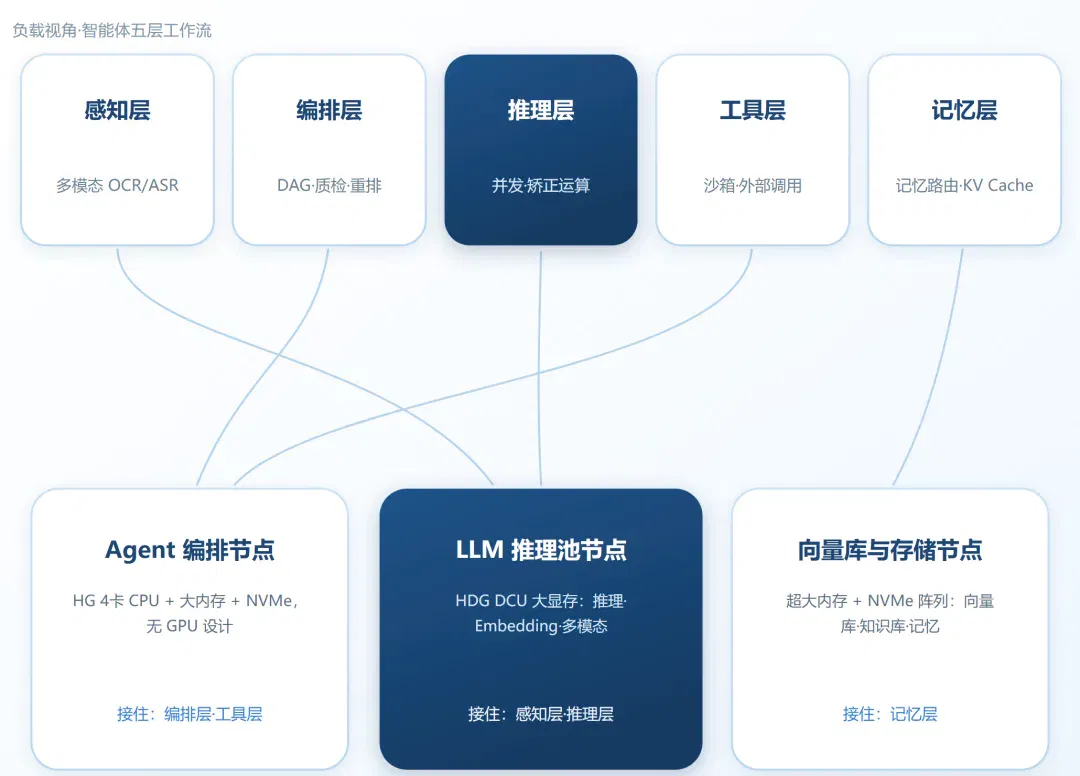
Once compute is decoupled into layers, there is no need to compromise for a single architecture. This avoids mismatches such as expensive graphics cards sitting idle while retrieval resources are congested, allowing the entire agent workflow to complete the full loop from goal input to result delivery continuously, stably and at low cost.
Hygon unveils its latest plans for the agentic era:
A Chinese technology base, modular nodes and private deployment
As agents create the new compute demands described above, infrastructure companies' roles are changing: from suppliers of compute hardware alone to partners in full-stack collaboration.
Previously, large-model providers adapted to existing compute. In the future, the infrastructure foundation may instead evolve alongside agent workloads above it, with iteration in both directions.
For most compute vendors, building strong CPU concurrency, DCU inference acceleration, tiered storage and secure sandboxes at the same time is difficult. But this set of capabilities happens to be the main direction Hygon has pursued over the past several years.
The forthcoming series of complete systems based on Hygon's technology reveals new thinking about Hygon servers in the agentic era: work with upstream and downstream industry partners to build a complete product portfolio suited to the agentic era.
This approach can be summarized as two product paths for agent deployment. One targets the cloud and large data centers, with a data-center solution built around combinations of modular nodes. It includes three types of dedicated nodes: agent orchestration and sandbox nodes, LLM inference nodes, and vector-database and memory nodes. Each has its own role and is scheduled collaboratively, supporting elastic expansion and contraction according to business needs and the operation of large-scale agent clusters.
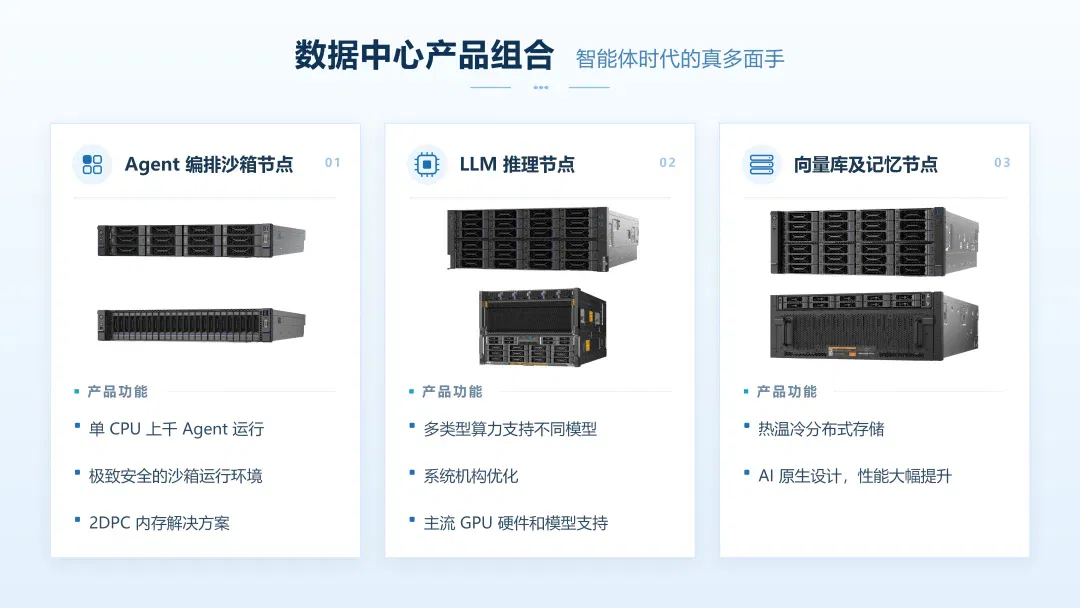
The agent orchestration and sandbox node is CPU-centered. A single node can run more than 1,000 agents concurrently, supports CSV file processing and provides an isolated, reliable sandbox execution environment. With 16 memory channels and support for 2DPC, it can meet performance requirements for frequent agent-state reads and writes and local memory access.
The LLM inference node can accommodate OAM modules, high-density multi-card clusters, supernodes and other workload configurations, delivering greater GPU compute and token throughput while remaining compatible with mainstream GPU hardware and large models.
The vector-database and memory node uses a distributed hot/warm/cold storage architecture, covering all-flash, hybrid-flash and high-capacity archival tiers, designed for AI-native scenarios.
Cloud clusters address the scaling problems of massive agent concurrency and elastic scheduling. But many government, enterprise, financial and manufacturing settings also have strict compliance and on-site data-residency requirements. This creates a second delivery format: the AgentServer Flex agent-compute matrix for enterprise private deployment.
Each configuration consists of three to nine orchestration, LLM and storage nodes, supporting on-demand combinations and elastic expansion. It can connect quickly with the software-partner ecosystem to support rapid deployment and delivery for end customers.
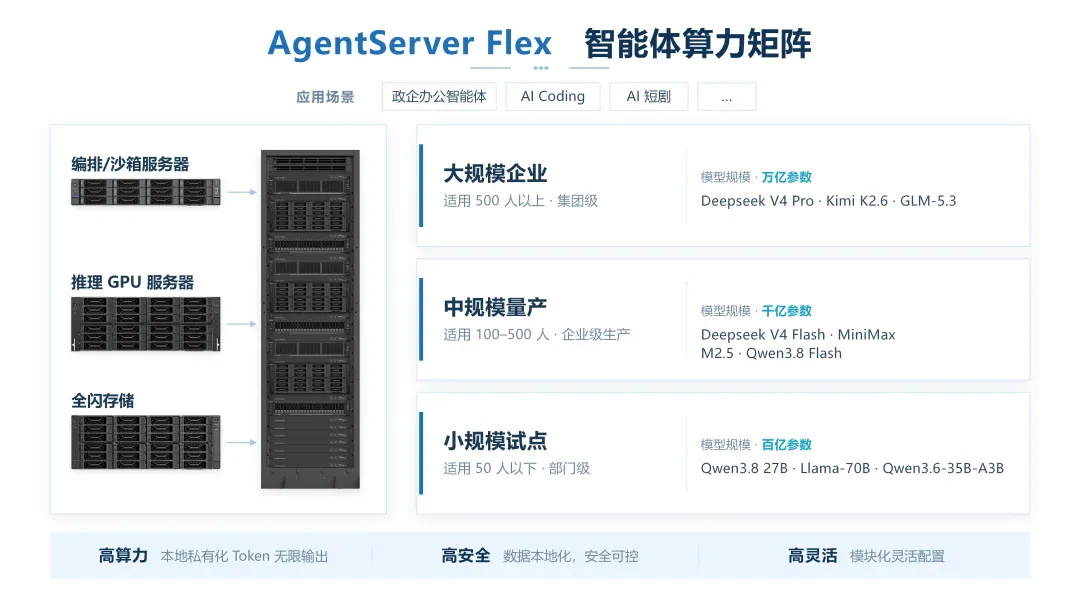
This private-deployment solution is intended to support local enterprise processing and customized resource combinations. Whether data leave the site still requires checking network egress, model services, logs and external-tool configurations. Hardware delivery alone cannot automatically guarantee compliance.
The overall solution also has a key foundation: it is built on Chinese CPUs and DCUs and aligned with mainstream x86 performance benchmarks, enabling independent control across the entire chain from chips to complete racks, along with delivery certainty.
The underlying change brought by agents is that compute demand expands from single-model inference into a composite workload involving scheduling, thinking and memory. The old approach of using one general-purpose compute cluster for everything struggles to accommodate such different workloads as inference throughput, I/O concurrency and memory retrieval. Hygon's data-center portfolio, with its clear division of responsibilities, responds precisely to these differentiated requirements across the agent workflow.
Conclusion: from conversation to autonomous execution
Agents are redefining AI infrastructure
The transformation brought by agents goes far beyond individual AI assistants that execute automatically. It is reshaping relationships between upstream and downstream participants across the AI industry. As demand from AI applications scales, close collaboration between application-layer innovation and underlying infrastructure becomes a requirement rather than an added advantage.
Against this industry background, we are launching a series using Hygon's new product portfolio for the agentic era as an example. Step by step, it will examine the core elements next-generation infrastructure needs as AI moves from conversational generation to autonomous execution.
This article comes from the Zhidx WeChat account. Author: Zhidx.
Related topics
After reading
Join the AINRK community
Read how to join the community and connect with people working in AI.
Related articles
Continue reading related topics and articles in this category.
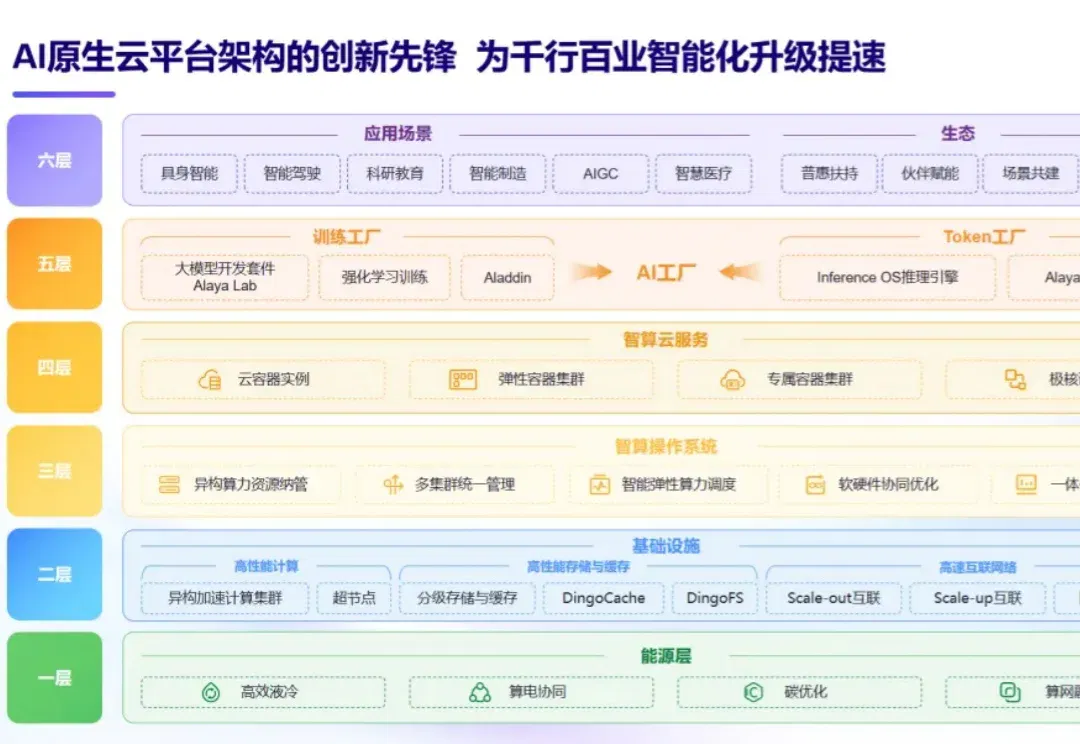
九章云极谈智算云运营:从 GPU 卡时到 Token 双账本 (opens in a new tab)
报道介绍九章云极以DCU核算资源投入、以Token记录交付,并通过异构调度及推理优化比较单位成本。公司披露的利用率、客户案例和收入变化反映其经营口径;统一内部计量不等于行业已形成通用结算标准。
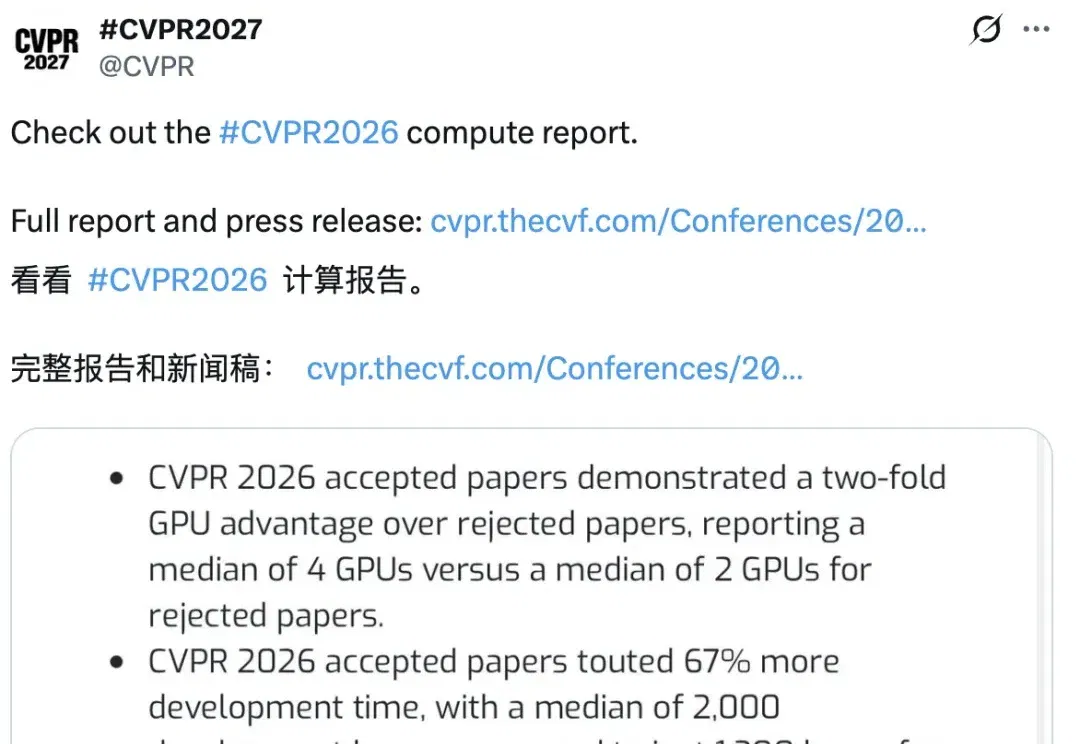
CVPR 2026 公布算力报告:录取论文与拒稿论文的资源差异 (opens in a new tab)
CVPR 2026 汇总16034份投稿算力表,录取与拒稿组的GPU数量中位数分别为4张和2张,研发计算投入也有差异。统计反映相关性,算力数据不向审稿人提供;报告同时展示低算力创新与效率奖励,不能据此推导录取所需的最低卡数。
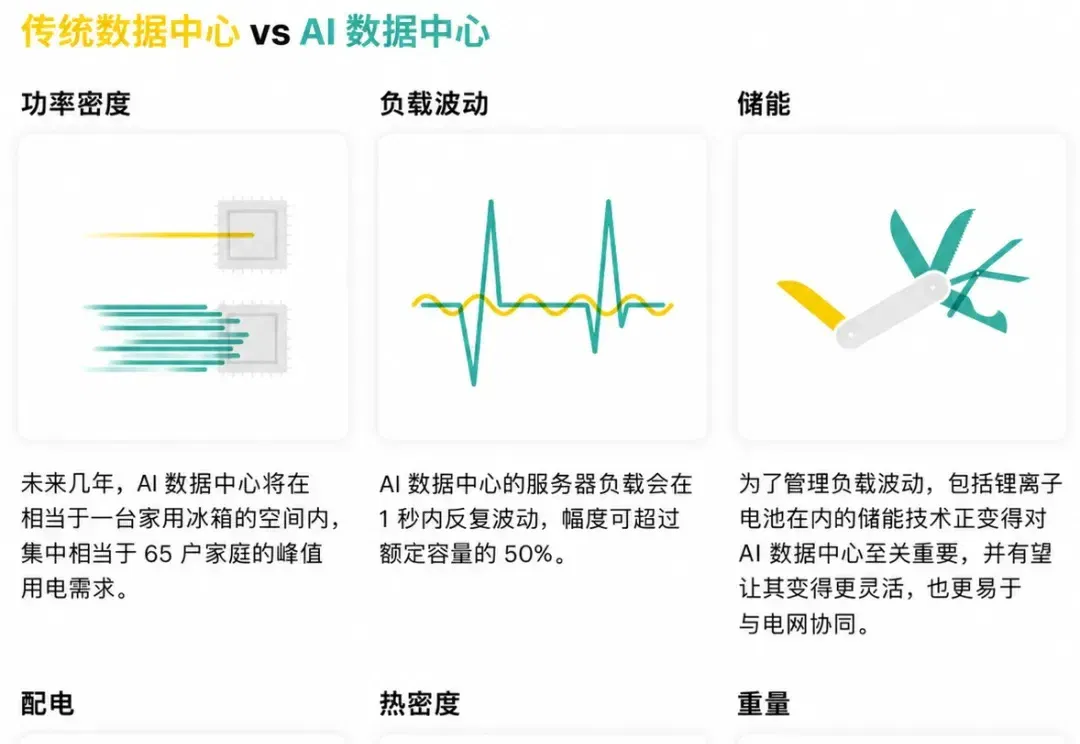
算力的尽头是电力?从第一性原理看AI基础设施 (opens in a new tab)
文章从电力、芯片与内存、散热、电网建设、融资和地方许可梳理 AI 基础设施的约束。结合 IEA 等资料,讨论任务能效提升为何未必降低总用电,以及芯片、数据中心和电网不同建设周期如何形成瓶颈,区分签约容量与实际通电能力。
AI 短剧,未必是「算力泔水」 (opens in a new tab)
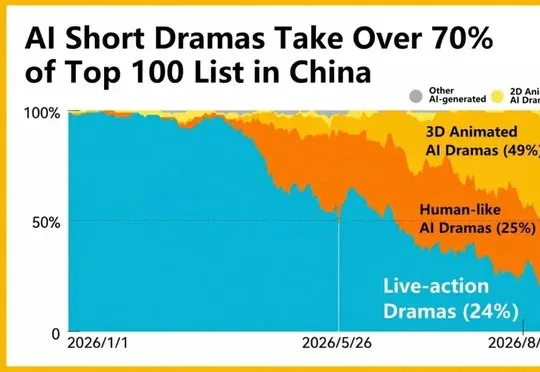
文章指出,AI短剧消耗国内55% Token和占据一半算力的说法并不准确,但其快速增长正创造新增推理需求,并推动视频模型与算力基础设施扩张。
黄仁勋14天交付算力集群!配合DeepSeek开源引擎,单卡每小时38美金立刻开赚 (opens in a new tab)
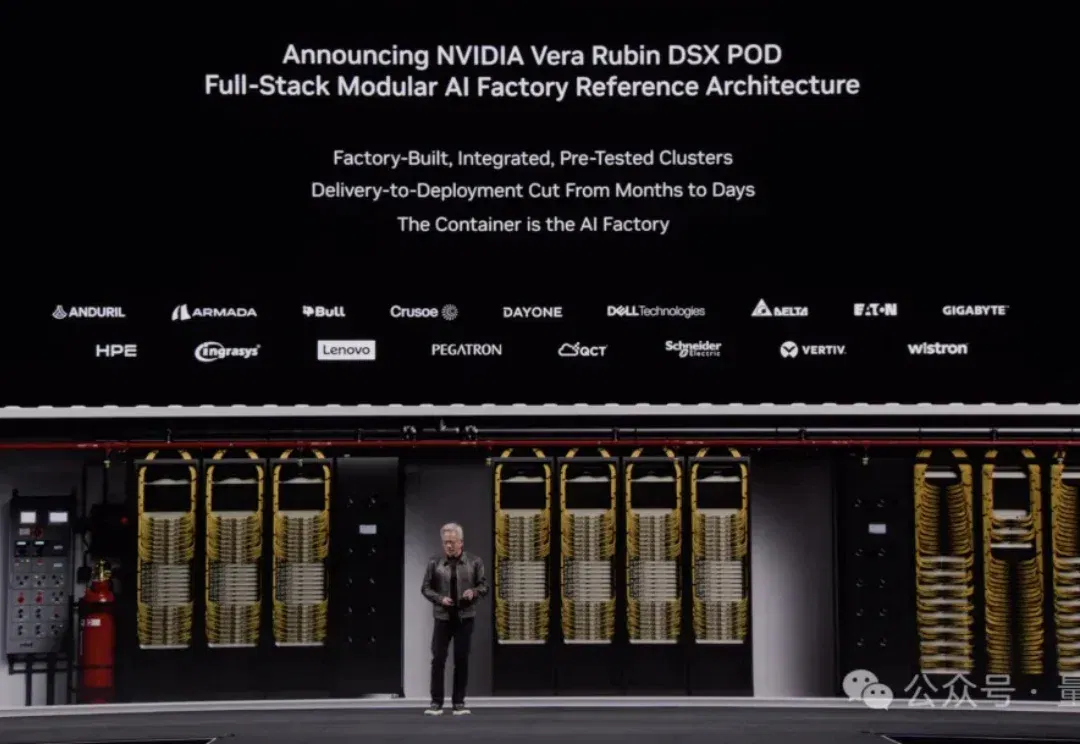
好了好了这下坏了,黄仁勋接住梁文锋的招了。