Yisuo Intelligence launches Sciland to connect scientific computing, experiments and feedback

Sciland uses LAEP to link computational tasks and lab equipment, adopting system changes through replay, regression tests and human checks. Deployment and performance figures are company-reported.
Editorial correction (November 16, 2026): An omitted product name has been restored and text formatting corrected. The times reported in seconds are for computational workflows, not the completion of wet-lab experiments.
Summary / ABSTRACT
Future competition in AI4S R&D will require not only compute and models, but also research infrastructure that connects computation, experiments and real-world data. As AI agents begin to “enter the wet lab,” scientific research is moving from “proposing hypotheses” toward a new stage of “continuous validation and feedback.”
In April 2024, US-based Xaira Therapeutics was jointly incubated by leading investors and scientists, attracting attention at launch with $1 billion in funding and a $2.7 billion valuation. Co-incubated by prominent venture investors ARCH Venture and Foresite Labs, Xaira is building in-house data-generation capabilities, AI models and a complete system called “X-Suite” in an attempt to cover several key stages of drug R&D. From X-Cell, X-Design and X-Patient to X-Scientist and X-Automate, competition among AI-driven pharmaceutical companies is gradually moving from the capabilities of individual models toward those of more complete R&D systems.
Since the start of this year, more large-model companies have also been moving deeper into specific scientific research and drug R&D settings. One clear change is that AI is gradually moving from an “analytical assistant” to a participant in real R&D workflows: proposing hypotheses, designing approaches, analyzing data and beginning to connect with actual experiments. The next stage of AI-driven research may therefore need to answer more than “Can the model produce a good answer?” How do hypotheses proposed by AI enter the real world? And how do data from real experiments return to the next round of AI research? These are becoming among the most important questions as AI4S moves into deeper waters.
Beijing Yisuo Intelligence Technology Co., Ltd. has launched the Sciland research workspace. The scale of user and institutional deployments is disclosed by the company and needs to be understood in the context of specific usage and experimental conditions.

Product interface of Yisuo Intelligence's Sciland research workspace
Sciland centers on a closed loop between computational and wet-lab experiments, self-evolution mechanisms and an open research ecosystem. It connects literature retrieval, data analysis, computational design and automated experiments, bringing computation and real experiments into a unified research space. Unlike traditional AI tools that complete one analysis and output one result, Sciland aims to establish a research system that can keep operating: computation produces hypotheses and candidates, experiments provide real-world feedback, and new evidence enters the next round of research. At the same time, validated research methods and system experience can be retained to keep improving subsequent research capabilities. This means the goal of AI research is beginning to move from “producing answers faster” toward a new scientific paradigm: “propose hypotheses—validate in the real world—correct through feedback—continue autonomous evolution.”
01
AI agents “charge into” the wet lab: computational prediction and real validation meet each other halfway
AI agents are leaving the purely digital world and beginning to enter real laboratories.
Around the time of Sciland's release, Nature published a News & Views article by Stanford professor James Zou titled “AI agents enter the ‘wet lab’.” It discusses the latest AutoDNA system and notes that AI systems of this kind are beginning to narrow the long-standing gap between “proposing experiments” and “executing experiments,” marking the beginning of AI agents' entry into the wet lab.
This change matters because, over the past few years, AI's scientific capabilities have mainly focused on computation: analyzing data, retrieving literature, predicting results and designing candidate molecules.
But in research, a “good answer” in the computational world does not mean it has been established as true. AI can design a candidate molecule in minutes, while actually validating it may require weeks or even months of experimental work. More importantly, real data from experimental successes and failures also determine where the next round of research should go. The true closed loop in scientific research is not completed when a model outputs a result, but after the real world provides feedback.
Sciland's central idea is precisely to put computational prediction and real experiments into the same research process. In a complete study, computational candidates and predictions can proceed to experimental validation. According to the research design, candidate molecules or scientific hypotheses are translated into corresponding experimental plans and validated by the experimental system. The results then return to the original research project for comparison with earlier predictions. If they meet expectations, the system gains new validation evidence. If an experiment fails, the failure is not simply discarded: it becomes new research information that helps locate problems in the original computations.
Sciland's technical report further records and classifies experimental failures, such as failure of protein expression, aggregation and precipitation, failure to bind the target, and failed curve fitting. These results are mapped back to the earlier hypotheses, candidates and computational processes to adjust the next round's research design. This means experiments are no longer merely the “final validation” in an AI R&D workflow. Experimental results themselves also become inputs to AI's next round of research.
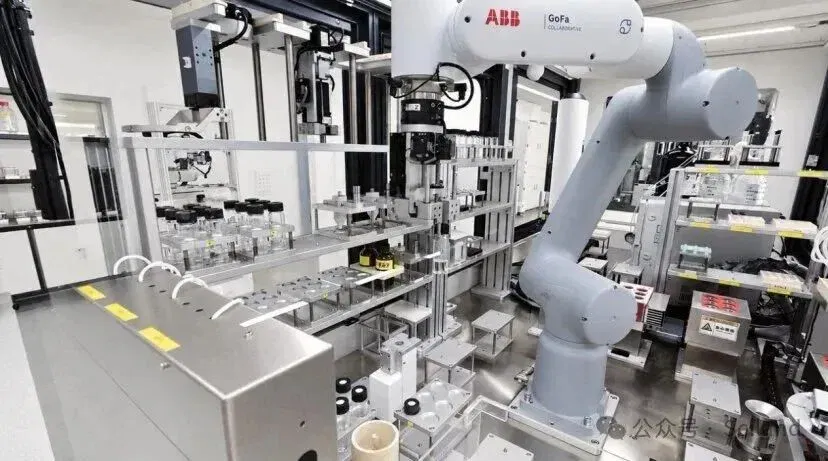
Actual view of robotic arms and experimental workstations in Yisuo Intelligence's automated laboratory
According to the technical report, the team tested 11 specialized tools and five preset computational workflows on a single H800, covering peptides, proteins, antibodies and small molecules. The 44.4 to 135.3 seconds represent end-to-end computational runtimes and do not include all waiting time for real experiments.
← Swipe left or right to view the full table →
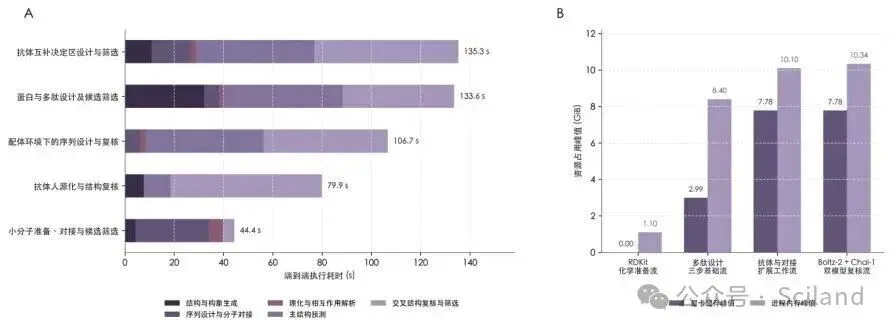
Figure: Measured performance and resource usage of multistep biomedical computational workflows on an NVIDIA H800 node. (A) Breakdown of end-to-end execution time by step for five preset multistep workflows; (B) comparison of peak GPU memory and process-memory usage while the specialized computational suites run.
For an AI research platform, the significance of these numbers goes beyond “speed.” More importantly, AI needs to enter a research workflow that can genuinely be verified and traced: computation proposes possibilities, while experiments answer for the real world. Through continued back-and-forth between computation and experiments, Sciland aims to base every research round on existing research materials, actual experimental results and traceable evidence, forming a continuing cycle from prediction to validation to optimization.
02
Research self-evolution: turning the experience of one study into capabilities for the next
The value of research is not only in reaching a conclusion once.
More importantly: what was learned during this study, and can it make the next study better?
In the antibody-optimization research disclosed by Anthropic and BigHat, the team at one point suspected that the thermostability and aggregation metrics it had been using could mislead candidate evaluation. Claude and the researchers reanalyzed the raw data and proposed new metrics and changes to the experimental plan. BigHat scientists then refined the proposals and carried out the experimental validation.
The change here went beyond replacing a candidate molecule. The “ruler” used to judge candidates was itself tested by experiment. Adjustments of this kind are a valuable part of research experience. If a team knows under what conditions an evaluation is reliable and where a workflow is prone to failure, its next study can avoid some detours. If these judgments remain scattered across personal memories, discussion records and temporarily modified code, a different task may still require starting over.
Sciland's self-evolution mechanism aims to retain validated improvements and apply them to subsequent research. According to the technical report, improvements can affect research methods and tool calls, the system's own code and interfaces, or even the criteria for judging how well research is done. Methodological gaps exposed by real projects become new evaluation samples and review checklist items. As the system grows stronger, the ruler used to assess it also keeps becoming stricter.
There is an important product trade-off here: the value of experience cannot be measured only by how much is saved. Methods must enter subsequent tasks with their sources and applicability conditions, and revisions must be validated before adoption, for accumulated experience to have a chance of becoming capability. If a failure leads to an effective methodological adjustment, the value it leaves behind can extend beyond that particular study.
However, Sciland's “self-evolution” does not simply mean letting the system modify itself and immediately deploy the changes. According to the technical report, system improvements follow a defined process: observe the phenomenon → analyze the root cause → review generalization → update in place → validate through replay and regression tests. Only issues with both “generalizability” and “value from generalization” enter system-level improvement, rather than taking the conclusions of one specific project and extending them directly to all research.
Before deployment, a change must pass two checks. First, rerun the real case in which the problem originally occurred to confirm that the root cause has actually been resolved. Then run the full regression suite to confirm that existing capabilities have not been broken. The technical report lists 1,155 regression tests. Even after all pass, human verification is still required before a change takes effect.
Sciland's technical report records three improvements that have already completed this process. All the complete improvements shown concern the system's own code and verification rules, rather than parameters for a particular study. For researchers, lessons from failures in their work within Sciland will be internalized, continually improving research quality and the research experience.
This connects the computational/wet-lab loop with self-evolution. New experimental data correct the current design, while improvements validated during research continue to affect methods and the system. Sciland aims to accumulate precisely this kind of research capability that influences subsequent execution.
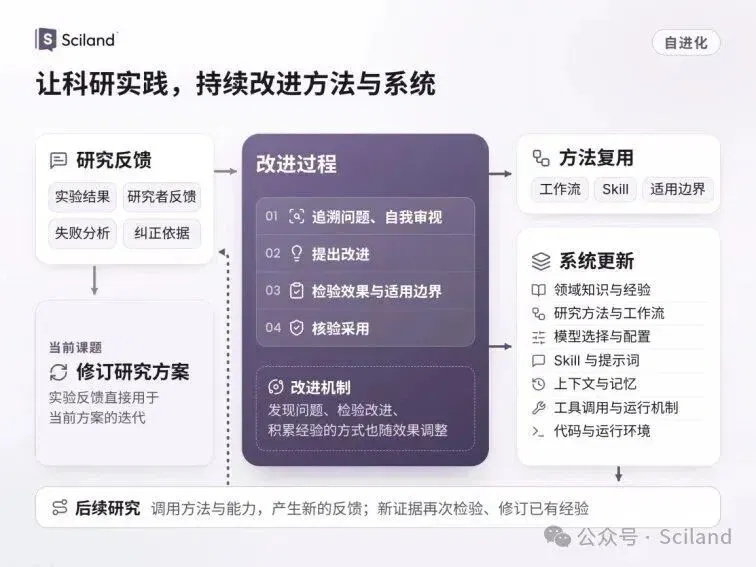
Sciland's self-evolution mechanism: research feedback informs method reuse and system updates after improvements have been validated. Image source: Yisuo Intelligence.
03
A one-stop research workspace: integrating specialist capabilities and connecting an open research ecosystem
Sciland organizes research design, specialized computation, result analysis and delivery within one workspace, supporting literature retrieval, computational analysis, independent review and report generation. Researchers can organize a workflow around the same project without repeatedly switching between tools. Research materials, computational results, code and charts remain with the project, and conclusions and their supporting evidence can be traced, allowing research to keep advancing from existing progress.
For specialized computation, Sciland covers drug-research settings involving proteins, peptides, antibodies and small molecules, supporting generation, prediction, evaluation and screening. Researchers can call a single model or tool directly, or combine multistep computations and adjust workflows and parameters according to their research objectives.
As more specialized models, tools and methods are integrated, researchers can combine and use an expanding range of scientific capabilities in a unified workspace. But connecting computation with experiments raises a more practical question: how can different AI systems, laboratories and automated equipment actually exchange data?
To address this, Sciland proposes LAEP (Laboratory–Agent Exchange Protocol), establishing a unified way to exchange experimental tasks and result data. Under this framework, researchers' validation plans can be translated into standardized experimental tasks and connected with experiment orchestration, execution by automated laboratory equipment and the return of results.
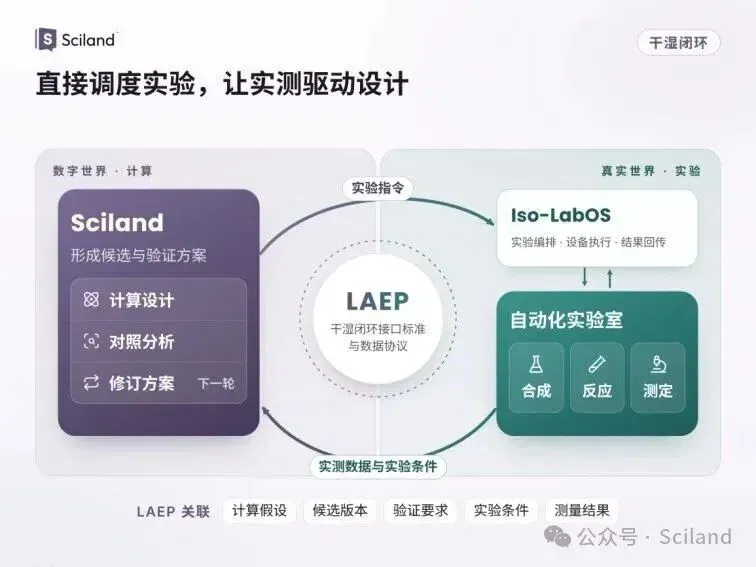
Sciland uses LAEP to connect Iso-LabOS with automated laboratories and return experimental results to the original study. Image source: Yisuo Intelligence.
Across the industry, interfaces and protocols of this kind are becoming increasingly important. As the trend described in Nature's latest reporting suggests, future AI laboratories will need more than a simple combination of one model and one piece of equipment: AI, experimental processes and multiple instruments must genuinely work together. AutoDNA has already shown the possibility of an AI-native laboratory coordinating multiple instruments to complete complex molecular-biology experiments.
Sciland is exploring a path that starts with an AI research workspace and builds sustained connections among research hypotheses, computational predictions, experimental tasks and experimental feedback. As AI truly begins to “enter the wet lab,” competition among research systems will gradually move beyond single-model capabilities toward “how models, experiments and real data form a closed loop.”
04
An open research ecosystem: from one tool to a network of continuous validation
Building on the connection between computation and experiments, Sciland extends further toward an open research ecosystem. Continued integration of models, Skills and workflows will keep expanding the platform's specialized computing capabilities. Laboratories, instrument manufacturers and industry partners can explore connecting existing experimental facilities and automated capabilities to research workflows, gradually broadening the scope of real experimental validation.

Schematic for building Sciland's open validation network: connecting research needs with experimental capabilities through LAEP. Image source: Yisuo Intelligence.
In the future, more researchers, specialized models, scientific tools and experimental capabilities will have the opportunity to enter the same research network. More scientific hypotheses can be proposed, computed, validated and revised within it. From this perspective, the future value of AI research platforms may be more than helping one researcher complete one study faster. They may gradually establish a new kind of research infrastructure: connecting different computing capabilities to real experiments, allowing different participants to share verifiable methods, and continually bringing research results into the next round of scientific discovery.
“
The next leap in scientific intelligence lies in turning growth in computing capabilities into growth in scientific discovery capabilities. Yisuo Intelligence hopes to organize continually improving models, automated laboratories and researchers' judgment so that this capability extends beyond a single project or laboratory and becomes research infrastructure that more people can build together and continually evolve.
Binbin Su, founder and CEO of Yisuo Intelligence
Sciland is currently open for users to try. In the future, the platform will continue opening access to researchers, model developers, laboratories and industry partners, gradually covering more research settings and experimental capabilities to make collaboration among different participants more efficient.
As AI agents begin to leave the “digital world” on screens and enter real wet laboratories, scientific research is also entering a new stage. AI no longer merely proposes answers. It begins to formulate hypotheses, organize research, enter experiments, accept feedback from the real world and start the next round of exploration based on new evidence.
Moving from “computational intelligence” to “real-world validation” may be the next genuine leap for AI4S.
This article comes from the Medaverse WeChat account. Author: Medaverse.
Related topics
After reading
Join the AINRK community
Read how to join the community and connect with people working in AI.
Related articles
Continue reading related topics and articles in this category.
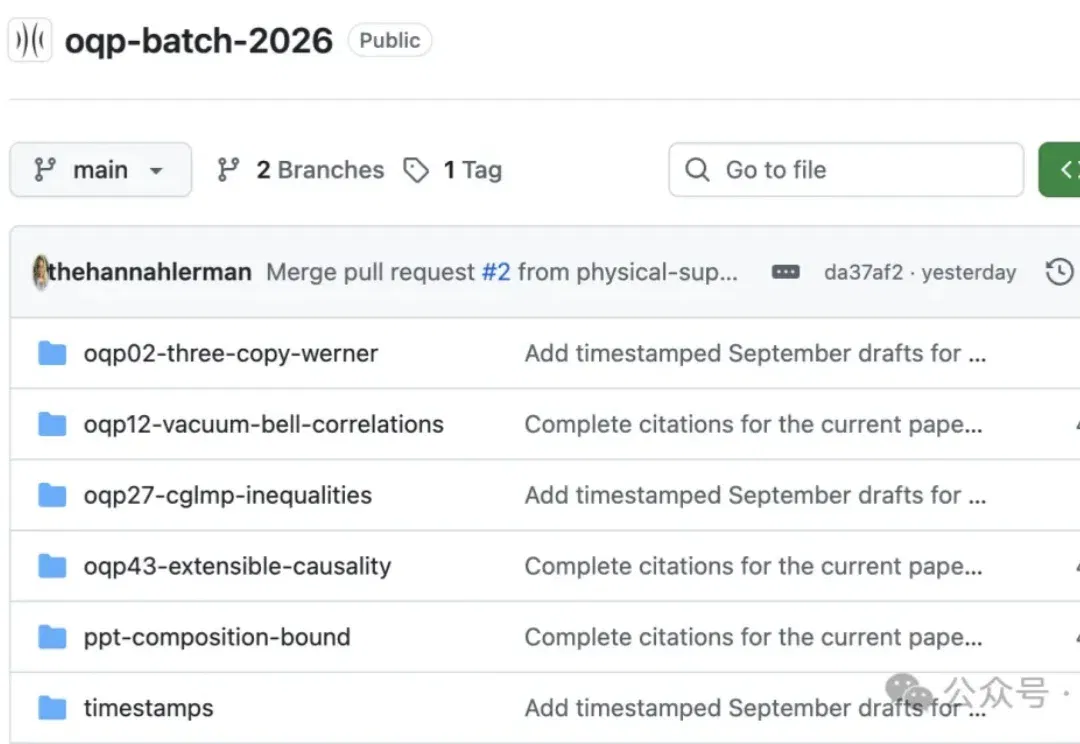
PSI 公布五项量子信息研究结果与 Lean 形式化材料 (opens in a new tab)
Physical Superintelligence 公布与开放量子问题目录相关的五项研究结果,并提供论文和 Lean 形式化材料供审查。结果涉及纠缠、贝尔不等式和量子因果过程等方向;各项结论有具体适用条件,需要区分对原问题的局部推进与完整解决。

ClawsGO Science 公布细致平衡反应网络的形式化证明 (opens in a new tab)
BitMiracle AI Lab 介绍科研智能体协作生成并检查 Lean 证明的过程,研究针对全局吸引子猜想中满足细致平衡的一类情形。报道同时讨论云端科研环境与多智能体分工,不意味着所有化学反应问题均已解决。

OpenAI 公布 ETH 等研究成果,独立专家将参与审查 (opens in a new tab)
OpenAI 发布涉及指数时间假设、局部光滑化与量子场论的模型研究材料,并为不同领域安排公开复核或专家合作。报道梳理成果所指的问题及审查方式,区分形式化证明与学术界进一步理解、验证的工作。

Jiuwen Symbiosis:物理智能体走进自动化科研实验室 (opens in a new tab)
如何把屏幕上罗列的实验流程准确变成一连串的实际操作?这个问题直指 AI 科研落地的核心门槛:AI 能够输出可行的实验方案,却很难自主完成整套线下实操。
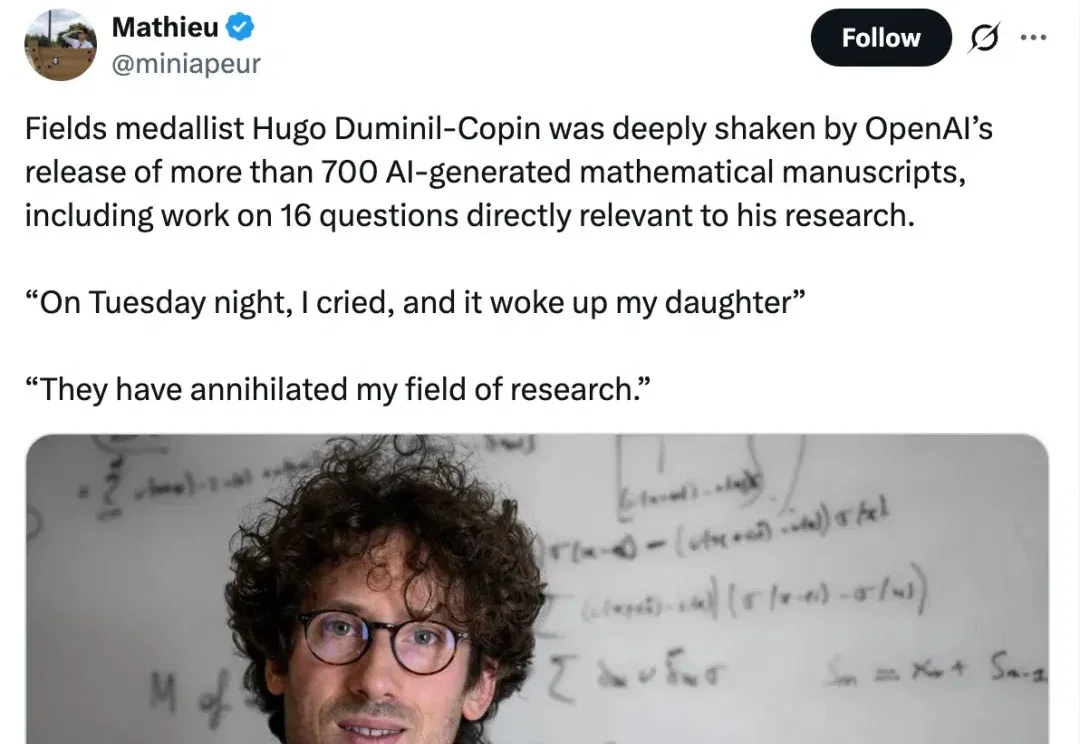
菲尔兹奖得主哭了:AI摧毁了我的研究领域 (opens in a new tab)
「他们彻底摧毁了我的研究领域。」 近日,2022 年菲尔兹奖得主、法国数学家 Hugo Duminil-Copin 情绪失控。 「周二晚上,我哭了,还把女儿吵醒了。」 起因是 OpenAI 近日发布的一批成果,超过 700 篇由人工智能生成的数学手稿被公开。其中 16 个问题,正是 Hugo Duminil-Copin 长期钻研的方向。 在此之前,Hugo Duminil-Copin 曾将 AI 生成证明的影响比作「核爆」。AI 每解决一道重大难题,数学版图都会受到一次冲击,人类能够继续探索的空间也会随之缩小。 OpenAI 这次集中发布数百项成果,则被一些数学家形容为一场「地毯式轰炸」。 一