a16z on B2A: agent-driven opportunities in product distribution and infrastructure

Zhidongxi summarizes a16z's views on agent apps, product optimization, payments and identity services, alongside company-reported usage, order and deployment figures.
Editorial correction (November 16, 2026): The B2A direction discussed here comes from an investment firm's judgment. Platform samples and different statistical definitions cannot be generalized directly to the entire internet.

Welcome to the B2A economy.
Zhidongxi reported on November 12 that well-known Silicon Valley venture-capital firm a16z had recently published an article on its official website, "Welcome to the B2A Economy," offering a new judgment: AI Agents are becoming the internet's main users, and businesses will in the future have to compete not only for human consumers, but also for traffic and orders brought by AI Agents.
For decades, internet companies have tried to stop bots from accessing websites. Now, they may have to turn around and compete for the bots' business.
a16z argues that Agents are becoming important new users. General bot traffic, AI-assisted writing, and autonomous-agent traffic are not the same metric. This article does not have sufficiently consistent statistical definitions to demonstrate that Agents already contribute most traffic across the web or most production code.
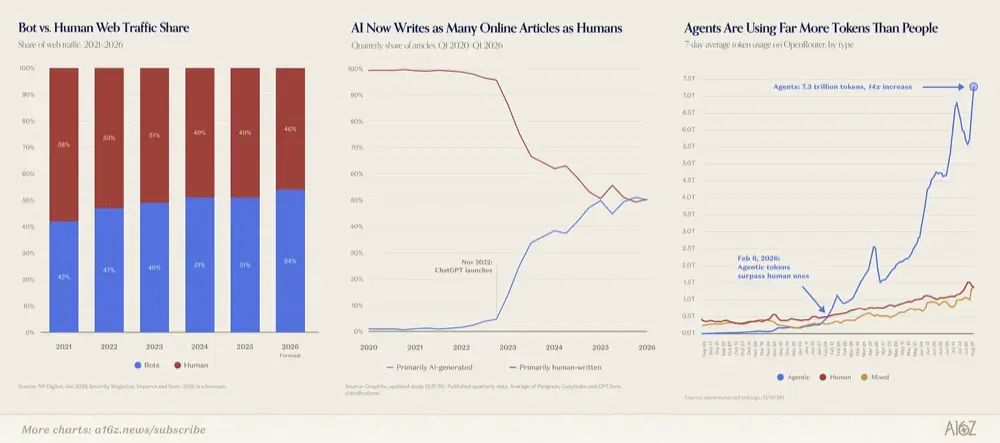
The article calls this business model B2A (Business-to-Agent), an economic model in which businesses serve agents.
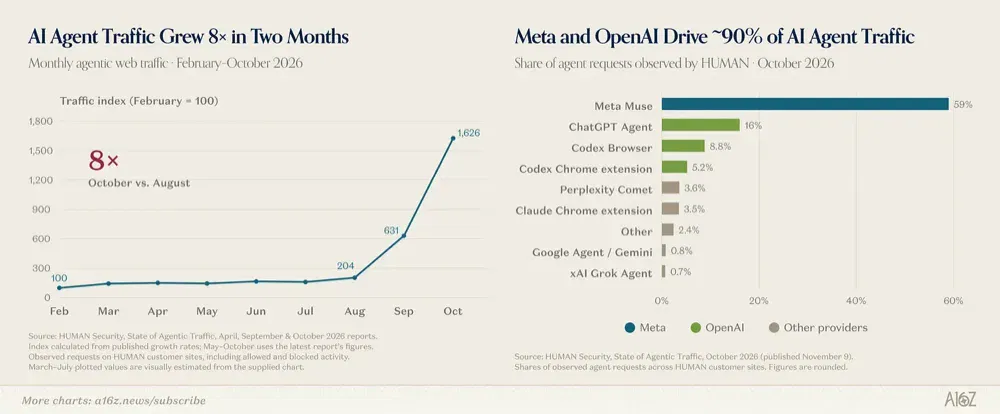
E-commerce platform Shopify disclosed that in the first quarter of 2026, AI-originated traffic to its stores grew eightfold year on year, while orders from AI search grew nearly thirteenfold. Cybersecurity company Human Security found that Agent-browser traffic grew eightfold between August and October this year.
In software development, Agents have already begun using third-party products directly. More than 60% of new databases on database platform Supabase are created by AI tools, while Agent-triggered deployments on cloud-deployment platform Vercel grew twenty-eightfold over the past year.
The article argues that B2A's commercial opportunities extend far beyond AI shopping. As Agents begin choosing and calling products on behalf of humans, the allocation of internet traffic, software sales, and methods of payment and identity verification may all change.
AI-driven orders grow nearly thirteenfold in a year
The internet gains a new source of traffic
Every platform transformation in the internet's history has changed how users obtain services and brought new business models into being.
In the Web era, businesses could set up online stores that anyone could visit. In the mobile-internet era, those stores moved into users' phones, giving rise to new products such as Uber that operate through mobile devices.
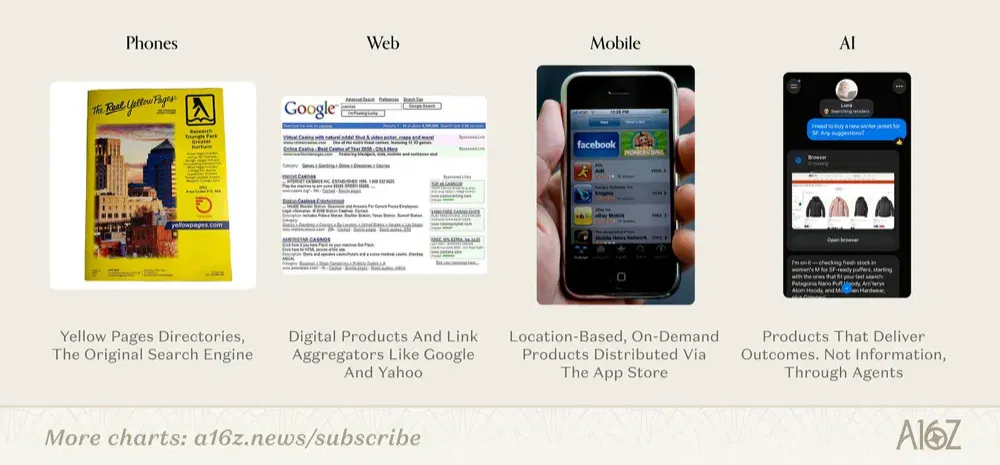
AI has already changed the tasks people can complete, but its transformation of product distribution is only beginning.
The article argues that progress in AI product capabilities has been far faster than changes in distribution channels. This also explains why, apart from ChatGPT, mass adoption of consumer AI products remains limited.
If Agents can truly enter ordinary consumers' daily lives and gain widespread use, AI has an opportunity to make the leap from an upgrade in technical capabilities to an internet-platform transformation.
Large-model products such as ChatGPT, Claude, and Grok have already become important sources of traffic for many businesses.
Shopify disclosed that in the first quarter of 2026, AI-originated traffic to stores on its platform grew eightfold year on year, while orders generated through AI search grew nearly thirteenfold.
Another set of figures comes from cybersecurity company Human Security. Between August and October this year, the Agent-browser traffic it observed grew eightfold. Muse contributed about 60% of activity, while OpenAI's products together contributed about 30%.
Compared with traditional search and advertising referrals, Agents may become a more effective channel for product recommendations. They have more specific knowledge of users' needs and preferences and can use it to select products and services.
Consumer traffic brought by AI recommendations has already shown higher user engagement, better revenue conversion, and lower bounce rates.
In the United States, users visit an AI service before entering the actual transaction website in about 11% of consumer shopping journeys.
As Agents gain more operating permissions, this traffic no longer has to appear as website visits. Users can state their needs directly to AI, and the Agent can find products, compare services, and decide which one to buy.
For businesses, whether consumers can find their products will increasingly depend on whether Agents are willing to recommend and use them.
AI chooses software
and even recommends that users buy paid plans
Agents not only bring traffic to businesses; they are also beginning to directly decide which third-party tools to call.
Most Agents currently still access the internet through browsers. They either take over the user's existing browser or create their own virtual machine and browser instance, completing tasks like a human through clicks, typing, and page navigation.
But connectors, plugins, and the Model Context Protocol (MCP) are providing another route. Agents can access third-party tools and websites directly through these interfaces, without relying on webpage operations.
The article likens this tool ecosystem to a more powerful Agent app store.
Previously, users had to compare software themselves, register accounts, choose plans, and operate different tools one by one. Agents can instead connect and use multiple products around the final task.
AI platforms are also gradually solving the identity and authorization issues needed for access across products.
For example, Sign in with ChatGPT lets users log in to third-party products with their ChatGPT identity, providing a more convenient identity-access method for Agents using external services.
As users become able to authorize identity information or access tokens for third-party services, it will also become easier for Agents to register for, use, and pay for products on their behalf.
In the future, Agents will be able to select and install the tools needed for a task themselves, without requiring humans to intervene in each one.
Claude already lets enterprise administrators connect plugins across an entire organization, so employees can use these tools directly.
OpenAI has also recently launched Businesses in ChatGPT. Businesses can claim their business information in ChatGPT, add product feeds, and see how users interact with their business in ChatGPT.
As AI platforms connect more third-party products to their ecosystems, users may no longer need to open software or websites directly to complete tasks that previously required multiple applications working together.
Businesses will also face a new question: how can they make Agents find their products and prioritize them when carrying out tasks?
Four kinds of opportunities in the B2A economy:
From Agent applications to payment infrastructure
a16z divides the potential beneficiaries of the B2A economy into four categories, including both companies that directly provide Agent capabilities and businesses providing products and infrastructure for Agents.
- Category one: Agent and large-model companies.
Current consumer-facing Agent products include standalone applications such as Instinct, Muse, and Wabi.
In the future, however, Agent capabilities will not necessarily exist only in dedicated agent products. As underlying models become better at taking action, more and more existing products can directly execute tasks assigned by users.
Among these, the article puts ChatGPT's weekly active user count at 1.2 billion, giving it a substantial user base as it transforms into an Agent product.
- Category two: new products made possible by Agents.
Amazon's business model depends on the internet, while Uber was built on widespread mobile-internet adoption. Agents may likewise bring about product forms that were previously impossible.
a16z identifies three directions:
First, small and medium-sized businesses that can operate autonomously, with Agents taking on large amounts of their everyday operations and management work.
Second, AI-mediated transaction marketplaces or network-based products, connecting different users, merchants, and services through Agents.
Third, automatically optimizing products, with Agents continually monitoring business operations and autonomously adjusting and optimizing workflows according to their objectives.
These products may no longer require users to repeatedly open software to operate it. Instead, Agents continuously carry out the tasks.
- Category three: existing businesses optimizing their products for Agents.
As large models become new sources of traffic, a GEO (Generative Engine Optimization) industry has emerged around optimizing for generative-AI search results.
Unlike traditional SEO, which mainly competes for search-engine rankings, GEO helps businesses improve the chances that their products and content are discovered, cited, and recommended in large-model answers.
However, GEO mainly addresses product discovery.
Once Agents can purchase and execute, businesses need not only to make AI aware of their products, but also to be selected when an Agent compares multiple options and to let the Agent successfully complete registration, subscription, or purchase.
This means that optimization for Agents will extend beyond product discovery into product evaluation, selection, and execution of transactions.
- Category four: Agent infrastructure companies.
To complete real-world tasks on behalf of humans, Agents also need supporting payment, identity, anti-fraud, and communication tools.
Even at the relatively limited current scale of Agent use, existing payment, identity-verification, and communication systems are already beginning to feel pressure.
For example, after an Agent initiates a transaction, a payment platform needs to distinguish legitimate transactions from fraud, while an identity-verification system needs to confirm whether the Agent has the user's authorization.
At the same time, Agents also need to communicate with external users and services through channels such as iMessage, phone calls, and email.
These systems were originally designed mainly around human users. As more Agents begin executing tasks, existing infrastructure will face new usage requirements.
Many large businesses still block Agent traffic because of concerns about fraud and chargebacks.
But if Agents can consistently bring high-quality customers and transactions, those businesses may have to readjust their access rules, moving from guarding against bots to actively serving them.
AI creates 60% of new databases
Coding Agents are already benefiting a group of software companies
Programming is already seeing the first Agent-driven changes in how products are used.
According to figures published by GitHub, as of September 2026, more than 40% of pull requests (Pull Request, PR) on the platform began with an Agent-generated initial draft, compared with only 17% six months earlier.
Agents are no longer merely helping developers write a few lines of code. They are beginning to take on a series of tasks from development to deployment.
For example, when a user asks an Agent to build a website, it may need to call different services for databases, cloud hosting, authentication, email sending, and monitoring.
The user only needs to state the website-building requirement, and the Agent can choose the external tools it needs during development.
The growth of AI programming has therefore driven the development not only of Agent products such as Cursor, Codex, Claude Code, and Cognition, but also of natural-language programming platforms such as Replit, Lovable, and Base44.
Companies providing databases, payments, and application deployment likewise receive substantial demand from Agents.
Database platform Supabase disclosed in June 2026 that more than 60% of its new databases were created by AI tools.
Another database platform, Neon, disclosed in May 2025 that automated Agents already accounted for 80% of its new database deployments.
Payments company Stripe disclosed in June 2026 that Agents accounted for nearly 40% of its documentation traffic and 70% of command-line interface (CLI) requests for API resources.
Cloud-deployment platform Vercel disclosed in October 2026 that Agent-triggered deployments had grown twenty-eightfold over the previous 12 months.
In traditional software-development workflows, developers need to visit database, deployment, payment, and other platforms themselves, learn their features, and complete configuration.
Now, Agents can directly read documentation, call APIs, create databases, and deploy applications to the cloud.
The direct users of software companies are shifting from developers to Agents that perform tasks for developers.
Software developers account for less than 1% of the global workforce. If coding Agents can already drive rapid growth in the use of database and cloud-deployment services, the relevant service markets may change even more when the remaining more than 99% of the workforce begins using Agents to do its work.
The article argues that describing this market merely as "AI e-commerce" falls far short. Agents will not only drive transactions in physical goods and services; they will also change how traffic, Token consumption, and revenue flow between digital products.
From job hunting to stock trading
a16z maps seven Agent application areas
Beyond programming, AI Agents are also entering ordinary people's work and daily lives. At the end of its article, a16z compiles two maps of the Agent economy ecosystem, covering user-facing Agent applications and the infrastructure that supports Agents.
The application map is divided into seven directions: general-purpose agents, work, travel, home, social, recruiting, and personal finance and investment.
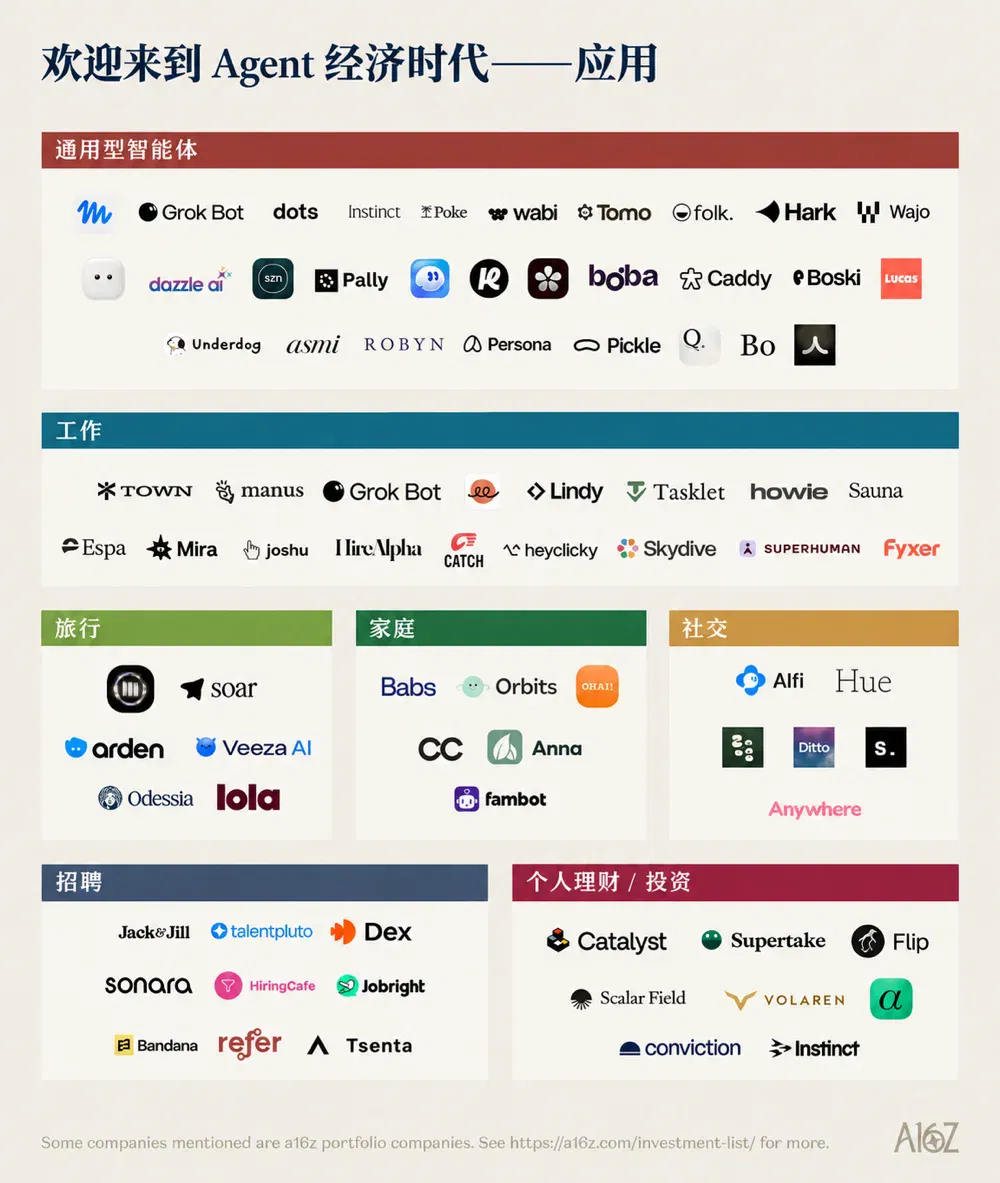
▲The Agent application ecosystem mapped by a16z
(1) In general-purpose agents, giants such as Meta, xAI, and OpenAI have successively introduced standalone products.
In September this year, Meta launched personal AI Agent Muse, which can send emails, book travel, fill in forms, and buy products on users' behalf. Muse has its own cloud virtual machine and browser and can continue executing tasks after the user closes the app. Meta also connected it to Stripe's Link payment tool so it can directly complete shopping checkouts.
Elon Musk's xAI launched Grok Bot in August this year, positioning it as an AI teammate that can work around the clock. Each Bot has its own computer and can log in to the software users work with every day, handling tasks across applications such as sales prospecting, marketing campaigns, everyday office work, and code fixes, and requesting confirmation when user approval is needed.
OpenAI launched Dots in September, likewise with an independent cloud computer capable of executing tasks around the clock. Dots can connect to more than 4,000 applications through plugins and gradually learn users' preferences and working styles through long-term interaction.
(2) In work scenarios, Manus is an example of an early product to achieve commercial revenue at scale.
Manus can autonomously conduct research, analyze data, build webpages, and do other work based on user requirements. This year, Manus disclosed that its annual recurring revenue (ARR) had exceeded $100 million, approximately CNY 667 million, reaching that level only 8 months after launch.
Manus also disclosed that its platform had cumulatively processed more than 147 trillion Tokens and created over 80 million virtual-computer environments.
(3) Compared with general-purpose Agents, products in vertical areas such as travel, home, and social are beginning to provide services around specific everyday needs.
In travel, Lola tries to combine booking hotels, finding restaurants, and arranging itineraries into a single AI conversation.
Lola is supported by travel-booking giant Booking Holdings. Based on users' budgets, travel preferences, and destinations, it can recommend hotels, restaurants, performances, and other activities, and provide real-time prices and booking services.
For example, users can tell Lola they plan to attend a concert somewhere, have AI arrange an itinerary around the event's timing, and receive recommendations for nearby hotels and restaurants. Lola has also introduced a membership service, with the VIP plan priced at $25 per month, approximately CNY 166.7.
In the home category, Ohai.ai tries to have Agents take on household-management work such as coordinating schedules, issuing reminders, and making appointments.
Users can ask Ohai to combine family members' calendars, organize school and activity notices, and send task reminders to other family members. In August this year, Ohai partnered with Ferry Health to introduce medical-appointment functions, allowing users to ask an Agent directly to book, reschedule, or cancel doctor appointments for family members.
In social settings, Alfi has already processed more than 60 million messages.
Developed by Text.ai, Alfi can join users' group chats, help friends arrange gatherings, recommend restaurants, create schedule reminders, and even complete restaurant reservations directly in chat.
The product already reaches more than 500,000 users and has cumulatively processed over 60 million messages. Unlike ordinary chatbots, Alfi also remembers group members' dietary preferences and shared experiences to suggest activities for social groups.
(4) Recruiting is another area with a concentration of Agent applications.
Among these, Jack & Jill offers AI Agents to both job seekers and hiring companies.
Job seekers can tell AI Agent Jack about their desired roles, salaries, locations, and other preferences, and have it help find suitable opportunities; companies can use Jill to find and contact candidates. According to the recruiting report Jack & Jill published in November this year, more than 400,000 candidates have already spoken with Jack.
Also included in the map, Sonara focuses on automated job hunting. After users set their job preferences, Sonara can continuously search for matching positions and complete the application process on their behalf.
(5) In personal finance and investment, Agents are moving beyond providing investment information toward developing trading strategies.
In September this year, venture-capital firm Union Square Ventures launched an incubation project, Supertake, which tries to let users turn their judgments about market trends into actual investment portfolios.
For example, users can propose an investment thesis that a particular industry will grow rapidly in the future. Supertake uses AI to analyze relevant markets and assets and constructs an investment portfolio around that thesis.
Another investment Agent, Volaren, can connect users' bank and brokerage accounts, monitor changes in holdings, analyze market information, and prepare or execute trades within the permissions and budget set by the user. Volaren supports interaction through text messages, and when AI proposes a trade, the user can reply directly to confirm.
Overall, Agent services already cover different areas including consumption, work, and finance. Users do not have to operate multiple pieces of software separately; they can state their needs directly to an Agent, which finds and calls the relevant services.
Agents need their own browsers, email accounts, and wallets
Infrastructure companies are also competing for business
To complete the tasks above on people's behalf, AI Agents also need to access websites, log in to accounts, contact external services, and make payments.
a16z further divides Agent infrastructure into seven main directions: search and access, account access, real-world tasks, computer and phone use, messaging, memory and personalization, and payment and settlement.
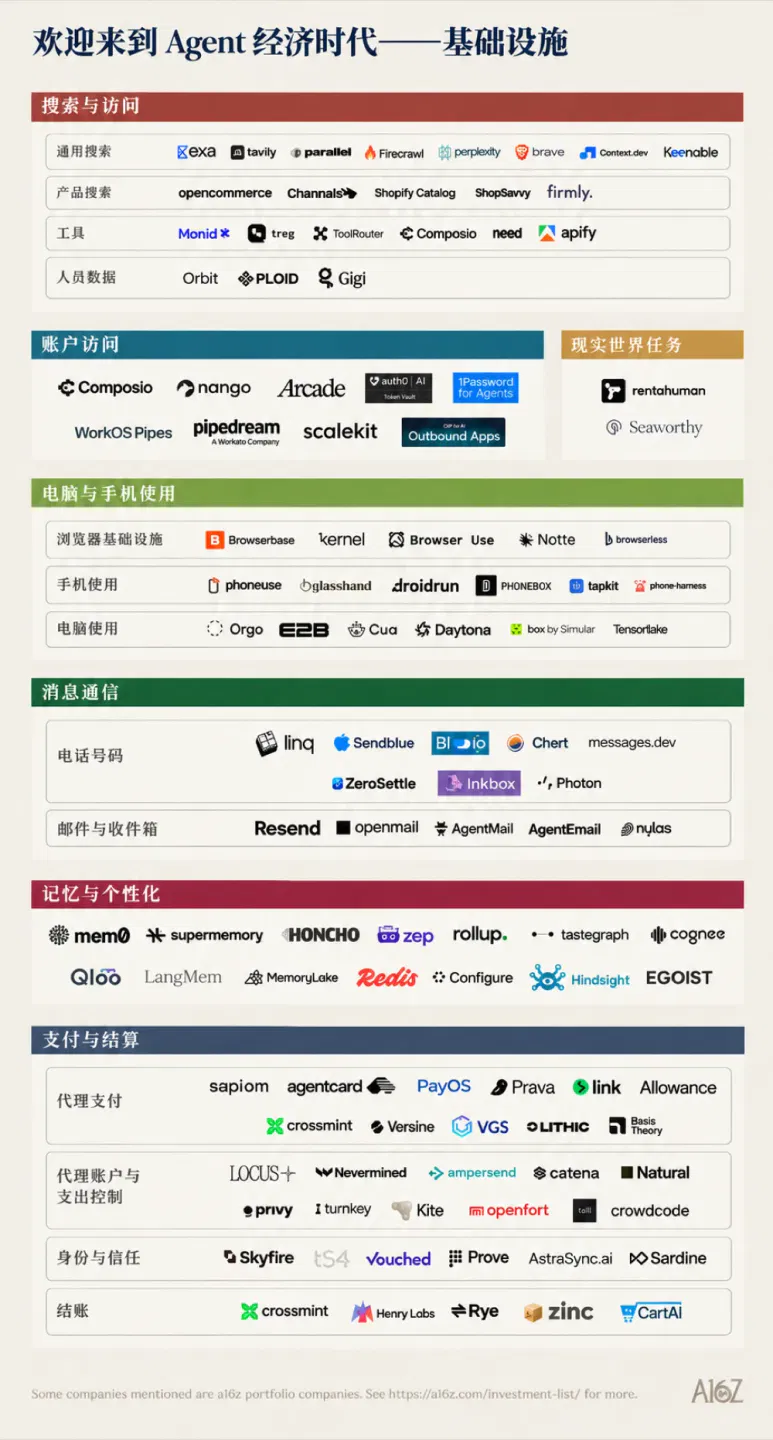
▲The Agent infrastructure ecosystem mapped by a16z
(1) In search and access, Exa has become one of the representative companies in the Agent-search market.
Unlike traditional search engines serving human users, Exa mainly provides webpage search and data-retrieval capabilities to AI applications through APIs.
Market-research firm Sacra reported in November this year that Exa's monthly searches had grown from about 1 billion in April to around 2 billion in October. It estimated Exa's annualized revenue in September at $100 million, approximately CNY 667 million, representing roughly tenfold year-on-year growth.
Other offerings in this field help Agents obtain product information through Shopify Catalog, call external tools through Composio, and search for people data through Ploid.
(2) In account access, password-management company 1Password has already introduced a product specifically for Agents.
On October 22 this year, 1Password launched 1Password for Agents, allowing Agents to log in to third-party websites and services without directly obtaining or storing users' passwords.
For example, when an Agent needs to log in to a website to complete a task, 1Password can ask the user for authorization. After the user approves, the system fills the login credentials directly into the page, without the Agent needing to read the actual password.
(3) In real-world tasks, platforms have also emerged that let AI hire humans.
For example, RentAHuman lets Agents post paid tasks through an API or MCP to find people who can complete real-world work.
These tasks may include taking photos on site, checking stores, picking up items, or product testing and data collection requiring human participation. The Agent posts requirements, screens people, manages the task, and arranges payment, while the hired person submits the relevant proof after completing the work.
(4) In computer and phone use, companies such as Browserbase and E2B are beginning to provide runtime environments for Agents.
Browserbase provides cloud browsers for Agents, allowing AI to visit websites, fill in forms, and operate webpages like a human. Its platform runs more than 35 million browser sessions per month and serves over 10,000 customers, including Microsoft, Ramp, and Lovable.
E2B provides isolated cloud-computing environments for Agents, allowing AI to run code, perform development tasks, or test applications. As of October this year, E2B had cumulatively launched more than 2 billion sandbox environments, while related SDKs had over 15 million monthly downloads.
For phone operations, Phone Use and similar products are also providing cloud phones and emulators, allowing Agents to call mobile apps, read screens, and perform operations such as tapping and typing.
(5) In messaging, Agents are beginning to have their own phone numbers and email addresses.
Linq provides iMessage, RCS, and SMS communication APIs. Developers can connect these capabilities to Agents so they can communicate with human users through text messages. Its infrastructure has processed more than 200 million messages.
In email, AgentMail specializes in mailbox services for AI Agents. Developers can create independent mailboxes for Agents through an API, allowing them to send and receive email themselves, manage conversations, and interact with other services by email.
(6) In memory and personalization, companies such as Mem0 are trying to solve Agents' long-term memory problem.
Agents need to remember users' past preferences, completed tasks, and the progress of long-term projects. Mem0 provides independent memory storage and retrieval capabilities, extracting important information from conversations for use in subsequent tasks and reducing Token consumption caused by repeated input and long contexts.
(7) In payment and settlement, a16z further identifies four subcategories: delegated payments, Agent accounts and spending controls, identity and trust, and checkout.
Among these, Crossmint has introduced payment tools for Agents, supporting purchases of goods and services using bank cards or stablecoins.
In October this year, Crossmint released the Agent Commerce Toolkit, integrating bank-card credential management, Agent payments, merchant checkout, and related capabilities into a developer toolkit.
Nevermined focuses on Agent payment authorization and spending controls. Users can set payment budgets, transaction counts, and validity periods in advance, allowing Agents to purchase external API access, compute resources, or other services within the authorized scope.
Identity-verification company Prove has introduced Agent identity-authentication and payment-related products, helping merchants confirm which user an Agent represents and what transaction permissions it has received.
At checkout, Rye provides a universal checkout API, helping Agents handle product prices, taxes, shipping fees, order payments, and related steps.
For example, once an Agent has helped a user choose a product, Rye can go on to handle checkout on the merchant's website, turning a product link into an actual order.
From Exa providing search to Browserbase carrying out webpage operations, 1Password handling login, and Crossmint completing payment, an Agent can consecutively call infrastructure from multiple companies in the background while executing a single task.
These companies do not need to serve end consumers directly. As Agent use scales up, they may also receive more API calls, software-subscription revenue, and transaction revenue.
Source: A16Z NEWS
This article comes from the WeChat official account "Zhidongxi," by "Zhidongxi."
Related topics
After reading
Join the AINRK community
Read how to join the community and connect with people working in AI.
Related articles
Continue reading related topics and articles in this category.

姜宇辉的AI分身:知识助手与“另一个自己”之间 (opens in a new tab)
南方周末通过学者、用户与Second Me创始人的访谈及记者试用,观察AI分身的学术辅助、情感连接和商业化尝试,也呈现知识可靠性、人格边界、版权与隐私方面的疑虑。

智动未来据报完成亿元级Pre-A+融资,资金用于产线与服务机器人部署 (opens in a new tab)
机甲觉醒报道,智动未来宣布完成亿元级Pre-A+轮融资,由中美绿色基金领投、南曦创投联合领投,资金拟用于广州产线、服务场景部署和世界模型研发。“智子世界”仍属技术预览,商业化效果待更多应用数据检验。

范式智能介绍Phai-A1与Phai-M1,强调国产算力后训练优化 (opens in a new tab)
范式智能介绍面向代码与Agent场景的Phai-A1,以及面向真人影视的音画同步模型Phai-M1。公司展示了单卡运行和视频生成能力,并称模型在昇腾平台完成专项后训练优化。
腾讯Q3资本开支814亿元,称WorkBuddy日Token用量居国内首位 (opens in a new tab)
腾讯三季报显示营收2073.36亿元、资本开支814.33亿元。公司称WorkBuddy日活超1000万,按用户每日大语言模型Token消耗总量居国内首位;报道还讨论云业务增收与AI投入对盈利、现金流的影响。
黄仁勋离任后:硅谷101访谈英伟达的技术、供应链与组织挑战 (opens in a new tab)
硅谷101采访半导体、科技与投资人士,讨论黄仁勋离任后CUDA生态、系统整合、供应链、开源投入和组织传承的潜在变化。产业放缓、估值折扣及人才流失判断属于受访者观点。