Ant Lingguang CTO on personal agents: goals, ecosystems and the boundaries of trust

Silicon Valley 101 discusses Lingguang's shift from Flash Apps to ongoing goals, Alipay integration, and unresolved questions around memory, proactive reminders, permission checks and monetization.
In the second half of 2026, global technology giants are opening a new battle over the entry point to AI.
From Silicon Valley's Grok Bot, Muse, OpenAI Dots and Anthropic Duet to startup Instinct, AI products taking the form of personal assistants are emerging one after another.
After AI's explosion in enterprise use, the personal consumer market is larger still—the next battleground all the giants are entering. China's battle over PA products has begun too, but its ecosystem will be very different from Silicon Valley's.
China has the giants' super-app ecosystems, making it easier for agents within them to connect payment, office work and travel services. But monetizing these products is also a major challenge in the mainland market, where AI product competition is more intense.
We spoke with Linjian Mo, workplace alias Lin Yi, CTO of Ant's Lingguang, which has just released version 2.0, about his thinking on the evolution of agent products.
A year ago, Lingguang 1.0 focused on generating “Flash Apps” from a single sentence, letting ordinary people without programming skills create their own tools. It was an imaginative direction. After launch, however, the team gradually discovered that being able to create an application did not mean it actually solved a problem, and creation itself was not necessarily a frequent need.

With 2.0, Lingguang is therefore trying to shift its focus from helping users create tools to helping them actually achieve goals. It aims not merely to answer a question once, but to remember needs, track tasks continuously, offer proactive reminders at the right moment and even act on users' behalf with authorization.
At the same time, this battle over personal AI assistants raises many questions worth discussing. Are users really willing to pay for an AI personal assistant? If AI shops for us, what happens to platforms built on traffic and advertising? As AI holds more personal information, how do we establish trust and ensure it does not do the wrong thing?
In this article, we discuss product upgrades, technological progress and the balancing of commercial interests behind the personal AI assistant battle, exploring how frequently used, high-value AI products accessible to ordinary people might reach us.

Qian Chen: Lin Yi, welcome to Silicon Valley 101. I know you have just released Lingguang 2.0, a year after version 1.0. Why launch 2.0 at this point?

Lin Yi: We have been thinking about 2.0 for a long time. People may remember 1.0 most for making Flash Apps, but we have always been considering how to help users get things done better. Whether question answering or applications, each often solves only one aspect of a problem, while tasks such as travel span a period of time.
We began preparing this work around June or July this year. Releasing it now is a natural outcome for us. Similar products have also happened to appear across the industry.
Qian Chen: So Lingguang 2.0 is still more consumer-oriented, hoping to help the public get things done and solve problems. Is it, in a sense, positioning itself against Muse?
Lin Yi: We did not start after seeing Muse; frankly, there would not have been enough time. We began this work much earlier. It is indeed aimed at individual consumers, and we very much want it to be a product ordinary people can use.
Let me describe my own experience. I began using tools such as Codex quite early to manage life and office tasks. For example, to help my child correct mistakes in schoolwork, I photograph an incorrectly answered question, have it analyze what went wrong, and ask it to produce a targeted new question. If the child gets that wrong too, we continue the process—rather like doing RL, reinforcement learning, by hand. But it is still complicated for ordinary people. My wife cannot really use it either, let alone my mother or other older people.
Qian Chen: You cannot complete it with a single natural-language instruction?
Lin Yi: One sentence does not do it. You have to understand the logic behind it.
Qian Chen: Because it was originally made for developers.
Lin Yi: Yes, but I think capabilities like these can be generalized. Take my mother: she has high blood pressure and needs to manage it. At present, she writes her blood pressure in a little notebook every day.
But recording is only the first step. More important is analyzing trends, and perhaps getting suggestions about what to do when blood pressure is high. Codex or a similar agent could manage such things, but she simply cannot use it.
We see these powerful capabilities, yet my mother cannot use them. Does she need them? Absolutely. We want to turn powerful capabilities into a product ordinary people can use.

Qian Chen: Was this also inspired by OpenClaw, the “little lobster” at the start of this year, and the later rise of Hermes? Ordinary people could not use those either. Many felt anxious: even after installing the “little lobster,” they did not know what to do with it.
Lin Yi: Yes, more as inspiration. That way of interacting is a valuable reference for us, but our central direction has never changed: helping users complete something better.
We want to move from means such as looking up information and making applications toward interaction directly organized around the user's goals. Users explain their goals and constraints, and we proactively help them achieve those goals along the way. This is a natural product upgrade that also incorporates inspiration from those products.
Qian Chen: To make an agent product everyone can use, what technical advances over the past year have made today's capabilities possible?
Lin Yi: Technically, the first factor is certainly model capability. Last year, attention may still have centered on coding and mathematical reasoning. Now there has been major progress in long-horizon task execution, which is one enabling condition.
Second is the harness, the agent runtime framework. It may not involve especially advanced technology, but it is crucial to deploying agents.
Models have limitations of their own. Even as they become stronger, some problems remain beyond them. They are still probabilistic models and cannot guarantee 100% correctness. Many things, including newly emerging information, need engineering safeguards. Model training takes at least months per cycle, so new information also has to be supplemented through external mechanisms such as memory.
The development of ecosystems, MCP—the Model Context Protocol—and other advances also moves this forward. Cost is equally crucial; otherwise, we could not support it doing so many things.

Qian Chen: All of these matter, and we will unpack them shortly. First, let us revisit Lingguang 1.0: from developing 1.0 to 2.0, what did you learn from market feedback?
Lin Yi: Our product is not an addition to an existing business. We want to work close to the technological frontier—for example, judging where technology might go in six months or a year and building products around those capabilities.
When we started last year, one major trend was improving coding capability. Could that help us achieve the goal of getting things done for people? A natural direction was helping them write programs and make applications. Generating an application from one sentence lowers the barrier enough for ordinary people to use it.
Qian Chen: Let me ask a challenging question. We saw figures suggesting that after Lingguang 1.0 launched, its three-day retention was just over 20%, below chatbots. What did that make you think, and how did it influence 2.0's design?

Lin Yi: We need to look at those numbers, but also at the core: is the number of genuinely useful applications that people use repeatedly growing?
Frankly, making Flash Apps is not a frequent need; many people prefer simply using them. That is also why we later created Lingguang Circle. Not everyone has so many ideas for applications they want to make themselves. One major reflection was that we should focus on how much value the product ultimately creates for users. Making an application does not mean value has been created. It has value when people actually use it and it solves their problems.
In 2.0, we will continue judging value that way. We will not look only at numbers or at how many people create something, because too many other factors interfere. The core is whether it helps users truly get things done and provides additional value.
Qian Chen: I see Muse's retention may now also be just over 20%. Is that higher or lower than you expected?

Lin Yi: I would want to see whether the people who have already created goals and use the product deeply continue to grow in number and stay.
Overall figures are affected by other factors, somewhat like our Flash Apps at the time. A product becoming hugely popular inevitably brings many users. Ideally, everyone who comes would stay, but in reality many factors interfere.
So I would rather look at whether users with three to five goals they genuinely care about keep growing in number and being retained. After launch, we may evaluate ourselves from this angle too.
Qian Chen: I think it recently passed ten million users and is growing quickly, but the rate of new-user growth is slowing. Is that inevitable?
Lin Yi: That may happen, and it may also relate to how capabilities evolve. For us, one thing remains constant: we should return to the most fundamental user value.
Qian Chen: Lingguang 1.0 launched a RMB 100 million Flash App incentive program. Was that money well spent? If so, will 2.0 have a corresponding program? If not, what lessons did you learn?
Lin Yi: For 1.0, incentives definitely had value in building habits: helping more people understand it and make their first application. They helped educate the market; that is quite clear.
Second, we rewarded not just creation but making the product good. That is why the program was tightly connected with Lingguang Circle. Making something is the first step. After that, we wanted people to create good work, share it, gain recognition and let others keep modifying what had been made.
But the barrier to truly excellent work remains fairly high, and overall capabilities still have room to improve. It is already good if people can make simple applications that conveniently solve problems around them.
Qian Chen: Do general-purpose agent products still need market education? Meta, for example, is using incentives and invitation codes to give both the inviter and invitee free token credits, subsidizing referral-driven growth. ChatGPT did not promote itself that way. Why did chatbots not need it then, while agents need it now? Is market education lacking, or are capabilities still insufficient to attract widespread voluntary use?
Lin Yi: I think several factors may be involved. Meta certainly wants market share, and the timing differs from ChatGPT's early days, when it stood alone.
Qian Chen: There was no competition then.
Lin Yi: Right, the situation was different. Meta faces intense competition, so referral-based marketing is understandable. It relates to the market environment.
Users have also formed a habit of using chatbots. With a personal agent, they need to state a goal rather than merely ask a question. Instead of “What is the weather like in southern Xinjiang?” it is “I want to travel in southern Xinjiang; arrange it for me.” That habit needs cultivating so users know they can use it this way. It is a change, but I think the latter is more natural: the user only needs to state the purpose.

Qian Chen: Changing habits is not easy. In the internet and mobile-internet eras, people opened applications and clicked through actions to get something done. Now they must tell a PA, a personal agent, what they want in natural language and let it do the work automatically. Will this interaction shift bring a tenfold gain in efficiency or convenience?
Lin Yi: I do not think it will be a replacement. The two should be integrated better.
Qian Chen: You do not think the old interaction paradigm will disappear?
Lin Yi: No, and both will improve. GUI, the graphical user interface, has major natural advantages. Many people have already learned to use it. It also packages the operating steps. For a complicated task, for example, step one is selecting a destination and step two selecting other conditions. Users understand immediately; the interface contains the best workflow.
In pure conversation, it is great if users can provide all the information in one sentence. But if it is too free-form, they may not know what to express next. So I think a GUI provides a very good package, because for repetitive workflows, clicking may be easier than speaking: one click and it is done.
So I do not think it will disappear. The two will certainly become better integrated. We have explored this extensively. In 1.0, we combined GUI and conversation, aiming to interact in the most suitable way and present results with the greatest information efficiency. Sometimes a picture is worth a thousand words; sometimes an interactive animation is more useful than lots of text. The same applies to 2.0.
Qian Chen: Natural language is not necessarily the most efficient way to communicate, and many things cannot be expressed in words.
Lin Yi: Right. How could I describe what this space looks like in one sentence?
Qian Chen: You might need an 800-character essay.
Lin Yi: Taking a photo would be best. There will certainly be multiple input methods, including multimodal and unstructured input, while output should be structured.

Qian Chen: Where do general agents deliver the most value? Taking Lingguang 2.0, which scenarios have users found most valuable?
Lin Yi: We have connected some capabilities from the Alipay ecosystem. A friend asked it to analyze his bills: where had he wasted money, and where could he save? It found that his refunds were five times higher than his spending. For example, he would buy six items of clothing, return five and keep one. It described him as an impulsive consumer, and he said it had hit the mark.
I analyzed my own bills too. Its advice was that my telecom plan was excessive. I checked and really did not need such a large allowance, so I downgraded one tier and saved some money. It is a small example, but I think it has value.
I also had a very good experience planning a summer family trip to Xinjiang. I told it the goal, itinerary and constraints, such as accommodation requirements, and it kept track for us throughout. Most importantly, it did more than provide a plan before departure; the experience during the trip was better. As circumstances changed, it told me how to adjust the next steps. Scenery in southern Xinjiang, for example, depends heavily on weather: in bad weather you cannot see it, so it helps adjust the itinerary.
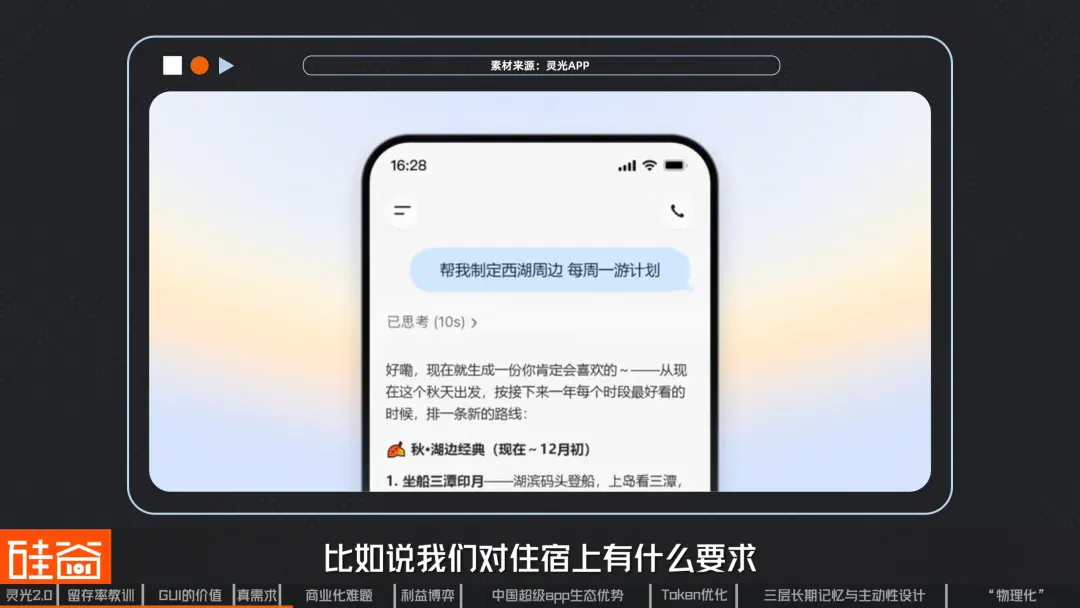
Qian Chen: It makes new suggestions based on real-time changes each day.
Lin Yi: Yes. At one point I ate something that upset my stomach and felt unwell, and it suggested revising the itinerary. During the trip, it updated the overall arrangements based on the conditions we cared about and external changes. It did not simply push yesterday's unfinished activity into tomorrow, but replanned around the goals of the whole trip. That was very reassuring.
Qian Chen: Interesting. I have noticed that some popular Muse use cases in Silicon Valley also involve saving money.
Lin Yi: Many that I have seen are shopping-related.
Qian Chen: Yes. Let me share two examples. One is helping people sell things on Facebook Marketplace. Another is asking Muse to search email for small refunds or checks that need claiming. There are so many emails that users can easily overlook them, but it finds them, making people feel it really has recovered a substantial amount of money.
Lin Yi: People could do these things if they spent the time, such as checking bills item by item. But often they forget or find it troublesome. A PA, a personal agent, can do it for them.
Qian Chen: What can agents actually do, and where are their high-value use cases? Is it more valuable for an agent to save your money and time, or to help you spend money and time?
Lin Yi: I do not think those conflict. Both are possible now, and both can be done quite well.
Take productivity and office software. The Office trio white-collar workers use most—making PowerPoint presentations, working in Excel and writing Word documents—was among the first use cases to take off. Claude Code and WorkBuddy also lean toward office work, expanding into personal life afterward.
These two settings do not conflict and can both be served well, but cost and value for money matter. Inference is still expensive, and office use cases make it relatively easier to recover costs.
Qian Chen: Serving enterprise users may have somewhat greater commercial value.
Lin Yi: But a purely office-work market is certainly smaller than the market for everyday life. Underlying technology is improving and costs are falling; that is one condition that makes the product viable. Saving time has clear value. Would it not be good to use that saved time to live better?
Qian Chen: Which agent tasks will occur frequently? Only use cases that are truly frequent and repeatable will have greater value and user stickiness.
Lin Yi: Office work is certainly frequent, and there are plenty of everyday examples. We may all have things on our minds each day, such as our children: vaccinations when they are young and managing their studies as they get older.
Qian Chen: Checking questions they answered incorrectly.
Lin Yi: Yes. There is also investing and managing money, how to save and earn money, and going out to enjoy yourself. There are many scenarios.
Many things also cannot be solved in one conversational turn; there is an underlying goal. Asking it to manage a child's homework means wanting the child to learn better. Many things can be done along the way to reach that goal.
Qian Chen: Will it become everyone's private secretary and make work easier?
Lin Yi: It feels that way. After a period of adjustment, the better it knows me, the more tedious matters it can handle for me. But it should still tell me about things that genuinely need my decision. When I do not need to be disturbed, it should act proactively. That sense of boundaries is essential.
Qian Chen: Will users pay for this kind of private secretary?
Lin Yi: It depends on the additional value it creates. If it could really improve my child's score by ten points, for example, why would I not pay? I already spend so much on education. So it comes back to what it creates. I think willingness to pay definitely exists.
Qian Chen: One commercial distinction is whether a product addresses a “pain point” or a “nice-to-have.” A nice-to-have is optional: better to have, but users compare prices and free competitors. A pain point is something people truly pay to resolve. When agents improve efficiency and manage everyday matters, are they solving pain points or offering nice-to-haves?
Lin Yi: That depends on capability progress and the specific use case. Education, which we just discussed, is definitely a pain point, but it still depends on how much additional value we provide. Having it cannot solve every problem; that is certainly impossible. But it can substantially improve efficiency in some parts, much more than ineffective drilling through exercises.
Some use cases could be called nice-to-haves. We often use it to summarize DingTalk messages. Previously, we had to inspect groups one by one; now it summarizes them automatically every day, greatly improving efficiency. Is it indispensable? I cannot say that. But it really gives me time for other things.

Qian Chen: Monetization has also prompted heated discussion in Silicon Valley recently. Instinct has said it will not charge users; it is currently burning venture capital. Whether it will later use advertising or take a percentage of the money it saves users as commission remains uncertain.
Large companies may have a different logic. Muse might not need to make money directly for Meta; it could eventually improve the advertising system and generate returns through greater ad efficiency. Grok Bot might target enterprise users and charge per token or in some other way.
Do you think commercial and product competition and users' payment habits in China will differ from international markets?
Lin Yi: Frankly, it is hard to judge, but much of the underlying logic should be similar: ultimately, whether to charge individual consumers or businesses.
We have not yet reached a stage where PA, personal-agent, monetization is highly successful. There are already many successes in the enterprise market, but perhaps not yet in the personal market.
For payment models, I personally lean toward subscriptions and the commissions mentioned earlier. Advertising may be difficult to reconcile with a PA. A PA differs from a chatbot or other tools, which still follow platform-and-traffic logic more closely. A PA is like a very intimate companion. Interacting with you while mixing in commercial interests seems very difficult to me.
Qian Chen: If it starts your morning by reading out two advertisements, the experience could be ruined completely.
Lin Yi: A PA, a personal agent, must earn the user's trust. Mixing in commercial interests makes that difficult. There may be innovation, but I think it is very hard.
Qian Chen: How does it monetize, then? Can it not monetize at all?
Lin Yi: That is not what I mean; I am talking about advertising. Subscriptions and commissions are worth trying. We might try them at an appropriate time too, but not necessarily now.
The core remains whether it creates additional value. First make the pie bigger; how everyone divides it comes next. If it truly resolves a pain point, improves users' lives and creates additional benefits, it will certainly receive its due share.
Qian Chen: I ask because I recently saw some investors arguing that personal agents in China are a game for big players, not small ones.
Product competition in China is intense. Large companies have resources and may deliver better interactions across the board, leaving few opportunities for smaller players and making monetization from the outset difficult.
Lin Yi: Yes. This may not be the best stage for immediate monetization. We should consider it, but do not necessarily need to push aggressively.
Entrepreneurs face another challenge related to PA capability boundaries. Models already have strong action and long-horizon planning capabilities. The key is what environment you give them. In a virtual or controlled environment, they can only do the things available there. Give one only a virtual machine, and its scope stays within that virtual world. Connect it to real services and the real world, and it can do more. It is not that the model lacks capability; the environment limits it. The ecosystem capabilities major platforms have accumulated can be very helpful here.
Qian Chen: That is my next key question: agents' capability boundaries and access permissions. When designing Lingguang 2.0, do you consider Ant's or Alibaba's overall ecosystem before deciding the product form or flagship use cases?
Lin Yi: Certainly. The first example about bills really does require an ecosystem such as Alipay.
Products may share broad concepts, but the core value they offer customers through their own ecosystems can differ. Bills and payments, for example, can give rise to many money-saving services.

Qian Chen: What other advantages do Ant's and Alibaba's ecosystems give Lingguang? Delivery happens very frequently, and so does travel.
Lin Yi: Yes. A second issue is the service provider's attitude and position in this change. If you have your own platform and invoke your own capabilities, the same problem does not arise.
Qian Chen: For example, Amazon has blocked Muse. What do you think motivates that, and what is the conflict? Where do Amazon as the platform, users, and Meta as the agent provider have conflicting interests?
Lin Yi: The biggest reason may still be commercial interests. Amazon's business model depends heavily on traffic and advertising.
Under the PA, personal-agent, model, users might transact directly without visiting the platform. That would certainly have a major impact on this source of value, creating a contest over interests.
Qian Chen: Is there no such conflict between Lingguang and Alibaba, such as Taobao?
Lin Yi: There can still be conflict. It will not directly replace platforms; the two habits will certainly coexist for a long time. I do not think people will eventually use agents exclusively and stop visiting platforms. But collaboration within one large ecosystem is much easier than working externally, especially inside Ant.
Qian Chen: Is there a way to align all three parties' interests?
Lin Yi: I think the bargaining will continue for a long time, but the core is whether this approach creates additional value. Without additional value, it is a zero-sum game. With it, there is new room to coordinate interests.
Take buying coffee. Some people need it, but I do not. I would not otherwise be able to go and buy one while driving. But if I could say a sentence when I wanted coffee and have it buy one for me, such a scenario exists. This involves more than capability: payment, trust and a whole series of other issues matter. The industry should explore them together.

Qian Chen: How are Lingguang 2.0's interfaces designed? What can it connect to now?
Lin Yi: Huabei and Jiebei statements, and many externally available services, including email, DingTalk and Feishu. Interfaces take different forms. If a merchant opens MCP, the Model Context Protocol, we connect through it. Some use A2A, an agent-to-agent communication protocol.
Qian Chen: What stage have these two protocols reached?
Lin Yi: The protocols themselves may not be the bottleneck; they have become de facto standards in some settings. Stateless or relatively simple queries can use interfaces. But some queries involve business logic. Take an internal credit service: “How much is my Huabei bill?” can be handled in one sentence through one interface. But “Why is my credit limit so low?” or “How can I raise it?” involves business logic best answered by the credit service's own agent, since an external system may not understand it accurately. A2A, agent-to-agent communication, may suit that better.
Qian Chen: So neither MCP nor A2A is categorically better; it depends on the situation. If the other party does not grant access, is Browser Use, browser operation, the only solution?
Lin Yi: Browser Use does not necessarily solve it either. It depends on why access is denied. If Amazon explicitly bars you and you insist on using Browser Use to enter, that becomes confrontation and is unlikely to end well.
Sometimes the other party is willing to open access but constrained. A small merchant may lack technical capability or the extra money to develop an interface. Browser Use may be good then, because the merchant is willing. But if it simply does not allow access, that is more than a technical issue. Browser Use certainly has technical difficulties, but the bigger problem may lie outside technology.
Qian Chen: If the two sides cannot coordinate and agree, will that become a bottleneck for agents?
Lin Yi: Yes.
Qian Chen: So the bottleneck is not just technology. The parties must coordinate interests first.
Lin Yi: Right. Many complex problems are not purely technical.
Qian Chen: What industry trend do you see? Are people increasingly aligning and cooperating, or are they still in confrontation?
Lin Yi: It is complicated. People are generally experimenting, and it is hard to say what the future will definitely be. Take Amazon again: different parties have different attitudes and their own interests.
But I think some things will certainly happen. Users will not jump straight to “only interacting with agents from now on,” but agents will certainly become a default option.
Qian Chen: Once people try it and find it useful, going back is difficult. A colleague sold furniture a couple of months ago. Previously, he had to photograph it, upload it and write descriptions on Facebook Marketplace. Now Muse can sell it for him, requiring much less of his time and effort. Once accustomed to that, he will not want to do it manually.
Lin Yi: Yes, that shift in habits is fairly clear. But within the trend, merchants and brands will have different attitudes.
High-margin merchants may be more willing to embrace it. Some brands have comfortable margins and do not necessarily fear price comparison. They may worry more about agents saying the wrong things for them: uncontrolled answers could affect brand image. Rather than let someone else speak for me, I might as well connect proactively myself.
Agents also naturally compare prices, while pricing systems can be complicated and differ between channels. Some merchants will be very concerned, particularly those with thin margins.
Qian Chen: It removes some of the room for intermediary arbitrage.
Lin Yi: Yes, so small merchants may have a harder time. Yet they cannot refuse to embrace it either, because users may no longer see them once traffic shifts. These are difficult problems.
Qian Chen: You mentioned conflicts for major platforms, such as Amazon refusing Muse access because of its existing business model and advertising revenue. Advertisers pay for ranking; could agents overturn that?
Lin Yi: Yes, exactly.
Qian Chen: Then perhaps its only option is to change its business model.
Lin Yi: I think it will certainly try doing similar things itself. Much of the US ecosystem is standardized and relatively open overall.
China mainly has several super-ecosystems, each forming a closed loop from payments to shopping. Amazon may be a typical overseas counterpart, while other parts are more fragmented and the overall ecosystem more open.
Qian Chen: Could agents reach practical adoption earlier in China because super apps already contain these ecosystems?
Lin Yi: There are enough use cases and room for development. I think it may be possible.

Qian Chen: Let us discuss safety. AI will still hallucinate, and agents may make mistakes or do unexpected things. How have you designed for safety?
Lin Yi: I consider it a matter of survival, potentially affecting the whole industry's development. We said a PA, a personal agent, would become one of users' default habits, but some conditions could reverse that trend. A genuinely large-scale harmful incident could destroy trust and set things back. It is therefore vital. We have done a series of things and must keep doing them.
Ant has deep experience in security. For example, we work with the internal security team's APASS platform on protections. Users' accounts and passwords are isolated from the agent.
For actions that might go wrong, we also classify instructions and execution actions into levels, with different levels triggering different permissions. For payment, the simplest approach now is to have the user confirm every transaction. We are exploring alternatives too. Ant Group as a whole is working on “AI Pay”: under conditions such as specified amounts and scenarios, it can pay automatically for users. That requires coordinated infrastructure.
For now, we still focus more on information queries and have not executed risky actions such as payments at scale. We do need to be especially careful before the infrastructure is ready.
Qian Chen: The final decision remains with people now; whether to pay still requires a human decision. Under what conditions could machines start paying? Could some small payments be automatic?
Lin Yi: The “AI Pay” we mentioned may be crucial infrastructure. Defining the conditions and scenarios in which it may pay for someone is precisely what infrastructure needs to solve.
Qian Chen: Alipay should have considerable experience.
Lin Yi: It has accumulated a lot. But doing this at scale still requires particular care. We also have some confidence because Ant Group has that experience.

Qian Chen: You mentioned that technical optimizations over the past year have reduced token costs, another important advance. What technologies specifically improved token efficiency?
Lin Yi: The biggest driver is certainly progress in model technology. On some key leaderboards, today's 100B models may outscore earlier 1T models. That is major progress and it continues. Models can work and get things done while consumption falls substantially. I think that is the biggest driver.
Product forms are changing too. In PAs, personal agents, such as Muse and Lingguang, many tasks execute in the background. Schedulable background work need not crowd into peak periods; it can smooth peaks and fill valleys, running at more suitable times and using inference hardware more efficiently. All these changes may lower costs.
Qian Chen: Are the largest models called underneath every time, or can small models complete some tasks?
Lin Yi: Small models can complete many things. Not everything requires the largest model.
Qian Chen: So the underlying system has large and small models, scheduling different ones for different tasks?
Lin Yi: Yes, that is possible in theory. But we still have considerable room to optimize it; we are not saying we already do it very well.
Qian Chen: Is scheduling the main area for further optimization?
Lin Yi: I think models remain the main factor, while scheduling can improve in parallel. Models will continue progressing. We have already seen major progress in Bailing. On public leaderboards such as AA, a model of the same size can improve rapidly over just a few months compared with its earlier scores.

Qian Chen: Models really are progressing quickly, and RSI, recursive self-improvement, may accelerate that further. What currently impossible AI use cases do you hope will become feasible in six months or a year as models improve?
Lin Yi: There is one thing I very much look forward to, but it is still hard: making a PA, a personal agent, improve the more you use it.
Qian Chen: Understand you better and better?
Lin Yi: Not just understand you, but become better.
Qian Chen: How do you define “better”?
Lin Yi: “Understanding you” is more about memory—knowing you better—which can be addressed through context.
But “better” is not only memory; it can also concern execution paths. Knowing your preferences when buying airline tickets means understanding you better. Yet the search and execution paths can also improve. Suppose it checks ten platforms or ten airlines. Could it retain the best experience and complete the next task more efficiently? That affects cost and efficiency as well as results.
Complex, long-horizon tasks cannot be guaranteed to succeed every time. Sometimes search fails; sometimes it times out. Accumulated experience may improve success rates too. Related concepts have existed for a long time, and Hermes also automatically summarizes skills. But this cannot be implemented casually, because there may be side effects.
Qian Chen: What side effects?
Lin Yi: Overgeneralization, for example.
Qian Chen: What do you mean by overgeneralization?
Lin Yi: I might say, “I am not eating spicy food today,” and it summarizes that as “This person never eats spicy food.” That boundary is hard to judge.
Qian Chen: It categorizes you incorrectly and fails to recognize the intent.
Lin Yi: Yes. If an execution path succeeds this time, is it necessarily the best forever? Not necessarily.
Qian Chen: And I may change too: no spicy food today, but I might want it tomorrow.
Lin Yi: Right. Preferences are one aspect; execution capability is another.
It is not that nothing can be done today. Memory can do a lot to help it “understand you.” But fully automatically optimizing the user's execution trajectories and consolidating those improvements into system capabilities, so it gets better with use, still requires addressing many conditions.
That closed loop involves not only memory but skills and models too. Which experiences should a model absorb, and which should it not? Many things work conceptually, but keeping improvement going in real operation remains difficult. There is enormous noise.
Qian Chen: Do you think it will gradually happen over the next few months?
Lin Yi: We hope so, but it will not necessarily be solved immediately in the coming months. I think it will keep progressing so users feel it improves with use.
Qian Chen: Have the long-term memory and long-context problems you mentioned been solved now?
Lin Yi: We certainly cannot say they are solved; even the earlier example is difficult. I think memory can broadly be divided into three categories.
First are relatively stable long-term preferences. For example, preferring a particular hotel brand or having long-standing habits.
Second are facts—things that actually happened. For example, during a trip, you visited three places today and did not visit the fourth. Those are facts.
Third are temporary matters, such as “I am not eating spicy food today.”
The three need distinguishing. When should something enter each category? When can a temporary matter become a long-term preference? Each question needs separate handling.
Compared with chatbots, a PA, a personal agent, has some advantages here: certain information can be used better in memory processing. Lingguang, for example, continuously helps manage a particular matter, with many interactions and steps along the way. That helps it retain factual memories—what truly happened.
Looking up a car brand in a chatbot does not mean I definitely intend to buy one; I merely searched for it. But setting a goal—“I want to save up to buy this car”—is a fact explicitly established by the user, helping interpret related queries afterward.
Putting temporary, one-off conversations into an ongoing task thread helps memory processing. Long-term preferences can be extracted from actual events, or those events can guide adjustments to answers. There is more basis for that than in a one-off conversation.

Qian Chen: This touches another dimension: AI being proactive or reactive. A chatbot responds passively, while a PA, a personal agent, can take initiative and sometimes even push you.
Lin Yi: Yes, we need to get that balance right.
Qian Chen: It can remind you what must be done today and tomorrow to reach long-term goals. It can be more active, but how should that level of initiative be designed?
Lin Yi: That is a very good question, and we are exploring it too. I think information can be divided into three levels.
The first is directly related to the action goal and on the main path. On a trip, for example: “If you do not get up now, you will miss the sunrise.” A reminder is appropriate; failing to provide it would be a failure of duty. These things must be done well.
The second is information with some, or a substantial, probability of changing the user's actions. I think that should also be delivered appropriately. Suppose it knows you love coffee, there is a well-reviewed café near your destination, and you have previously shown willingness to change your itinerary for coffee. That is outside the main plan, but quite likely to change what you do, so it should tell you.
Third is information such as an introduction to the destination. It resembles a secretary leaving a document beside you: read it if you want, or leave it unread.

Information therefore needs layers, and interactions may differ too. The first category deserves a strong alert. The second might be mentioned in conversation or shown in a dedicated place. The third can sit somewhere additional for optional viewing, but at least should not trigger proactive push reminders. Lingguang remains conservative for now and does not interrupt users so proactively.
Qian Chen: Could there be different modes later? I might want an active assistant that reminds me not to be lazy and to do more each day.
Lin Yi: Yes, personalization matters here too.
Qian Chen: Personal agents with different temperaments and personalities.
Lin Yi: Yes, and personality affects how information is categorized. The same good café might be second-category information for someone who loves coffee, but not for me. It depends on how much it would affect you.
Qian Chen: That is the additional value you mentioned at the start. Without knowing the café existed, I would not spend there. Knowing and wanting to try it creates additional demand.
There are also things “I do not know I do not know.” If a PA, a personal agent, tells me something exists and asks whether I want to consider it, that adds to my awareness, information and choices, potentially also producing additional spending.
Lin Yi: Yes, possibly. We mainly handle the first category now and are trying to explore the second.
Qian Chen: I think this is valuable. I used an application built by a friend's startup whose agent connects new acquaintances with existing contacts.
Before I meet someone, for example, it tells me their background and how to introduce myself. It also roughly knows what we discussed and where I have been recently. When I went to Beijing once, it proactively told me someone might also be there and suggested meeting. Or it knows I am about to go to the airport but have a two-hour gap, and suggests using it to meet someone. That helps my connections and social network a great deal.
Lin Yi: Yes, that can create a wonderful sense of surprise. We should definitely do the second category we discussed.
Qian Chen: So the truly valuable future opportunities may lie in the second category?
Lin Yi: I think both the second and third have value, but one must judge how likely the information is to change a user's actions.
If that likelihood is low, it may belong in the third category: good to know, but fine not to know. The second has a substantial chance of affecting action—the additional value and surprise you described.
Qian Chen: What prerequisites are needed to do the second category well?
Lin Yi: First, it must understand the user. The same information may change one person's actions but not another's. Whether we call it memory or “understanding this person,” that is a prerequisite.
Second, it needs enough information. I first have to know that the café is there and well reviewed. Once that is known, many technical approaches are available.
Qian Chen: Are most agents still in the first category?
Lin Yi: I would not put it that way. Most agents certainly must handle the first category; otherwise, they hardly qualify as agents. But product strategies differ. Some are extremely proactive, even to the point of being verbose.
Qian Chen: Pushing too much, even ordering me to meet people.
Lin Yi: Yes. It may have treated some third-category information as first or second. Products make different choices. We may currently be too conservative overall and should explore additional value more proactively.
Qian Chen: So Lingguang mainly does the first category now and will move toward the second?
Lin Yi: Yes: the first category plus a little of the second. We hope to explore more.
Qian Chen: Are there other interesting real examples from testing Lingguang 2.0 internally?
Lin Yi: I now depend on it deeply and have truly entrusted it with some things in my life.
Qian Chen: By deep dependence, do you mean opening it many times each day?
Lin Yi: Yes, and spending quite a lot of time with it. On the Xinjiang trip, for example, I might use it for an hour or two.
Previously, unless deliberately testing, I might interact only a few or a dozen-plus times a day and would not spend so long. But treating it as a PA, a personal agent, rather than merely an information-query tool gives me much more to tell it: feeling unwell or changes to the itinerary, for example, so it can plan for me. More importantly, the better it knows me, the better it can help.
At the end of each day, my child also willingly tells it what they liked and disliked, proactively writing a travel diary. That information can help plan the next trip and let it understand us better. People are willing to spend time when they see value. If interaction is more interesting, the child is more willing to do it too, and usage time naturally increases.
There is exercise too, because I like running. If I want to run a half marathon, it can design a training plan, scheduling how many kilometers to run today and strength training tomorrow. There are also connectors: Garmin watches, body-fat scales and strength-training applications can now be connected. Their data return on a daily schedule. I do not need to tell it how long I ran; it summarizes that and plans the next day, saving effort.
Sometimes I open it to report being too tired to run. At other times I check the day's arrangements. Previously I had to ask “What should I do today?” Now it sends the plan to me, and I can simply follow the schedule.
Entrusting goals you truly care about to it and using it as a PA, a personal agent, is deep use. It makes mistakes too. Tell it what is wrong, and it changes. Used this way, I find it very sticky.
Qian Chen: It understands you better the more you use it.
Lin Yi: Yes, and its value increases. But we also need to solve how to help users use it better. It is not as direct as conversation, where a question gets an answer; it takes a process.
Qian Chen: Will the ultimate form of a PA, a personal agent, be always-on? That seems necessary for understanding you better, but there are many technical challenges.

Lin Yi: It does not necessarily have to be truly always-on. A real assistant does not need to follow and watch you 24 hours a day either.
Qian Chen: But having a good assistant there around the clock would be wonderful.
Lin Yi: I think being there when most needed is enough. For fitness, a few moments each day are key: give you the training plan, analyze results afterward and suggest the next day's work. It should also explain clearly when you have questions. That is sufficient for doing this job competently.
The next step is more second-category work, such as offering better training advice. Users feeling that it is always available does not mean it must run continuously in the background. It can wake at the right time and get the job done.
Qian Chen: What technical milestones would be needed for always-on operation?
Lin Yi: The same point applies: perceived always-on availability and technically continuous operation are two different things. Running a PA, a personal agent, nonstop for 24 hours is mainly a question of cost and the additional value it creates, rather than technology.
Qian Chen: Still a balance between cost and additional value.
Lin Yi: Yes. Often it is just running without doing useful work. Without additional value, it is not worth so much.

Qian Chen: Are you optimistic about agent phones? An application requires taking out the phone and opening it. On-device hardware can accompany users and receive information better, creating an always-on PA, a personal agent. Is that the eventual form?
Lin Yi: I think it will develop in that direction. When driving, for example, people may want to ask questions or chat briefly. Opening a phone and then an application is not the best option.
With hardware entry points such as in-car systems and glasses, a PA could be everywhere. I think it is a trend because the need exists. While driving, I sometimes want to take out my phone and ask something too, but that is a bit dangerous.
Qian Chen: Yes, I do too. I drive a Tesla, and while using FSD I sometimes want to do something on my phone. But if I take my eyes off the road, the interior camera flags a violation.
Lin Yi: So the need exists but is not well met yet. I think it will certainly be met through headphones, in-car systems and similar devices.
Qian Chen: Imagine the future: what would Lingguang 3.0 look like?
Lin Yi: I cannot say what 3.0 will look like, but a few directions are clear and will keep moving forward.
One is a ubiquitous PA, a personal agent, accessible at any time in the most convenient way, with the most natural interaction. Much today still uses voice and text, with images supported too. Real-time multimodal interaction and other forms can be explored, but the technical challenges are substantial.
Second is connecting to more of the physical world. Today it is still a virtual world plus some services, and that scope will certainly keep expanding.
There is also the layer in between: a PA must complete tasks very reliably. The central test of a PA is whether it actually completes the tasks users entrust to it. Reliability is the most fundamental requirement.
Qian Chen: What specifically do you mean by connecting to the physical world?

Lin Yi: Interfaces can connect it to smart-home devices and robot vacuums, for example. Many home devices already offer such interfaces. Connecting them is natural, and the conditions already exist.
Qian Chen: I think that is very useful. A Tesla, for example, lets you set the cabin temperature in advance. In the US it can be in the 30s Celsius outside and the 40s inside the car, but I often forget to switch on the air conditioning early. If an agent knew I was returning to the car in about three minutes and connected to the Tesla app beforehand, it could lower the temperature automatically. That is a feature I would pay for.
Lin Yi: Its advantage is access to a broader range of information. The Tesla app can already switch on the air conditioning in advance.
Qian Chen: But it is not proactive, because it does not know when I am coming back.
Lin Yi: Exactly. A PA has broader information. Take accompanying a child to a one-and-a-half-hour tutoring class. I do not know whether yours attends those yet, but they are common in China.
Qian Chen: My child is one and a half, so not yet, but perhaps in the future.
Lin Yi: It knows the class lasts an hour and a half and may know when I entered the parking lot. At least in China, information from smart, contactless parking is pushed to Alipay.
Knowing the parking time, class duration and outside temperature above 30 degrees Celsius, it might connect these facts without being told and switch on the air conditioning at a suitable time in advance. If the day is cool, there is no need. How far in advance also depends on arrival time. These are all conceivable in theory, and I think they are not far away.

Qian Chen: Two final, more personal questions. Many agent founders I speak with are excited, feeling they are creating products that make human life easier and faster. Do you feel similarly? What moments made you feel you were building something exciting?
Lin Yi: Yes, very strongly. Several earlier examples did, such as using it to work on incorrect answers. My child's math score really did improve.
Qian Chen: Really? From what score to what score?
Lin Yi: From the 80s to 90.
Qian Chen: That is very good.
Lin Yi: Yes, it really is, and the key is saving time. Repeated exercises might have achieved it too, but this gives targeted help. That was the first thing that made its value directly tangible to me.
During our trip, my child also volunteered, “I have not told it my travel diary tonight.” I found that valuable too.
There was another small moment. My child wanted to buy my wife a gift and asked what would be good. It knew we would go to Japan during the National Day holiday. After some conventional suggestions, it said, “You are going to Japan for National Day. Why not choose something for Mom there?”
At that moment, I felt the product was different. Instead of directly giving a formulaic answer, it really knew the itinerary and suggested choosing a bracelet for Mom in Japan.
Qian Chen: Very personalized.
Lin Yi: Those moments make it feel useful. I even hope my mother can use it. If she tells me one day that it is very useful to her, I will feel even more fulfilled.
Qian Chen: I think older people will need this greatly. Another interviewee was worried about global aging. Children are working and under pressure themselves; many older people need companionship and more help with medical visits, loneliness and everyday social interaction, and current assistance is insufficient.
A product that could really order food for older people, track health indicators or offer small suggestions for daily life would be very meaningful.
Lin Yi: Yes. I hope to help ordinary people live better: leave the chores to Lingguang and give everyone more time to live.
Qian Chen: We also hope our agent products keep improving and help more people. Thank you very much for your time.
Lin Yi: Thank you.
That concludes our conversation with Lin Yi. One clear trend emerges: AI is becoming increasingly “proactive” and “able to get things done.” But several hurdles remain before personal AI assistants truly enter everyday life:
The first is technology and trust.
The second is ecosystems and the distribution of benefits.
The third is monetization.
Behind these issues is a connection between technological and commercial logic. The ultimate competition among personal AI assistants may depend less on who has the strongest model than on who earns users' trust, connects enough real services and continuously creates measurable value.
Companies and products still need to overcome and resolve these three hurdles one by one. But we believe that once they do, AI assistants will integrate naturally into our lives and truly give people their time back.
Note: some images are sourced from the internet.
[This episode does not constitute investment advice.]
This article comes from the Silicon Valley 101 WeChat account. Author: Silicon Valley 101.
Related topics
After reading
Join the AINRK community
Read how to join the community and connect with people working in AI.
Related articles
Continue reading related topics and articles in this category.
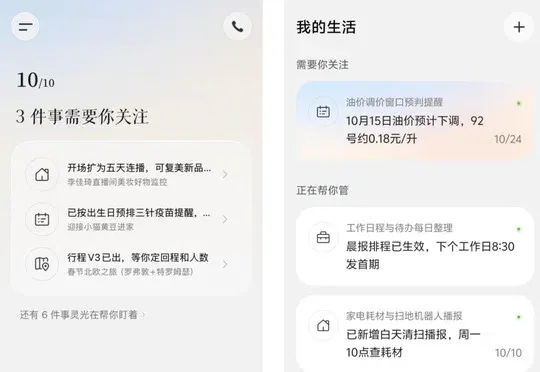
独家|灵光要搞个大的!中国版 Muse,要来了? (opens in a new tab)
蚂蚁集团旗下AI产品灵光已开启新版小范围内测,新增“我的生活”,向具备长期记忆和主动推进任务能力的个人Agent升级,计划本月全面开放。

Gemini 3.0还在预热,中国AI抢先!30秒造APP全网首测 (opens in a new tab)
Gemini 3.0还未杀到,一系列惊艳实测就已宣告:AI「生成涌现」时代,真的来了!几乎同一时间,国内一款新生AI神器,竟将这股超能力塞进手机,30秒手搓一个APP。
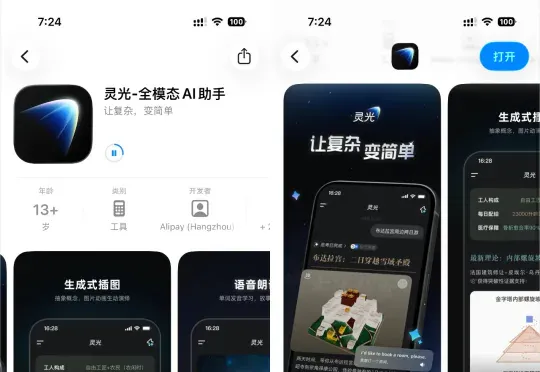
蚂蚁也正式加入AI超级入口战场,他的名字,叫灵光。 (opens in a new tab)
昨天千问之后。 今天,一个全新的AI助手,灵光,正式宣布加入战场。。 来自蚂蚁,对,就是做支付宝的那个蚂蚁。 咱就是说,最近是发生了什么... 怎么感觉,零售大战打完,整个阿里系,决定要来大AI入口大
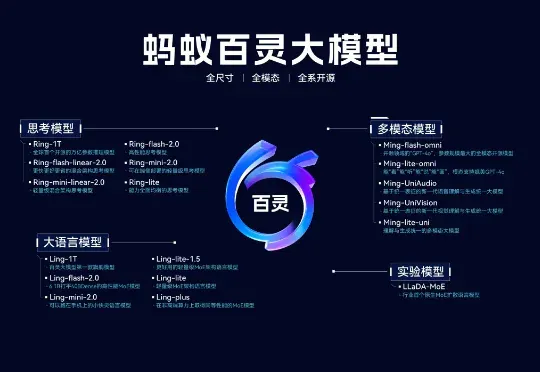
连续发布两款万亿参数模型,蚂蚁 AI 来势汹汹 (opens in a new tab)
10 月 9 日凌晨,蚂蚁百灵大模型团队奇袭般官宣了一款自家最新语言大模型 Ling-1T,参数量达到 1000B(即 1万亿参数)。然而,就在十天前,百灵团队才将自研 Ring-1T-preview 大模型开源。
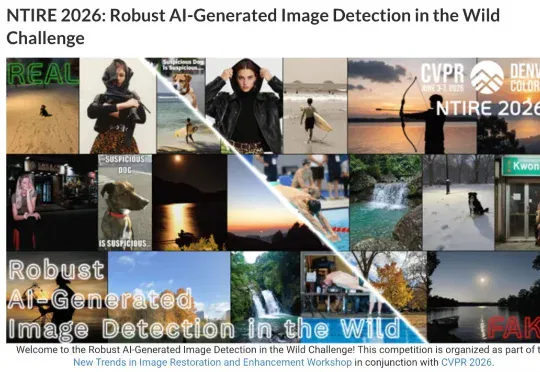
库里被「采访」、杨紫被「演」短剧?别慌!蚂蚁AI鉴真拿下CVPR 2026冠军,专治黑产 (opens in a new tab)
最近,计算机视觉领域的顶级会议 CVPR 2026 的 NTIRE 鲁棒性 AIGC 图像检测挑战赛( Robust AI-Generated Image Detection in the Wild Challenge )结果出炉。蚂蚁集团 AI 安全实验室的队伍 MICV 凭借在鲁棒性测试样本上 ROC AUC 达到了惊人的 0.9723,成功摘得「复杂真实场景鲁棒性样本测试」挑战赛的冠军。