MXI-SimWorld tops RoboColiseum's weekly rankings and selects actions through simulation
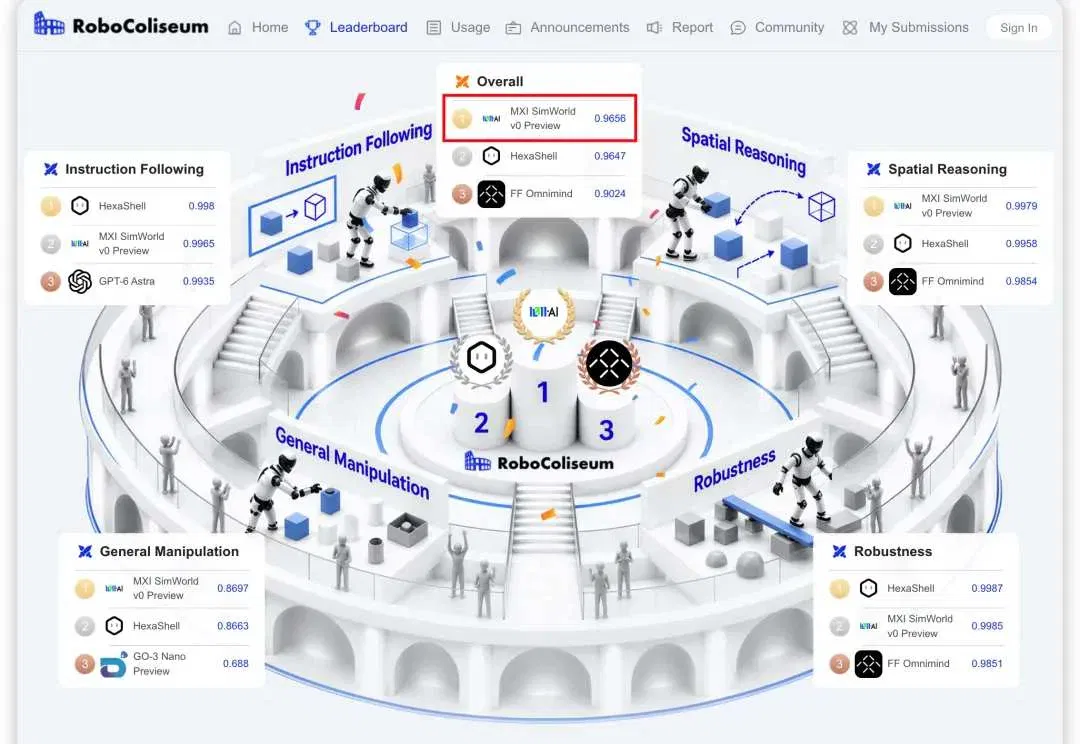
The team describes a system linking scene reconstruction, interaction calibration and parallel action rehearsals. The report gives November 11 rankings and outlines real-robot validation.
Editorial correction (November 13, 2026): The rankings are a November 11, 2026 snapshot. Relationships between simulation and real robots depend on specific tasks and do not guarantee performance for arbitrary models or deployments.
In the latest RoboColiseum weekly rankings, MXI-SimWorld scored 0.9656, placing first overall and first on the spatial-understanding and general-manipulation sub-leaderboards.
As large models enter the physical world, helping robots understand instructions, perceive environments and complete operations has become an important embodied-intelligence research question.
On November 11, RoboColiseum officially released its latest weekly rankings (opens in a new tab). As of noon, 12:00 on November 11, 2026, the MXI team at 1011.AI, led by Professor Chao Yang of Peking University's School of Mathematical Sciences, used the physical-AI framework MXI-SimWorld v0 Preview to achieve a composite score of 0.9656 and place first overall in RoboColiseum's embodied-intelligence evaluation. Across the four sub-leaderboards, MXI-SimWorld v0 Preview also showed no weak spot: first in spatial understanding and general manipulation, second in instruction following and perturbation adaptation. All four dimensions ranked in the top two.
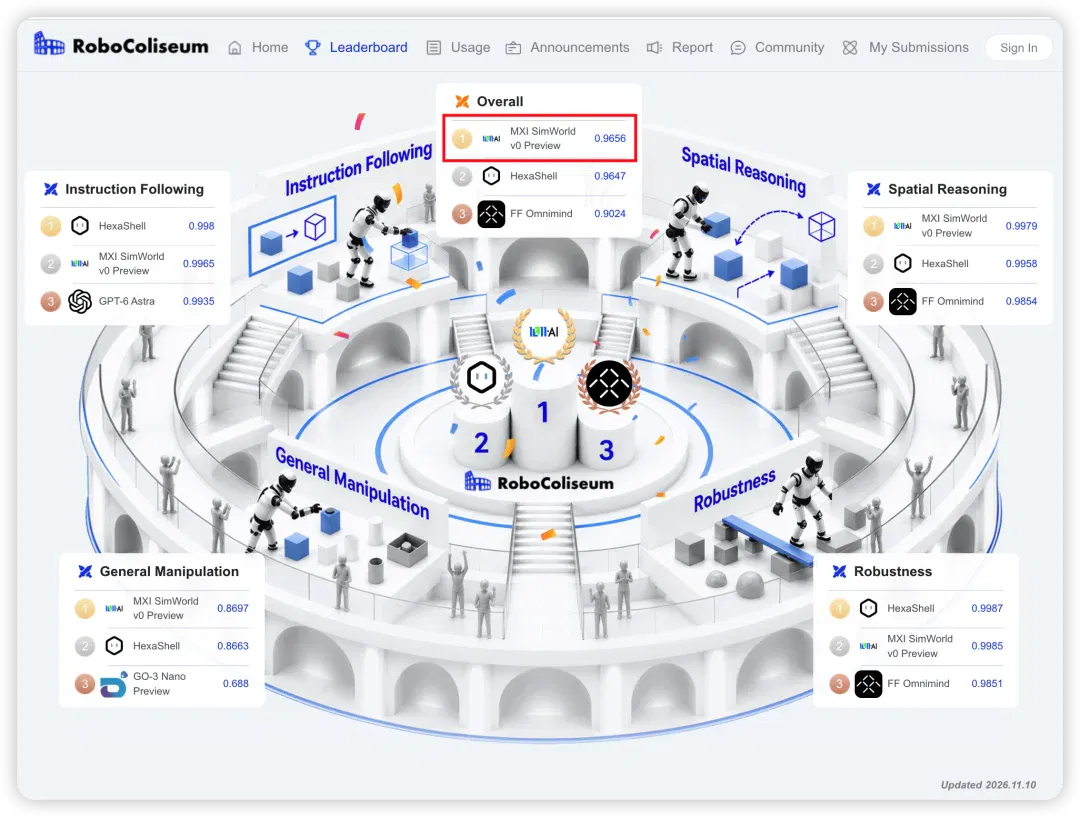
RoboColiseum overall rankings as of November 11, 2026. Image source: RoboColiseum.
RoboColiseum evaluates robotics approaches through multidimensional simulation tasks. Correlation between simulation and real robots depends on tasks, equipment and test settings. Correlation or discrepancy figures from one set cannot be treated as guarantees of real-robot performance for all models.
The leaderboard has four dimensions: instruction following, spatial understanding, perturbation adaptation, and general manipulation. The first two test cognitive abilities to "see and understand, and think clearly"; the latter two directly assess the physical ability to "actually get the job done."
As general-purpose large models improve, one question attracts increasing attention: how can a model's ability to understand tasks translate into a robot's ability to perform physical operations?
Large models can already write code fluently and perform complex logical reasoning, but directing a robot in tabletop grasping or putting objects away still involves object positions, spatial relationships and action execution. General-purpose models including GPT-6 Astra, GPT-6.1 Sol, Claude Opus 5.5 and Gemini 4 Argon have also participated in RoboColiseum. In an earlier evaluation round, their overall performance approached that of leading specialized embodied models.
AI understands "put the pen in the pen holder," yet must still determine the arm's approach angle, where an object will slide when touched and when to release it. Large models have learned what the world "looks like" from vast amounts of text and images, but not "what the world becomes after an action."
The physical world has no undo button. A single execution error irreversibly changes the environment's state. This is a fatal weakness in deploying general-purpose large models in robotics.
I. SimWorld: let robots rehearse in simulation first
What if, before actually executing an action, a robot could try different approaches and see their possible consequences?
That is MXI-SimWorld's idea (hereafter SimWorld): rehearse before acting.
SimWorld long-horizon tabletop-organization demonstration. Video source: 1011.AI.
Take the tabletop-organization task in the video above. The robot's first step is to put the black pen on the table into the pen holder. Where should it grasp the pen? What arm path avoids the nearby objects?
SimWorld first obtains observations from head and wrist cameras, identifies tabletop objects, retrieves similar simulation assets and adjusts their sizes, shapes and positions to build an interactive simulated scene.
Starting from the same tabletop state, it then tries different grasp poses and motion paths in multiple simulated environments in parallel. Plans that hit obstacles or fail the task are gradually eliminated, while successful trajectories are retained.
Finally, SimWorld brings the selected trajectory back to the original task scene, having the arm pick up the black pen and place it in the holder. Before one action is executed, the system has already rehearsed multiple possibilities in simulation.
From scene observation to action selection, simulation no longer merely generates training data; it also participates in model decisions. The MXI team calls this Simulation as Policy: supporting policy decisions through simulation.
II. Simulation gives models a world for repeated attempts
The tabletop-organization video is only a microcosm of robots interacting with the physical world.
Putting a pen in a holder requires judging object positions, grasp direction and the arm's motion path. Change the position, use a differently shaped object or add an obstacle, and the original action plan may no longer apply.
For robots, the real world is not a fixed set of exam questions. Object shapes, materials and arrangements change, and action outcomes may differ from expectations. Models need enough interaction experience under different conditions to have a chance of learning how to handle these changes.
The most direct approach is repeated practice in the real world.
But real interactions require equipment, space, people and time. After each attempt, researchers may need to rearrange objects and reset the robot before beginning another experiment. Repeated collection is harder still in dangerous, rare or wear-prone situations.
Simulation offers another approach to these problems.
In simulation, the same scene can be copied, adjusted and reset. Researchers can change object positions, shapes or scene conditions to let models try actions under different circumstances. They can also start several candidate paths from the same initial state and observe each outcome.
Simulation's value therefore extends beyond producing more training data. It can also become an interactive rehearsal environment that supports rollback and parallel execution: when a system needs to choose, it first tries options there, then uses feedback to decide the next step.
For rehearsal results to be genuinely informative, the simulated environment must also reflect object contacts, collisions and movement as closely as possible. Real data remains important, both to calibrate simulation and to assess models' real-world performance.
From NVIDIA's Isaac Sim to World Labs' acquisition of robotics-simulation company SceniX, spatial understanding, physical interaction and simulation capabilities are attracting increasing attention. Different technical approaches respond to the same question: how can AI better understand the physical world and act within it?
The MXI team believes simulation can go further: serving not only model training but action decisions, giving models an environment to observe outcomes and compare plans before acting.
Several concrete questions remain: How can a simulation be built from the scene before the robot? How can object interactions be made as realistic as possible? How can multiple action plans be rehearsed efficiently?
These are precisely the problems SimWorld addresses next.
III. How SimWorld rehearses:
scene configuration, interaction calibration and action rehearsal
To involve simulation in model decisions, first use observations to build an interactive scene; next, make virtual objects respond to actions with feedback that can inform decisions; finally, try different plans in multiple simulated environments to support action selection. SimWorld connects these stages into a complete process of scene reconstruction, calibration and rehearsal.
Step one: reconstruct—"move" the scene before the robot into simulation.
SimWorld's core component is the Interactive World Simulator. It turns online visual observations and task instructions into a simulated environment that can be manipulated.
The system first identifies task-relevant objects and uses depth information to estimate their 3D positions, orientations, scales and relationships. Using the MXI team's in-house Xiewu simulation engine, it reconstructs the scene through "similar-asset retrieval → unseen-asset generation → instance-level editing".
Each reconstructed object has two "bodies": a geometric mesh for appearance and a collider for contact computations. Parameters such as size, pose and friction can be adjusted. Once all assets occupy the same scene coordinate system, a visual image becomes an interactive scene with geometric structure, spatial layout and physical properties.

Simulation-asset reconstruction pipeline. Video source: 1011.AI.
Step two: calibrate—make simulation not only "look alike" but "move alike."
Even when scenes look identical, objects may move differently under forces, during collisions or after release.
SimWorld therefore introduces In-Context Learning. Taking object interactions in training examples as references, it analyzes correspondences between actions and object motion: where contact occurs, how objects move after collisions, how they roll after release and where they finally stop.
Trajectory replay follows. The system compares simulation with motion and final states in reference videos, repeatedly adjusting physical parameters. Calibration considers both where an object finally stops and how it got there.
This step moves reconstructed scenes from visually "looking alike" to "accurate interaction" under actions.

Simulation-calibration interaction process. Video source: 1011.AI.
Step three: rehearse—try simultaneously in multiple parallel worlds, then execute the best plan.
With a trustworthy environment, SimWorld's Self-Evolving Policy copies the current state into multiple independent simulated worlds. Different candidates start from exactly the same point to test transport paths, approach directions, release positions and placement actions.
The system filters plans by arm reachability, path collisions, object landing positions and placement stability, then executes the selected one in reality. New visual observations afterward update object states and align actual results with simulation predictions as the starting point for the next search.
Validate multiple plans before execution and keep correcting afterward. The MXI team calls this "Simulation as Policy": supporting policy decisions through simulation.

Parallel rehearsal across multiple environments and candidate-trajectory filtering. Video source: 1011.AI.
RoboColiseum is notably a timed evaluation. However many attempts happen in simulation, an action must still be produced within the time budget.
The whole decision chain—observation processing, scene updates, candidate generation, physical rollouts and result filtering—must therefore be fast. Rollout scale also involves trade-offs: longer rollouts reveal post-release rolling and instability; finer time steps reveal contact processes more clearly. Both increase computation.
This is precisely 1011.AI's expertise. The Xiewu simulation engine optimizes both solver algorithms and hardware adaptation. On one hand, it reduces rollout time for a single candidate trajectory; on the other, it runs multiple independent environments simultaneously, increasing the number of plans checked per unit of time.
Existing test data show that on an RTX 5090 platform with double-precision computation, the in-house Xiewu engine's physics-solving speed in typical rigid-body, rigid–soft-coupled and large-deformation scenarios such as cloth and cables reaches at least twice that of mainstream physics engines such as Genesis, MuJoCo and Newton.

Xiewu simulation engine compared with Genesis and Newton on complex-environment tasks. Video source: 1011.AI.
From observing a scene and rehearsing interactions to executing actions, how does SimWorld apply these capabilities to concrete tasks? The video below presents the team's exploration in RoboColiseum and the system's performance on simulated tasks.
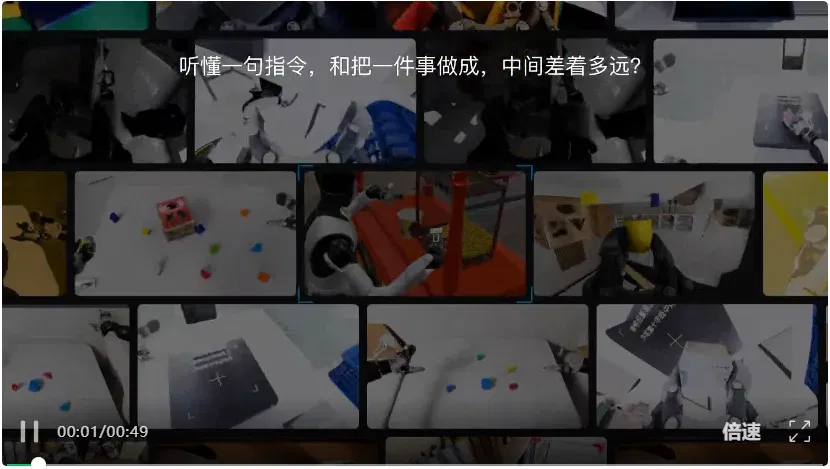
Selected SimWorld demos in RoboColiseum. Video source: 1011.AI.
However good simulation becomes, it must ultimately be tested on real robots.
The MXI team conducted Sim2Real validation on tasks such as pouring measured quantities of water. Fluids and their interactions with containers are widely recognized as among the hardest categories to simulate. On these tasks, Xiewu's simulation results and real-robot performance showed relatively good agreement.
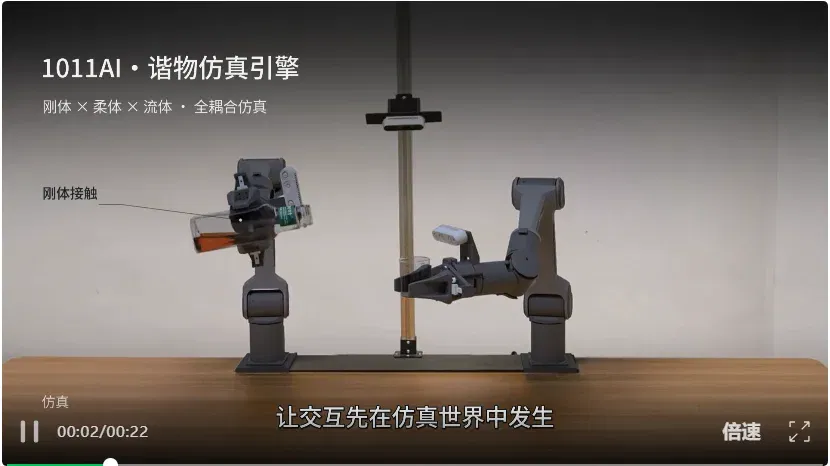
Comparison of simulated and real-robot pouring demonstrations. Video source: 1011.AI.
IV. A team from Peking University's mathematics school:
rebuilding physical intelligence from mathematical principles
Putting high-fidelity simulation into every robot decision requires two capabilities: precise physical modeling and the engineering ability to make computation fast enough. These two capabilities are 1011.AI's foundations.
Founder Chao Yang is a professor at Peking University's School of Mathematical Sciences. In 2016, he led a team that won the ACM Gordon Bell Prize, the highest international award in supercomputing, marking China's first win. He is also an inaugural Wang Xuan Distinguished Young Scholar Award recipient and has long worked in high-performance computing, numerical simulation and AI.
Founded in June 2026, 1011.AI focuses on physical-AI infrastructure and model R&D and has raised more than RMB 100 million since its founding. The team is building a full-stack system of "high-performance computing + physical simulation + AI." According to the team, model series including MXI-RoboICL and MXI-Hybrid-v0 will also be released in succession.
Large models can already "understand." To "act well," they must also know what consequences actions bring.
The real world does not allow repeated trial and error, so first give robots a trustworthy, interactive world they can restart indefinitely. Let them take their falls there before entering the real arena.
This is SimWorld's answer, and why it reached the top of RoboColiseum.
This article comes from "Synced." Author: "Synced."
Related topics
After reading
Join the AINRK community
Read how to join the community and connect with people working in AI.
Related articles
Continue reading related topics and articles in this category.
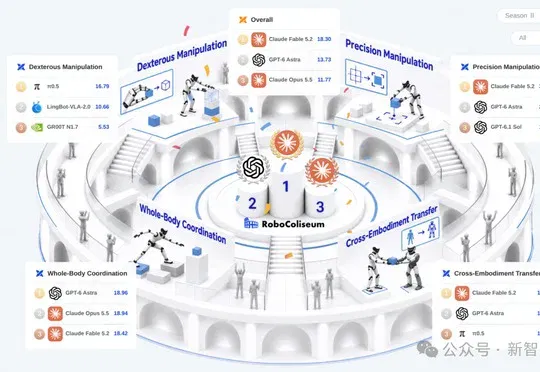
RoboColiseum Updates Simulation Tracks; Fable 5.2 Leads Overall but Struggles With Dexterous Hands (opens in a new tab)
The update covers dexterous manipulation, whole-body coordination, precision tasks and cross-embodiment transfer. Agents and policies are managed separately, with scores reflecting progress and execution efficiency.

突发,全球顶级角斗场RoboColiseum爆冷!Opus 5.5竟击败GPT6、Gemini 4 (opens in a new tab)
如今,AI正式杀入物理世界! 在具身能力方面,语言模型到底谁能称王? 更残酷的问题是,机器人公司耗费数年苦练的本领,会被通用LLM直接碾压吗? 就在今天,GPT-6 Astra、GPT-6.1 Sol、Claude Opus 5.5 以及 Gemini 4 Argon 等全球最顶尖的多模态大模型齐聚一堂。 在常态化具身智能仿真评测平台 RoboColiseum(机器人角斗场) 上,它们展开了一场真刀真枪的「肉搏战」。 这份榜单不仅彻底炒热了具身智能圈,更无情地揭露了当前顶尖大模型在控制机器人时的「隐藏命门」! 揭榜时刻:四模型大乱斗,结果令人意外 本次测试,所有的顶尖模型都接入了统一的控制框架
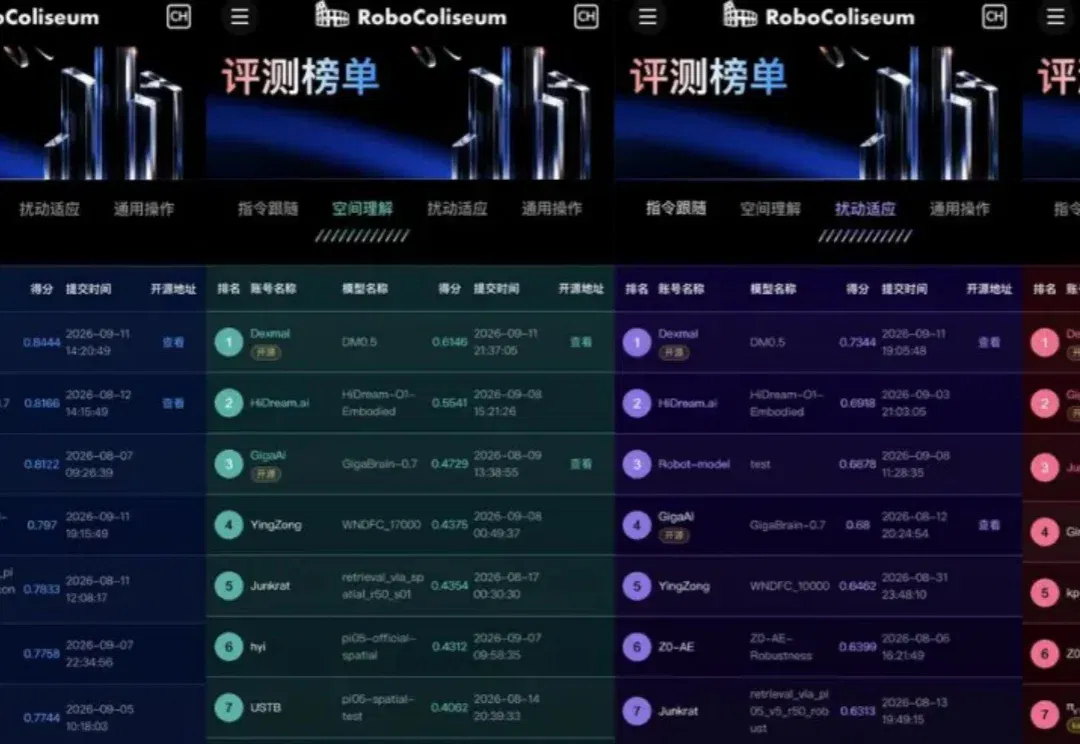
横扫四榜,DM0.5 凭什么面面俱到? (opens in a new tab)
单科冠军不够,具身智能落地需要没有结构性短板的底座
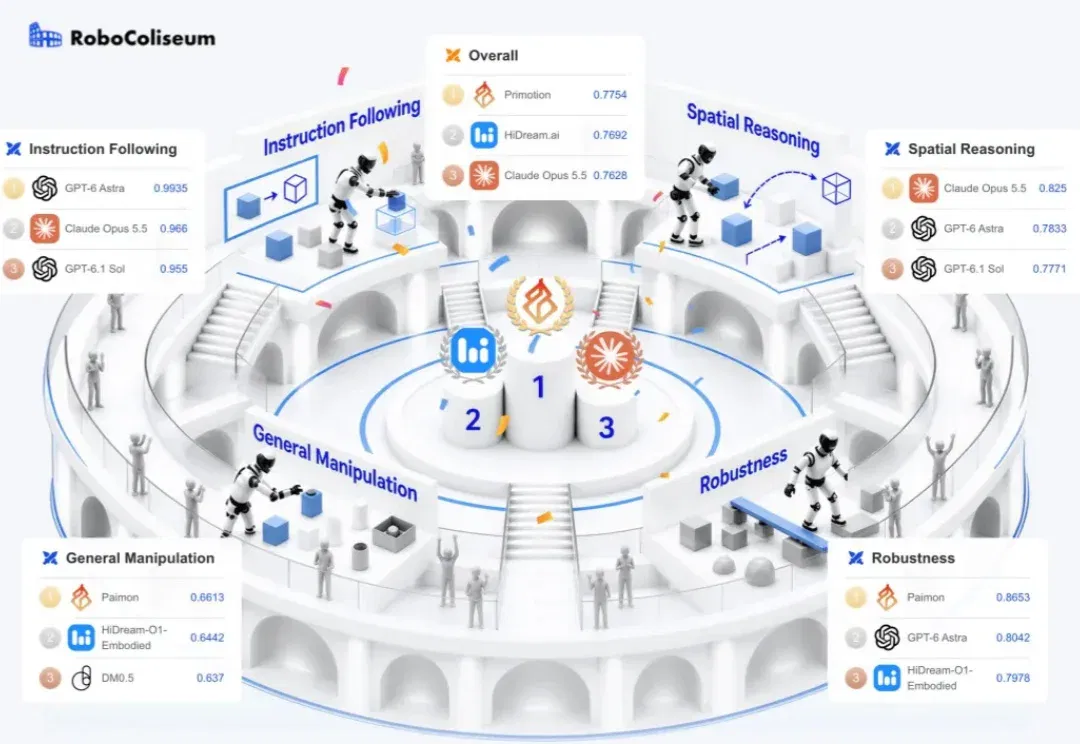
对决RoboColiseum!GPT、Claude、Gemini机器人能力PK,险胜之后还有黑马 (opens in a new tab)
如果让 GPT、Claude、Gemini 直接指挥机器人干活,谁更靠谱?
姜宇辉的AI分身:知识助手与“另一个自己”之间 (opens in a new tab)
南方周末通过学者、用户与Second Me创始人的访谈及记者试用,观察AI分身的学术辅助、情感连接和商业化尝试,也呈现知识可靠性、人格边界、版权与隐私方面的疑虑。